
CHEM-101 · Lesson 8 of 12 · 24 min
Periodic trends
The periodic table is more than a filing system. Many properties of the elements, including the sizes of their atoms, how tightly they hold their electrons and how strongly they attract electrons in bonds, change smoothly across periods and down groups. These periodic trends follow from two ideas developed in lesson 7: the effective nuclear charge felt by valence electrons and the shell in which those electrons sit. This lesson examines the major trends, explains them, notes the exceptions that confirm the explanations, and connects them to the chemistry of some important groups.
Numerical values in this lesson are rounded from standard reference tables (such as the CRC Handbook and the NIST databases); different sources differ slightly, especially for atomic radii, which depend on how they are measured.
Atomic radius
An atom has no sharp edge, because orbitals fade gradually with distance. Chemists therefore define radius operationally. The covalent radius is half the distance between the nuclei of two identical atoms joined by a single bond; the metallic radius is half the distance between neighbouring atoms in a metal. Either way, two trends emerge clearly.
Down a group, atomic radius increases. Each step down adds a new shell, and the valence electrons occupy orbitals with a larger principal quantum number, farther from the nucleus. Although the nuclear charge increases too, the added inner electrons shield it, so Z_eff on the valence electrons changes little.
Across a period from left to right, atomic radius decreases. Electrons are being added to the same shell while protons are added to the nucleus. Electrons in the same shell shield each other poorly, so Z_eff increases and pulls the whole shell inward. Lithium's radius is about 130 pm; fluorine's is about 60 pm, less than half as large, even though fluorine has six more electrons.
| Group 1 | Radius (pm) | Period 2 | Radius (pm) |
|---|---|---|---|
| Li | 128 | Li | 128 |
| Na | 166 | Be | 96 |
| K | 203 | B | 84 |
| Rb | 220 | C | 76 |
| Cs | 244 | N | 71 |
| O | 66 | ||
| F | 57 |
Across the transition metals, radii change only slightly, because the electrons being added go into an inner (n − 1)d subshell, which shields the outer ns electrons fairly well. After the lanthanides, the 5d metals are almost the same size as the 4d metals above them; zirconium and hafnium have nearly identical radii and are notoriously hard to separate. This lanthanide contraction arises because 4f electrons shield very poorly.
Ionic radius
Cations are smaller than their parent atoms. Losing electrons often empties the outer shell entirely (Na⁺ has lost its 3s electron), and with fewer electrons, repulsion falls and each remaining electron feels more of the nuclear charge. Anions are larger than their parent atoms, because added electrons increase repulsion and spread the cloud. The sodium atom has a radius of about 166 pm but Na⁺ only about 102 pm; Cl is about 100 pm and Cl⁻ about 181 pm.
For an isoelectronic series, radius falls steadily as nuclear charge rises, because the same number of electrons is held by an increasing number of protons:
| Ion | O²⁻ | F⁻ | Na⁺ | Mg²⁺ | Al³⁺ |
|---|---|---|---|---|---|
| Protons | 8 | 9 | 11 | 12 | 13 |
| Electrons | 10 | 10 | 10 | 10 | 10 |
| Radius (pm) | 140 | 133 | 102 | 72 | 54 |
Ionic size matters in biology and technology alike. Lithium-ion batteries depend on small Li⁺ ions slipping between layers of graphite. Sodium-ion batteries, an active research area in Canada and the United States because sodium is cheap and abundant, must accommodate a larger ion.
Ionization energy
The first ionization energy, IE₁, is the energy needed to remove the most loosely held electron from a gaseous atom: X(g) → X⁺(g) + e⁻. It is always positive, because energy must be supplied to pull an electron away. Ionization energies are usually reported in kJ/mol.
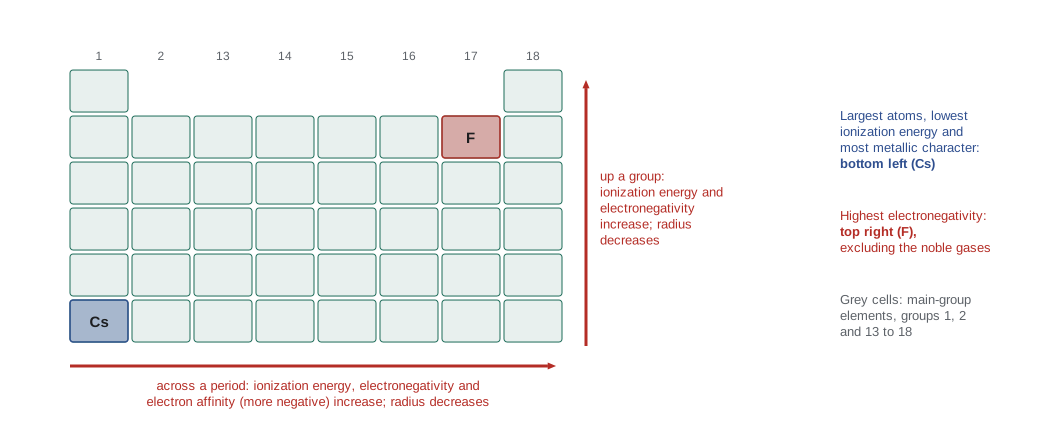
The trends mirror those of atomic radius. Ionization energy decreases down a group, because the valence electron is farther from the nucleus and more effectively shielded. It increases across a period, because Z_eff increases and the electron is held closer. The noble gases have the highest first ionization energies of their periods, and the alkali metals the lowest. Helium's IE₁ (2,372 kJ/mol) is the highest of any element; cesium's (376 kJ/mol) is among the lowest, which is why cesium is used in photoelectric cells and in atomic clocks that ionize it easily.
Two small dips break the steady rise across each period, and both are explained by electron configurations. First, IE₁ drops from beryllium (2s²) to boron (2s² 2p¹), because boron's electron is in a 2p orbital, which is higher in energy and less penetrating than 2s. Second, IE₁ drops from nitrogen (2p³) to oxygen (2p⁴), because oxygen's fourth p electron must pair with another in the same orbital, and the extra repulsion makes it easier to remove. The same two dips appear between magnesium and aluminum and between phosphorus and sulfur.
Successive ionization energies
Atoms can lose more than one electron, and each successive ionization energy (IE₂, IE₃, …) is larger than the last, because each electron is removed from an increasingly positive ion. The key observation is a very large jump after the valence electrons are gone: removing a core electron requires far more energy. The position of that jump reveals how many valence electrons an element has.
| Element | IE₁ | IE₂ | IE₃ | IE₄ |
|---|---|---|---|---|
| Na | 496 | 4,562 | 6,910 | 9,543 |
| Mg | 738 | 1,451 | 7,733 | 10,543 |
| Al | 578 | 1,817 | 2,745 | 11,577 |
# Identify the group of an element from the largest jump in successive ionization energies
data = {
    "Na": [496, 4562, 6910, 9543],
    "Mg": [738, 1451, 7733, 10543],
    "Al": [578, 1817, 2745, 11577],
    "X":  [1086, 2353, 4620, 6223, 37831],   # a mystery element from period 2
}
for el, ies in data.items():
    ratios = [ies[i + 1] / ies[i] for i in range(len(ies) - 1)]
    jump = ratios.index(max(ratios)) + 1          # number of electrons before the big jump
    pretty = ", ".join(f"{r:.1f}" for r in ratios)
print(f"{el:2s}: ratios IE(n+1)/IE(n) = {pretty} -> {jump} valence electron(s)")Na: ratios IE(n+1)/IE(n) = 9.2, 1.5, 1.4 -> 1 valence electron(s) Mg: ratios IE(n+1)/IE(n) = 2.0, 5.3, 1.4 -> 2 valence electron(s) Al: ratios IE(n+1)/IE(n) = 3.1, 1.5, 4.2 -> 3 valence electron(s) X : ratios IE(n+1)/IE(n) = 2.2, 2.0, 1.3, 6.1 -> 4 valence electron(s)
The mystery element has four valence electrons and is in period 2, so it is carbon. This kind of reasoning explains why sodium forms Na⁺ but never Na²⁺, why magnesium forms Mg²⁺, and why aluminum forms Al³⁺: the energy of removing a core electron could never be repaid by forming bonds.
Electron affinity
Electron affinity describes the energy change when a gaseous atom gains an electron: X(g) + e⁻ → X⁻(g). By the convention used in most general chemistry texts, a negative value means energy is released, so the anion is more stable than the separated atom and electron. (Some references tabulate the same quantity with the opposite sign, so always check which convention a table uses.)
The trends are less regular than for ionization energy, but the broad pattern is that electron affinities become more negative toward the upper right of the table, excluding the noble gases. The halogens release the most energy on gaining an electron, because the added electron completes an ns² np⁶ configuration: chlorine's electron affinity is about −349 kJ/mol, the most negative of any element. Noble gases have positive (unfavourable) electron affinities, because an added electron would have to start a new shell. Group 2 elements and nitrogen also have low or positive values, because the added electron would enter a higher subshell or pair up in a half-filled p subshell.
| Group | 1 | 2 | 13 | 14 | 15 | 16 | 17 | 18 |
|---|---|---|---|---|---|---|---|---|
| Period 2 | Li −60 | Be > 0 | B −27 | C −122 | N ≈ 0 | O −141 | F −328 | Ne > 0 |
| Period 3 | Na −53 | Mg > 0 | Al −42 | Si −134 | P −72 | S −200 | Cl −349 | Ar > 0 |
Fluorine's electron affinity is less negative than chlorine's, an exception to the trend. Fluorine is so small that an added electron experiences strong repulsion from the electrons already crowded into its compact 2p subshell.
Electronegativity
Electronegativity measures how strongly an atom attracts the shared electrons in a chemical bond. Unlike ionization energy and electron affinity, it is not a property of an isolated atom and cannot be measured directly; it is inferred from bond energies or other data. The most widely used scale, devised by Linus Pauling in 1932, runs from about 0.8 for cesium to 4.0 for fluorine (3.98 in recent tabulations).
Electronegativity increases across a period and decreases down a group, so fluorine is the most electronegative element, followed by oxygen (3.4), nitrogen and chlorine (both about 3.0–3.2). Metals have low electronegativities, nonmetals high ones. Lesson 9 shows how the difference in electronegativity between two bonded atoms determines whether a bond is nonpolar covalent, polar covalent or ionic.
Metallic character and group chemistry
Metallic character, the tendency to lose electrons and behave as a metal, increases down a group and decreases across a period, the opposite of ionization energy. That is why group 14 runs from carbon, a nonmetal, through the metalloids silicon and germanium, to the metals tin and lead, and why group 15 runs from nitrogen gas to metallic bismuth.
The trends explain the chemistry of whole groups. The alkali metals all react with water to form hydroxides and hydrogen gas, 2 M + 2 H₂O → 2 MOH + H₂, but with increasing violence down the group: lithium fizzes, sodium darts across the surface and may ignite the hydrogen, and potassium burns with a lilac flame. This order follows the falling ionization energies. The halogens show the reverse: fluorine and chlorine are powerful oxidizing agents, and reactivity decreases down the group as atoms grow and attract electrons less strongly. Chlorine displaces bromide and iodide from solution, Cl₂ + 2 Br⁻ → 2 Cl⁻ + Br₂, but iodine cannot displace chloride.
# Approximate first ionization energies (kJ/mol) and Pauling electronegativities
props = {
    #      IE1   EN
    "Li": (520, 0.98), "Na": (496, 0.93), "K": (419, 0.82), "Rb": (403, 0.82), "Cs": (376, 0.79),
    "F": (1681, 3.98), "Cl": (1251, 3.16), "Br": (1140, 2.96), "I": (1008, 2.66),
}
print("Group 1 (reactivity with water increases down the group):")
for el in ["Li", "Na", "K", "Rb", "Cs"]:
    ie, en = props[el]
    print(f"   {el:2s}  IE1 = {ie:4d} kJ/mol   EN = {en:.2f}")
print("Group 17 (oxidizing strength decreases down the group):")
for el in ["F", "Cl", "Br", "I"]:
    ie, en = props[el]
    print(f"   {el:2s}  IE1 = {ie:4d} kJ/mol   EN = {en:.2f}")
r = sum(1 for a, b in zip("Li Na K Rb".split(), "Na K Rb Cs".split()) if props[b][0] < props[a][0])
print("ionization energy falls at every step down group 1:", r == 4)Group 1 (reactivity with water increases down the group): Li IE1 = 520 kJ/mol EN = 0.98 Na IE1 = 496 kJ/mol EN = 0.93 K IE1 = 419 kJ/mol EN = 0.82 Rb IE1 = 403 kJ/mol EN = 0.82 Cs IE1 = 376 kJ/mol EN = 0.79 Group 17 (oxidizing strength decreases down the group): F IE1 = 1681 kJ/mol EN = 3.98 Cl IE1 = 1251 kJ/mol EN = 3.16 Br IE1 = 1140 kJ/mol EN = 2.96 I IE1 = 1008 kJ/mol EN = 2.66 ionization energy falls at every step down group 1: True
Diagonal relationships are a curious footnote: lithium resembles magnesium, and beryllium resembles aluminum, more than they resemble the elements directly below them. Moving one step right and one step down roughly cancels the opposing trends in size and electronegativity. Lithium and magnesium, for example, both form nitrides by direct reaction with nitrogen, which the other alkali metals do not.
Common mistakes
MistakeAtoms get larger from left to right because they have more electrons.
InsteadAtoms get smaller across a period because Z_eff increases while the shell stays the same.
MistakeAnions are smaller than their parent atoms because they hold electrons tightly.
InsteadAnions are larger; added electrons increase repulsion and spread the electron cloud.
MistakeIonization energy rises smoothly across every period.
InsteadIt dips between groups 2 and 13 and between groups 15 and 16, for reasons of subshell energy and electron pairing.
MistakeElectronegativity is the energy released when an atom gains an electron.
InsteadThat is electron affinity; electronegativity describes attraction for shared electrons in a bond.
MistakeReactivity increases down every group.
InsteadMetal reactivity increases down a group, but nonmetal (halogen) reactivity decreases down a group.
Summary and key terms
- Atomic radius increases down a group (new shells) and decreases across a period (rising Z_eff).
- Cations are smaller and anions larger than their parent atoms; in an isoelectronic series, radius falls as nuclear charge rises.
- First ionization energy decreases down a group and increases across a period, with dips explained by subshell energies and electron pairing.
- A large jump in successive ionization energies marks the removal of core electrons and reveals the number of valence electrons.
- Electron affinity is most negative for the halogens; noble gases do not gain electrons readily.
- Electronegativity, the attraction for shared electrons, increases toward fluorine at the upper right.
- Metallic character increases down and to the left; trends explain group chemistry such as alkali-metal and halogen reactivity.
- covalent radius
- Half the distance between the nuclei of two identical bonded atoms.
- isoelectronic series
- A set of atoms and ions with the same number of electrons.
- first ionization energy
- The energy to remove the most loosely held electron from a gaseous atom.
- successive ionization energies
- The energies to remove the first, second, third and later electrons in turn.
- electron affinity
- The energy change when a gaseous atom gains an electron.
- electronegativity
- The ability of an atom in a bond to attract shared electrons.
- lanthanide contraction
- The smaller-than-expected size of elements after the lanthanides, caused by poor shielding by 4f electrons.
- metallic character
- The extent to which an element shows metallic properties such as losing electrons.
- diagonal relationship
- Similarity between an element and the one diagonally below and to the right of it.
- periodic trend
- A regular variation of a property across periods or down groups.
Practice problems
Work each problem on paper first, then reveal the answer to check.
Arrange in order of increasing atomic radius: Mg, Na, S, Cl.
Show answer
Cl < S < Mg < Na.
Which is larger, Fe²⁺ or Fe³⁺? Why?
Show answer
Fe²⁺; it has one more electron, so less attraction per electron and more repulsion.
Arrange in order of decreasing radius: S²⁻, Cl⁻, K⁺, Ca²⁺.
Show answer
S²⁻ > Cl⁻ > K⁺ > Ca²⁺ (isoelectronic; radius falls as Z rises).
Which has the higher first ionization energy, P or S? Explain.
Show answer
P; sulfur’s fourth 3p electron is paired, and repulsion makes it easier to remove.
An element has IE values (kJ/mol) of 577, 1,817, 2,745 and 11,577. How many valence electrons does it have?
Show answer
Three; the large jump comes after the third.
Why does chlorine have a more negative electron affinity than sulfur?
Show answer
Chlorine has a higher Z_eff, and the added electron completes its noble-gas configuration.
Which is more electronegative, N or P?
Show answer
N; electronegativity decreases down a group.
Which reacts more vigorously with water, Na or K? Why?
Show answer
K; it has a lower ionization energy, so it loses its electron more easily.
Will bromine displace chloride from a solution of NaCl?
Show answer
No; chlorine is the stronger oxidizing agent, so the reverse reaction occurs instead.
Why is the electron affinity of neon positive?
Show answer
An added electron would have to enter a new, higher-energy shell (3s), far from the nucleus.
Lesson quiz · 5 questions
Score 60% or more to complete this lesson.
Create a free account to save your progress, take quizzes and earn a certificate.