
CHEM-101 · Lesson 4 of 12 · 30 min
Chemical reactions and equations
A chemical equation is a compact statement of what happens in a reaction: which substances react, which form, and in what proportions. This lesson covers writing and balancing equations, the main families of reactions, and reactions in water, including precipitation, neutralization and the first ideas of oxidation and reduction. Lesson 5 uses balanced equations to calculate amounts; CHEM-102 returns to acids, bases and redox in depth.
Reading a chemical equation
In a chemical equation, reactants appear on the left, products on the right, and an arrow means “react to form”. Physical states are shown in parentheses: (s) solid, (l) liquid, (g) gas and (aq) aqueous, meaning dissolved in water. The numbers in front of formulas are coefficients; they give the relative numbers of molecules or formula units, and equally the relative numbers of moles. Subscripts belong to the formulas themselves and are never changed when balancing.
Read at the particulate level, this says one methane molecule reacts with two oxygen molecules to form one carbon dioxide molecule and two water molecules. Read at the laboratory level, it says 1 mol of methane reacts with 2 mol of oxygen to form 1 mol of carbon dioxide and 2 mol of water. It does not say 1 g of methane reacts with 2 g of oxygen; masses follow from moles through molar masses, as lesson 5 shows.
Balancing equations
An equation is balanced when each element has the same number of atoms on both sides, as conservation of mass requires. For ionic equations, the total charge must also balance. Most equations can be balanced by inspection: start with the element that appears in the fewest formulas, or with the most complicated formula, adjust coefficients one element at a time, leave free elements (such as O₂) until last, and finally reduce to the smallest whole numbers.
Worked problem
Balancing the combustion of propane
Balance C₃H₈ + O₂ → CO₂ + H₂O.
Show solution
- Carbon: 3 on the left, so put 3 in front of CO₂.
- Hydrogen: 8 on the left, so put 4 in front of H₂O.
- Oxygen: the right now has 3(2) + 4(1) = 10 O atoms, so put 5 in front of O₂.
- Check: C 3 = 3; H 8 = 8; O 10 = 10.
Answer: C₃H₈ + 5 O₂ → 3 CO₂ + 4 H₂O.
When a fractional coefficient appears, multiply everything by the denominator. Balancing the combustion of butane by inspection gives C₄H₁₀ + 13/2 O₂ → 4 CO₂ + 5 H₂O; doubling gives 2 C₄H₁₀ + 13 O₂ → 8 CO₂ + 10 H₂O.
Balancing can also be treated as a problem in linear algebra. Each element gives one equation that the unknown coefficients must satisfy, and the smallest positive whole-number solution is the balanced equation. The program below sets up those equations and solves them exactly with fractions. Chemistry software uses the same idea for complicated reactions.
from fractions import Fraction
from math import lcm

def balance(reactants, products):
    """reactants/products: lists of dicts of element counts. Returns integer coefficients."""
    species = reactants + products
    elements = sorted({el for s in species for el in s})
    # matrix rows = elements, columns = species; products get negative sign
    rows = [[Fraction(s.get(el, 0) * (1 if i < len(reactants) else -1))
             for i, s in enumerate(species)] for el in elements]
    n = len(species)
    # Gaussian elimination to reduced row echelon form
    piv_cols, r = [], 0
    for c in range(n):
        p = next((i for i in range(r, len(rows)) if rows[i][c] != 0), None)
        if p is None:
            continue
        rows[r], rows[p] = rows[p], rows[r]
        rows[r] = [x / rows[r][c] for x in rows[r]]
        for i in range(len(rows)):
            if i != r and rows[i][c] != 0:
                f = rows[i][c]
                rows[i] = [a - f * b for a, b in zip(rows[i], rows[r])]
        piv_cols.append(c); r += 1
    free = [c for c in range(n) if c not in piv_cols][0]   # assume one free variable
    x = [Fraction(0)] * n
    x[free] = Fraction(1)
    for i, c in enumerate(piv_cols):
        x[c] = -rows[i][free]
    scale = lcm(*[v.denominator for v in x])
    return [int(v * scale) for v in x]

C3H8, O2, CO2, H2O = {"C": 3, "H": 8}, {"O": 2}, {"C": 1, "O": 2}, {"H": 2, "O": 1}
print("propane combustion:", balance([C3H8, O2], [CO2, H2O]))
Fe2O3, CO, Fe = {"Fe": 2, "O": 3}, {"C": 1, "O": 1}, {"Fe": 1}
print("iron smelting:     ", balance([Fe2O3, CO], [Fe, CO2]))
KMnO4 = {"K": 1, "Mn": 1, "O": 4}
HCl, KCl, MnCl2, Cl2 = {"H": 1, "Cl": 1}, {"K": 1, "Cl": 1}, {"Mn": 1, "Cl": 2}, {"Cl": 2}
print("permanganate + HCl:", balance([KMnO4, HCl], [KCl, MnCl2, Cl2, H2O]))propane combustion: [1, 5, 3, 4] iron smelting: [1, 3, 2, 3] permanganate + HCl: [2, 16, 2, 2, 5, 8]
The last example, 2 KMnO₄ + 16 HCl → 2 KCl + 2 MnCl₂ + 5 Cl₂ + 8 H₂O, is hard to balance by inspection. It is an oxidation–reduction reaction, and CHEM-102 teaches a systematic half-reaction method for such cases.
Families of reactions
Thousands of reactions fall into a handful of patterns. Recognizing the pattern helps predict products.
| Type | General pattern | Example |
|---|---|---|
| Combination (synthesis) | A + B → AB | 2 Mg(s) + O₂(g) → 2 MgO(s) |
| Decomposition | AB → A + B | CaCO₃(s) → CaO(s) + CO₂(g) (on heating) |
| Single displacement | A + BC → AC + B | Zn(s) + CuSO₄(aq) → ZnSO₄(aq) + Cu(s) |
| Double displacement (metathesis) | AB + CD → AD + CB | AgNO₃(aq) + NaCl(aq) → AgCl(s) + NaNO₃(aq) |
| Combustion | Fuel + O₂ → oxides | C₂H₅OH(l) + 3 O₂(g) → 2 CO₂(g) + 3 H₂O(l) |
Combustion of hydrocarbons and other compounds containing carbon, hydrogen and oxygen gives carbon dioxide and water when oxygen is plentiful. With too little oxygen, carbon monoxide and soot form instead. This is why fuel-burning appliances need ventilation and why carbon monoxide detectors are required in homes with fuel-burning appliances in most Canadian provinces and many US states.
Decomposition of limestone, the second example in the table, is the first step in making cement and accounts for roughly half the carbon dioxide emitted by the cement industry, because the CO₂ comes from the rock itself rather than from fuel.
Aqueous solutions and electrolytes
Many important reactions happen in water. A substance that dissolves to give ions, so that the solution conducts electricity, is an electrolyte. Strong electrolytes dissociate essentially completely: soluble ionic compounds such as NaCl, and strong acids such as HCl. Weak electrolytes, such as acetic acid and ammonia, produce only a small fraction of ions. Nonelectrolytes, such as sugar and ethanol, dissolve as intact molecules.
Whether an ionic compound dissolves appreciably is summarized by solubility rules. They are generalizations with exceptions, but they predict most outcomes correctly.
| Usually soluble | Important exceptions |
|---|---|
| Compounds of group 1 ions and NH₄⁺ | None common |
| Nitrates, acetates | None common |
| Chlorides, bromides, iodides | Ag⁺, Pb²⁺, Hg₂²⁺ |
| Sulfates | Ba²⁺, Pb²⁺, Ca²⁺ and Sr²⁺ (sparingly), Ag⁺ |
| Usually insoluble | Important exceptions |
|---|---|
| Carbonates, phosphates | Group 1 and NH₄⁺ compounds |
| Hydroxides | Group 1, NH₄⁺; Ba²⁺, Sr²⁺ and Ca²⁺ are moderately soluble |
| Sulfides | Group 1, NH₄⁺, and group 2 |
Precipitation reactions and net ionic equations
When solutions of two soluble ionic compounds are mixed, an insoluble combination of ions may form a solid, called a precipitate. Mixing silver nitrate and sodium chloride solutions produces white silver chloride. Three equations describe this. The molecular equation shows complete formulas. The complete ionic equation shows strong electrolytes as separate ions. The net ionic equation removes the spectator ions, which appear unchanged on both sides, leaving only the species that react.
The net ionic equation reveals what really happens: silver ions meet chloride ions. It applies equally to silver perchlorate and potassium chloride, or to any other soluble silver salt and soluble chloride.
Worked problem
Predicting a precipitate
Does a precipitate form when solutions of barium chloride and sodium sulfate are mixed? If so, write the net ionic equation.
Show solution
- Possible new combinations: BaSO₄ and NaCl.
- NaCl is soluble (group 1 compound). Barium sulfate is an exception to the soluble-sulfate rule, so it is insoluble.
- Spectators: Na⁺ and Cl⁻.
Answer: Yes: Ba²⁺(aq) + SO₄²⁻(aq) → BaSO₄(s). Barium sulfate is so insoluble that a suspension of it is swallowed safely as a contrast agent for X-rays of the digestive tract.
Precipitation is used to remove ions from water. Municipal water treatment plants and industrial wastewater systems add lime or other reagents to precipitate phosphate and heavy metals; the solid is then settled or filtered out. In the laboratory, gravimetric analysis weighs a precipitate to find how much of an ion was present, a technique that CHEM-211 develops.
Acid–base neutralization
An acid, in the definition of Svante Arrhenius, produces H⁺ ions in water; a base produces OH⁻ ions. When they react, the H⁺ and OH⁻ combine to form water, and the remaining ions form a salt. The net ionic equation for any strong acid reacting with any strong base is the same:
For example, HCl(aq) + NaOH(aq) → NaCl(aq) + H₂O(l). Acids also react with carbonates and hydrogen carbonates to release carbon dioxide: that is the fizz when vinegar meets baking soda, and the basis of antacid tablets. In water, H⁺ is actually bonded to water molecules as hydronium, H₃O⁺. CHEM-102 introduces the broader Brønsted–Lowry definition, weak acids, pH and equilibrium.
Oxidation–reduction: a first look
In an oxidation–reduction, or redox, reaction, electrons are transferred. Oxidation is loss of electrons; reduction is gain of electrons. (A common memory aid is OIL RIG: oxidation is loss, reduction is gain.) The two always occur together. When zinc metal is placed in copper(II) sulfate solution, zinc atoms lose electrons to become Zn²⁺, and Cu²⁺ ions gain them to become copper metal, which coats the zinc.
To track electrons in reactions that are not obviously ionic, chemists assign oxidation numbers, a bookkeeping device that treats every bond as if it were ionic. The rules, applied in order, are: an atom in a pure element has oxidation number 0; a monatomic ion has its charge; oxygen is usually −2 (−1 in peroxides); hydrogen is +1 with nonmetals and −1 with metals; fluorine is always −1; and the oxidation numbers in a neutral compound sum to zero, or to the ion's charge in a polyatomic ion.
Worked problem
Assigning oxidation numbers
Find the oxidation number of the named element in each species: (a) S in H₂SO₄, (b) Mn in MnO₄⁻, (c) C in CH₄, (d) Cr in Cr₂O₇²⁻.
Show solution
- (a) 2(+1) + S + 4(−2) = 0, so S = +6.
- (b) Mn + 4(−2) = −1, so Mn = +7.
- (c) C + 4(+1) = 0, so C = −4.
- (d) 2Cr + 7(−2) = −2, so 2Cr = +12 and Cr = +6.
Answer: (a) +6; (b) +7; (c) −4; (d) +6.
An increase in oxidation number is oxidation; a decrease is reduction. The species oxidized is the reducing agent, because it supplies electrons; the species reduced is the oxidizing agent. Combustion is a redox reaction: carbon in methane goes from −4 to +4 in CO₂, while oxygen goes from 0 to −2.
The activity series ranks metals by how readily they are oxidized. A metal can displace from solution the ions of any metal below it. Zinc displaces copper; copper does not displace zinc. Metals above hydrogen displace H₂ from acids; gold and platinum, near the bottom, resist oxidation, which is why they are found as native metals and used in jewellery and electronics contacts.
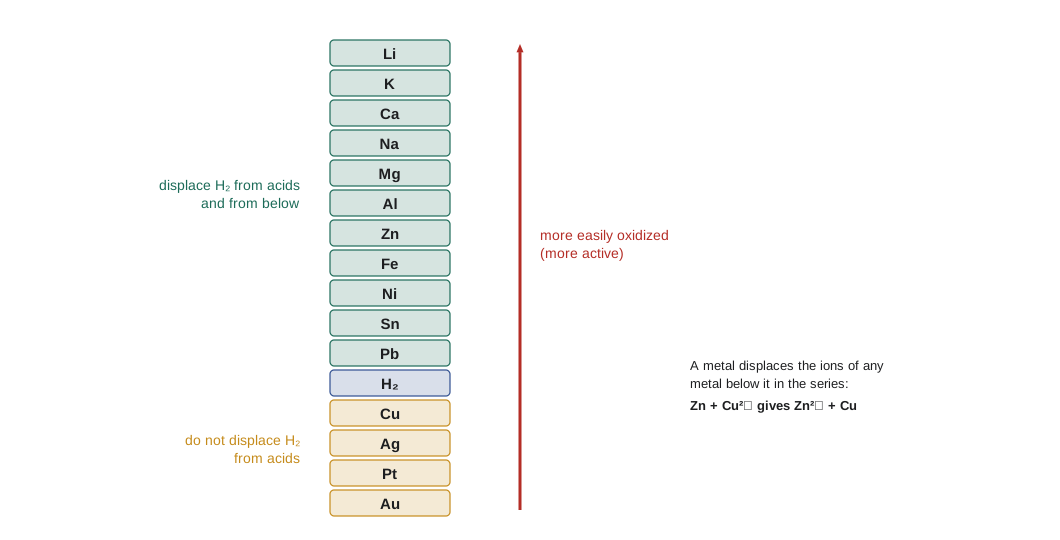
# Predict single-displacement reactions with a short activity series (most active first)
series = ["Li", "K", "Ca", "Na", "Mg", "Al", "Zn", "Fe", "Ni", "Sn", "Pb", "H", "Cu", "Ag", "Pt", "Au"]

def displaces(metal, ion_of):
    return series.index(metal) < series.index(ion_of)

tests = [("Zn", "Cu"), ("Cu", "Zn"), ("Fe", "H"), ("Cu", "H"), ("Mg", "Ag"), ("Ag", "Pb")]
for metal, ion in tests:
    verdict = "reaction" if displaces(metal, ion) else "no reaction"
print(f"{metal:2s} metal placed in a solution of {ion:2s} ions: {verdict}")Zn metal placed in a solution of Cu ions: reaction Cu metal placed in a solution of Zn ions: no reaction Fe metal placed in a solution of H ions: reaction Cu metal placed in a solution of H ions: no reaction Mg metal placed in a solution of Ag ions: reaction Ag metal placed in a solution of Pb ions: no reaction
Common mistakes
MistakeTo balance H₂ + O₂ → H₂O, change the product to H₂O₂.
InsteadNever change subscripts; change coefficients: 2 H₂ + O₂ → 2 H₂O.
MistakeCoefficients give the mass ratio of reactants.
InsteadCoefficients give mole (and molecule) ratios; masses require molar masses.
MistakeSpectator ions take part in the reaction because they are in the solution.
InsteadSpectator ions are unchanged and are removed from the net ionic equation.
MistakeOxidation means gaining oxygen, so reactions without oxygen cannot be redox.
InsteadOxidation is loss of electrons (an increase in oxidation number); many redox reactions involve no oxygen.
MistakeThe oxidizing agent is the substance that is oxidized.
InsteadThe oxidizing agent is reduced; it takes electrons from the substance it oxidizes.
Summary and key terms
- Chemical equations show reactants, products, physical states and mole ratios through coefficients; subscripts are never changed in balancing.
- Equations are balanced by inspection or, systematically, by solving linear equations for the coefficients.
- Common reaction types are combination, decomposition, single displacement, double displacement and combustion.
- Strong electrolytes dissociate completely in water; solubility rules predict which ionic compounds dissolve.
- Net ionic equations show only the species that react, removing spectator ions.
- Strong acid–strong base neutralizations share the net ionic equation H⁺ + OH⁻ → H₂O.
- Redox reactions transfer electrons; oxidation numbers track them, and the activity series predicts displacement reactions.
- coefficient
- A number in front of a formula in an equation giving the relative amount of that substance.
- electrolyte
- A substance that forms ions in solution, so the solution conducts electricity.
- precipitate
- An insoluble solid formed in a solution reaction.
- spectator ion
- An ion present in solution that does not take part in the reaction.
- net ionic equation
- An equation showing only the species that actually react.
- neutralization
- A reaction between an acid and a base, forming water and a salt.
- oxidation
- Loss of electrons, or an increase in oxidation number.
- reduction
- Gain of electrons, or a decrease in oxidation number.
- oxidation number
- A charge assigned to an atom by treating all bonds as ionic, used to track electron transfer.
- activity series
- A ranking of metals by how easily they are oxidized.
Practice problems
Work each problem on paper first, then reveal the answer to check.
Balance: Al + O₂ → Al₂O₃.
Show answer
4 Al + 3 O₂ → 2 Al₂O₃.
Balance: C₂H₆ + O₂ → CO₂ + H₂O.
Show answer
2 C₂H₆ + 7 O₂ → 4 CO₂ + 6 H₂O.
Classify: 2 KClO₃ → 2 KCl + 3 O₂.
Show answer
Decomposition.
Will a precipitate form when Pb(NO₃)₂ and KI solutions are mixed? Give the net ionic equation.
Show answer
Yes: Pb²⁺(aq) + 2 I⁻(aq) → PbI₂(s), a bright yellow solid.
Write the net ionic equation for HNO₃(aq) + KOH(aq).
Show answer
H⁺(aq) + OH⁻(aq) → H₂O(l).
Give the oxidation number of N in NH₄⁺ and in NO₃⁻.
Show answer
−3 and +5.
In 2 Na + Cl₂ → 2 NaCl, which species is oxidized and which is the oxidizing agent?
Show answer
Sodium is oxidized (0 to +1); chlorine is the oxidizing agent.
Will copper metal react with silver nitrate solution?
Show answer
Yes; copper is above silver in the activity series: Cu + 2 Ag⁺ → Cu²⁺ + 2 Ag.
Is ethanol an electrolyte?
Show answer
No; it dissolves as neutral molecules.
Why is a carbon monoxide detector needed near a gas furnace?
Show answer
Incomplete combustion with too little oxygen produces toxic, odourless CO.
Lesson quiz · 5 questions
Score 60% or more to complete this lesson.
Create a free account to save your progress, take quizzes and earn a certificate.