
CHEM-101 · Lesson 2 of 12 · 32 min
Atoms, elements and isotopes
Every chemical explanation eventually comes down to atoms. This lesson traces how chemists came to believe in atoms, how experiments around 1900 revealed that atoms have internal structure, and how we describe atoms today in terms of protons, neutrons and electrons. It ends with isotopes, average atomic masses and the layout of the periodic table, the organizing chart that the rest of the course will explain.
From laws of combination to atomic theory
Lesson 1 introduced three laws discovered by careful weighing. The law of conservation of mass says the total mass is unchanged in a chemical reaction. The law of definite proportions says a given compound always contains its elements in the same proportions by mass: pure water from a glacier and pure water from a laboratory are both 11.19 % hydrogen and 88.81 % oxygen by mass. The law of multiple proportions says that when two elements form more than one compound, the masses of one element that combine with a fixed mass of the other are in ratios of small whole numbers.
Worked problem
Checking the law of multiple proportions
Carbon forms two oxides. In one, 1.000 g of carbon combines with 1.332 g of oxygen; in the other, 1.000 g of carbon combines with 2.664 g of oxygen. Show that these data obey the law of multiple proportions.
Show solution
- Fix the mass of carbon at 1.000 g in both compounds (already done).
- Ratio of oxygen masses: 2.664 g ÷ 1.332 g = 2.000.
- A ratio of 2 : 1 is a ratio of small whole numbers, as the law requires.
- Interpretation: the second compound has twice as many oxygen atoms per carbon atom as the first (CO₂ compared with CO).
Answer: The oxygen masses are in the ratio 2 : 1, consistent with CO and CO₂.
In 1808 John Dalton, a Manchester schoolteacher, explained these laws with an atomic theory. Its main postulates were that each element is made of tiny indivisible particles called atoms; that all atoms of a given element are identical in mass and other properties, while atoms of different elements differ; that compounds form when atoms of different elements combine in fixed, small whole-number ratios; and that a chemical reaction rearranges atoms but neither creates nor destroys them. Conservation of mass follows because atoms are conserved; definite proportions follow because a compound has a fixed atomic ratio; multiple proportions follow because atoms combine only in whole numbers.
Two of Dalton's postulates turned out to be wrong in detail. Atoms are not indivisible: they contain smaller particles. And atoms of the same element are not all identical in mass: most elements are mixtures of isotopes. Yet the core of the theory, that matter consists of atoms that are rearranged in reactions, has survived every test for two centuries.
The discovery of the electron
In 1897 J. J. Thomson studied cathode rays, the glowing beams produced when a high voltage is applied across a gas at low pressure. He found that the rays were deflected by electric and magnetic fields in the direction expected for negatively charged particles, and that the ratio of their charge to their mass was the same whatever gas or electrode metal he used. He concluded that all atoms contain these particles, later named electrons. Their charge-to-mass ratio was about 1,800 times larger than that of hydrogen ions, which meant either a much larger charge or a much smaller mass.
Robert Millikan resolved the question between 1909 and 1913 with his oil-drop experiment. He sprayed tiny oil drops into a chamber, gave them charges with X-rays, and measured the electric field needed to hold each drop stationary against gravity. The charges were always whole-number multiples of a smallest value, about 1.60 × 10⁻¹⁹ coulombs, which he took to be the charge of one electron. Combined with Thomson's ratio, this gave the electron's mass: about 9.11 × 10⁻³¹ kg, roughly 1/1,836 of the mass of a hydrogen atom.
# Millikan-style analysis: find the common unit charge in a set of drop charges.
# The charges below are invented but realistic (in units of 1e-19 C), with small errors.
charges = [3.21, 4.79, 6.42, 8.03, 1.61, 11.22, 9.60]

best = None
for trial in [x / 1000 for x in range(1500, 1700)]:     # test unit charges 1.500 to 1.699
    err = sum((q / trial - round(q / trial)) ** 2 for q in charges)
    if best is None or err < best[1]:
        best = (trial, err)

e = best[0]
print(f"best unit charge: {e:.3f} x 10^-19 C")
for q in charges:
print(f" {q:5.2f} = {q / e:4.2f} units")best unit charge: 1.603 x 10^-19 C 3.21 = 2.00 units 4.79 = 2.99 units 6.42 = 4.00 units 8.03 = 5.01 units 1.61 = 1.00 units 11.22 = 7.00 units 9.60 = 5.99 units
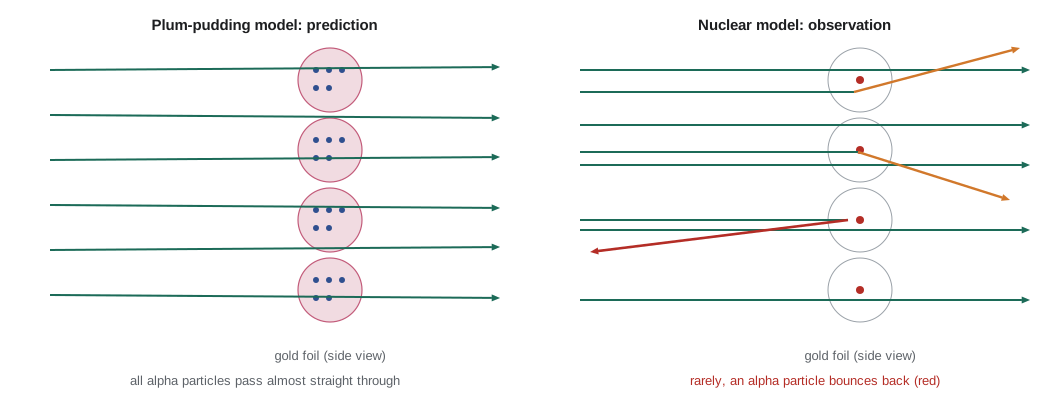
Since atoms are electrically neutral, they must also contain positive charge balancing the electrons. Thomson proposed the plum-pudding model: electrons embedded in a diffuse sphere of positive charge.
Rutherford and the nuclear atom
In 1909 Hans Geiger and Ernest Marsden, working with Ernest Rutherford at the University of Manchester, fired alpha particles (helium nuclei emitted by radioactive elements) at a very thin gold foil. Rutherford had earlier done much of his work on radioactivity at McGill University in Montreal, where he won the 1908 Nobel Prize in Chemistry for it. If the plum-pudding model were right, the alpha particles should pass through the foil with only slight deflections. Most did. But about 1 in 8,000 bounced back at large angles. Rutherford later said it was as if a 15-inch shell fired at tissue paper had come back and hit him.
Rutherford's explanation, published in 1911, was that nearly all the mass and all the positive charge of an atom is concentrated in a tiny, dense nucleus, with the electrons occupying the much larger space around it. The nucleus has a diameter of about 10⁻¹⁵ m, while the atom is about 10⁻¹⁰ m across. If an atom were the size of a hockey arena, the nucleus would be about the size of a pea at centre ice.
Rutherford identified the proton as the positive particle of the nucleus in 1919. Because nuclei were heavier than their protons alone could explain, he predicted a neutral particle, and James Chadwick discovered the neutron in 1932.
Protons, neutrons and electrons
| Particle | Symbol | Charge (relative) | Charge (C) | Mass (u) | Location |
|---|---|---|---|---|---|
| Proton | p⁺ | +1 | +1.602 × 10⁻¹⁹ | 1.007 28 | Nucleus |
| Neutron | n | 0 | 0 | 1.008 66 | Nucleus |
| Electron | e⁻ | −1 | −1.602 × 10⁻¹⁹ | 0.000 549 | Around the nucleus |
The number of protons in the nucleus is the atomic number, Z. It defines the element: every carbon atom has 6 protons, every gold atom 79. In a neutral atom the number of electrons equals Z. The mass number, A, is the total number of protons and neutrons (collectively, nucleons), so the number of neutrons is A − Z. An atom with a particular Z and A is a nuclide, written with the mass number as a superscript and the atomic number as a subscript before the symbol:
Because Z is implied by the symbol, nuclides are often written with the mass number only: carbon-12, C-12 or ¹²C.
Isotopes
Isotopes are atoms of the same element with different numbers of neutrons, and therefore different mass numbers. Carbon has two stable isotopes, ¹²C (6 neutrons) and ¹³C (7 neutrons), and a radioactive one, ¹⁴C (8 neutrons), used in radiocarbon dating. Isotopes of an element have nearly identical chemical properties, because chemistry depends on electrons, and electron arrangements are set by the nuclear charge, not the nuclear mass. Small differences in physical properties, such as the slightly higher boiling point of heavy water (D₂O, where D is deuterium, ²H), can nevertheless be exploited.
Canada has a particular connection to isotopes. The CANDU reactors that supply much of Ontario's electricity use heavy water as a moderator, which allows them to run on natural, unenriched uranium. Canadian research reactors have also long been among the world's major producers of medical isotopes such as cobalt-60 for cancer therapy and sterilization.
Worked problem
Counting subatomic particles
How many protons, neutrons and electrons are in (a) ⁵⁶Fe, (b) ⁵⁶Fe³⁺ and (c) ³⁷Cl⁻?
Show solution
- (a) Iron has Z = 26: 26 protons, 56 − 26 = 30 neutrons, and 26 electrons in the neutral atom.
- (b) The 3+ charge means three electrons have been lost: 26 protons, 30 neutrons, 23 electrons.
- (c) Chlorine has Z = 17: 17 protons, 37 − 17 = 20 neutrons, and 18 electrons (one gained).
Answer: Fe-56: 26 p, 30 n, 26 e; Fe³⁺: 26 p, 30 n, 23 e; ³⁷Cl⁻: 17 p, 20 n, 18 e.
Ions
Atoms gain or lose electrons to form ions. A cation is a positive ion, formed by losing electrons; metals tend to form cations, such as Na⁺, Mg²⁺ and Al³⁺. An anion is a negative ion, formed by gaining electrons; nonmetals tend to form anions, such as Cl⁻, O²⁻ and N³⁻. The nucleus does not change when an ion forms. Many common ions have charges that can be predicted from the element's position in the periodic table, for reasons explained in lessons 7 and 9: group 1 metals form 1+ ions, group 2 metals form 2+ ions, and the group 17 halogens form 1− ions.
Atomic mass and the atomic mass unit
Atoms are far too light to weigh in grams conveniently, so chemists use the unified atomic mass unit (u, also called the dalton, Da), defined as exactly one-twelfth of the mass of a carbon-12 atom: 1 u = 1.660 54 × 10⁻²⁷ kg. On this scale a proton and a neutron each have a mass very close to 1 u, so the mass of an atom in u is close to its mass number, though not exactly: the masses of nuclei are slightly less than the sum of their parts, by an amount corresponding to the nuclear binding energy.
The atomic mass shown on the periodic table is a weighted average of the masses of the element's naturally occurring isotopes, weighted by their natural abundances. It is why chlorine's atomic mass is 35.45 rather than a whole number: natural chlorine is about 75.8 % chlorine-35 and 24.2 % chlorine-37.
Worked problem
Average atomic mass of chlorine
Chlorine-35 has a mass of 34.969 u and an abundance of 75.78 %; chlorine-37 has a mass of 36.966 u and an abundance of 24.22 %. Calculate the average atomic mass.
Show solution
- Convert percentages to fractions: 0.7578 and 0.2422.
- Weighted sum: 0.7578 × 34.969 + 0.2422 × 36.966.
- = 26.499 + 8.953 = 35.452 u.
Answer: 35.45 u, matching the periodic table value. The average is closer to 35 than to 37 because chlorine-35 is more abundant.
# Average atomic masses from isotopic data (masses in u, abundances in fractions)
elements = {
    "B":  [(10.0129, 0.199), (11.0093, 0.801)],
    "Mg": [(23.9850, 0.7899), (24.9858, 0.1000), (25.9826, 0.1101)],
    "Cu": [(62.9296, 0.6915), (64.9278, 0.3085)],
    "Cl": [(34.9689, 0.7578), (36.9659, 0.2422)],
}
for sym, isotopes in elements.items():
    total = sum(f for _, f in isotopes)
    avg = sum(m * f for m, f in isotopes)
    print(f"{sym:2s}: average mass = {avg:.3f} u  (abundances sum to {total:.4f})")

# Working backward: copper is 63.546 u. Find the fraction of Cu-63.
m63, m65, M = 62.9296, 64.9278, 63.546
x = (m65 - M) / (m65 - m63)
print(f"fraction of Cu-63 = {x:.4f}")B : average mass = 10.811 u (abundances sum to 1.0000) Mg: average mass = 24.305 u (abundances sum to 1.0000) Cu: average mass = 63.546 u (abundances sum to 1.0000) Cl: average mass = 35.453 u (abundances sum to 1.0000) fraction of Cu-63 = 0.6915
The last calculation runs the problem backward. If an element has two isotopes with known masses, and the average atomic mass is known, the abundances follow from a single equation: M = x·m₁ + (1 − x)·m₂, so x = (m₂ − M)/(m₂ − m₁).
Mass spectrometry
Isotopic masses and abundances are measured with a mass spectrometer. The sample is vaporized and ionized, usually by losing one electron to form 1+ ions. The ions are accelerated by an electric field and separated according to their mass-to-charge ratio (m/z), traditionally by bending them in a magnetic field: lighter ions bend more. A detector records how many ions arrive at each m/z. The resulting mass spectrum is a set of peaks whose positions give isotopic masses and whose heights give relative abundances. Modern instruments separate ions by time of flight, by electric fields in an ion trap, or by other means, but the principle is the same. Mass spectrometry is also used to identify unknown compounds, to detect drugs in athletes' urine and to date geological samples.
A first look at the periodic table
In 1869 Dmitri Mendeleev arranged the 63 elements then known in order of atomic mass, in rows such that elements with similar properties fell in the same columns. He left gaps for undiscovered elements and predicted their properties; the discovery of gallium (1875), scandium (1879) and germanium (1886), with properties close to his predictions, made the table famous. In 1913 Henry Moseley showed, from X-ray spectra, that the true ordering principle is atomic number, not atomic mass, which resolved a few anomalies such as tellurium and iodine.
The modern periodic table has 118 elements arranged in seven horizontal rows, called periods, and 18 vertical columns, called groups. Elements in the same group have similar chemical properties. Some groups have names: group 1 (except hydrogen) are the alkali metals, group 2 the alkaline earth metals, group 17 the halogens and group 18 the noble gases. Groups 1, 2 and 13 to 18 are the main-group elements; groups 3 to 12 are the transition metals; and the two rows usually printed below the table are the lanthanides and actinides. The four most recently named elements, nihonium (113), moscovium (115), tennessine (117) and oganesson (118), were named by IUPAC in 2016, completing the seventh period.
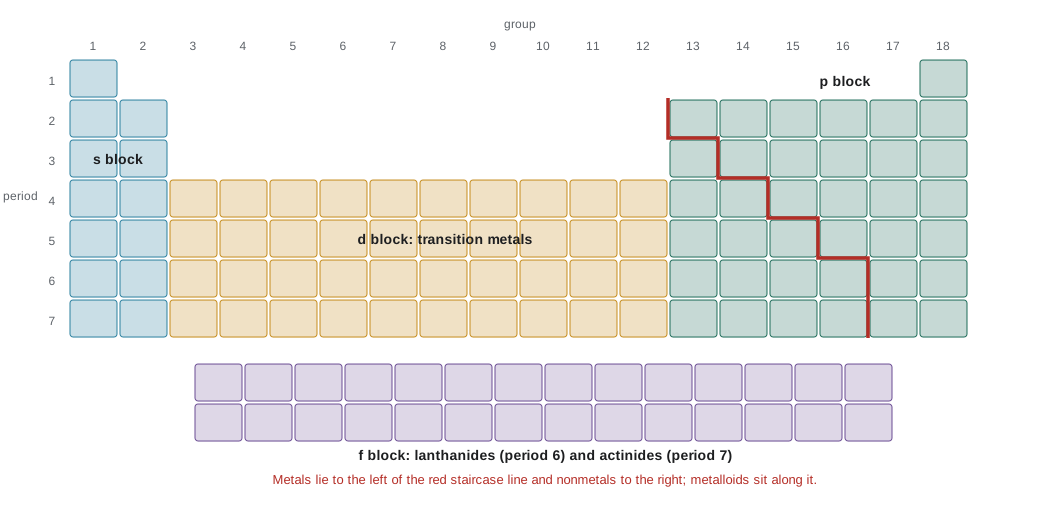
A staircase line running from boron to astatine separates metals (to the left) from nonmetals (to the right). About three-quarters of the elements are metals: shiny, malleable, good conductors of heat and electricity, and inclined to form cations. Nonmetals are generally poor conductors, and many are gases at room temperature; they tend to form anions or to share electrons in covalent bonds. The metalloids along the staircase, such as silicon, germanium and arsenic, have intermediate properties; silicon's ability to conduct a little electricity, controllably, is the basis of the semiconductor industry. Lessons 7 and 8 explain why the table has exactly this shape.
Common mistakes
MistakeIsotopes of an element have different numbers of protons.
InsteadIsotopes have the same number of protons (same element) but different numbers of neutrons.
MistakeThe mass number is the mass of an atom in grams.
InsteadThe mass number is a count of protons plus neutrons; the atomic mass in u is close to it but not equal.
MistakeAn ion with a 2+ charge has gained two electrons.
InsteadA positive charge means electrons have been lost; a 2+ ion has lost two electrons.
MistakeThe atomic mass on the periodic table is the mass of the most common isotope.
InsteadIt is the abundance-weighted average of all naturally occurring isotopes.
MistakeRutherford's experiment showed that atoms are solid and dense throughout.
InsteadIt showed that atoms are mostly empty space, with a tiny dense nucleus.
Summary and key terms
- The laws of conservation of mass, definite proportions and multiple proportions led Dalton to propose that matter is made of atoms.
- Thomson discovered the electron (1897); Millikan measured its charge (about 1.60 × 10⁻¹⁹ C).
- Rutherford’s gold-foil experiment revealed a tiny, dense, positive nucleus; protons and neutrons make up the nucleus.
- The atomic number Z (protons) defines the element; the mass number A counts protons plus neutrons.
- Isotopes differ in neutron number; their chemistry is nearly identical because it depends on electrons.
- Atomic masses on the periodic table are abundance-weighted averages of isotopic masses, measured by mass spectrometry.
- The periodic table is ordered by atomic number into periods and groups; elements in a group have similar properties.
- atomic number (Z)
- The number of protons in the nucleus of an atom.
- mass number (A)
- The total number of protons and neutrons in a nucleus.
- isotope
- An atom of an element with a particular number of neutrons.
- nuclide
- An atom with a specified atomic number and mass number.
- atomic mass unit (u)
- One-twelfth of the mass of a carbon-12 atom; also called the dalton.
- cation
- A positively charged ion formed by losing electrons.
- anion
- A negatively charged ion formed by gaining electrons.
- mass spectrometer
- An instrument that separates ions by mass-to-charge ratio to measure isotopic masses and abundances.
- group
- A vertical column of the periodic table, containing elements with similar properties.
- period
- A horizontal row of the periodic table.
Practice problems
Work each problem on paper first, then reveal the answer to check.
Give the numbers of protons, neutrons and electrons in ²⁷Al³⁺.
Show answer
13 protons, 14 neutrons, 10 electrons.
Write the symbol for the nuclide with 17 protons and 18 neutrons.
Show answer
³⁵Cl (chlorine-35).
Nitrogen and oxygen form NO and NO₂. For a fixed mass of nitrogen, what is the ratio of oxygen masses?
Show answer
1 : 2.
Gallium is 60.11 % Ga-69 (68.926 u) and 39.89 % Ga-71 (70.925 u). Calculate its atomic mass.
Show answer
0.6011 × 68.926 + 0.3989 × 70.925 = 69.72 u.
Boron has isotopes B-10 (10.013 u) and B-11 (11.009 u) and an atomic mass of 10.81 u. What is the fraction of B-11?
Show answer
x = (10.81 − 10.013)/(11.009 − 10.013) ≈ 0.80.
Which part of Dalton’s theory did the discovery of isotopes contradict?
Show answer
That all atoms of an element are identical in mass.
Why do isotopes of an element have nearly the same chemistry?
Show answer
Chemistry depends on electrons, whose arrangement is set by the number of protons, which isotopes share.
Name the group and give the typical ion charge for calcium.
Show answer
Group 2, the alkaline earth metals; Ca²⁺.
In a mass spectrometer, which ion is deflected more in a magnetic field: ³⁵Cl⁺ or ³⁷Cl⁺?
Show answer
³⁵Cl⁺, because it has a smaller mass-to-charge ratio.
Classify silicon, sulfur and potassium as metal, nonmetal or metalloid.
Show answer
Silicon: metalloid; sulfur: nonmetal; potassium: metal.
Lesson quiz · 5 questions
Score 60% or more to complete this lesson.
Create a free account to save your progress, take quizzes and earn a certificate.