
CHEM-101 · Lesson 1 of 12 · 34 min
Chemistry, measurement and problem solving
Chemistry is the study of matter and the changes it undergoes. Everything you can touch, breathe or drink is matter, and nearly every technology you use depends on controlling how matter behaves: the lithium-ion battery in a phone, the concrete in a bridge, the insulin in a pharmacy refrigerator and the fertilizer that feeds a city. This first lesson sets out how chemists describe matter, how they measure it, and how they solve quantitative problems reliably. These habits of careful measurement and unit-aware calculation run through every lesson that follows, and through CHEM-102 and the later courses in the program.
If you have taken CHEM-103 (Chemistry for Engineers), some ideas here will look familiar. CHEM-101 goes further into why atoms behave as they do: the quantum structure of atoms, the periodic table and chemical bonding. The emphasis is on the reasoning a chemistry major needs, not only on the calculations an engineer applies.
What chemistry studies
Chemists describe matter at two levels at once. The macroscopic level is what we can see and measure: a colourless liquid that boils at 100 °C, a grey metal that conducts electricity, a gas that relights a glowing splint. The particulate level is the world of atoms, ions and molecules that explains those observations. Water boils at 100 °C because its molecules attract one another through hydrogen bonds that must be overcome; copper conducts because some of its electrons move freely through the metal. A third level, the symbolic level of formulas and equations, connects the two. Learning chemistry means moving fluently between these three levels.
Matter is classified by composition. A pure substance has a fixed composition and distinct properties. Pure substances are either elements, which cannot be broken down into simpler substances by chemical means (oxygen, iron, carbon), or compounds, which contain two or more elements combined in fixed proportions (water, sodium chloride, carbon dioxide). A mixture contains two or more substances that keep their own identities and can be present in varying amounts. A homogeneous mixture, or solution, is uniform throughout (salt water, air, brass); a heterogeneous mixture is not (granite, a salad dressing, muddy water).
| Category | Composition | Can it be separated physically? | Examples |
|---|---|---|---|
| Element | One kind of atom | No; cannot be broken down chemically either | Copper, helium, sulfur |
| Compound | Two or more elements in fixed ratio | No; requires a chemical reaction | Water, table salt, glucose |
| Homogeneous mixture | Variable; uniform throughout | Yes (distillation, evaporation) | Air, vinegar, stainless steel |
| Heterogeneous mixture | Variable; not uniform | Yes (filtration, decanting) | Concrete, sand in water, granite |
Properties are physical or chemical. A physical property can be observed without changing the substance's identity: melting point, density, colour, electrical conductivity. A chemical property describes how a substance changes into other substances: iron rusts in moist air, methane burns in oxygen, baking soda reacts with vinegar. Correspondingly, a physical change (ice melting, sugar dissolving) leaves the substance chemically the same, while a chemical change, or chemical reaction, forms new substances. Properties are also intensive (independent of amount, such as density and boiling point) or extensive (proportional to amount, such as mass and volume). Intensive properties are what we use to identify substances.
The scientific approach
Chemistry advanced when people began to measure carefully. Antoine Lavoisier's quantitative experiments in the 1770s, weighing reactants and products in sealed vessels, established the law of conservation of mass: in a chemical reaction, mass is neither created nor destroyed. Joseph Proust's law of definite proportions (a compound always contains the same elements in the same proportions by mass) and John Dalton's law of multiple proportions followed, and together they led Dalton to his atomic theory in the early 1800s, the subject of lesson 2.
The pattern is typical of science. Observations suggest a hypothesis, a tentative explanation that can be tested. Experiments test predictions made from the hypothesis. A hypothesis that survives many tests and explains a wide range of observations may become part of a theory, a well-supported explanation of why things happen. A scientific law, by contrast, summarizes what happens, often as a mathematical relationship, without necessarily explaining why. Theories are never proven beyond all doubt, but well-established theories such as atomic theory are about as secure as human knowledge gets.
SI units
Scientists use the International System of Units (SI). Seven base units are defined; all others are derived from them. Canada adopted the metric system officially in the 1970s, and metric units are standard in Canadian science, medicine and industry, though feet, inches and pounds persist in construction and everyday speech. In the United States, customary units (pounds, feet, degrees Fahrenheit) dominate daily life, but science, medicine and most of industry use SI. In this course, as in all scientific work, we use SI.
| Quantity | SI base unit | Symbol |
|---|---|---|
| Mass | kilogram | kg |
| Length | metre | m |
| Time | second | s |
| Temperature | kelvin | K |
| Amount of substance | mole | mol |
| Electric current | ampere | A |
| Luminous intensity | candela | cd |
Since 2019 all seven base units have been defined by fixing the exact values of physical constants. The kilogram, for example, is defined by fixing the Planck constant, and the mole by fixing the Avogadro constant at exactly 6.022 140 76 × 10²³ per mole. Before 2019 the kilogram was the mass of a platinum–iridium cylinder kept near Paris. The change means that any well-equipped laboratory can, in principle, realize the units without reference to a physical artefact.
Prefixes scale units by powers of ten. Chemists use a wide range, from picometres for atomic radii to kilojoules for reaction energies.
| Prefix | Symbol | Factor | Example |
|---|---|---|---|
| giga | G | 10⁹ | 1 GJ of energy |
| mega | M | 10⁶ | 1 MPa of pressure |
| kilo | k | 10³ | 1 kg = 1,000 g |
| centi | c | 10⁻² | 1 cm = 0.01 m |
| milli | m | 10⁻³ | 1 mL = 0.001 L |
| micro | µ | 10⁻⁶ | 1 µg = 10⁻⁶ g |
| nano | n | 10⁻⁹ | visible light, 400–700 nm |
| pico | p | 10⁻¹² | carbon atom radius ≈ 70 pm |
Some derived units appear constantly. Volume is a cubed length; the SI unit is the cubic metre, but chemists more often use the litre (L), defined as exactly 1 cubic decimetre (1 dm³), so 1 mL = 1 cm³. Density is mass per unit volume, usually in g/cm³ for solids and liquids and g/L for gases. Energy is measured in joules (J), where 1 J = 1 kg·m²/s². Pressure is measured in pascals (Pa), where 1 Pa = 1 N/m²; lesson 11 introduces the atmosphere and other pressure units.
Temperature
Temperature measures how hot or cold something is, and at the particulate level it reflects the average kinetic energy of particles. Three scales are in common use. The Celsius scale sets the freezing and boiling points of water at 1 atm at 0 °C and 100 °C. The Kelvin scale has the same size of degree but starts at absolute zero, the lowest possible temperature, so that 0 K = −273.15 °C. Kelvin temperatures have no degree sign and are never negative. Gas laws and thermodynamics require Kelvin. The Fahrenheit scale, used in everyday US life, sets water's freezing point at 32 °F and boiling point at 212 °F, so 180 Fahrenheit degrees span the same interval as 100 Celsius degrees.
Worked problem
Converting temperatures
A weather forecast in Winnipeg calls for −30 °C. A colleague in Minneapolis asks what that is in Fahrenheit, and a chemistry student wants it in kelvins.
Show solution
- Fahrenheit: (9/5)(−30) + 32 = −54 + 32 = −22 °F.
- Kelvin: −30 + 273.15 = 243.15 K, or 243 K to the nearest kelvin.
- Check: −40 is the one temperature that is equal on both scales, and −30 °C is a little warmer than −40, so a value a little above −40 °F makes sense.
Answer: −30 °C = −22 °F = 243 K.
Uncertainty, precision and accuracy
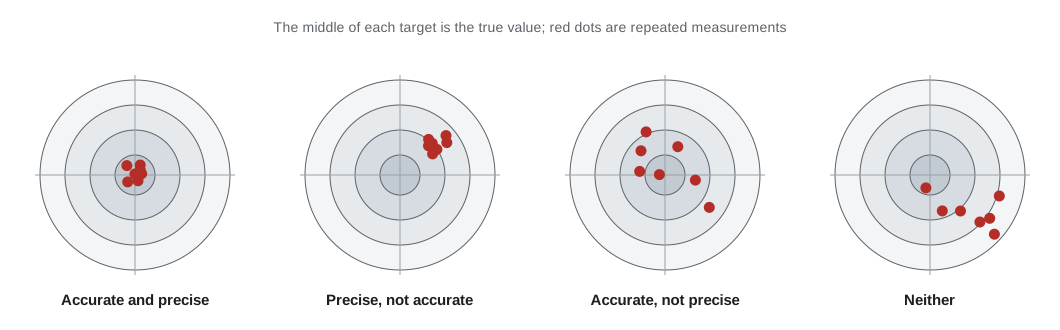
Every measurement has some uncertainty. A kitchen scale might read a mass to the nearest gram; an analytical balance reads to the nearest 0.1 mg. When we report a measured value, the digits we write should tell the reader how precise it is. Accuracy is how close a measurement is to the true value; precision is how close repeated measurements are to one another. A set of measurements can be precise but inaccurate if the instrument has a systematic error, such as a balance that has not been zeroed. Random errors scatter results on both sides of the true value and can be reduced by averaging; systematic errors shift every result the same way and are reduced only by finding and fixing their cause.
Significant figures
Significant figures are the digits in a measured number that carry meaning: all certain digits plus one estimated digit. The rules for counting them are simple once learned. Non-zero digits are always significant. Zeros between non-zero digits are significant (1,005 has four). Leading zeros are never significant; they only place the decimal point (0.0042 has two). Trailing zeros are significant if the number contains a decimal point (2.50 has three, 100.0 has four) and ambiguous without one (1,200 could have two, three or four). Scientific notation removes the ambiguity: 1.20 × 10³ has three.
Exact numbers have unlimited significant figures. These include counted quantities (12 eggs, 3 trials) and defined relationships (1 m = 100 cm, 1 inch = 2.54 cm exactly). They never limit the precision of a calculated result.
| Operation | Rule | Example |
|---|---|---|
| Multiplication and division | Answer has as many significant figures as the measurement with the fewest | 4.56 × 1.4 = 6.384 → 6.4 (two) |
| Addition and subtraction | Answer has as many decimal places as the measurement with the fewest | 12.11 + 0.3 = 12.41 → 12.4 (one decimal place) |
| Multi-step calculations | Keep extra digits until the end, then round once | Avoids rounding error building up |
| Logarithms | Decimal places in the log equal significant figures in the number | log(2.5 × 10⁻³) = −2.60 |
When rounding, if the first digit to be dropped is 5 or greater, round up; otherwise leave the last kept digit unchanged. Many textbooks and calculators handle an exact 5 slightly differently, but for this course the simple rule is enough. The code below counts significant figures in a few measured values and shows how a product is rounded.
from decimal import Decimal

def sig_figs(s):
    """Count significant figures in a measured value written as a string."""
    s = s.replace(",", "").lower()
    mant = s.split("e")[0].lstrip("+-")
    digits = mant.replace(".", "").lstrip("0")
    if "." not in mant:
        digits = digits.rstrip("0") or "0"   # trailing zeros ambiguous: assume not significant
    return len(digits)

for value in ["0.004 20", "1,005", "2.50", "1200", "1.200e3", "100.0"]:
    print(f"{value:>8}  ->  {sig_figs(value.replace(' ', ''))} significant figures")

a, b = Decimal("4.56"), Decimal("1.4")
product = a * b
print("4.56 x 1.4 =", product, "-> report", f"{float(product):.2g}")0.004 20 -> 3 significant figures
1,005 -> 4 significant figures
2.50 -> 3 significant figures
1200 -> 2 significant figures
1.200e3 -> 4 significant figures
100.0 -> 4 significant figures
4.56 x 1.4 = 6.384 -> report 6.4Dimensional analysis
Most calculations in chemistry convert one quantity into another. Dimensional analysis, also called the factor-label method, does this by multiplying by conversion factors written as fractions equal to 1. Because 1 in = 2.54 cm, the fractions (2.54 cm / 1 in) and (1 in / 2.54 cm) both equal 1. Choose the one that cancels the unit you have and leaves the unit you want. If the units come out right, the arithmetic is usually right too; if they do not, something is wrong.
Worked problem
A chain of conversions
A car is rated at 7.8 L per 100 km. Express its fuel economy in miles per US gallon (1 mile = 1.609 km; 1 US gallon = 3.785 L).
Show solution
- Start with the reciprocal, distance per volume: 100 km / 7.8 L = 12.82 km/L.
- 12.82 km/L × (1 mile / 1.609 km) = 7.968 miles/L.
- 7.968 miles/L × (3.785 L / 1 gal) = 30.16 miles/gal.
- The data have two significant figures (7.8), so round to 30 miles per gallon.
Answer: About 30 miles per US gallon. Note that L/100 km and miles per gallon are reciprocals of each other in form: a smaller L/100 km means better economy, while a larger miles per gallon means better economy.
Dimensional analysis works equally well for squared and cubed units, as long as the conversion factor is squared or cubed too. Converting 2.0 m³ to litres requires (10 dm / 1 m)³ = 1,000 dm³/m³, giving 2.0 × 10³ L. A common slip is to convert 1 m = 100 cm and conclude that 1 m³ = 100 cm³; the correct figure is 10⁶ cm³.
Density
Density, mass divided by volume, is a useful intensive property for identifying substances and for converting between mass and volume.
Worked problem
Using density as a conversion factor
Ethanol has a density of 0.789 g/mL at 20 °C. What volume of ethanol has a mass of 25.0 g? What is the mass of 1.00 L?
Show solution
- V = m / d = 25.0 g ÷ 0.789 g/mL = 31.7 mL.
- Mass of 1.00 L: 1.00 L × (1,000 mL / 1 L) × (0.789 g / 1 mL) = 789 g.
Answer: 25.0 g of ethanol occupies 31.7 mL; 1.00 L of ethanol has a mass of 789 g. Both answers have three significant figures, matching the data.
Density usually decreases as temperature rises, because most substances expand when heated. Water is a striking exception: its density is greatest at about 4 °C, and ice is less dense than liquid water, so lakes freeze from the top down and aquatic life survives the winter beneath the ice. Lesson 12 explains this behaviour in terms of hydrogen bonding.
Problem-solving strategy
Chemistry problems become manageable with a consistent approach. First, identify what is given and what is asked for, with units. Second, plan a route that connects them: which relationships and conversion factors link the given quantity to the target? Third, carry out the calculation, keeping units throughout. Fourth, check the answer. Are the units correct? Is the magnitude reasonable? Does the number of significant figures match the data? An estimate made before calculating, even a rough one, catches most errors.
# A unit-carrying calculation: how many grams of water are in a 355 mL can of pop?
# Treat the drink as mostly water with density 1.04 g/mL and 89 % water by mass.
volume_mL = 355
density_g_per_mL = 1.04
water_fraction = 0.89

mass_drink_g = volume_mL * density_g_per_mL
mass_water_g = mass_drink_g * water_fraction
print(f"mass of drink: {mass_drink_g:.0f} g")
print(f"mass of water: {mass_water_g:.0f} g")

# rough check: 355 mL of pure water would be 355 g; our answer should be close
print("estimate check (355 g of pure water):", abs(mass_water_g - 355) < 50)mass of drink: 369 g mass of water: 329 g estimate check (355 g of pure water): True
Working safely in a chemistry laboratory
Laboratory work carries real hazards: corrosive acids, flammable solvents, toxic gases, hot surfaces and broken glass. Safe practice begins before the experiment, with reading the procedure, identifying the hazards and knowing where the eyewash station, safety shower, fire extinguisher and exits are. Eye protection is worn at all times in a teaching laboratory; contact lenses are discouraged. Food and drink are never brought into the lab. Chemicals are never tasted, and odours are checked only by wafting vapours gently toward the nose.
In Canada, hazard information about chemicals at work follows the Workplace Hazardous Materials Information System (WHMIS 2015), which is aligned with the United Nations Globally Harmonized System of Classification and Labelling of Chemicals (GHS). Suppliers must provide labels with GHS pictograms and safety data sheets (SDSs) in a standard 16-section format. Amendments to the federal Hazardous Products Regulations, published in December 2022, aligned WHMIS with the seventh revision of the GHS; the three-year transition ended on 14 December 2025, so all hazardous products must now meet the amended requirements (Health Canada, checked October 2026). HSE-102 covers WHMIS training in detail.
A GHS label carries a product identifier, one or more pictograms, a signal word, hazard statements, precautionary statements and supplier information. There are two signal words: DANGER for the more severe hazards and WARNING for the less severe. The SDS adds information on handling, storage, first aid, fire-fighting, spill response and toxicology. Reading the SDS for every chemical in a procedure is part of preparing for the experiment, not an optional extra.
| GHS pictogram | Hazard it signals | Teaching-lab example |
|---|---|---|
| Flame | Flammable liquids, gases, solids | Ethanol, acetone |
| Corrosion | Skin corrosion, serious eye damage, corrosive to metals | Concentrated hydrochloric acid, sodium hydroxide |
| Skull and crossbones | Acute toxicity (fatal or toxic) | Sodium cyanide (rarely used in teaching) |
| Exclamation mark | Irritant, harmful, skin sensitizer | Dilute ammonia |
| Health hazard | Carcinogen, respiratory sensitizer, organ toxicity | Formaldehyde, some solvents |
| Flame over circle | Oxidizer | Potassium permanganate, hydrogen peroxide (concentrated) |
| Gas cylinder | Gas under pressure | Compressed nitrogen |
Common mistakes
MistakeA compound and a mixture are the same thing, since both contain more than one element.
InsteadA compound has a fixed composition and new properties; a mixture has variable composition and its components keep their own properties.
MistakeTrailing zeros are never significant.
InsteadTrailing zeros after a decimal point are significant: 2.50 has three significant figures.
MistakeSince 1 m = 100 cm, 1 m³ = 100 cm³.
InsteadThe conversion factor must be cubed: 1 m³ = (100 cm)³ = 10⁶ cm³.
MistakeA precise measurement must be accurate.
InsteadPrecision is agreement among repeated results; a systematic error can make precise results inaccurate.
MistakeKelvin temperatures can be negative, like Celsius.
InsteadThe Kelvin scale starts at absolute zero, so kelvin temperatures are never negative.
Summary and key terms
- Chemistry explains macroscopic observations through the behaviour of atoms, ions and molecules, using formulas and equations as the link.
- Matter is classified as elements, compounds, homogeneous mixtures and heterogeneous mixtures; properties are physical or chemical, intensive or extensive.
- SI units, defined since 2019 by fixed physical constants, are used throughout science in both Canada and the United States.
- Temperature conversions: K = °C + 273.15; °F = (9/5)°C + 32.
- Significant figures show precision: multiply and divide by the fewest significant figures, add and subtract by the fewest decimal places.
- Dimensional analysis multiplies by conversion factors equal to 1 and checks the work through units.
- Safe laboratory practice depends on reading GHS labels and safety data sheets before working with any chemical.
- matter
- Anything that has mass and occupies space.
- element
- A substance that cannot be broken down into simpler substances by chemical means.
- compound
- A substance made of two or more elements combined in fixed proportions.
- homogeneous mixture
- A mixture with uniform composition throughout; a solution.
- intensive property
- A property that does not depend on the amount of substance, such as density.
- accuracy
- How close a measurement is to the true value.
- precision
- How close repeated measurements are to one another.
- significant figures
- The digits in a measurement that are known with certainty plus one estimated digit.
- dimensional analysis
- A method of converting units by multiplying by conversion factors equal to 1.
- safety data sheet
- A standard 16-section document giving hazard, handling and emergency information for a chemical.
Practice problems
Work each problem on paper first, then reveal the answer to check.
Classify each as element, compound, homogeneous mixture or heterogeneous mixture: brass, carbon dioxide, granite, neon.
Show answer
Brass: homogeneous mixture; carbon dioxide: compound; granite: heterogeneous mixture; neon: element.
How many significant figures are in 0.020 50?
Show answer
Four (2, 0, 5, 0); the leading zeros do not count.
Calculate 3.42 × 0.0021 to the correct significant figures.
Show answer
0.0072 (two significant figures).
Add 15.2 g, 0.36 g and 102 g.
Show answer
117.56 rounds to 118 g, because 102 has no decimal places.
Convert 98.6 °F to °C and K.
Show answer
37.0 °C and 310.2 K.
A block of aluminum is 2.0 cm × 3.0 cm × 4.0 cm and has a mass of 64.8 g. What is its density?
Show answer
V = 24 cm³; d = 64.8 / 24 = 2.7 g/cm³.
How many cubic centimetres are in 0.25 m³?
Show answer
0.25 × 10⁶ = 2.5 × 10⁵ cm³.
Mercury has a density of 13.6 g/mL. What is the mass of 5.00 mL?
Show answer
68.0 g.
A student measures a known 10.00 g mass as 9.71, 9.72 and 9.70 g. Describe the precision and accuracy.
Show answer
Precise (close together) but not accurate (all about 0.3 g low), suggesting a systematic error.
Which two signal words appear on GHS labels, and what do they indicate?
Show answer
DANGER for more severe hazards and WARNING for less severe hazards.
Lesson quiz · 5 questions
Score 60% or more to complete this lesson.
Create a free account to save your progress, take quizzes and earn a certificate.