
CHEM-101 · Lesson 7 of 12 · 30 min
Electron configurations and the periodic table
Hydrogen has one electron, and lesson 6 described its orbitals exactly. Every other atom has several electrons, which repel one another as well as being attracted to the nucleus. Schrödinger's equation cannot be solved exactly for such atoms, but good approximations show that their electrons occupy orbitals much like hydrogen's, with one important difference: orbitals in the same shell no longer all have the same energy. This lesson shows how electrons fill orbitals, writes electron configurations for atoms and ions, and explains why the periodic table has the shape it does.
Orbital energies in many-electron atoms
In hydrogen, the 2s and 2p orbitals have the same energy, as do 3s, 3p and 3d. In a many-electron atom they do not. The reason is shielding. Each electron is attracted by the nucleus but repelled by the other electrons, especially those closer to the nucleus. The inner electrons partly cancel, or shield, the nuclear charge felt by an outer electron. The net charge it experiences is the effective nuclear charge, Z_eff, which is less than the actual nuclear charge Z.
Orbitals differ in how well their electrons penetrate the inner electron cloud. An s electron has some probability of being very close to the nucleus, inside the inner shells, so it experiences a larger Z_eff than a p electron of the same shell. A p electron, in turn, penetrates better than a d electron. As a result, within a shell the subshell energies increase in the order s < p < d < f. The effect is large enough that the 4s orbital lies slightly below 3d for potassium and calcium, which is why the fourth period starts with the 4s orbital before the 3d orbitals fill.
Three rules for filling orbitals
The ground-state electron configuration of an atom, the arrangement of its electrons with the lowest total energy, follows three rules.
The Pauli exclusion principle, stated by Wolfgang Pauli in 1925, says no two electrons in an atom can have the same set of four quantum numbers. Since an orbital is defined by n, l and mₗ, two electrons in the same orbital must have opposite spins (mₛ = +½ and −½). Each orbital therefore holds at most two electrons, and a subshell with 2l + 1 orbitals holds 2(2l + 1) electrons: 2 for s, 6 for p, 10 for d and 14 for f.
The aufbau principle (German for “building up”) says electrons occupy the lowest-energy orbitals available. Filling follows the approximate order 1s, 2s, 2p, 3s, 3p, 4s, 3d, 4p, 5s, 4d, 5p, 6s, 4f, 5d, 6p, 7s, 5f, 6d, 7p. This order can be remembered with the diagonal diagram below, or, better, read directly from the periodic table.
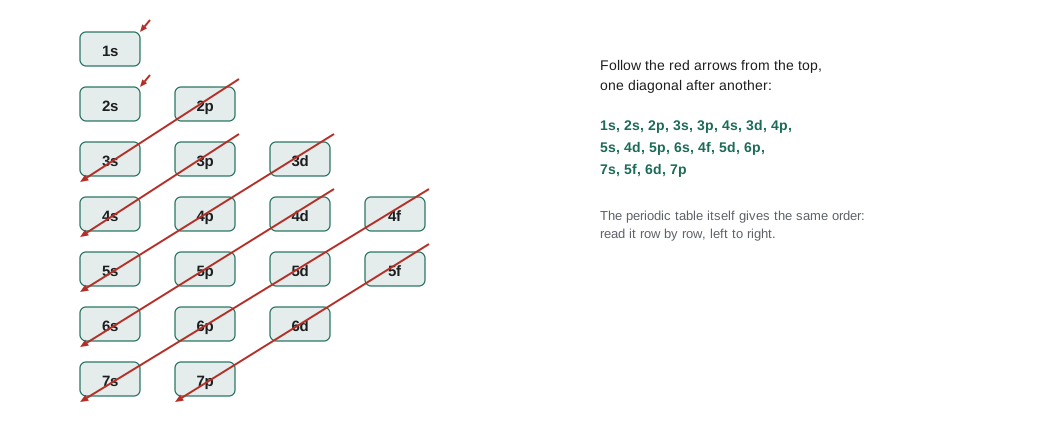
Hund's rule says that when electrons occupy orbitals of equal energy, such as the three 2p orbitals, they spread out singly with parallel spins before any orbital receives a second electron. Electrons in separate orbitals repel one another less, and parallel spins lower the energy further through a quantum effect called exchange.
Writing electron configurations
An electron configuration lists occupied subshells with the number of electrons as a superscript. An orbital diagram shows each orbital as a box with arrows for electrons, making spins visible. To save space, the configuration of the preceding noble gas can be written in brackets: sodium, 1s² 2s² 2p⁶ 3s¹, becomes [Ne] 3s¹. The electrons in the noble-gas core are core electrons; the electrons beyond it in the outermost shell are valence electrons, the ones involved in chemical bonding. (For transition metals, the d electrons just beyond the core are often counted as valence electrons too.)
Worked problem
Configurations and orbital diagrams
Write the full and noble-gas configurations of nitrogen (Z = 7), sulfur (Z = 16) and iron (Z = 26), and draw the orbital diagram for nitrogen’s valence shell.
Show solution
- Nitrogen: 1s² 2s² 2p³, or [He] 2s² 2p³. By Hund’s rule the three 2p electrons occupy separate orbitals with parallel spins: 2s ↑↓, 2p ↑ ↑ ↑.
- Sulfur: 1s² 2s² 2p⁶ 3s² 3p⁴, or [Ne] 3s² 3p⁴. The 3p orbital diagram is ↑↓ ↑ ↑, with two unpaired electrons.
- Iron: 1s² 2s² 2p⁶ 3s² 3p⁶ 4s² 3d⁶, or [Ar] 4s² 3d⁶ (also written [Ar] 3d⁶ 4s²). The 3d orbital diagram is ↑↓ ↑ ↑ ↑ ↑, with four unpaired electrons.
Answer: N: [He] 2s² 2p³ (three unpaired electrons); S: [Ne] 3s² 3p⁴ (two unpaired); Fe: [Ar] 4s² 3d⁶ (four unpaired).
The program below generates ground-state configurations by filling subshells in aufbau order. It includes the two most common exceptions among the first 36 elements, discussed next.
ORDER = ["1s", "2s", "2p", "3s", "3p", "4s", "3d", "4p", "5s", "4d", "5p",
         "6s", "4f", "5d", "6p", "7s", "5f", "6d", "7p"]
CAP = {"s": 2, "p": 6, "d": 10, "f": 14}
SYMBOLS = ("H He Li Be B C N O F Ne Na Mg Al Si P S Cl Ar K Ca Sc Ti V Cr Mn Fe "
           "Co Ni Cu Zn Ga Ge As Se Br Kr").split()
EXCEPTIONS = {24: {"4s": 1, "3d": 5}, 29: {"4s": 1, "3d": 10}}   # Cr and Cu

def configuration(Z):
    left, filled = Z, {}
    for sub in ORDER:
        if left == 0:
            break
        n = min(CAP[sub[-1]], left)
        filled[sub] = n
        left -= n
    filled.update(EXCEPTIONS.get(Z, {}))
    return " ".join(f"{s}{n}" for s, n in filled.items() if n)

for Z in (1, 6, 8, 11, 17, 20, 24, 26, 29, 35):
print(f"{SYMBOLS[Z - 1]:2s} (Z = {Z:2d}): {configuration(Z)}")H (Z = 1): 1s1 C (Z = 6): 1s2 2s2 2p2 O (Z = 8): 1s2 2s2 2p4 Na (Z = 11): 1s2 2s2 2p6 3s1 Cl (Z = 17): 1s2 2s2 2p6 3s2 3p5 Ca (Z = 20): 1s2 2s2 2p6 3s2 3p6 4s2 Cr (Z = 24): 1s2 2s2 2p6 3s2 3p6 4s1 3d5 Fe (Z = 26): 1s2 2s2 2p6 3s2 3p6 4s2 3d6 Cu (Z = 29): 1s2 2s2 2p6 3s2 3p6 4s1 3d10 Br (Z = 35): 1s2 2s2 2p6 3s2 3p6 4s2 3d10 4p5
Exceptions: chromium and copper
A few configurations break the simple filling order. Chromium is [Ar] 4s¹ 3d⁵ rather than [Ar] 4s² 3d⁴, and copper is [Ar] 4s¹ 3d¹⁰ rather than [Ar] 4s² 3d⁹. The 4s and 3d orbitals are so close in energy that small effects decide the arrangement: a half-filled or completely filled d subshell has particularly favourable exchange energy and reduced electron repulsion. The same pattern appears below them in the table (molybdenum, silver, gold), and there are further exceptions among the heavier transition metals and the lanthanides and actinides. In this course, you should know chromium and copper; the others are best looked up.
Configurations of ions
For main-group elements, ions usually have the configuration of the nearest noble gas. Sodium loses its 3s electron to form Na⁺, [Ne]; chlorine gains one electron to form Cl⁻, [Ar]. Species with the same configuration, such as O²⁻, F⁻, Ne, Na⁺ and Mg²⁺, are isoelectronic.
Transition metals are different in one important way: when they form cations, they lose their outermost s electrons before their d electrons, even though the s orbital filled first. Iron, [Ar] 4s² 3d⁶, forms Fe²⁺ as [Ar] 3d⁶ and Fe³⁺ as [Ar] 3d⁵. Once the metal is ionized, the 3d orbitals drop below 4s in energy, so the 4s electrons are the easiest to remove.
Worked problem
Configurations of ions
Write configurations for Mg²⁺, S²⁻, Cu⁺ and Mn²⁺.
Show solution
- Mg²⁺: Mg is [Ne] 3s²; removing two electrons gives [Ne], isoelectronic with neon.
- S²⁻: S is [Ne] 3s² 3p⁴; adding two gives [Ne] 3s² 3p⁶ = [Ar].
- Cu⁺: Cu is [Ar] 4s¹ 3d¹⁰; removing the 4s electron gives [Ar] 3d¹⁰.
- Mn²⁺: Mn is [Ar] 4s² 3d⁵; removing both 4s electrons gives [Ar] 3d⁵.
Answer: Mg²⁺ [Ne]; S²⁻ [Ar]; Cu⁺ [Ar] 3d¹⁰; Mn²⁺ [Ar] 3d⁵ (five unpaired electrons).
Magnetism
Unpaired electrons give a substance paramagnetism: it is drawn into a magnetic field. Substances whose electrons are all paired are diamagnetic and are weakly repelled by a field. Measuring magnetic behaviour counts unpaired electrons and so tests predicted configurations. Fe³⁺, with five unpaired d electrons, is strongly paramagnetic; Zn²⁺ ([Ar] 3d¹⁰) is diamagnetic. Ferromagnetism, the much stronger permanent magnetism of iron, cobalt and nickel, arises when unpaired spins on neighbouring atoms line up across whole domains of a solid. Lesson 10 uses paramagnetism to test a bonding theory: liquid oxygen sticks to the poles of a strong magnet, which simple bonding pictures cannot explain.
Effective nuclear charge in numbers
Slater's rules, devised by John Slater in 1930, give a quick estimate of the shielding constant. For an electron in an s or p orbital: electrons in higher shells contribute nothing; other electrons in the same ns, np group contribute 0.35 each (0.30 for 1s); electrons in the n − 1 shell contribute 0.85 each; and electrons in shells n − 2 and below contribute 1.00 each. The results are approximate but capture the trends well.
# Slater's-rules estimate of Z_eff for the outermost s/p electron of main-group atoms
def zeff_valence(Z, config):
    """config: list of (n, electrons in ns+np) shells from inner to outer, e.g. [(1,2),(2,8),(3,1)]"""
    n_out, e_out = config[-1]
    S = (e_out - 1) * (0.30 if n_out == 1 else 0.35)
    if len(config) >= 2:
        S += config[-2][1] * 0.85
    S += sum(e for n, e in config[:-2]) * 1.00
    return Z - S

atoms = {
    "Li": (3,  [(1, 2), (2, 1)]),
    "C":  (6,  [(1, 2), (2, 4)]),
    "F":  (9,  [(1, 2), (2, 7)]),
    "Na": (11, [(1, 2), (2, 8), (3, 1)]),
    "Cl": (17, [(1, 2), (2, 8), (3, 7)]),
    "K":  (19, [(1, 2), (2, 8), (3, 8), (4, 1)]),
}
for sym, (Z, cfg) in atoms.items():
print(f"{sym:2s}: Z = {Z:2d}, Z_eff on valence electron = {zeff_valence(Z, cfg):.2f}")Li: Z = 3, Z_eff on valence electron = 1.30 C : Z = 6, Z_eff on valence electron = 3.25 F : Z = 9, Z_eff on valence electron = 5.20 Na: Z = 11, Z_eff on valence electron = 2.20 Cl: Z = 17, Z_eff on valence electron = 6.10 K : Z = 19, Z_eff on valence electron = 2.20
Two patterns stand out. Across a period, from lithium to fluorine, Z_eff rises steadily, because each added proton is only partly shielded by the added electron in the same shell. Down a group, from lithium to sodium to potassium, Z_eff on the valence electron changes little, but the electron is in a larger shell, farther from the nucleus. These two facts explain most of the periodic trends in lesson 8.
The shape of the periodic table explained
The periodic table is a map of electron configurations. Its blocks correspond to the subshell being filled. The s block (groups 1 and 2, plus helium) fills an s orbital; the p block (groups 13 to 18) fills p orbitals; the d block (the transition metals, groups 3 to 12) fills d orbitals; and the f block (lanthanides and actinides) fills f orbitals. The widths of the blocks, 2, 6, 10 and 14 columns, are exactly the capacities of the subshells. The period number gives the principal quantum number of the outermost s and p electrons, while the d subshell being filled in period n is (n − 1)d and the f subshell is (n − 2)f.
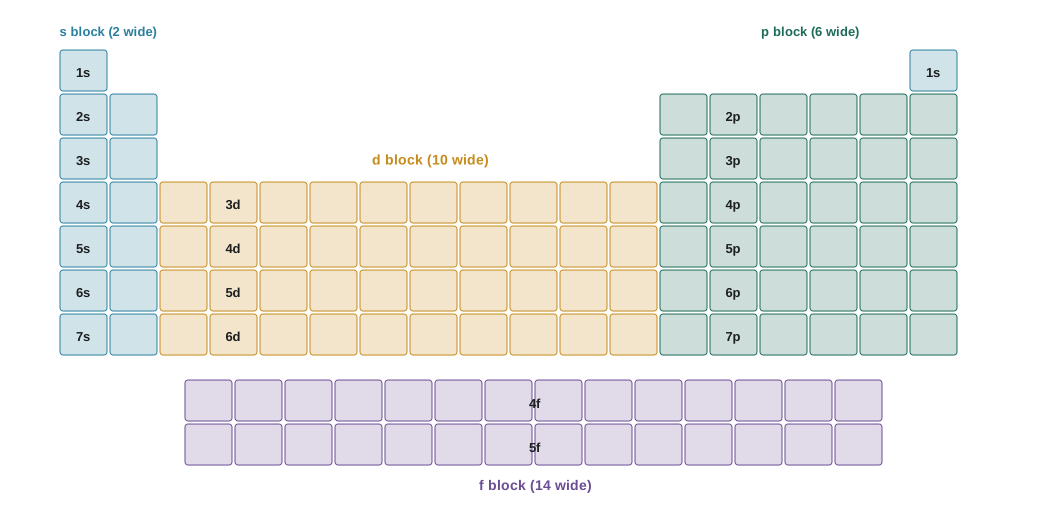
Elements in the same group have the same number and type of valence electrons, which is why they behave alike. All the alkali metals end in ns¹, so all lose one electron readily and react vigorously with water. All the halogens end in ns² np⁵, one electron short of a noble-gas configuration, so all gain an electron readily. The noble gases have filled ns² np⁶ shells (1s² for helium) and are very unreactive. Mendeleev built his table from chemical behaviour without knowing anything about electrons; quantum mechanics explained, half a century later, why his arrangement works.
Worked problem
Reading a configuration from the table
Without writing out every subshell, give the valence configuration of selenium (period 4, group 16) and of strontium (period 5, group 2), and state the number of valence electrons.
Show solution
- Selenium is the fourth element of the 4p block; the preceding noble gas is argon, and the 3d subshell is filled in period 4.
- Configuration: [Ar] 4s² 3d¹⁰ 4p⁴. Valence electrons (4s and 4p): 6.
- Strontium is the second element of the 5s block: [Kr] 5s². Valence electrons: 2.
Answer: Se: [Ar] 4s² 3d¹⁰ 4p⁴, six valence electrons; Sr: [Kr] 5s², two valence electrons.
Common mistakes
MistakeElectrons fill the 3d orbitals before the 4s orbital.
InsteadIn neutral atoms, 4s fills before 3d because it is slightly lower in energy for potassium and calcium.
MistakeTransition metals lose their d electrons first when they form cations.
InsteadThey lose their outermost s electrons first: Fe²⁺ is [Ar] 3d⁶, not [Ar] 4s² 3d⁴.
MistakeTwo electrons in the same orbital can have the same spin.
InsteadThe Pauli principle requires opposite spins for two electrons in one orbital.
MistakeThe three 2p electrons in nitrogen pair up in one orbital.
InsteadHund’s rule places them in separate orbitals with parallel spins.
MistakeChromium is [Ar] 4s² 3d⁴.
InsteadChromium is an exception: [Ar] 4s¹ 3d⁵, with a half-filled d subshell.
Summary and key terms
- In many-electron atoms, shielding and penetration make subshell energies rise in the order s < p < d < f within a shell.
- The Pauli exclusion principle limits each orbital to two electrons of opposite spin.
- The aufbau principle fills the lowest-energy orbitals first, in the order read from the periodic table.
- Hund’s rule spreads electrons singly with parallel spins across orbitals of equal energy.
- Chromium and copper are exceptions, favouring half-filled and filled d subshells.
- Transition metals lose their outermost s electrons first when forming cations; unpaired electrons cause paramagnetism.
- The s, p, d and f blocks of the periodic table correspond to the subshells being filled; groups share valence configurations.
- effective nuclear charge
- The net positive charge felt by an electron after shielding by other electrons.
- shielding
- The reduction of nuclear attraction on an electron by other electrons.
- penetration
- The ability of an electron in a given orbital to approach the nucleus closely.
- Pauli exclusion principle
- No two electrons in an atom can have the same four quantum numbers.
- aufbau principle
- Electrons occupy the lowest-energy available orbitals.
- Hund’s rule
- Electrons occupy orbitals of equal energy singly with parallel spins before pairing.
- valence electrons
- Electrons in the outermost shell, involved in bonding.
- isoelectronic
- Having the same electron configuration.
- paramagnetic
- Attracted into a magnetic field because of unpaired electrons.
- diamagnetic
- Having all electrons paired, and weakly repelled by a magnetic field.
Practice problems
Work each problem on paper first, then reveal the answer to check.
Write the configuration of phosphorus.
Show answer
1s² 2s² 2p⁶ 3s² 3p³, or [Ne] 3s² 3p³.
How many unpaired electrons does oxygen have?
Show answer
Two (2p⁴: ↑↓ ↑ ↑).
Write the noble-gas configuration of zinc.
Show answer
[Ar] 4s² 3d¹⁰.
Write the configuration of Co³⁺.
Show answer
Co is [Ar] 4s² 3d⁷; Co³⁺ is [Ar] 3d⁶.
Which ions are isoelectronic with argon: K⁺, Ca²⁺, Cl⁻, Na⁺?
Show answer
K⁺, Ca²⁺ and Cl⁻.
Is Ti²⁺ paramagnetic or diamagnetic?
Show answer
Ti²⁺ is [Ar] 3d², with two unpaired electrons: paramagnetic.
Which element has the configuration [Kr] 5s² 4d¹⁰ 5p²?
Show answer
Tin (Sn).
How many electrons can the n = 3 shell hold?
Show answer
18.
Use Slater’s rules to estimate Z_eff for the 3s electron of magnesium.
Show answer
S = 1(0.35) + 8(0.85) + 2(1.00) = 9.15; Z_eff = 12 − 9.15 = 2.85.
Why do the alkali metals have similar chemistry?
Show answer
They all have one valence electron in an ns¹ configuration.
Lesson quiz · 5 questions
Score 60% or more to complete this lesson.
Create a free account to save your progress, take quizzes and earn a certificate.