
CHEM-101 · Lesson 11 of 12 · 35 min
Gases
Gases are the simplest state of matter to describe mathematically. Whatever their chemical identity, nearly all gases at ordinary conditions obey the same simple relationships between pressure, volume, temperature and amount. This lesson develops those gas laws, uses them in stoichiometry, explains them with the kinetic molecular theory, and finally shows when and why real gases depart from ideal behaviour. CHEM-103 covers gas laws from an engineering standpoint; here the emphasis is on the molecular explanation.
Pressure
Pressure is force per unit area. Gas molecules constantly collide with the walls of their container, and the force of those collisions spread over the wall's area is the gas pressure. The SI unit is the pascal (Pa = N/m²), a small unit; atmospheric pressure at sea level is about 101 kPa. Several older units remain in use. One standard atmosphere (atm) is exactly 101,325 Pa; the torr (or mm Hg), the pressure that supports a 1 mm column of mercury, is 1/760 atm; the bar is exactly 100 kPa. Tire pressures are given in kilopascals in Canada, often alongside pounds per square inch, and in psi in the United States; 1 atm is about 14.7 psi.
| Unit | Equivalent to 1 atm | Where it is used |
|---|---|---|
| pascal (Pa), kilopascal (kPa) | 101,325 Pa = 101.325 kPa | SI; Canadian weather reports and tire pressures |
| bar | 1.01325 bar | Meteorology, industry, scuba diving |
| torr or mm Hg | 760 torr | Vacuum work, blood pressure (mm Hg) |
| pounds per square inch (psi) | 14.696 psi | US tire pressures and engineering |
| inches of mercury (in Hg) | 29.92 in Hg | US weather reports and aviation |
A barometer measures atmospheric pressure. Evangelista Torricelli's 1643 design, a glass tube of mercury inverted in a dish, holds a column about 760 mm high at sea level. Atmospheric pressure falls with altitude: it is about 89 kPa in Calgary (1,045 m) and about 83 kPa in Denver (1,609 m), which is why water boils at about 95 °C in Denver and why baking recipes are adjusted at altitude.
The simple gas laws
Four variables describe a gas sample: pressure P, volume V, temperature T and amount n. Experiments in the seventeenth to nineteenth centuries found how each pair is related when the others are held constant.
| Law | Relationship | Held constant | Mathematical form |
|---|---|---|---|
| Boyle’s law (1662) | Volume is inversely proportional to pressure | n, T | P₁V₁ = P₂V₂ |
| Charles’s law (1787) | Volume is proportional to absolute temperature | n, P | V₁/T₁ = V₂/T₂ |
| Gay-Lussac’s law (1802) | Pressure is proportional to absolute temperature | n, V | P₁/T₁ = P₂/T₂ |
| Avogadro’s law (1811) | Volume is proportional to amount | P, T | V₁/n₁ = V₂/n₂ |
Charles's law has a remarkable consequence. Plotting volume against Celsius temperature for any gas gives a straight line, and extending the lines for different gases shows that they all reach zero volume at the same temperature, −273.15 °C. That temperature is absolute zero, the basis of the Kelvin scale. All gas-law calculations must use kelvins.
The ideal gas law
Combining the simple laws gives a single equation that relates all four variables:
R is the gas constant. Choose the value whose units match the data: with pressure in kPa and volume in L, R = 8.314 L·kPa/(mol·K), numerically the same as the SI value. A gas that obeys this equation exactly is an ideal gas. No real gas is perfectly ideal, but most gases come close at moderate pressures and temperatures well above their boiling points.
Standard conditions for gases need care, because two definitions are in use. IUPAC's standard temperature and pressure (STP) is 273.15 K (0 °C) and 100 kPa, at which one mole of an ideal gas occupies 22.71 L. Many textbooks, especially in the United States, still use the older definition of 0 °C and 1 atm, giving 22.41 L. Always state which conditions you mean.
Worked problem
Using the ideal gas law
A 50.0 L steel cylinder holds argon at 15.0 MPa and 20 °C. How many moles and what mass of argon does it contain?
Show solution
- Convert units: P = 15.0 MPa = 1.50 × 10⁴ kPa; T = 293 K.
- n = PV/RT = (1.50 × 10⁴ kPa)(50.0 L) / [(8.314 L·kPa/mol·K)(293 K)] = 308 mol.
- Mass = 308 mol × 39.95 g/mol = 1.23 × 10⁴ g = 12.3 kg.
Answer: About 308 mol, or 12.3 kg, of argon. (At such high pressure real gases deviate somewhat from ideal behaviour, so this is an estimate.)
When conditions change for a fixed amount of gas, the combined gas law, P₁V₁/T₁ = P₂V₂/T₂, is often the quickest route.
Worked problem
A weather balloon
A weather balloon is filled with 4.00 m³ of helium at 101 kPa and 15 °C. What is its volume at an altitude where the pressure is 30.0 kPa and the temperature −45 °C?
Show solution
- T₁ = 288 K, T₂ = 228 K.
- V₂ = V₁ × (P₁/P₂) × (T₂/T₁) = 4.00 m³ × (101/30.0) × (228/288).
- = 4.00 × 3.367 × 0.7917 = 10.7 m³.
Answer: About 10.7 m³. The drop in pressure expands the balloon far more than the cold shrinks it. Environment and Climate Change Canada and the US National Weather Service launch such balloons twice a day from dozens of stations.
Molar mass and density of gases
Because n = m/M, the ideal gas law can be rearranged to relate gas density to molar mass: d = m/V = PM/RT. Gas density therefore increases with molar mass and pressure and decreases with temperature. This explains why hot-air balloons rise, why carbon dioxide (M = 44 g/mol) settles in low places while helium (4 g/mol) floats away, and how chemists determine the molar mass of an unknown volatile liquid by weighing a known volume of its vapour.
R = 8.314   # L kPa / (mol K)

def gas_density(M, P_kPa=101.325, T=298.15):
    return P_kPa * M / (R * T)        # g/L

for name, M in [("helium", 4.003), ("methane", 16.04), ("nitrogen", 28.01),
                ("air (average)", 28.96), ("carbon dioxide", 44.01), ("propane", 44.10)]:
    d = gas_density(M)
    air = gas_density(28.96)
    verdict = "same as air" if abs(d - air) < 1e-9 else ("lighter than air" if d < air else "heavier than air")
    print(f"{name:15s} M = {M:6.2f} g/mol  density at 25 C, 1 atm = {d:5.3f} g/L  ({verdict})")

# molar mass of an unknown substance in the gas phase: 1.00 L at 100 C and 101.3 kPa has mass 2.55 g
M_unknown = 2.55 * R * 373.15 / (101.3 * 1.00)
print(f"molar mass of unknown gas: {M_unknown:.1f} g/mol")helium M = 4.00 g/mol density at 25 C, 1 atm = 0.164 g/L (lighter than air) methane M = 16.04 g/mol density at 25 C, 1 atm = 0.656 g/L (lighter than air) nitrogen M = 28.01 g/mol density at 25 C, 1 atm = 1.145 g/L (lighter than air) air (average) M = 28.96 g/mol density at 25 C, 1 atm = 1.184 g/L (same as air) carbon dioxide M = 44.01 g/mol density at 25 C, 1 atm = 1.799 g/L (heavier than air) propane M = 44.10 g/mol density at 25 C, 1 atm = 1.803 g/L (heavier than air) molar mass of unknown gas: 78.1 g/mol
Propane being denser than air is a safety point: leaked propane pools in basements and boat bilges, so propane appliances are not allowed in some enclosed spaces, whereas natural gas (mostly methane) rises and disperses.
Gas stoichiometry
The ideal gas law turns gas volumes into moles, so it slots into the stoichiometry chain of lesson 5. Automobile airbags provide a classic example: older designs inflated by rapidly decomposing sodium azide, 2 NaN₃(s) → 2 Na(s) + 3 N₂(g). (Modern airbags use less toxic propellants, but the calculation is the same.)
Worked problem
Inflating an airbag
What mass of sodium azide (65.01 g/mol) is needed to fill a 60.0 L airbag with nitrogen at 125 kPa and 25 °C?
Show solution
- Moles of N₂: n = PV/RT = (125 kPa)(60.0 L)/[(8.314)(298 K)] = 3.03 mol.
- Moles of NaN₃: 3.03 mol N₂ × (2 mol NaN₃ / 3 mol N₂) = 2.02 mol.
- Mass: 2.02 mol × 65.01 g/mol = 131 g.
Answer: About 131 g of sodium azide.
Gay-Lussac also found that, at the same temperature and pressure, volumes of reacting gases are in small whole-number ratios, the law of combining volumes. It follows from Avogadro's law: equal volumes contain equal numbers of moles, so volume ratios equal mole ratios. Two volumes of hydrogen combine with one volume of oxygen to give two volumes of water vapour.
Mixtures of gases: Dalton's law
In a mixture of gases that do not react, each gas behaves independently and exerts the pressure it would exert if it were alone. That pressure is its partial pressure, and the total pressure is their sum (Dalton's law of partial pressures, 1801). The partial pressure of each gas equals its mole fraction, χ, times the total pressure.
Dry air is 78.1 % N₂, 20.9 % O₂ and 0.93 % Ar by moles, with about 0.04 % CO₂ (about 420 ppm and rising). At sea level the partial pressure of oxygen is therefore about 21 kPa; in Denver it is about 17 kPa, which is why visitors notice the thinner air. Scuba divers must manage partial pressures carefully: at 40 m depth the total pressure is about 5 atm, and breathing air there gives a nitrogen partial pressure high enough to cause nitrogen narcosis, while oxygen itself becomes toxic above a partial pressure of about 1.4–1.6 atm.
Gases collected over water, a common laboratory technique, are mixed with water vapour. The pressure of the dry gas is the total pressure minus the vapour pressure of water at that temperature (3.17 kPa at 25 °C).
Worked problem
Collecting hydrogen over water
Zinc reacts with hydrochloric acid, and 0.250 L of hydrogen is collected over water at 25 °C and a total pressure of 100.8 kPa. How many moles of H₂ were produced?
Show solution
- P(H₂) = 100.8 − 3.17 = 97.6 kPa.
- n = PV/RT = (97.6)(0.250)/[(8.314)(298.15)] = 9.85 × 10⁻³ mol.
Answer: 9.85 × 10⁻³ mol of H₂ (and so 9.85 × 10⁻³ mol of zinc reacted).
The kinetic molecular theory
Why do all gases obey the same laws? The kinetic molecular theory, developed by Rudolf Clausius, James Clerk Maxwell and Ludwig Boltzmann in the nineteenth century, explains gas behaviour with a simple model. A gas consists of a huge number of molecules in constant, random motion. The molecules themselves occupy a negligible fraction of the container's volume. They exert no forces on one another except during collisions, which are perfectly elastic. And the average kinetic energy of the molecules is proportional to the absolute temperature.
From these assumptions, applying Newton's laws to molecules striking a wall gives PV = ⅓ Nmū², where ū² is the mean-square speed. Combined with the link between kinetic energy and temperature, this reproduces the ideal gas law. Each gas law has a molecular explanation: compressing a gas (Boyle) makes molecules hit the walls more often; heating it (Gay-Lussac) makes them hit harder and more often; adding molecules (Avogadro) increases the number of collisions.
The theory also predicts how fast molecules move. The root-mean-square speed, a kind of average, depends on temperature and molar mass (in kg/mol):
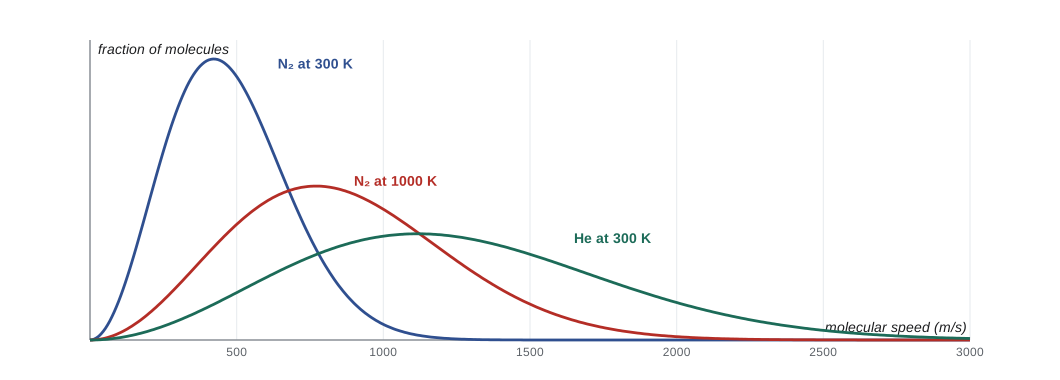
Molecules in a gas have a spread of speeds, described by the Maxwell–Boltzmann distribution. Higher temperatures shift the distribution to higher speeds and broaden it; lighter molecules move faster on average than heavier ones at the same temperature.
import numpy as np
R = 8.314   # J/(mol K)

def u_rms(M_kg, T):
    return np.sqrt(3 * R * T / M_kg)

for name, M in [("H2", 0.002016), ("He", 0.004003), ("N2", 0.02801), ("O2", 0.03200), ("CO2", 0.04401)]:
    print(f"{name:4s} u_rms at 25 C = {u_rms(M, 298.15):6.0f} m/s")

# Sample molecular speeds of N2 at 298 K from the Maxwell-Boltzmann distribution
rng = np.random.default_rng(101)
kT_over_m = R * 298.15 / 0.02801
v = np.linalg.norm(rng.normal(0, np.sqrt(kT_over_m), size=(200_000, 3)), axis=1)
print(f"N2 sample: mean speed {v.mean():.0f} m/s, most molecules between "
f"{np.percentile(v, 10):.0f} and {np.percentile(v, 90):.0f} m/s")H2 u_rms at 25 C = 1921 m/s He u_rms at 25 C = 1363 m/s N2 u_rms at 25 C = 515 m/s O2 u_rms at 25 C = 482 m/s CO2 u_rms at 25 C = 411 m/s N2 sample: mean speed 475 m/s, most molecules between 228 and 743 m/s
Nitrogen molecules in room-temperature air move at about 500 m/s, faster than a jet airliner, yet a smell takes time to cross a room because each molecule collides with others billions of times a second and follows a zigzag path. Hydrogen and helium molecules move fast enough that a small fraction exceed Earth's escape velocity at the top of the atmosphere, which is one reason Earth's atmosphere holds very little of either.
Effusion and diffusion
Effusion is the escape of gas molecules through a tiny hole into a vacuum; diffusion is the gradual mixing of one gas through another. Thomas Graham found in 1846 that the rate of effusion is inversely proportional to the square root of molar mass, as the kinetic theory predicts:
Helium balloons deflate faster than air-filled ones because helium atoms effuse through tiny pores in the rubber about 2.7 times faster than nitrogen and oxygen molecules. Graham's law was put to massive industrial use in the 1940s, when gaseous uranium hexafluoride was forced through porous barriers thousands of times to separate ²³⁵UF₆ from ²³⁸UF₆; their effusion rates differ by only 0.4 %. Modern enrichment uses gas centrifuges instead. CANDU reactors, as lesson 2 noted, avoid the need for enriched fuel altogether.
Real gases
The ideal gas law ignores two things: molecules have finite size, and they attract each other. Both matter when molecules are close together, at high pressures and low temperatures. At high pressure, the volume of the molecules themselves becomes a significant fraction of the container volume, so the real volume is larger than ideal. At low temperature, attractions pull molecules together and reduce the force of their collisions with the walls, so the real pressure is lower than ideal. Johannes van der Waals corrected the ideal gas law for both effects in 1873:
The constant a reflects intermolecular attraction and b the volume of the molecules. Gases with stronger attractions, such as water vapour and ammonia, have larger a values. The compressibility factor Z = PV/nRT measures deviation from ideality: Z = 1 for an ideal gas.
R = 0.08206   # L atm / (mol K)
GASES = {   # van der Waals constants: a (L^2 atm / mol^2), b (L/mol)
    "He":  (0.0346, 0.0238),
    "N2":  (1.370, 0.0387),
    "CO2": (3.658, 0.0429),
}
n, T = 1.00, 300.0
for V in (22.0, 1.00, 0.20):
    ideal = n * R * T / V
    row = f"V = {V:5.2f} L: ideal P = {ideal:7.1f} atm"
    for gas, (a, b) in GASES.items():
        P = n * R * T / (V - n * b) - a * n**2 / V**2
        row += f" | {gas} {P:7.1f}"
print(row)V = 22.00 L: ideal P = 1.1 atm | He 1.1 | N2 1.1 | CO2 1.1 V = 1.00 L: ideal P = 24.6 atm | He 25.2 | N2 24.2 | CO2 22.1 V = 0.20 L: ideal P = 123.1 atm | He 138.9 | N2 118.4 | CO2 65.3
At 22 L, near ordinary conditions, all three gases behave almost ideally. Squeezed into 0.20 L, helium's pressure exceeds the ideal value because the volume of its atoms matters more than its very weak attractions, while carbon dioxide's pressure falls far below the ideal value because its molecules attract each other strongly. Attractions like these are what allow gases to condense into liquids, the subject of lesson 12.
Common mistakes
MistakeGas law calculations can use degrees Celsius.
InsteadTemperature must be in kelvins; Celsius values give wrong answers and can even be zero or negative.
MistakeOne mole of any gas always occupies 22.4 L.
InsteadOnly at 0 °C and 1 atm (22.41 L); at IUPAC STP (100 kPa) it is 22.71 L, and at room temperature about 24.5 L.
MistakeThe partial pressure of a gas depends on its molar mass.
InsteadPartial pressure depends on the mole fraction, not the identity, of the gas.
MistakeAt the same temperature, heavier gas molecules have greater average kinetic energy.
InsteadAll gases at the same temperature have the same average kinetic energy; heavier molecules simply move more slowly.
MistakeReal gases deviate from ideal behaviour most at high temperature and low pressure.
InsteadDeviations are greatest at high pressure and low temperature, where molecules are close together.
Summary and key terms
- Pressure is force per area; 1 atm = 101.325 kPa = 760 torr ≈ 14.7 psi.
- Boyle’s, Charles’s, Gay-Lussac’s and Avogadro’s laws combine into the ideal gas law, PV = nRT, with T in kelvins.
- Gas density, d = PM/RT, rises with molar mass; the ideal gas law converts gas volumes to moles for stoichiometry.
- Dalton’s law: total pressure is the sum of partial pressures, each equal to mole fraction times total pressure.
- The kinetic molecular theory explains the gas laws; u_rms = √(3RT/M), and speeds follow the Maxwell–Boltzmann distribution.
- Graham’s law: effusion rates are inversely proportional to the square root of molar mass.
- Real gases deviate from ideality at high pressure and low temperature; the van der Waals equation corrects for molecular volume and attraction.
- pressure
- Force per unit area.
- absolute zero
- The lowest possible temperature, 0 K or −273.15 °C.
- ideal gas
- A hypothetical gas that obeys PV = nRT exactly.
- gas constant
- The proportionality constant R in the ideal gas law.
- standard temperature and pressure
- Reference conditions for gases; IUPAC uses 0 °C and 100 kPa.
- partial pressure
- The pressure a gas in a mixture would exert if it were alone in the container.
- mole fraction
- The moles of one component divided by the total moles in a mixture.
- kinetic molecular theory
- A model explaining gas behaviour in terms of moving molecules.
- effusion
- The escape of gas molecules through a tiny opening into a vacuum.
- compressibility factor
- Z = PV/nRT, a measure of deviation from ideal gas behaviour.
Practice problems
Work each problem on paper first, then reveal the answer to check.
Convert 745 torr to kPa and atm.
Show answer
99.3 kPa; 0.980 atm.
A gas occupies 2.50 L at 100 kPa. What is its volume at 250 kPa (same T and n)?
Show answer
1.00 L.
A balloon holds 3.0 L at 25 °C. What is its volume at −20 °C (same P)?
Show answer
3.0 × 253/298 = 2.5 L.
How many moles of gas are in 5.00 L at 200 kPa and 27 °C?
Show answer
n = (200)(5.00)/(8.314 × 300) = 0.401 mol.
What is the density of oxygen at 0 °C and 100 kPa?
Show answer
d = (100)(32.00)/(8.314 × 273.15) = 1.41 g/L.
A 2.00 L flask contains 0.200 mol N₂ and 0.100 mol O₂ at 300 K. Find the total and partial pressures.
Show answer
P_total = 0.300 × 8.314 × 300/2.00 = 374 kPa; P(N₂) = 249 kPa, P(O₂) = 125 kPa.
Calculate u_rms for He at 300 K.
Show answer
√(3 × 8.314 × 300/0.004003) = 1.37 × 10³ m/s.
How much faster does H₂ effuse than O₂?
Show answer
√(32.00/2.016) = 3.98 times faster.
What volume of CO₂ at 25 °C and 101.3 kPa forms when 10.0 g of CaCO₃ decomposes?
Show answer
0.0999 mol × 8.314 × 298/101.3 = 2.44 L.
Why does ammonia deviate more from ideal behaviour than helium?
Show answer
Ammonia molecules attract each other much more strongly (hydrogen bonding), so the a correction is larger.
Lesson quiz · 5 questions
Score 60% or more to complete this lesson.
Create a free account to save your progress, take quizzes and earn a certificate.