
CHE-350 · Lesson 9 of 12 · 20 min
Liquid-liquid extraction
The ester line's decanter already uses liquid-liquid equilibrium: the condensed overhead splits into an ester-rich layer and a water-rich layer. During a design review, a contractor suggests going further. Instead of distilling the ester-rich layer in a final column, why not wash the ethanol out of it with water in a small extraction column, which needs no reboiler steam? Ingrid asks Theo to evaluate the idea properly. It is a good excuse to learn liquid-liquid extraction: how to represent three-component liquid systems, how to count extraction stages, and how to size the equipment that lets two liquids separate.
When extraction is the right tool
Extraction moves a solute from one liquid, the feed or raffinate phase, into a second, partly immiscible liquid, the solvent or extract phase. It is used when distillation is impossible or expensive: when the components have close boiling points or form azeotropes, when the solute is heat-sensitive, as with antibiotics and food flavours, or when the solute is a small amount of a heavy component in a large amount of a light one, so that distillation would boil the whole feed to recover it. Phenol recovery from wastewater, caprolactam purification, aromatics extraction in refineries and acetic acid recovery from dilute water are classic examples. Its weakness is that the solvent must then be recovered, usually by distillation, so extraction rarely removes distillation from a flowsheet; it changes what is distilled.
Ternary diagrams and the lever rule
Three-component liquid systems are shown on triangular diagrams. Each corner is a pure component; each point inside represents a mixture whose mass fractions are its distances from the opposite sides. A curve called the binodal separates the region where one liquid phase forms from the two-phase region, and tie lines inside the two-phase region join the compositions of the two liquids in equilibrium. The tie lines are found by experiment or from a model such as NRTL or UNIQUAC fitted to liquid-liquid data.
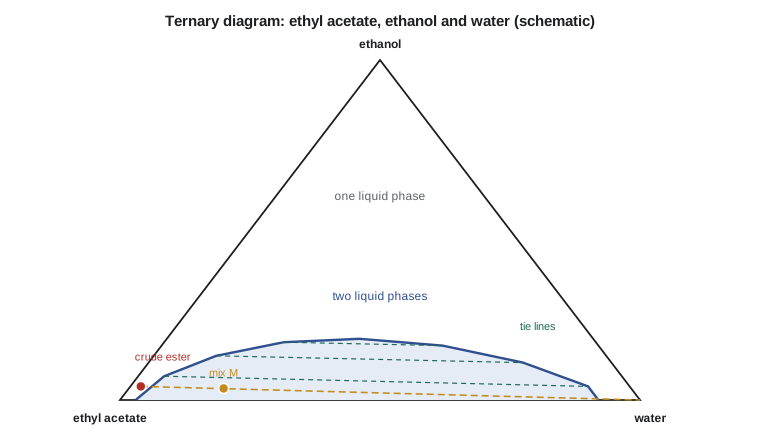
Mixing two streams gives a point on the straight line joining them, located by the lever rule: the mixture divides the line in the inverse ratio of the masses. The program mixes 2,500 kg/h of crude ester (94 wt % ester, 4 % ethanol, 2 % water) with 500 kg/h of water. The mixture lies one-sixth of the way along the line from the crude ester toward the water corner, at 78.3 % ester, 3.3 % ethanol and 18.3 % water, inside the two-phase region. It separates into two layers whose compositions lie on the tie line through the mixture point, and the lever rule gives their masses.
Distribution ratio and extraction factor
For design, the key property is how a solute divides between the two liquids, the distribution ratio \(K_D\), the solute's concentration in the extract divided by that in the raffinate. Using mass ratios on a solute-free basis, \(Y = K_D X\), with \(Y\) kg of solute per kg of solvent and \(X\) kg per kg of feed carrier. If the two carrier liquids are nearly immiscible, the extraction factor plays the role of the absorption factor:
where \(S\) is the solvent flow and \(F'\) the feed carrier flow, both solute-free. The Kremser equation of lesson 8 then applies directly to a countercurrent cascade: the fraction of solute left in the raffinate after \(N\) stages is \((E - 1)/(E^{N+1} - 1)\). For a crosscurrent cascade, where fresh solvent is split equally among \(n\) stages, the fraction left is \(\big(1/(1 + E/n)\big)^n\), which can never fall below \(e^{-E}\) however many stages are used.
For ethanol between water and ethyl acetate, Theo uses an illustrative \(K_D\) of 1.4 on a mass-ratio basis: ethanol slightly prefers the water phase. The target is to cut the ethanol from 4.0 wt % to 0.4 wt % of the washed ester.
# Washing ethanol out of crude ethyl acetate with water: stage calculations and settler sizing
import math
# 1) lever rule: mixing crude ester with wash water on a ternary diagram (mass fractions ester, ethanol, water)
crude = (0.940, 0.040, 0.020); Fc = 2500.0     # kg/h
wash = (0.0, 0.0, 1.0);        Sw = 500.0
M = [(Fc * a + Sw * b) / (Fc + Sw) for a, b in zip(crude, wash)]
print(f"mixing point M: ester {M[0]:.3f}, ethanol {M[1]:.3f}, water {M[2]:.3f}; "
      f"M lies {Sw / (Fc + Sw):.3f} of the way along the line from the crude point to the water point")
# 2) stages with a constant distribution ratio, treating the phases as immiscible on a solute-free basis
KD = 1.4      # (kg ethanol / kg water) / (kg ethanol / kg ester), illustrative
X0 = 0.040 / 0.940                               # kg ethanol per kg ester in the feed
F_es = Fc * 0.940                                # kg/h of ester
target = 0.0040 / 0.996                          # 0.4 wt % ethanol left
for S in (800.0, 2000.0, 3000.0):
    E = KD * S / F_es
    # countercurrent (Kremser): fraction left = (E - 1) / (E**(N+1) - 1)
    left = target / X0
    if E < 1 and left < 1 - E:
        print(f"water {S:4.0f} kg/h: extraction factor {E:.2f} is below 1, so even infinite stages leave {100 * (1 - E):.0f} % of the ethanol")
        continue
    N_cc = math.log((E - 1) / left + 1) / math.log(E) - 1
    # crosscurrent with the same total water split equally over n stages: best possible is exp(-E) left
    n, cc = 1, None
    while n <= 60:
        if (1 / (1 + KD * (S / n) / F_es)) ** n <= left: cc = n; break
        n += 1
    cross = f"crosscurrent {cc} stages" if cc else f"crosscurrent cannot reach it (best {100 * math.exp(-E):.0f} % left)"
    print(f"water {S:4.0f} kg/h: extraction factor {E:.2f}; countercurrent {N_cc:.1f} stages, {cross}")
# 3) ester lost by dissolving in the wash water (solubility about 8 wt % at 25 C)
S = 2000.0
loss = S * 0.08 / (1 - 0.08)
print(f"ester dissolved in {S:.0f} kg/h of wash water: about {loss:.0f} kg/h ({100 * loss / F_es:.1f} % of the product)")
# 4) settling: Stokes velocity of water droplets falling through the ester layer, and settler area
g, d, drho, mu = 9.81, 150e-6, 1000.0 - 895.0, 0.45e-3    # m, kg/m3, Pa s (ester continuous)
v = g * d ** 2 * drho / (18 * mu)
Q = (Fc - 60) / 895.0 / 3600                              # m3/s of the ester phase rising
A = Q / v
print(f"Stokes settling velocity for {d * 1e6:.0f} micron drops: {v * 1000:.2f} mm/s; settler area needed about {A:.2f} m2")
print(f"with a factor of 2 for turbulence and short-circuiting: {2 * A:.2f} m2, e.g. a horizontal drum {math.sqrt(2 * A / 3):.2f} m wide by {3 * math.sqrt(2 * A / 3):.2f} m long")mixing point M: ester 0.783, ethanol 0.033, water 0.183; M lies 0.167 of the way along the line from the crude point to the water point water 800 kg/h: extraction factor 0.48 is below 1, so even infinite stages leave 52 % of the ethanol water 2000 kg/h: extraction factor 1.19; countercurrent 5.3 stages, crosscurrent cannot reach it (best 30 % left) water 3000 kg/h: extraction factor 1.79; countercurrent 2.8 stages, crosscurrent cannot reach it (best 17 % left) ester dissolved in 2000 kg/h of wash water: about 174 kg/h (7.4 % of the product) Stokes settling velocity for 150 micron drops: 2.86 mm/s; settler area needed about 0.26 m2 with a factor of 2 for turbulence and short-circuiting: 0.53 m2, e.g. a horizontal drum 0.42 m wide by 1.26 m long
Why the wash fails
The answer is clear. With 800 kg/h of water, the extraction factor is only 0.48: below 1, so even an infinite countercurrent cascade leaves more than half the ethanol in the ester. With 2,000 kg/h, \(E = 1.19\) and 5.3 countercurrent stages would meet the target; with 3,000 kg/h, \(E = 1.79\) and 2.8 stages would do. A crosscurrent wash, the simple approach of washing in a tank several times with fresh water, cannot reach the target at all with those amounts of water: its best possible result leaves 30 % or 17 % of the ethanol.
The fatal problem is the solubility of the ester in water, about 8 wt % at 25 °C. With 2,000 kg/h of wash water, about 174 kg/h of ester dissolves in it, 7.4 % of the product. Recovering that ester means stripping the wash water, which takes steam, and the wash water with its ethanol and ester would then need distilling as well. The extraction has not removed a distillation step; it has added a stripping step and enlarged the decanter loop. Theo's note to the design review: extraction with water is unsuitable here because the solute's distribution ratio is close to 1 and the product is appreciably soluble in the solvent. The ester column stays.
Worked problem
Is the target reachable?
With \(K_D = 1.4\) and 2,350 kg/h of ester carrier, what minimum water rate makes the 90 % ethanol removal possible in a countercurrent cascade?
Show solution
- A countercurrent cascade can approach complete removal only if \(E > 1\); with \(E < 1\) at least \(1 - E\) remains.
- For 90 % removal, \(1 - E\) must be below 0.10 if \(E < 1\), so \(E > 0.90\) at the very least.
- \(E = K_D S/F' = 1.4 S/2350 > 0.90\) gives \(S > 1510\) kg/h.
- In practice \(E\) of 1.2 to 2 is used, or 2,000 to 3,400 kg/h.
Answer: At least about 1,500 kg/h, and realistically 2,000 kg/h or more: far more water than ethanol.
Graphical stage methods
When the carriers are partly miscible or \(K_D\) changes with concentration, the Kremser equation is no longer accurate. The Hunter-Nash method, published in 1934, steps off countercurrent stages directly on the ternary diagram. A difference point, found where the lines through the two ends of the cascade intersect, plays the role of the operating line, and stages alternate between tie lines and lines through the difference point. The method is the extraction equivalent of McCabe-Thiele and has the same strengths: it shows minimum solvent rate, where a tie line passes through the difference point, and it shows at a glance whether a specification is feasible. Simulators now do the same stepping with an activity coefficient model.
Extraction equipment
Extractors must mix the two liquids to transfer mass and then separate them again. Mixer-settlers do the two steps in separate vessels for each stage; they are robust and easy to scale up, and they handle high throughputs, as in hydrometallurgy, but they take floor space and hold large inventories of solvent. Columns stack the stages vertically. Unagitated spray and packed columns are cheap but give few stages; sieve-tray columns are better; agitated columns, with rotating discs or reciprocating plates, give the most stages per metre. Centrifugal extractors separate phases in seconds for unstable products such as pharmaceuticals.
Settling: the decanter and Stokes' law
Whatever the contactor, the two liquids must separate, and that is often the size-determining step. Droplets of one phase settle through the other at the Stokes velocity,
where \(d\) is the drop diameter, \(\Delta\rho\) the density difference and \(\mu\) the viscosity of the continuous phase. For 150 µm water drops falling through ethyl acetate, with a density difference of about 105 kg/m³ and a viscosity of 0.45 mPa·s, the velocity is 2.9 mm/s. The settler must give the continuous phase an upward velocity smaller than that, so the area is the continuous-phase flow divided by the settling velocity: 0.26 m² for the 2,440 kg/h ester layer. Doubling it to allow for turbulence and short-circuiting gives 0.53 m², for instance a horizontal drum about 0.4 m wide and 1.3 m long at the interface. Small drops settle far more slowly, since \(v\) depends on \(d^2\), so poor mixing that makes fine drops, or surfactants that stabilise them, can overwhelm a settler; that is why the decanter on the ester line has a coalescing pad.
Common mistakes
MistakeChoosing a solvent without checking the product's solubility in it.
InsteadProduct dissolved in the solvent is lost or must be recovered.
MistakeAssuming more crosscurrent washes always reach the target.
InsteadWith fixed total solvent, crosscurrent removal cannot exceed \(1 - e^{-E}\).
MistakeDesigning an extractor with \(E\) below 1 for high removal.
InsteadCountercurrent extraction needs \(E > 1\) to approach complete removal.
MistakeSizing a settler for the average drop.
InsteadSize for the small drops; settling velocity falls with the square of the diameter.
Summary and key terms
- Ternary diagrams show the one- and two-phase regions; the lever rule locates mixtures.
- For nearly immiscible carriers, the extraction factor \(E = K_D S/F'\) and the Kremser equation give the stages.
- Washing ethanol from crude ester needs \(E > 1\), at least about 1,500 kg/h of water, and loses about 7 % of the ester.
- Crosscurrent washing cannot match countercurrent extraction with the same solvent.
- Settlers are sized from Stokes' law; the ester-layer settler needs about 0.5 m² with allowances.
- Raffinate
- The phase from which the solute is extracted.
- Extract
- The solvent-rich phase that receives the solute.
- Binodal curve
- The boundary between one-phase and two-phase regions on a ternary diagram.
- Tie line
- A line joining two liquid phases in equilibrium.
- Distribution ratio
- Solute concentration in the extract divided by that in the raffinate.
- Extraction factor
- K_D S/F′, the extraction analogue of the absorption factor.
Practice problems
Work each problem on paper first, then reveal the answer to check.
Mix 1,000 kg of a 20 % solute feed with 250 kg of pure solvent. What is the solute fraction of the mixture?
Show answer
\(200/1250 = 0.16\).
With \(E = 2\), what fraction remains after three countercurrent stages?
Show answer
\((2 - 1)/(2^4 - 1) = 1/15 = 6.7\) %.
With \(E = 2\) split over many crosscurrent stages, what is the best possible fraction left?
Show answer
\(e^{-2} = 13.5\) %.
Halving the drop diameter changes the Stokes velocity by what factor?
Show answer
One-quarter.
Why can extraction rarely eliminate distillation from a flowsheet?
Show answer
The solvent must usually be recovered, often by distillation.
Name a case where extraction beats distillation.
Show answer
Recovering acetic acid from dilute water, or heat-sensitive products such as antibiotics.
Lesson quiz · 5 questions
Score 60% or more to complete this lesson.
Create a free account to save your progress, take quizzes and earn a certificate.