
CHE-350 · Lesson 3 of 12 · 21 min
Binary distillation design: efficiency, duties and column variations
Seventeen equilibrium stages is an answer about thermodynamics, not about hardware. A real tray does not bring the gas and liquid on it to equilibrium: the gas bubbles through the liquid for a fraction of a second, and only part of the possible transfer happens. To turn the McCabe-Thiele answer into a column that can be bought, Theo needs tray efficiencies, the heat duties of the condenser and reboiler, and decisions about details such as the condenser type and any side draws. Ingrid also wants an energy figure for the design basis: how much steam per kilogram of ethanol recovered.
Murphree efficiency
The most widely used tray efficiency compares the change in gas composition across a real tray with the change on an ideal one. The Murphree vapour efficiency is
where \(y_{n+1}\) is the gas entering tray \(n\) from below, \(y_n\) is the gas actually leaving, and \(y_n^{*}\) is the gas that would be in equilibrium with the liquid leaving the tray. An efficiency of 0.7 means the gas makes 70 % of the composition change that an ideal stage would give. On a McCabe-Thiele diagram the efficiency is applied by drawing a pseudo-equilibrium curve that lies the fraction \(E_{MV}\) of the vertical distance from the operating line to the true curve, and stepping off against it. The steps are then actual trays.
Murphree efficiencies depend on the tray design, the flows, and the physical properties of the mixture. For aqueous alcohol systems on well-designed sieve or valve trays, values from about 0.5 to 0.8 are common. They can also be greater than 1 locally on large trays, because the liquid changes composition as it flows across the tray, so different parts of the gas see different liquid.
Overall efficiency and the O'Connell correlation
For a first estimate, designers often use a single overall efficiency \(E_O\), the ratio of equilibrium stages to real trays. The O'Connell correlation, built from plant data on bubble-cap columns in the 1940s and still used for screening, relates it to the product of the liquid viscosity in mPa·s and the relative volatility of the key components, both at average column conditions:
Viscous liquids and high relative volatilities both lower the efficiency: viscosity slows transfer in the liquid, and a high \(\alpha\) means each stage asks for a larger composition change. The correlation is only a guide, with scatter of 10 to 20 percentage points, and modern trays often do better. Vendors give their own estimates for their hardware.
# Column design details for the rectifier: tray efficiency, real trays and heat duties
import math
# Ethanol (1) - water (2) at 1 atm: Antoine (mmHg, deg C) and van Laar constants fitted in CHE-320
ANT = {'ethanol': (8.20417, 1642.89, 230.300), 'water': (8.07131, 1730.63, 233.426)}
A12, A21 = 1.672, 0.930
def psat(c, T):  # kPa
    a, b, cc = ANT[c]
    return 10 ** (a - b / (T + cc)) * 0.133322
def gammas(x1):
    x2 = 1 - x1
    d = A12 * x1 + A21 * x2
    return math.exp(A12 * (A21 * x2 / d) ** 2), math.exp(A21 * (A12 * x1 / d) ** 2)
def bubble(x1, P=101.325):
    g1, g2 = gammas(x1)
    lo, hi = -20.0, 250.0
    for _ in range(60):
        T = (lo + hi) / 2
        s = x1 * g1 * psat('ethanol', T) + (1 - x1) * g2 * psat('water', T)
        lo, hi = (T, hi) if s < P else (lo, T)
    y1 = x1 * g1 * psat('ethanol', T) / P
    return T, y1
def y_eq(x): return bubble(x)[1]
def x_eq(y):
    lo, hi = 0.0, 0.894
    for _ in range(50):
        m = (lo + hi) / 2
        lo, hi = (m, hi) if y_eq(m) < y else (lo, m)
    return (lo + hi) / 2
F, zF, xD, xB = 100.0, 0.10, 0.80, 0.0005
D = F * (zF - xB) / (xD - xB); B = F - D
R = 1.59
L, V = R * D, (R + 1) * D
Lb, Vb = L + F, V                      # saturated liquid feed
def op(x):                             # operating line: y entering a tray from below, given x leaving it
    return R / (R + 1) * x + xD / (R + 1) if x > zF else Lb / Vb * x - B * xB / Vb
def trays(E):
    # step down from the top with Murphree efficiency E: y_n = y_(n+1) + E (y*_n - y_(n+1))
    n, x, y = 0, xD, xD
    while x > xB and n < 300:
        # find x leaving this tray so that the tray's actual y matches
        lo, hi = 0.0, x
        for _ in range(50):
            xm = (lo + hi) / 2
            yin = op(xm)
            yout = yin + E * (y_eq(xm) - yin)
            lo, hi = (xm, hi) if yout < y else (lo, xm)
        x = (lo + hi) / 2; y = op(x); n += 1
    return n
for E in (1.0, 0.8, 0.65, 0.5):
    print(f"Murphree efficiency {E:.2f}: {trays(E)} stages")
# O'Connell correlation for overall efficiency (viscosity in mPa s at average column conditions)
alpha_avg, mu = 2.6, 0.32     # illustrative averages for the stripping-dominated column
E0 = 0.492 * (mu * alpha_avg) ** -0.245
Nt = 17
print(f"O'Connell overall efficiency {E0:.2f}; {Nt} theoretical stages incl. reboiler -> about {round((Nt - 1) / E0)} real trays")
# heat duties with constant molar overflow and latent heats near the boiling points
lam_top = 0.8 * 38.6 + 0.2 * 41.5      # kJ/mol for the distillate composition (approximate)
lam_bot = 40.7                          # water at 100 C
Qc = V * 1000 / 3600 * lam_top          # kW
Qr = Vb * 1000 / 3600 * lam_bot
steam = Qr / 2085 * 3600                # kg/h of saturated steam at about 3 bar(g), latent heat about 2,085 kJ/kg
print(f"D = {D:.2f}, B = {B:.2f}, L = {L:.2f}, V = {V:.2f} kmol/h")
print(f"condenser duty {Qc:.0f} kW, reboiler duty {Qr:.0f} kW, steam about {steam:.0f} kg/h")
print(f"energy per kg of distillate ethanol: {Qr / (D * xD * 46.07 / 3600) / 1000:.2f} MJ/kg")Murphree efficiency 1.00: 17 stages Murphree efficiency 0.80: 21 stages Murphree efficiency 0.65: 25 stages Murphree efficiency 0.50: 32 stages O'Connell overall efficiency 0.51; 17 theoretical stages incl. reboiler -> about 31 real trays D = 12.45, B = 87.55, L = 19.79, V = 32.23 kmol/h condenser duty 351 kW, reboiler duty 364 kW, steam about 629 kg/h energy per kg of distillate ethanol: 2.86 MJ/kg
Real trays for the recovery column
The program steps the column down from the top with the Murphree efficiency applied to every stage, including the reboiler for simplicity. At 100 % efficiency it reproduces the 17 stages of lesson 2. At 80 % it needs 21, at 65 % it needs 25, and at 50 % it needs 32. The O'Connell estimate, with an average relative volatility of 2.6 and a liquid viscosity of 0.32 mPa·s for the water-rich lower column, gives an overall efficiency of 0.51 and about 31 real trays besides the reboiler, consistent with the 50 % case. Theo carries 32 trays into the design basis, a figure that leaves room for the low efficiencies that dilute aqueous systems sometimes show, and notes that a vendor's tray rating may reduce it.
Treating the reboiler as an ordinary tray with an efficiency is a simplification. A kettle reboiler behaves close to an ideal stage. Since the error is one stage at most, it does not change the design decision.
Heat duties
With constant molar overflow and a total condenser, the condenser must condense the whole of the gas reaching the top, \(V = (R+1)D\), and the reboiler must boil \(\bar V\):
For the recovery column, \(V = \bar V = 32.23\) kmol/h. With a latent heat of about 39.2 kJ/mol for the 80 % ethanol overhead and 40.7 kJ/mol for water at the bottom, the condenser duty is about 351 kW and the reboiler duty about 364 kW. With plant steam at about 3 bar gauge, whose latent heat is roughly 2,085 kJ/kg, the reboiler needs about 630 kg/h of steam. The energy per kilogram of ethanol recovered in the distillate is 2.86 MJ/kg.
Strictly, the reboiler duty must also supply the sensible heat to bring the feed to its bubble point and cover heat losses, and the condenser can be trimmed by subcooling the reflux. For a saturated liquid feed and a well-insulated column, those corrections are small. A full energy balance appears in rigorous methods (lesson 5); the McCabe-Thiele duty is a sound first figure.
Worked problem
Steam per kilogram of ethanol
Find the steam rate and the energy per kilogram of distillate ethanol at \(R = 1.59\).
Show solution
- \(\bar V = 32.23\) kmol/h \(= 8.95\) mol/s; \(Q_R = 8.95 \times 40.7 = 364\) kW.
- Steam: \(364 / 2085 \times 3600 = 629\) kg/h.
- Ethanol in distillate: \(12.45 \times 0.80 \times 46.07 = 459\) kg/h \(= 0.127\) kg/s.
- Energy: \(364/0.127 = 2860\) kJ/kg \(= 2.86\) MJ/kg.
Answer: About 630 kg/h of steam, or 2.9 MJ per kilogram of ethanol recovered.
Comparing reflux ratios on cost
The duties scale with \((R+1)\). At 1.3 times the minimum (\(R = 1.38\)) the reboiler needs about 8 % less steam than at \(R = 1.59\), but the column needs 20 equilibrium stages instead of 17, about 37 real trays instead of 32. At twice the minimum, the steam rises by about 20 % and the trays fall to about 24. Ingrid asks Theo to set up the comparison on an annualised basis: the installed cost of the column shell and trays, spread over the project life, plus a year's steam at the plant's cost. For a small column like this one, steam dominates after only a few years, and the optimum moves toward the lower end of the 1.2 to 1.5 range. For the purposes of this term, 1.5 times the minimum is kept as a conservative choice that gives some margin if the feed turns out richer or wetter than expected.
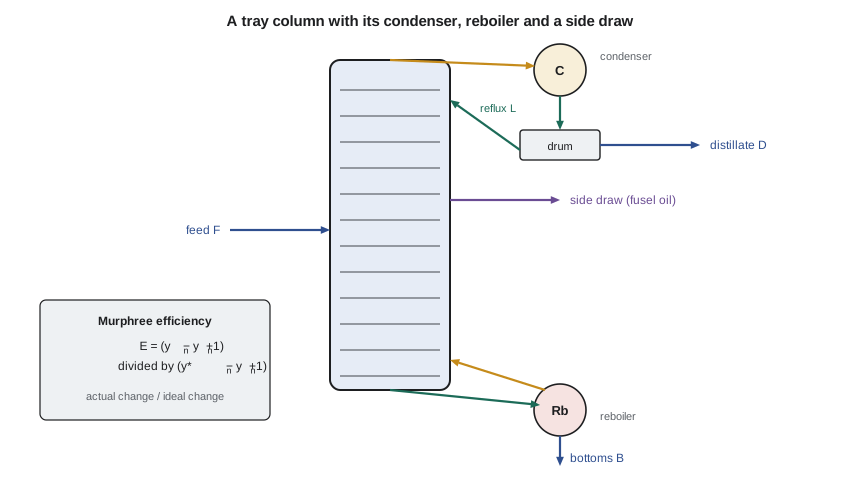
Condensers: total and partial
A total condenser condenses all the overhead gas, and the distillate and reflux have the same composition. A partial condenser condenses only enough to provide reflux and sends the rest forward as vapour. It is an equilibrium stage, because the vapour product is in equilibrium with the liquid reflux. Partial condensers are used when the product is wanted as vapour, as when the recovery column's overhead could be fed straight into the main rectifier as a vapour, or when non-condensable gases must be vented. For the recovery column, Theo keeps a total condenser so that the distillate can be stored and pumped, and so that dissolved carbon dioxide in the feed can be vented from the reflux drum.
Side draws and why fusel oil matters
Fermentation produces small amounts of higher alcohols, chiefly n-propanol, isobutanol and isoamyl alcohol, collectively called fusel oil. In ethanol-water distillation they behave strangely: in dilute aqueous solution they are more volatile than ethanol, but in ethanol-rich solution they are less volatile. They therefore rise from the bottom of the column but fall from the top, and accumulate on intermediate trays where their volatility relative to the mixture changes. If they are not removed, they build up until they form a second liquid phase or leave with one of the products. Ethanol plants remove them with a side draw a few trays above the feed, decant the fusel oil from the water, and sell it or burn it as fuel.
The recovery column's feed contains far less fusel oil than the beer, but its rinse-water streams carry some. Theo includes a small side-draw nozzle on the trays where a rigorous simulation (lesson 5) predicts the peak, with a valve so that operators can use it if the column's temperature profile starts to wander. Each side draw adds an operating line to the McCabe-Thiele diagram, with a slope change at the draw tray.
Intermediate reboilers and condensers
A column can also take heat in or reject it partway up. An intermediate reboiler boils some liquid at a stage above the bottom, at a lower temperature than the main reboiler, so it can use cheaper low-pressure steam or waste heat. An intermediate condenser removes heat at a higher temperature than the top condenser, where it may be useful elsewhere. Both reduce the separation per stage slightly and increase the stage count, but can save energy cost when heat at different temperatures has different value. Lesson 7 returns to heat integration.
Common mistakes
MistakeUsing equilibrium stages as the number of trays to buy.
InsteadDivide by an efficiency; real trays are typically 0.5 to 0.8 of ideal.
MistakeTreating the O'Connell correlation as precise.
InsteadIt is a screening tool with scatter of 10 to 20 percentage points.
MistakeCalculating the reboiler duty from the distillate flow alone.
InsteadUse the boil-up \(\bar V = (R+1)D\) for a saturated liquid feed.
MistakeIgnoring fusel oil in an ethanol column.
InsteadProvide a side draw where intermediate-volatility components accumulate.
Summary and key terms
- Murphree efficiency compares a tray's actual composition change with the ideal change.
- The recovery column needs 17 equilibrium stages, or about 32 real trays at 50 % efficiency.
- O'Connell gives an overall efficiency of about 0.51 for this column.
- Condenser 351 kW, reboiler 364 kW, about 630 kg/h of steam, 2.9 MJ per kilogram of ethanol.
- Partial condensers count as stages; side draws remove components that accumulate inside the column.
- Murphree vapour efficiency
- The actual change in gas composition across a tray divided by the ideal change.
- Overall efficiency
- Equilibrium stages divided by real trays.
- Partial condenser
- A condenser that returns liquid reflux and sends vapour product forward; an equilibrium stage.
- Side draw
- A product stream withdrawn from an intermediate tray.
- Fusel oil
- Higher alcohols from fermentation that accumulate on intermediate trays.
- Boil-up
- The gas generated by the reboiler and returned to the column.
Practice problems
Work each problem on paper first, then reveal the answer to check.
A tray receives gas at \(y = 0.40\), its equilibrium value is \(y^* = 0.50\), and the gas leaves at 0.47. Find \(E_{MV}\).
Show answer
\((0.47 - 0.40)/(0.50 - 0.40) = 0.70\).
With \(E_O = 0.6\), how many trays does a column with 13 equilibrium stages (including the reboiler) need?
Show answer
\((13 - 1)/0.6 = 20\) trays plus the reboiler.
Estimate the condenser duty at \(R = 2.0\).
Show answer
\(V = 3 \times 12.45 = 37.35\) kmol/h; \(Q_C \approx 10.4 \times 39.2 = 407\) kW.
Why does a high relative volatility lower the O'Connell efficiency?
Show answer
Each stage must make a larger composition change in the same contact time.
Why is a partial condenser counted as a stage?
Show answer
Its vapour product leaves in equilibrium with its liquid reflux.
Where do fusel alcohols accumulate in an ethanol column?
Show answer
On intermediate trays, typically a few trays above the feed.
Lesson quiz · 5 questions
Score 60% or more to complete this lesson.
Create a free account to save your progress, take quizzes and earn a certificate.