
CHE-350 · Lesson 8 of 12 · 20 min
Staged absorption and stripping
In CHE-314 Theo designed the fermentation vent scrubber as a packed column, using transfer units: a height of a transfer unit times a number of transfer units. Absorbers and strippers can equally be designed in equilibrium stages, and many are built with trays. The stage approach has two advantages. It connects absorption and stripping to the rest of this course, and for dilute systems it has an exact algebraic solution, the Kremser equation, that gives the number of stages without any graphical stepping. This lesson applies it twice: to check the vent scrubber, and to design the stripper that will clean the ester line's decanter water.
Absorption and stripping as stage processes
An absorber moves a solute from a gas into a liquid solvent; a stripper moves it from a liquid into a gas or steam. Both are countercurrent cascades. For dilute solutions, three simplifications make the algebra easy: the gas and liquid flows are nearly constant through the column, the equilibrium line is straight, \(y = mx\), and the temperature is nearly constant. Under those conditions the operating line, from a solute balance between the top and any stage, is also straight, and the stage-to-stage calculation can be solved in closed form.
The absorption and stripping factors
Two dimensionless groups govern the result. The absorption factor compares the slope of the operating line, \(L/V\), with the slope of the equilibrium line:
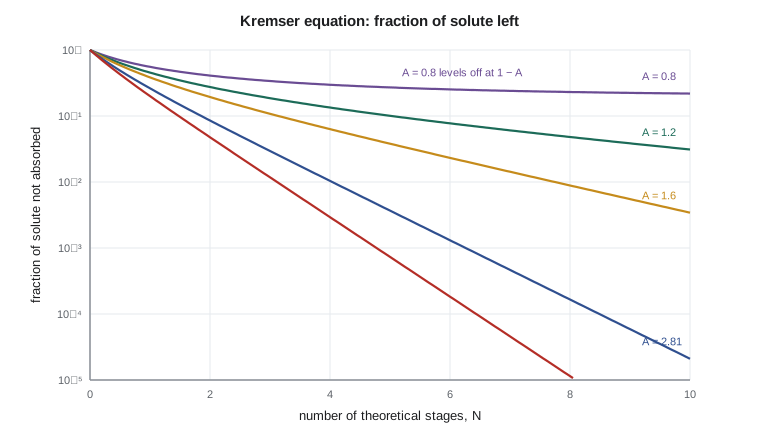
and the stripping factor \(S\) is its reciprocal. If \(A\) is greater than 1, the liquid can carry away more solute than the gas brings in, and with enough stages nearly all of it can be absorbed. If \(A\) is less than 1, the liquid saturates before the gas is clean, and even infinitely many stages leave a fraction \(1 - A\) of the solute in the gas. The same logic applies to stripping with \(S\).
The Kremser equation
For an absorber fed with solute-free solvent, the fraction of the entering solute that leaves unabsorbed after \(N\) equilibrium stages is
Joseph Kremser published the result for gasoline absorbers in 1930, and Souders and Brown generalised it. Solving for \(N\) gives the stages needed for a target recovery:
The stripping form is identical with \(S\) in place of \(A\) and liquid compositions in place of gas compositions: the fraction of solute left in the liquid after \(N\) stages is \((S - 1)/(S^{N+1} - 1)\) when the stripping gas enters solute-free.
# Staged absorption and stripping with the Kremser equation
import math
def kremser_N(frac_left, A):
    # absorber: fraction of solute NOT absorbed with absorption factor A and N stages (lean solvent solute-free)
    # frac_left = (A - 1) / (A**(N + 1) - 1)  ->  solve for N
    return math.log((A - 1) / frac_left + 1) / math.log(A) - 1
def frac_left(A, N): return (A - 1) / (A ** (N + 1) - 1)
# 1) the fermentation vent scrubber from CHE-314 as a tray column
m, LG = 0.57, 1.60             # equilibrium slope at 32 C and the final molar L/G
A = LG / m
rec = 0.9966
print(f"vent scrubber: A = {A:.2f}, minimum L/G for {100 * rec:.2f} % recovery = {m * rec:.3f}")
N = kremser_N(1 - rec, A)
print(f"  theoretical stages needed: {N:.2f}; packed height 7.0 m gives an HETP of about {7.0 / N:.2f} m")
for Nn in (4, 6, 8, 10):
    print(f"  with {Nn} theoretical stages: recovery {100 * (1 - frac_left(A, Nn)):.2f} %")
# 2) steam-stripping ethyl acetate and ethanol from the decanter water layer at about 1 atm
def psat_mmHg(a, b, c, T): return 10 ** (a - b / (T + c))
T = 100.0
P_es = psat_mmHg(7.10179, 1244.95, 217.88, T) * 0.133322      # ethyl acetate, kPa
P_et = psat_mmHg(8.20417, 1642.89, 230.300, T) * 0.133322     # ethanol, kPa
gam_es, gam_et = 50.0, 5.0      # approximate infinite-dilution activity coefficients in water
m_es, m_et = gam_es * P_es / 101.325, gam_et * P_et / 101.325
L = 18.7                        # kmol/h of water layer
print(f"\nstripper: m ester = {m_es:.0f}, m ethanol = {m_et:.1f} for {L} kmol/h of liquid")
for Vs in (1.5, 3.0):           # kmol/h of live steam
    for name, mm in (('ethyl acetate', m_es), ('ethanol', m_et)):
        S = mm * Vs / L
        out = ', '.join(f"{Nn} stages {((S - 1) / (S ** (Nn + 1) - 1)):.1e}" for Nn in (2, 4, 8))
        print(f"  steam {Vs} kmol/h, {name:13s} S = {S:5.2f}: fraction left {out}")
print(f" minimum steam for complete ethanol stripping: {L / m_et:.2f} kmol/h")vent scrubber: A = 2.81, minimum L/G for 99.66 % recovery = 0.568 theoretical stages needed: 5.08; packed height 7.0 m gives an HETP of about 1.38 m with 4 theoretical stages: recovery 98.96 % with 6 theoretical stages: recovery 99.87 % with 8 theoretical stages: recovery 99.98 % with 10 theoretical stages: recovery 100.00 % stripper: m ester = 101, m ethanol = 11.2 for 18.7 kmol/h of liquid steam 1.5 kmol/h, ethyl acetate S = 8.09: fraction left 2 stages 1.3e-02, 4 stages 2.0e-04, 8 stages 4.8e-08 steam 1.5 kmol/h, ethanol S = 0.90: fraction left 2 stages 3.7e-01, 4 stages 2.5e-01, 8 stages 1.7e-01 steam 3.0 kmol/h, ethyl acetate S = 16.17: fraction left 2 stages 3.6e-03, 4 stages 1.4e-05, 8 stages 2.0e-10 steam 3.0 kmol/h, ethanol S = 1.79: fraction left 2 stages 1.7e-01, 4 stages 4.5e-02, 8 stages 4.2e-03 minimum steam for complete ethanol stripping: 1.67 kmol/h
The vent scrubber, in stages
The CHE-314 scrubber uses water at an \(L/G\) of 1.60 against an ethanol equilibrium slope of 0.57 at 32 °C, so \(A = 2.81\). The minimum water rate for 99.66 % recovery is \(L/G = m \times 0.9966 = 0.568\): below that, \(A\) falls below the recovery fraction and no column could meet the target. At the design rate, the Kremser equation needs 5.1 equilibrium stages. Four stages would recover 98.96 %, six 99.87 %, and eight 99.98 %.
The CHE-314 design met the same recovery with 7 m of 50 mm Pall rings. Dividing, the height equivalent to a theoretical plate is 1.38 m. That sounds poor for packing, but it is exactly what the transfer-unit and stage descriptions predict for this absorption factor. When the operating and equilibrium lines are not parallel, the two are related by
With \(H_{OG} = 0.86\) m from CHE-314 and \(\lambda = 0.356\), the ratio \(\ln\lambda/(\lambda - 1)\) is 1.60, giving 1.38 m. A large excess of solvent makes each theoretical stage do a lot of work, so each stage takes more height. The two methods agree, and Theo now has a feel for converting between them.
Worked problem
Minimum solvent and stages
For the scrubber with \(m = 0.57\), find the minimum \(L/G\) for 99.66 % recovery, and the stages at \(L/G = 1.60\).
Show solution
- At minimum solvent, \(A_{min}\) equals the fraction absorbed for a dilute system: \(L/G_{min} = 0.57 \times 0.9966 = 0.568\).
- Design: \(A = 1.60/0.57 = 2.81\).
- \(N = \ln[(2.81 - 1)/0.0034 + 1]/\ln 2.81 - 1 = \ln 533/1.033 - 1\).
- \(N = 6.08 - 1 = 5.08\) equilibrium stages.
Answer: Minimum \(L/G = 0.57\); about 5.1 stages at the design rate.
Stripping the decanter water layer
The ester line's decanter (lessons 6 and 12) produces a water-rich layer saturated with ethyl acetate and carrying some ethanol. In the CHE-320 design example it was about 18.7 kmol/h with roughly 29 kg/h of dissolved ester. That water cannot go to the plant's wastewater treatment as it is: the ester is product, and its biological oxygen demand would load the treatment plant. A steam stripper recovers both organics and sends them back to the decanter.
For a stripper the equilibrium slope comes from the modified Raoult's law at infinite dilution, \(m = \gamma^\infty P^{sat}/P\). Ethyl acetate is only sparingly soluble in water, with an infinite-dilution activity coefficient of about 50 (approximate, from CHE-320), and at 100 °C its vapour pressure is about twice atmospheric, so \(m\) is about 100. Ethanol, with \(\gamma^\infty\) about 5, has \(m\) about 11. Those slopes decide everything that follows.
With 1.5 kmol/h of live steam, about 8 % of the liquid flow, the ester's stripping factor is 8.1, and four stages leave only 0.02 % of it in the water. The ethanol's stripping factor is only 0.90, below 1, so no number of stages can strip it completely: eight stages leave 17 % behind. The minimum steam for complete ethanol stripping is \(L/m = 1.67\) kmol/h. Doubling the steam to 3.0 kmol/h raises the ethanol's factor to 1.79, and eight stages then leave 0.4 %. The ester is now stripped to parts per billion, far beyond what is needed.
The design question is therefore set by the ethanol, not the ester, even though the ester is the product being recovered. Theo proposes 3.0 kmol/h of steam and eight equilibrium stages, packed, with the overhead returned to the decanter. Wren checks the water's remaining organic load against the plant's discharge agreement; the 0.4 % ethanol left is a small fraction of the plant's existing load to treatment.
Choosing the stripping medium and the hardware
Steam is not the only stripping gas. Air stripping, at ambient temperature, removes volatile organics from groundwater and wastewater cheaply, but the organics then leave in a large air stream that may need treatment itself, and at ambient temperature the vapour pressures, and therefore \(m\), are far lower. For ethyl acetate at 25 °C, \(m\) would be about 6 instead of 100. Steam stripping runs hot, gives large \(m\) values, and its overhead condenses, so the organics are recovered as a liquid that can be returned to the decanter. Live steam adds water to the bottoms, about 3 kmol/h here; a reboiler avoids that dilution at the cost of an exchanger that may foul. For the ester line, live steam is simple and the extra water is small, so Theo keeps it.
For hardware, an eight-stage stripper on less than 0.5 m³/h of water is a small column, and like the recovery column of lesson 7 it should be packed. At an HETP of about 0.5 m for this service, 4 m of packing would do. Trayed strippers suit larger flows and liquids that foul. In the plant's beer stripping, for example, the liquid carries yeast and solids and the columns use trays with large openings that resist plugging.
The stage picture also explains why designers spread margin unevenly. Adding a stage to a column with a large stripping factor, like the ester here, multiplies its remaining fraction by about \(1/S\), a large improvement; adding a stage when \(S\) is close to 1 helps only slightly, and the remedy is more steam instead. Before buying extra height, check which factor is limiting.
When the simple equations fail
The Kremser equation needs constant flows, a straight equilibrium line and a constant temperature. Concentrated absorption, where the gas flow shrinks as solute dissolves, needs solute-free flows and mole ratios, or stage-by-stage calculation. Absorbers that heat up as the solute's heat of solution is released, such as ammonia or hydrogen chloride absorbers, need energy balances; the temperature bulge inside such a column can move the equilibrium badly. Chemical absorption, such as the bisulfite reaction of CHE-314 or the amine absorption of carbon dioxide, changes the equilibrium entirely. For those cases simulators run stage-by-stage or rate-based models, with Kremser as a quick check.
Common mistakes
MistakeDesigning an absorber below minimum solvent.
InsteadIf \(A\) is below the target fraction absorbed, no column can meet the target.
MistakeChoosing steam for a stripper from the easiest component.
InsteadSet the stripping factor above 1 for the hardest component to strip.
MistakeComparing HETP values without considering the absorption factor.
InsteadHETP depends on \(\lambda\) as well as on the packing.
MistakeUsing Kremser for a concentrated or strongly heat-releasing absorber.
InsteadUse solute-free flows, energy balances or a rigorous model.
Summary and key terms
- The absorption factor \(A = L/mV\) and stripping factor \(S = mV/L\) decide what is achievable.
- The Kremser equation gives the stages for dilute, isothermal systems in closed form.
- The vent scrubber needs about 5.1 stages at \(A = 2.81\), consistent with 7 m of packing and an HETP of 1.38 m.
- In the decanter-water stripper, ethanol (\(m\) about 11), not ester (\(m\) about 100), sets the steam rate.
- With 3.0 kmol/h of steam and 8 stages, 0.4 % of the ethanol remains.
- Absorption factor
- L/(mV): the ratio of operating-line slope to equilibrium-line slope.
- Stripping factor
- mV/L, the reciprocal of the absorption factor.
- Kremser equation
- A closed-form result for the stages of a dilute countercurrent cascade.
- Minimum solvent rate
- The solvent flow at which an infinite number of stages would just meet the target.
- Live steam
- Steam injected directly into a stripper as the stripping gas.
- HETP
- Height equivalent to a theoretical plate, the packed height that does one stage’s work.
Practice problems
Work each problem on paper first, then reveal the answer to check.
An absorber has \(A = 1.5\). What fraction leaks after 4 stages?
Show answer
\((1.5 - 1)/(1.5^5 - 1) = 0.5/6.59 = 0.076\), about 7.6 %.
With \(A = 0.9\), what is the best possible recovery?
Show answer
90 %; the leak levels off at \(1 - A\).
Find \(S\) for ethanol with \(m = 11.2\), steam 2.0 kmol/h and liquid 18.7 kmol/h.
Show answer
\(11.2 \times 2.0/18.7 = 1.20\).
Convert \(H_{OG} = 0.5\) m to HETP at \(\lambda = 0.5\).
Show answer
\(0.5 \times \ln 0.5/(0.5 - 1) = 0.5 \times 1.386 = 0.69\) m.
Why does the ester strip so much more easily than ethanol?
Show answer
Its infinite-dilution activity coefficient in water is about ten times larger.
Why might a strongly exothermic absorber need more than Kremser?
Show answer
Its temperature rises inside the column, changing the equilibrium.
Lesson quiz · 5 questions
Score 60% or more to complete this lesson.
Create a free account to save your progress, take quizzes and earn a certificate.