
CHE-350 · Lesson 11 of 12 · 20 min
Membrane separations
Membranes separate by letting some components through a thin barrier faster than others. They have no moving parts apart from pumps and compressors, they run at modest temperatures, and they are built in modules, so capacity can be added a piece at a time. Three questions reach Theo's desk in the same month, and all three involve membranes. Could pervaporation dry the ethanol that the ester line recycles, instead of sending it back through the plant's sieves? Could the plant's anaerobic digester, which treats stillage and wastewater and makes biogas, upgrade that biogas to renewable natural gas with a membrane? And how much more boiler feed water could the existing reverse osmosis unit make if it ran at higher recovery?
How membranes separate
Porous membranes, used in microfiltration and ultrafiltration, sieve particles and large molecules by size. Dense membranes, used in reverse osmosis, pervaporation and gas separation, have no pores in the ordinary sense. Molecules dissolve in the membrane material at the feed side, diffuse across it, and leave at the permeate side. The flux of each component is proportional to its permeability, the product of its solubility and diffusivity in the membrane, times its driving force, and inversely proportional to the membrane thickness. Two numbers describe a membrane's performance: its permeance, the flux per unit driving force, and its selectivity, the ratio of two components' permeances. Thin selective layers on porous supports give high fluxes; the selective layer of a modern gas-separation or reverse osmosis membrane is well under a micrometre thick.
The driving force differs by process. In reverse osmosis it is the applied pressure difference minus the osmotic pressure difference. In gas permeation it is the difference in each component's partial pressure across the membrane. In pervaporation, a liquid feed contacts the membrane and the permeate leaves as vapour under vacuum, so the driving force is the difference between the component's partial pressure in equilibrium with the liquid feed and its partial pressure on the vacuum side.
# Membrane separations: pervaporation, biogas upgrading by gas permeation, and reverse osmosis
import math
# 1) pervaporation: dehydrate recycle ethanol from 94 to 99.5 wt % with a hydrophilic membrane
Feed = 2210.0                      # kg/h of 94 wt % ethanol (about 48 kmol/h of ethanol on the ester line)
w_in, w_out = 0.060, 0.005         # water mass fractions in and out
J_ref = 1.5                        # kg/(m2 h) water flux at 6 wt % water, 100 C (illustrative)
def Jw(w): return J_ref * w / 0.060      # flux taken as proportional to water fraction
ethanol = Feed * (1 - w_in)
A, w = 0.0, w_in
dW = 0.1                           # kg/h of water removed per step
water = Feed * w_in
while water / (ethanol + water) > w_out:
    w = water / (ethanol + water)
    A += dW / Jw(w); water -= dW
removed = Feed * w_in - water
print(f"pervaporation: water removed {removed:.0f} kg/h, membrane area about {A:.0f} m2")
print(f"  a constant flux at the inlet value would suggest only {removed / J_ref:.0f} m2: the dry end needs most of the area")
# 2) biogas upgrading: one-stage complete-mixing permeator, CO2 / CH4 selectivity 20, pressure ratio 10
alpha, Pr = 20.0, 10.0
xf = 0.40                           # CO2 mole fraction in the biogas
def solve(theta):
    # complete mixing: retentate x, permeate y with y/(1-y) = alpha (x - y/Pr) / ((1-x) - (1-y)/Pr)
    lo, hi = 1e-6, xf
    for _ in range(100):
        x = (lo + hi) / 2
        # permeate composition from the local flux ratio
        a, b = 1e-9, 1 - 1e-9
        for _ in range(100):
            y = (a + b) / 2
            r = y / (1 - y) - alpha * (x - y / Pr) / ((1 - x) - (1 - y) / Pr)
            a, b = (y, b) if r < 0 else (a, y)
        # overall balance xf = theta y + (1 - theta) x
        lo, hi = (x, hi) if theta * y + (1 - theta) * x < xf else (lo, x)
    return x, y
print("\nbiogas permeator (complete mixing):")
for theta in (0.35, 0.40, 0.45, 0.50):
    x, y = solve(theta)
    ch4_rec = (1 - theta) * (1 - x) / (1 - xf)
    print(f"  stage cut {theta:.2f}: retentate {100 * (1 - x):.1f} % CH4, permeate {100 * y:.1f} % CO2, CH4 recovery {100 * ch4_rec:.1f} %")
# 3) reverse osmosis of boiler make-up water: flux and the concentrate's osmotic pressure
Aw = 1.2                           # L/(m2 h bar), water permeability (illustrative)
c_feed = 1500.0                    # mg/L dissolved salts, taken as sodium chloride
def osm(c): return 2 * (c / 58440) * 0.08314 * 298.15     # bar, van 't Hoff with i = 2
dP = 15.0                          # bar applied
for rec in (0.50, 0.75, 0.85):
    c_conc = c_feed / (1 - rec)    # assuming complete salt rejection
    pi_avg = (osm(c_feed) + osm(c_conc)) / 2
    J = Aw * (dP - pi_avg)
print(f"RO recovery {100 * rec:.0f} %: concentrate {c_conc:.0f} mg/L, osmotic pressure {osm(c_conc):.2f} bar, flux about {J:.1f} L/(m2 h)")pervaporation: water removed 122 kg/h, membrane area about 216 m2 a constant flux at the inlet value would suggest only 81 m2: the dry end needs most of the area biogas permeator (complete mixing): stage cut 0.35: retentate 79.7 % CH4, permeate 76.6 % CO2, CH4 recovery 86.3 % stage cut 0.40: retentate 82.0 % CH4, permeate 73.0 % CO2, CH4 recovery 82.0 % stage cut 0.45: retentate 84.0 % CH4, permeate 69.3 % CO2, CH4 recovery 77.0 % stage cut 0.50: retentate 85.6 % CH4, permeate 65.6 % CO2, CH4 recovery 71.3 % RO recovery 50 %: concentrate 3000 mg/L, osmotic pressure 2.54 bar, flux about 15.7 L/(m2 h) RO recovery 75 %: concentrate 6000 mg/L, osmotic pressure 5.09 bar, flux about 14.2 L/(m2 h) RO recovery 85 %: concentrate 10000 mg/L, osmotic pressure 8.48 bar, flux about 12.1 L/(m2 h)
Pervaporation for the recycle ethanol
The ester line recycles about 2,210 kg/h of ethanol containing 6 wt % water, and the pre-reactor (CHE-345) prefers dry ethanol because water lowers the esterification equilibrium. Hydrophilic pervaporation membranes, such as zeolite A or crosslinked poly(vinyl alcohol), pass water readily and ethanol only slightly. Theo takes a water flux of 1.5 kg/(m² h) at 6 wt % water and 100 °C as illustrative, and assumes the flux falls in proportion to the water content as the liquid dries. Removing 122 kg/h of water to reach 0.5 wt % needs about 216 m² of membrane. A naive estimate at the inlet flux would suggest only 81 m²; the dry end, where the driving force is small, needs most of the area.
That shape is typical of membrane processes: the last part of a separation is the most expensive. It explains why pervaporation is often used in hybrid schemes, with distillation taking ethanol most of the way and the membrane crossing the azeotrope, and why a membrane is seldom asked to deliver extreme purity alone. For the ester line, 216 m² of membrane is a modest installation. Against it, the plant already has sieve capacity with room to spare (lesson 10), so routing the recycle ethanol through the existing dehydration unit costs only some extra purge and steam. Theo reports pervaporation as technically sound but not justified while the sieves have spare capacity, and notes the figure for a future expansion.
Gas permeation: biogas upgrading
The plant's digester makes biogas of about 60 % methane and 40 % carbon dioxide. To be injected into the gas grid as renewable natural gas it must be upgraded, typically to about 96 % methane or more, depending on the pipeline's specification. Glassy polymer membranes pass carbon dioxide much faster than methane, with selectivities of roughly 20 to 50.
The simplest model is a single stage with complete mixing on both sides: the permeate composition follows from the ratio of the two components' fluxes at the retentate composition, and the overall balance fixes the retentate. Two parameters matter besides selectivity. The pressure ratio, feed pressure over permeate pressure, limits how much faster the fast gas can permeate however selective the membrane is. The stage cut, the fraction of the feed that permeates, trades purity against recovery: cut more, and the retentate becomes purer but more methane escapes into the permeate.
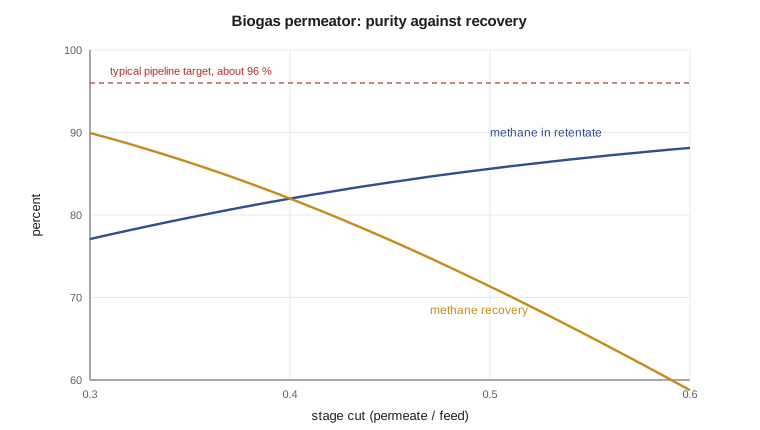
With a selectivity of 20 and a pressure ratio of 10, a stage cut of 0.35 gives a retentate of 79.7 % methane with 86 % recovery; a cut of 0.50 gives 85.6 % methane with only 71 % recovery. No single complete-mixing stage meets the grid specification. Real biogas plants use hollow-fibre modules, whose countercurrent flow pattern performs much better than complete mixing, in two or three stages, recompressing and recycling the second stage's permeate to recover methane. Methane in the final permeate, released to air or burned, matters for the climate case, because methane is a far more potent greenhouse gas than carbon dioxide, so modern designs aim for methane losses of well under 1 %. Wren notes that the project would sit under the Ontario Ministry of the Environment, Conservation and Parks's approvals for the digester as well as the gas utility's injection agreement.
Worked problem
Stage cut balance
At a stage cut of 0.40, the retentate is 82.0 % methane. Check the methane recovery and the permeate's carbon dioxide content.
Show solution
- Per 100 mol of feed: retentate 60 mol, of which \(0.820 \times 60 = 49.2\) mol is methane.
- Recovery \(= 49.2/60 = 82.0\) %.
- Permeate 40 mol carries \(60 - 49.2 = 10.8\) mol of methane, so it is \(29.2/40 = 73.0\) % carbon dioxide.
- Carbon dioxide check: \(29.2 + 0.18 \times 60 = 40.0\) mol, the feed's 40 mol.
Answer: 82 % recovery, and a permeate of 73 % carbon dioxide that still carries 18 % of the methane.
Reverse osmosis: boiler feed water
The plant's reverse osmosis unit treats well water for the boilers. Water flux is \(J = A_w(\Delta P - \Delta\pi)\), with \(A_w\) the water permeability. The osmotic pressure of a dilute salt solution follows the van 't Hoff equation, \(\pi = icRT\), about 1.3 bar for the feed’s 1,500 mg/L of salts treated as sodium chloride. As recovery rises, salt concentrates in the reject stream: at 50 % recovery the concentrate is 3,000 mg/L, at 75 % it is 6,000 mg/L, at 85 % it is 10,000 mg/L with an osmotic pressure of 8.5 bar. At 15 bar applied pressure, the average flux falls from about 15.7 to 12.1 L/(m² h) across that range. Higher recovery saves well water and reduces the reject stream, but needs more membrane area and, more importantly, risks scaling. Sparingly soluble salts such as calcium carbonate and calcium sulfate precipitate on the membrane when concentrated. In practice antiscalant dosing and the feed's chemistry, not the osmotic pressure, set the recovery limit, and Theo passes the question to the water-treatment vendor with the numbers above.
Membrane modules and limits
Membranes come as spiral-wound modules, the usual form for reverse osmosis and many gas separations; hollow fibres, which pack thousands of square metres into a vessel; plate-and-frame units for pervaporation and fouling-prone liquids; and tubular modules for slurries. All suffer from concentration polarisation, the build-up of rejected components at the membrane surface, which lowers the effective driving force, and from fouling, which lowers flux over time and must be cleaned. Polymers have temperature and chemical limits: chlorine destroys polyamide reverse osmosis membranes, and solvents swell many polymers. Ceramic and zeolite membranes resist harsh conditions at a higher price. Membrane performance also follows a trade-off: more permeable polymers tend to be less selective, a limit described by Robeson's upper bound for gas separation.
Common mistakes
MistakeSizing a membrane from the inlet flux alone.
InsteadIntegrate along the module; the flux falls as the driving force falls.
MistakeExpecting one stage to give both high purity and high recovery.
InsteadPurity and recovery trade against each other through the stage cut; use multiple stages.
MistakeIgnoring the pressure ratio.
InsteadIt limits separation however selective the membrane is.
MistakeSetting reverse osmosis recovery from osmotic pressure only.
InsteadScaling by sparingly soluble salts usually sets the limit.
Summary and key terms
- Dense membranes separate by solution-diffusion; performance is set by permeance and selectivity.
- Pervaporation could dry the recycle ethanol with about 216 m²; the dry end needs most of the area.
- One complete-mixing biogas stage cannot reach grid quality; staged hollow-fibre designs are used.
- Reverse osmosis flux falls as recovery raises the concentrate's osmotic pressure; scaling usually limits recovery.
- Concentration polarisation, fouling and chemical limits govern membrane life.
- Permeance
- Flux per unit driving force through a membrane.
- Selectivity
- The ratio of two components’ permeances.
- Pervaporation
- Separation of a liquid feed through a membrane into a vapour permeate under vacuum.
- Stage cut
- The fraction of the feed that passes through the membrane.
- Osmotic pressure
- The pressure that balances the tendency of water to flow into a more concentrated solution.
- Concentration polarisation
- Accumulation of rejected components at the membrane surface.
Practice problems
Work each problem on paper first, then reveal the answer to check.
What is the osmotic pressure of 3,000 mg/L sodium chloride at 25 °C?
Show answer
\(2 \times (3/58.44) \times 0.08314 \times 298 = 2.5\) bar.
At 15 bar applied and 5 bar average osmotic pressure, with \(A_w = 1.2\) L/(m² h bar), what is the flux?
Show answer
\(1.2 \times 10 = 12\) L/(m² h).
Why does the pervaporation flux fall along the module?
Show answer
The water content, and with it the driving force, falls as the liquid dries.
What does raising the stage cut do to the retentate?
Show answer
Raises its purity but lowers recovery of the slow gas.
Why must methane slip from upgrading be kept low?
Show answer
Methane is a much stronger greenhouse gas than carbon dioxide.
Which chemical destroys polyamide reverse osmosis membranes?
Show answer
Chlorine.
Lesson quiz · 5 questions
Score 60% or more to complete this lesson.
Create a free account to save your progress, take quizzes and earn a certificate.