
CHE-350 · Lesson 1 of 12 · 21 min
Separation processes and the equilibrium stage
Theo Laurent's fifth and final work term at Kingfisher Bioenergy in Sarnia begins where the last one ended. The pre-reactor he sized in CHE-345 turns most of the acid and ethanol into ethyl acetate, but what leaves a reactor is never a product. It is a mixture: ester, water, unreacted ethanol and acid, and small amounts of by-products. Turning that mixture into ester that meets a customer's specification, into water clean enough to send to treatment, and into ethanol that can be recycled is the job of the separation train. At most chemical plants that train costs more to build and far more to run than the reactor it serves. Ingrid Solheim, who seals the process design basis as a P.Eng., gives Theo two jobs for the term: a small ethanol recovery column for the plant's dilute side streams, and the purification train for the ethyl acetate line. This course follows both.
Separation processes take one mixture and produce two or more streams of different composition. Thermodynamics says that unmixing never happens by itself: the second law makes mixing spontaneous, so separating always costs energy, a solvent, a membrane's driving pressure, or some other input. The art of separation design is to find a property in which the components differ, and to exploit that difference as cheaply and reliably as possible.
Separating agents and the properties they exploit
Every separation adds something to create a second phase or a barrier. That addition is the separating agent. Some agents are energy, others are material:
| Process | Separating agent | Property exploited | Example at the plant |
|---|---|---|---|
| Flash and distillation | Heat (energy) | Volatility | Beer column, rectifier, ester column |
| Absorption | Liquid solvent (material) | Solubility | Fermentation vent scrubber (CHE-314) |
| Stripping | Steam or gas (material) | Volatility from a liquid | Decanter water-layer stripper |
| Liquid-liquid extraction | Second liquid (material) | Distribution between liquids | Decanter, water washing |
| Adsorption | Solid sorbent (material) | Selective adsorption | Molecular sieve dryers |
| Membranes | Pressure difference and a barrier | Permeation rate | Pervaporation, reverse osmosis |
An energy separating agent, such as the steam to a reboiler, leaves the process as heat at a lower temperature, and the products contain nothing new. A material separating agent, such as water in a scrubber or a solvent in an extractor, ends up in a product stream and must usually be recovered by another separation. That second step is why distillation dominates when it is feasible: it needs no recovery step for its agent. About nine-tenths of the separations in the chemical process industries are done by distillation, and distillation alone is often quoted as consuming several percent of all the energy used in industry. Where distillation is impossible or wasteful, as with the ethanol-water azeotrope or heat-sensitive products, the material agents take over.
The equilibrium stage
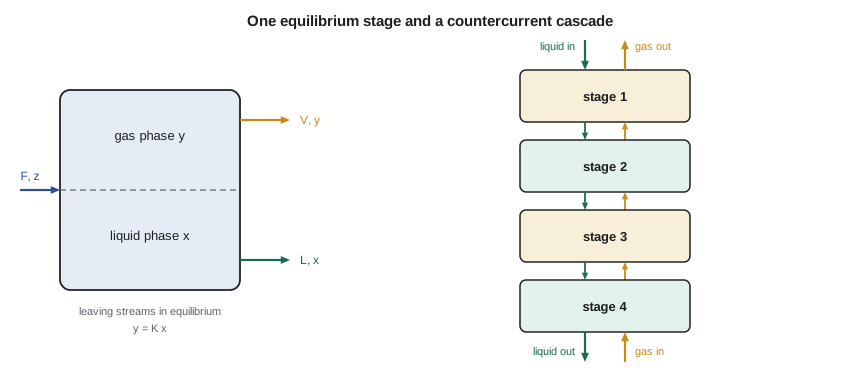
Almost every separation method in this course is analysed with one idealisation, the equilibrium stage. Two phases are brought into contact, mixed long enough for their compositions to reach equilibrium, and then separated cleanly. The two streams leaving the stage are therefore in equilibrium with each other: for distillation, the gas leaving has the composition \(y\) that is in equilibrium with the liquid leaving, \(x\). For each component,
where \(K_i\) is the vapour-liquid equilibrium ratio from the modified Raoult's law of CHE-320. A real tray or a metre of packing does not reach equilibrium, but it is easier to calculate how many ideal stages a separation needs and then correct for real performance with an efficiency than to model the transfer rates directly. Lesson 3 makes that correction.
Ethanol and water on one stage
The recovery column will separate ethanol from water, so Theo starts by asking what one stage can do. The phase equilibrium comes from CHE-320: Antoine equations for the pure-component vapour pressures and the van Laar activity coefficient model fitted to ethanol-water data at 1 atm, with \(A_{12} = 1.672\) and \(A_{21} = 0.930\). The bubble-point calculation finds the temperature at which the liquid's partial pressures add up to the system pressure, and the gas composition follows.
The program below tabulates the equilibrium, then flashes a feed of 100 kmol/h containing 10 mol % ethanol at several fractions vaporised. Each flash is one equilibrium stage: the feed splits into a gas and a liquid in equilibrium, and the overall balance \(z = (1 - V/F)\,x + (V/F)\,y\) fixes where they lie.
# One equilibrium stage: flashing a dilute ethanol-water liquid at 1 atm
import math
# Ethanol (1) - water (2) at 1 atm: Antoine (mmHg, deg C) and van Laar constants fitted in CHE-320
ANT = {'ethanol': (8.20417, 1642.89, 230.300), 'water': (8.07131, 1730.63, 233.426)}
A12, A21 = 1.672, 0.930
def psat(c, T):  # kPa
    a, b, cc = ANT[c]
    return 10 ** (a - b / (T + cc)) * 0.133322
def gammas(x1):
    x2 = 1 - x1
    d = A12 * x1 + A21 * x2
    return math.exp(A12 * (A21 * x2 / d) ** 2), math.exp(A21 * (A12 * x1 / d) ** 2)
def bubble(x1, P=101.325):
    g1, g2 = gammas(x1)
    lo, hi = -20.0, 250.0
    for _ in range(60):
        T = (lo + hi) / 2
        s = x1 * g1 * psat('ethanol', T) + (1 - x1) * g2 * psat('water', T)
        lo, hi = (T, hi) if s < P else (lo, T)
    y1 = x1 * g1 * psat('ethanol', T) / P
    return T, y1
z = 0.10     # mole fraction ethanol in the feed
F = 100.0    # kmol/h
print("x (liquid)  T bubble (C)   y (rising)   K ethanol  K water")
for x in (0.02, 0.05, 0.10, 0.20, 0.40, 0.60, 0.80):
    T, y = bubble(x)
    print(f"{x:6.2f}      {T:7.2f}       {y:7.3f}     {y / x:6.2f}    {(1 - y) / (1 - x):6.3f}")
def flash(vf):
    # find liquid composition x such that the stage balance closes: z = (1 - vf) x + vf y
    lo, hi = 1e-6, z
    for _ in range(80):
        x = (lo + hi) / 2
        T, y = bubble(x)
        if (1 - vf) * x + vf * y > z: hi = x
        else: lo = x
    return x, y, T
print()
for vf in (0.1, 0.2, 0.3, 0.5):
    x, y, T = flash(vf)
    rec = vf * F * y / (z * F)
    print(f"V/F = {vf:.1f}: T = {T:5.1f} C, liquid x = {x:.4f}, rising y = {y:.3f}, "
          f"ethanol recovered overhead {100 * rec:4.1f} %")
x, y, T = flash(0.2)
alpha = (y / x) / ((1 - y) / (1 - x))
print(f"relative volatility at the V/F = 0.2 stage: {alpha:.1f}")x (liquid) T bubble (C) y (rising) K ethanol K water 0.02 95.12 0.178 8.92 0.838 0.05 90.63 0.323 6.46 0.713 0.10 86.60 0.440 4.40 0.622 0.20 83.19 0.536 2.68 0.580 0.40 80.69 0.621 1.55 0.632 0.60 79.24 0.703 1.17 0.742 0.80 78.35 0.821 1.03 0.893 V/F = 0.1: T = 88.7 C, liquid x = 0.0690, rising y = 0.379, ethanol recovered overhead 37.9 % V/F = 0.2: T = 91.0 C, liquid x = 0.0470, rising y = 0.312, ethanol recovered overhead 62.4 % V/F = 0.3: T = 92.8 C, liquid x = 0.0335, rising y = 0.255, ethanol recovered overhead 76.6 % V/F = 0.5: T = 95.1 C, liquid x = 0.0202, rising y = 0.180, ethanol recovered overhead 89.9 % relative volatility at the V/F = 0.2 stage: 9.2
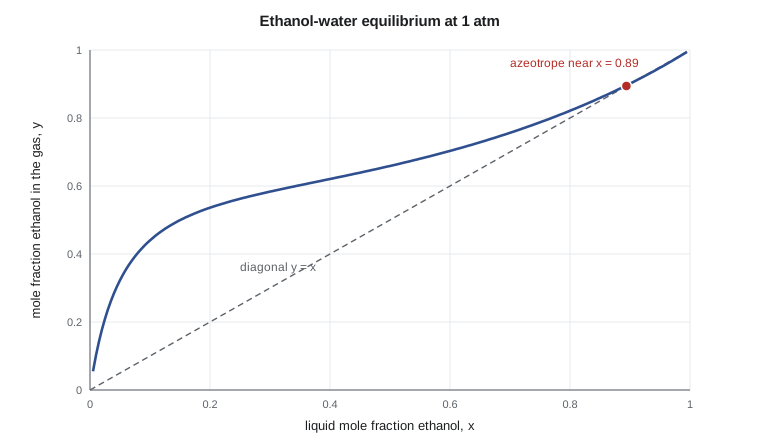
Three features of the results matter for everything that follows. First, ethanol is very volatile when dilute: at \(x = 0.02\) its K-value is almost 9, and at \(x = 0.10\) the gas holds 44 % ethanol. Second, the advantage shrinks as the liquid gets richer: at \(x = 0.80\), \(K\) is only 1.03, so the gas is barely richer than the liquid. Third, one stage gives a poor separation however it is run. Vaporising a fifth of the feed recovers 62 % of the ethanol into a gas of only 31 mol %; vaporising half recovers 90 % but at only 18 mol %. Purity and recovery trade against each other on a single stage, and the way out of that trade is to use many stages.
Relative volatility
For a pair of components the useful measure of how easy the separation is, is the relative volatility:
On the stage that vaporises one-fifth of the feed, \(\alpha\) is about 9, so a single stage enriches ethanol strongly. Near the top of the curve \(\alpha\) falls towards 1, and at the azeotrope, close to \(x = 0.89\) (about 96 wt % in this model, 95.6 wt % measured), it equals 1 exactly. No number of ordinary distillation stages can cross that point. Lesson 6 deals with the ways around it, and lesson 10 with the molecular sieves that the plant actually uses to make fuel-grade ethanol.
For nearly ideal mixtures such as similar hydrocarbons, \(\alpha\) is almost constant across the composition range, and simple formulas apply. Ethanol and water are strongly non-ideal, so their \(\alpha\) changes by a factor of ten across the range. That is why the recovery column is designed in lessons 2 to 5 from the equilibrium curve itself rather than from a single \(\alpha\).
Why stages are arranged countercurrently
A cascade of stages can be connected in several ways. In a crosscurrent arrangement, fresh separating agent contacts the product of each stage in turn; in a countercurrent arrangement, the two phases flow in opposite directions, so the richest liquid meets the richest gas and the leanest liquid meets the leanest gas. Countercurrent flow keeps a driving force for transfer at every stage and gives far better separation for the same amount of agent. Distillation columns, absorbers, strippers and most extractors are countercurrent cascades. Lesson 9 compares the two arrangements with numbers and shows how large the difference can be.
A distillation column adds one more idea: reflux. Some of the condensed overhead product is returned to the top as liquid, and some of the bottoms is boiled and returned as gas. The column then makes its own countercurrent liquid and gas from the feed, with heat as the only separating agent. Lesson 2 builds the column from stages and shows how the reflux ratio trades stages for energy.
The two design questions
For any staged separation, design comes down to two questions. How many equilibrium stages are needed to reach the specified purities and recoveries? And how much separating agent, whether reflux, solvent, steam or adsorbent, must be used? The answers are linked: more agent means fewer stages, and there is always a minimum agent rate below which no number of stages will do the job and a minimum number of stages below which no amount of agent will. The economic optimum lies between those limits, usually at about 1.1 to 1.5 times the minimum agent rate. Every lesson that follows comes back to these two questions for a different process.
Worked problem
A single-stage check
The flash at \(V/F = 0.2\) gives \(x = 0.0470\) and \(y = 0.312\). Check the ethanol balance and the recovery.
Show solution
- Gas: \(V = 0.2 \times 100 = 20\) kmol/h carrying \(20 \times 0.312 = 6.24\) kmol/h of ethanol.
- Liquid: \(L = 80\) kmol/h carrying \(80 \times 0.0470 = 3.76\) kmol/h.
- Total \(6.24 + 3.76 = 10.0\) kmol/h, equal to the feed's \(100 \times 0.10\).
- Recovery in the gas \(= 6.24/10.0 = 62.4\) %.
Answer: The balance closes, and one stage recovers 62 % of the ethanol at only 31 mol %.
Energy, cost and the order of separations
Because separations dominate the cost of many processes, a few rules of thumb from process synthesis guide where each one goes. Remove corrosive or hazardous components early. Remove the most plentiful component early, so that later equipment is smaller. Do the easiest separations first and the hardest, with relative volatility closest to 1, last and with as little else present as possible. Avoid separations that create new problems, such as adding a solvent that must itself be removed. For the ethyl acetate line, these rules shape the train of lesson 12: the reactive distillation column removes water as it forms, a decanter makes a cheap first split using the liquid-liquid miscibility gap, and the final ester column handles a mixture from which most of the water has already gone.
The plant's energy bill is the other driver. Kingfisher Bioenergy buys natural gas for its boilers, and every kilogram of steam to a reboiler has a price and a carbon footprint. Theo's design basis therefore reports, for each separation, the energy it needs per unit of product, so that options such as heat pumps (lesson 7) and membranes (lesson 11) can be compared fairly.
Common mistakes
MistakeExpecting one flash stage to give both high purity and high recovery.
InsteadA single stage trades one against the other; use a cascade.
MistakeUsing one constant relative volatility for ethanol and water.
InsteadTheir \(\alpha\) changes by about a factor of ten across the range; use the equilibrium curve.
MistakeCalling distillation's separating agent free.
InsteadHeat costs money and carbon; report energy per unit of product.
MistakeForgetting that a material separating agent must usually be recovered.
InsteadCount the extra separation needed to reclaim the solvent or adsorbent.
Summary and key terms
- Every separation needs a separating agent: energy or a material.
- The equilibrium stage is the idealisation used to count stages; real equipment is corrected by an efficiency.
- Ethanol is very volatile when dilute (\(K\) about 9 at 2 mol %) but barely so near the azeotrope.
- One stage trades purity against recovery; countercurrent cascades remove that limit.
- Design answers two linked questions: how many stages, and how much separating agent.
- Separating agent
- Energy or material added to create a second phase or a barrier.
- Equilibrium stage
- An idealised contact whose leaving streams are in phase equilibrium.
- K-value
- The ratio y/x for a component at equilibrium.
- Relative volatility
- The ratio of two components’ K-values, a measure of how easy distillation is.
- Azeotrope
- A mixture whose equilibrium gas and liquid have the same composition.
- Countercurrent
- Flow in which the two phases move in opposite directions through the stages.
Practice problems
Work each problem on paper first, then reveal the answer to check.
From the table, what is \(\alpha\) at \(x = 0.40\)?
Show answer
\(K_1/K_2 = 1.55/0.632 = 2.45\).
Why does vaporising more feed lower the gas purity?
Show answer
More of the less volatile water vaporises, diluting the ethanol in the gas.
Name a separation at the plant that uses a material agent and the step that recovers it.
Show answer
The vent scrubber uses water; the recovered ethanol-water is returned to the process and distilled.
What happens to \(\alpha\) at the azeotrope?
Show answer
It equals 1; the gas and liquid have the same composition.
Why is distillation preferred when it works?
Show answer
Its separating agent is heat, which needs no recovery step.
State the two design questions for a staged separation.
Show answer
How many stages, and how much separating agent.
Lesson quiz · 5 questions
Score 60% or more to complete this lesson.
Create a free account to save your progress, take quizzes and earn a certificate.