
CHE-350 · Lesson 12 of 12 · 21 min
Capstone: the ethyl acetate purification train
The term ends with the design basis for the ethyl acetate line's purification train, the job Ingrid set on Theo's first day. The pre-reactor of CHE-345 delivers a liquid at about 65 % conversion to a reactive distillation column, supplied by a vendor, that completes the reaction and removes water. Everything downstream of that column is Kingfisher Bioenergy's responsibility: the decanter, the ester purification column, the water-layer stripper, and the energy they need. The product must meet a customer specification for ester purity, water and ethanol content, and acidity. The design basis will be reviewed by Ingrid, by Wren for environmental and product-quality aspects, and by the plant's operations team. This lesson works through it as Theo did.
Step 1: the flowsheet
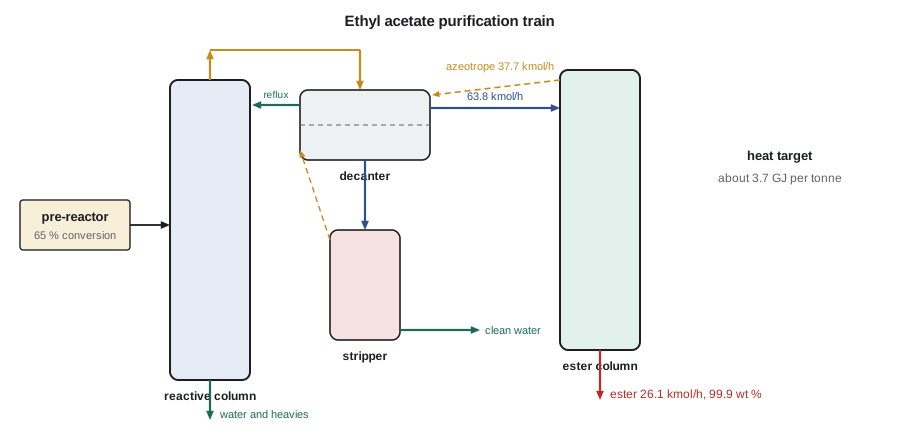
The structure follows from the thermodynamics of lesson 6. The reactive column's overhead is close to the ternary heterogeneous azeotrope of ester, ethanol and water, which boils at about 70.3 °C. It condenses and splits in the decanter into an ester-rich layer and a water-rich layer. Part of the ester-rich layer returns to the reactive column as reflux; the rest feeds the ester column. That column's bottoms is the product, essentially pure ester, because the ester is the highest-boiling component of its feed once the water and ethanol go overhead as the azeotrope. Its distillate, again near the azeotrope, returns to the decanter. The water-rich layer goes to the stripper of lesson 8, whose bottoms is clean water and whose overhead returns to the decanter. The decanter is therefore the hub where three recycle streams meet, and it is what lets the train cross the distillation boundary that no column could cross alone.
Step 2: material balances
Theo starts from the product: 26.1 kmol/h of ester from CHE-345, specified at 99.7 mol %, about 99.9 wt %, with the remainder mainly water and ethanol. The ester column's distillate is taken as the ternary azeotrope, about 82.6 wt % ester, 8.4 % ethanol and 9.0 % water (approximate published values), which is 57.9 mol % ester, 11.3 % ethanol and 30.9 % water. For the feed, the ester-rich layer, he uses an illustrative composition of 75 mol % ester, 10 % ethanol and 15 % water, consistent with the ternary data of CHE-320. An ester balance around the column then gives the flows.
# Capstone: balances and energy target for the ethyl acetate purification train
P = 26.1                            # kmol/h of ester product (CHE-345 pre-reactor plus reactive distillation)
xP = 0.997                          # mole fraction ester in the product (about 99.9 wt %)
M = {'ester': 88.11, 'ethanol': 46.07, 'water': 18.015}
# ternary heterogeneous azeotrope, about 82.6 / 8.4 / 9.0 wt % (approximate)
wt_az = {'ester': 0.826, 'ethanol': 0.084, 'water': 0.090}
n = {c: wt_az[c] / M[c] for c in M}; s = sum(n.values())
z_az = {c: n[c] / s for c in M}
print("azeotrope mole fractions: " + ", ".join(f"{c} {z_az[c]:.3f}" for c in M))
# organic (ester-rich) layer from the decanter, illustrative composition
z_org = {'ester': 0.750, 'ethanol': 0.100, 'water': 0.150}
# ester purification column: F = P + D, ester balance gives F
F = P * (xP - z_az['ester']) / (z_org['ester'] - z_az['ester'])
D = F - P
print(f"ester column feed {F:.1f} kmol/h, distillate (back to the decanter) {D:.1f} kmol/h, product {P:.1f} kmol/h")
# duties: boil-up (R + 1) D for the top section, latent heats in kJ/mol near the boiling points (approximate)
lam = {'ester': 31.9, 'ethanol': 38.6, 'water': 40.7}
lam_top = sum(z_az[c] * lam[c] for c in M)
for R in (1.0, 1.5, 2.0):
    Q = (R + 1) * D * lam_top * 1000 / 3600
    print(f"  reflux ratio {R:.1f}: condenser duty about {Q:.0f} kW")
R = 1.5
Q_epc = (R + 1) * D * lam_top * 1000 / 3600
# water-layer stripper from lesson 8: 3.0 kmol/h of live steam
Q_str = 3.0 * 40.7 * 1000 / 3600
# reactive distillation column reboiler: taken from the vendor's concept (illustrative)
Q_rd = 1450.0
total = Q_epc + Q_str + Q_rd
prod_t = P * xP * M['ester'] / 1000
print(f"\nheat: reactive distillation {Q_rd:.0f} kW, ester column {Q_epc:.0f} kW, stripper {Q_str:.0f} kW, total {total:.0f} kW")
print(f"product {prod_t:.2f} t/h: energy target about {total * 3.6 / prod_t / 1000:.2f} GJ per tonne of ester")
# heat recovery: use the hot product (about 77 C) and stripper bottoms (100 C) to preheat feeds (illustrative)
Q_rec = 0.6 * (P * 0.170 * (77 - 30) + 21.0 * 0.0754 * (100 - 40)) * 1000 / 3600
print(f"feed preheat from product and stripper bottoms: about {Q_rec:.0f} kW, "
f"lowering the target to {(total - Q_rec) * 3.6 / prod_t / 1000:.2f} GJ/t")azeotrope mole fractions: ester 0.579, ethanol 0.113, water 0.309 ester column feed 63.8 kmol/h, distillate (back to the decanter) 37.7 kmol/h, product 26.1 kmol/h reflux ratio 1.0: condenser duty about 740 kW reflux ratio 1.5: condenser duty about 925 kW reflux ratio 2.0: condenser duty about 1111 kW heat: reactive distillation 1450 kW, ester column 925 kW, stripper 34 kW, total 2409 kW product 2.29 t/h: energy target about 3.78 GJ per tonne of ester feed preheat from product and stripper bottoms: about 51 kW, lowering the target to 3.70 GJ/t
The ester column takes 63.8 kmol/h of feed and returns 37.7 kmol/h of distillate to the decanter: more than its product flow. The large recycle is the price of crossing the boundary. Every mole of water and ethanol that enters the ester column must leave in the distillate at the azeotrope's composition, which carries a lot of ester with it. The recycle can be reduced only by making the ester-rich layer drier, either by cooling the decanter, which lowers the mutual solubilities, or by improving the reactive column's water removal. Theo includes a sensitivity table in the design basis showing how the recycle falls as the water in the ester layer falls.
Worked problem
Closing the ester column balance
Check the non-ester balance for the ester column with \(F = 63.8\), \(P = 26.1\) and \(D = 37.7\) kmol/h.
Show solution
- Non-ester in feed: \(0.25 \times 63.8 = 15.95\) kmol/h.
- In product: \(0.003 \times 26.1 = 0.08\) kmol/h.
- In distillate: \(0.421 \times 37.7 = 15.87\) kmol/h.
- Sum \(0.08 + 15.87 = 15.95\) kmol/h, matching the feed.
Answer: The balance closes; almost all the water and ethanol leave overhead.
Step 3: column design
The ester column is designed by the methods of lessons 2 to 5, with one complication: its feed and distillate lie close to a distillation boundary, so a shortcut method is unreliable and the design is done with a rigorous model using the NRTL parameters chosen in CHE-320 lesson 12. That model predicts both the vapour-liquid and the liquid-liquid equilibria, and the simulation checks that no tray forms a second liquid phase, which would upset a conventional column. Theo's simulation needs about 20 equilibrium stages at a reflux ratio of 1.5 for the product purity, with the feed near the top because the column is mainly a stripping column for the water and ethanol. The duties scale with the boil-up: at \(R = 1.5\) the condenser takes about 925 kW, against 740 kW at \(R = 1.0\) and 1,110 kW at 2.0. The column diameter, about 1 m by Fair's method of lesson 7, and the low liquid loads suit structured packing.
Step 4: the stripper and the water
The stripper of lesson 8 uses 3.0 kmol/h of live steam and eight stages, recovering essentially all the ester and leaving about 0.4 % of the ethanol in the water. Its steam, about 34 kW, is small beside the columns. The cleaned water goes to the plant's wastewater treatment under the existing discharge arrangements, and its organic load is reported in the design basis for Wren's review.
Step 5: the energy target
The train's heat use is dominated by the two columns. The vendor's concept for the reactive column needs about 1,450 kW at its reboiler (an illustrative figure from the concept study), the ester column about 925 kW and the stripper 34 kW: a total of about 2.4 MW for 2.29 t/h of ester, or about 3.8 GJ per tonne. Using the hot product and the stripper bottoms to preheat feeds recovers only about 50 kW, lowering the target to about 3.7 GJ/t. Bigger savings need bigger moves: a heat pump on the ester column, whose 70 °C overhead could be compressed to drive its own reboiler, or integrating its condenser with a lower-temperature user elsewhere on the site. Theo lists both for the decarbonization study with the duties above, as he did for the recovery column in lesson 7.
Step 6: what could go wrong
Ingrid's review concentrates on the decanter. If its temperature rises, the mutual solubilities increase and the ester-rich layer carries more water to the ester column, raising the recycle and the steam. If acetic acid leaks through from the reactive column, it accumulates in the loop, because it is not volatile enough to leave with the azeotrope and not heavy enough to stay in the product cleanly; the product's acidity specification then fails. Theo adds an analyser on the product for acidity and a small purge from the ester column bottoms back to the reactive column for start-up and upsets. For the safety review under CSA Z767, the train holds several cubic metres of flammable liquid at its boiling point; the hazard study will cover relief sizing for fire exposure, vapour release from the decanter vent, and the decanter's interface control, because a lost interface sends water to the ester column and ester to the stripper at the same time.
Off-design cases
A design that works only at its design point is not finished. Theo runs two off-design cases through the balances. In the first, the reactive column's conversion falls, as it will when its catalyst ages, so the overhead carries more ethanol. The ester-rich layer then holds more ethanol, the ester column's feed rises, and so do its recycle and condenser duty; at a few percent lower conversion the recycle grows by roughly a tenth, which the column's hydraulic margin must cover. In the second, the plant runs at 60 % throughput during a feed shortage. The columns' flows fall in proportion, which takes the packed ester column close to its minimum wetting rate (CHE-314 lesson 9) and the stripper's liquid distributor close to its turndown limit. Theo specifies a distributor with a wider range and records the minimum throughput at which the train can stay on specification.
Both cases point to the same instrumentation: a temperature on a sensitive stage of each column (lesson 5), the decanter temperature and interface, the recycle flows, and product analysers for water, ethanol and acidity. They also set the vendor guarantees the plant will ask for, so the design basis carries them as numbers rather than adjectives.
Step 7: the design basis document
The deliverable is not a single number but a document others can check. Theo's design basis for the train records: the product specification and the basis for it; the thermodynamic model and the data that support it; the flowsheet with every recycle; material and energy balances for the design case and two off-design cases; equipment sizes with the methods used and their assumptions; the decisions taken and the options rejected, including water washing (lesson 9), pervaporation of the recycle ethanol (lesson 11) and pressure swing (lesson 6); the energy target with the improvement options; and the open items for the hazard study. Ingrid reviews it, asks for two clarifications on the decanter temperature, and seals it as a P.Eng. once they are answered.
Over five work terms, Theo has followed Kingfisher Bioenergy's ethanol from fermentation through mass transfer, thermodynamics, reaction and separation. The same pattern runs through all of them: start from balances, choose the property that separates or converts, find the limits, design with margin, and write it down so someone else can check it.
Common mistakes
MistakeIgnoring the recycles that cross a distillation boundary.
InsteadRecycles around a decanter can exceed the product flow; balance them first.
MistakeDesigning a column near a boundary with a shortcut method.
InsteadUse a rigorous model whose thermodynamics predicts both phase equilibria.
MistakeReporting heat use without a target.
InsteadState GJ per tonne and the options to lower it.
MistakeTreating the decanter as a simple vessel.
InsteadIts temperature and interface control set the whole train's performance.
Summary and key terms
- The decanter splits the heterogeneous azeotrope and lets the train cross the distillation boundary.
- The ester column takes 63.8 kmol/h, makes 26.1 kmol/h of product, and recycles 37.7 kmol/h of azeotrope.
- Its condenser duty is about 925 kW at \(R = 1.5\).
- The whole train needs about 2.4 MW, or about 3.7 to 3.8 GJ per tonne of ester.
- Decanter temperature and acid carry-over are the main operating risks.
- Purification train
- The sequence of separation steps that turns a reactor effluent into products.
- Recycle
- A stream returned to an earlier point in a process.
- Energy target
- The heat use per unit of product that a design aims to meet or beat.
- Design basis
- The document recording the specifications, data, methods and decisions behind a design.
- Interface control
- Control of the level between two liquid layers in a decanter.
- Distillation boundary
- A composition limit that a simple column cannot cross.
Practice problems
Work each problem on paper first, then reveal the answer to check.
What fraction of the ester column's feed is recycled?
Show answer
\(37.7/63.8 = 59\) %.
If the ester layer were 80 % ester with the same azeotrope distillate, would the recycle rise or fall?
Show answer
Fall; less water and ethanol must leave overhead.
Convert 2.41 MW for 2.29 t/h into GJ/t.
Show answer
\(2.41 \times 3.6/2.29 = 3.8\) GJ/t.
Why does acetic acid accumulate in the loop?
Show answer
It is not volatile enough to leave with the azeotrope or heavy enough to stay cleanly in the product.
Name two options rejected in the design basis and why.
Show answer
Water washing (ester loss and \(K_D\) near 1); pervaporation (the sieves have spare capacity).
Why is the decanter's interface level safety-relevant?
Show answer
Losing it sends the wrong layers to the ester column and the stripper at once.
Lesson quiz · 5 questions
Score 60% or more to complete this lesson.
Create a free account to save your progress, take quizzes and earn a certificate.