
CHE-350 · Lesson 10 of 12 · 20 min
Adsorption
The plant's last step in making fuel ethanol is not distillation at all. Hydrous ethanol from the rectifier, at about 95 wt %, is vaporised and passed through beds of molecular sieve, a synthetic zeolite whose pores are just large enough to admit water molecules and too small for ethanol. The water stays in the sieve and dry ethanol vapour comes out. Every few minutes the beds switch: the loaded bed is depressurised and purged to release its water while the other bed takes the feed. Theo spends a week with the operators of the dehydration unit, and Ingrid asks him to write the unit's design basis from first principles, because the original vendor's documentation is thin.
Adsorbents and why sieves work
Adsorption concentrates molecules from a fluid onto the surface of a porous solid. The common industrial adsorbents have enormous internal surface areas, hundreds of square metres per gram: activated carbon, which adsorbs organic molecules and is used for odour and solvent recovery; silica gel and activated alumina, used for drying gases; and zeolites, crystalline aluminosilicates with pores of molecular size. Type 3A zeolite has pores of about 0.3 nm. A water molecule, about 0.28 nm across, enters; an ethanol molecule, about 0.44 nm, does not. That size exclusion, together with the zeolite's strong attraction for polar water, gives a separation that ignores the vapour-liquid azeotrope entirely, which is why molecular sieves replaced azeotropic and extractive distillation (lesson 6) in fuel ethanol plants from the 1980s onward.
Isotherms
At equilibrium, the amount adsorbed depends on the partial pressure, or concentration, of the adsorbate and on temperature. The relationship at fixed temperature is the adsorption isotherm. The Langmuir isotherm, derived for a uniform surface on which each site holds one molecule, is
where \(q_m\) is the monolayer capacity and \(b\) an affinity constant that falls as temperature rises. At low pressure \(q^*\) is proportional to \(p\); at high pressure it approaches \(q_m\). The Freundlich isotherm, \(q^* = K p^{1/n}\), is an empirical alternative that fits many heterogeneous adsorbents over a limited range. Zeolites with water give strongly favourable isotherms, nearly saturated at low partial pressures, so they can dry gases to very low water contents. For the plant's design basis, Theo uses Langmuir constants of \(q_m = 0.20\) kg/kg and \(b = 0.50\) kPa⁻¹ for water on 3A sieve near 120 °C. They are illustrative values of realistic size; the vendor's isotherm would replace them.
Regeneration: temperature swing and pressure swing
An adsorbent bed is useful only if it can be regenerated. Temperature-swing adsorption (TSA) heats the loaded bed, usually with a hot purge gas, to lower \(b\) and drive the adsorbate off; the cycles take hours because the bed must be heated and cooled. Pressure-swing adsorption (PSA) lowers the pressure, often to vacuum, which lowers \(p\) and releases the adsorbate; cycles take minutes because pressure changes quickly. A purge with a small part of the product helps sweep the released water out. Ethanol dehydration units are usually PSA units with vacuum regeneration, purged with some of the dry ethanol vapour. The wet purge returns to the rectifier, so no ethanol is lost, but it adds to the rectifier's load.
# Molecular sieve dehydration of hydrous ethanol: isotherm, working capacity and a breakthrough curve
import math
qm, b = 0.20, 0.50                 # Langmuir constants for water on 3A sieve: kg/kg and 1/kPa (illustrative)
def qstar(p): return qm * b * p / (1 + b * p)
ethanol = 18.8e3                   # kg/h anhydrous product (about 158 kt/yr over 8,400 h)
water = ethanol * 5.0 / 95.0       # kg/h of water in a 95 wt % feed
y_w = (water / 18.015) / (water / 18.015 + ethanol / 46.07)
P_ads, P_reg = 170.0, 14.0         # kPa: adsorption and vacuum regeneration pressures
p_ads = y_w * P_ads
p_reg = 1.0                        # kPa of water left over the bed after the vacuum purge (illustrative)
print(f"water to remove {water:.0f} kg/h; water mole fraction in the feed {y_w:.3f}; partial pressure {p_ads:.1f} kPa")
print(f"loading at feed conditions {qstar(p_ads):.3f} kg/kg, after regeneration {qstar(p_reg):.3f} kg/kg")
dq_eq = qstar(p_ads) - qstar(p_reg)
dq = 0.5 * dq_eq                   # about half of the equilibrium swing is used in a short cycle
t_ads = 8.0                        # min on adsorption per bed
mass = water * t_ads / 60 / dq
print(f"equilibrium swing {dq_eq:.3f}, working capacity used {dq:.3f} kg/kg; sieve per bed for {t_ads:.0f} min: {mass / 1000:.1f} t (before mass-transfer-zone allowance)")
# breakthrough of a long-cycle bed regenerated by hot purge (temperature swing) by a linear-driving-force model
L, Dbed, rho_b = 3.0, 3.0, 700.0   # m, m, kg/m3 of bed
rho_g = P_ads * 1000 * (y_w * 0.018015 + (1 - y_w) * 0.04607) / (8.314 * 393.15)
u = (ethanol + water) / 3600 / rho_g / (math.pi * Dbed ** 2 / 4)
c0 = water / 3600 / (u * math.pi * Dbed ** 2 / 4)          # kg water per m3 of gas
kL = 0.001                          # 1/s, LDF constant (illustrative)
n = 60; dz = L / n; dt = 1.0
p_tsa = 0.0                        # a hot purge is taken to leave the sieve essentially dry
q = [qstar(p_tsa)] * n
t, out = 0.0, []
while t < 6 * 3600:
    c = c0
    for i in range(n):
        p = c / c0 * p_ads
        rate = kL * (qstar(p) - q[i])                        # kg/(kg s)
        rate = min(rate, c * u / (rho_b * dz))               # a cell cannot take more water than reaches it
        q[i] += rate * dt
        c = max(c - rho_b * rate * dz / u, 0.0)               # quasi-steady gas balance across the cell
    out.append((t, c / c0)); t += dt
ts = rho_b * (qstar(p_ads) - qstar(p_tsa)) * L / (u * c0)      # stoichiometric time
tb = next(tt for tt, r in out if r >= 0.05)
print(f"\nbed {Dbed} m by {L} m, {rho_b * L * math.pi * Dbed ** 2 / 4 / 1000:.1f} t of sieve; gas {rho_g:.2f} kg/m3 at {u:.2f} m/s")
print(f"stoichiometric time {ts / 3600:.2f} h, breakthrough (5 %) at {tb / 3600:.2f} h")
print(f"length of unused bed {L * (1 - tb / ts):.2f} m")
for frac in (0.05, 0.5, 0.95):
    tt = next(tt for tt, r in out if r >= frac)
print(f" outlet reaches {100 * frac:.0f} % of the feed water at {tt / 3600:.2f} h")water to remove 989 kg/h; water mole fraction in the feed 0.119; partial pressure 20.2 kPa loading at feed conditions 0.182 kg/kg, after regeneration 0.067 kg/kg equilibrium swing 0.115, working capacity used 0.058 kg/kg; sieve per bed for 8 min: 2.3 t (before mass-transfer-zone allowance) bed 3.0 m by 3.0 m, 14.8 t of sieve; gas 2.22 kg/m3 at 0.35 m/s stoichiometric time 2.73 h, breakthrough (5 %) at 2.41 h length of unused bed 0.36 m outlet reaches 5 % of the feed water at 2.41 h outlet reaches 50 % of the feed water at 2.64 h outlet reaches 95 % of the feed water at 3.35 h
Sizing the pressure-swing beds
The plant makes about 18.8 t/h of anhydrous ethanol, around 158 thousand tonnes a year over 8,400 hours. A 95 wt % feed carries 989 kg/h of water. At 170 kPa and 120 °C, the feed vapour is 11.9 mol % water, a partial pressure of 20.2 kPa, at which the sieve would hold 0.182 kg of water per kilogram at equilibrium. After vacuum regeneration, with an assumed 1 kPa of water left over the bed, it still holds 0.067 kg/kg. The equilibrium swing is therefore 0.115 kg/kg, but a short cycle never reaches equilibrium through the whole bed, so Theo assumes about half of it, 0.058 kg/kg, is actually used. For an eight-minute adsorption step, each bed must take up about 132 kg of water, which needs about 2.3 t of sieve before any allowance for the mass-transfer zone.
That figure is a lower bound. Real units carry more sieve, to allow for the mass-transfer zone, for the gradual loss of capacity as the sieve ages, and for upsets that bring wetter feed. Comparing his estimate with the installed sieve inventory, Theo finds the plant's beds hold several times the minimum, which explains why the unit tolerates feed swings well, and why the sieve can last many years before replacement.
Breakthrough curves and the mass-transfer zone
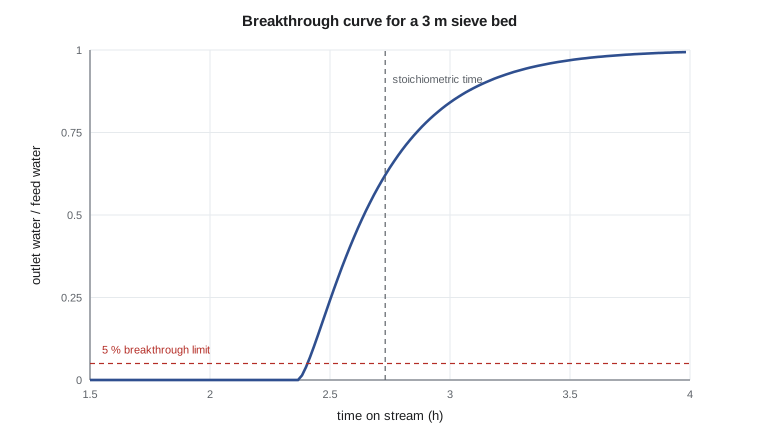
Inside a bed, the adsorbate is not taken up at a sharp front. Near the inlet the sieve is saturated; downstream it is still fresh; between them lies the mass-transfer zone, where loading rises from fresh to saturated. As feed continues, the zone moves through the bed, and when its leading edge reaches the outlet the adsorbate appears in the product: breakthrough. A plot of outlet concentration against time is the breakthrough curve, an S-shaped trace whose steepness reflects how fast mass transfer is.
The program simulates a long-cycle bed, 3 m in diameter and 3 m deep, holding 14.8 t of sieve and regenerated by a hot purge so that it starts essentially dry. It uses a linear-driving-force model, \(dq/dt = k_L(q^* - q)\), with \(k_L = 0.001\) s⁻¹ (illustrative). If mass transfer were instantaneous, the bed would saturate at the stoichiometric time, 2.73 h, and break through sharply then. With finite transfer, the outlet reaches 5 % of the feed water at 2.41 h, half at 2.64 h and 95 % at 3.35 h.
Length of unused bed
The length of unused bed (LUB) turns a breakthrough curve into a design number. If the bed must be taken off line at the breakthrough time \(t_b\), the part of the bed not yet saturated is
where \(t_s\) is the stoichiometric time. Here \(\text{LUB} = 3.0(1 - 2.41/2.73) = 0.36\) m. Because the zone travels through the bed at constant shape for a favourable isotherm, the LUB measured in a laboratory or pilot column at the same velocity can simply be added to the stoichiometric length of a full-size bed. That scale-up rule, from Collins in the 1960s, is why designers ask for breakthrough curves at plant velocity rather than isotherms alone.
Worked problem
Stoichiometric time
Verify \(t_s\) for the 3 m bed with \(\rho_b = 700\) kg/m³, a loading change of 0.182 kg/kg, \(u = 0.35\) m/s and \(c_0 = 0.111\) kg/m³ of water in the gas.
Show solution
- Water capacity per square metre of bed: \(700 \times 0.182 \times 3.0 = 382\) kg/m².
- Water arriving per square metre per second: \(0.35 \times 0.111 = 0.0389\) kg/(m² s).
- \(t_s = 382/0.0389 = 9{,}830\) s \(= 2.73\) h.
Answer: About 2.7 h, the time at which an ideal bed would saturate.
Safety and practical points
Molecular sieve beds release heat as they adsorb water, roughly the heat of condensation plus a binding energy, so a fresh bed exposed suddenly to wet feed can heat by tens of degrees. Sieve dust is abrasive, so the beds have hold-down layers and outlet screens, and filters protect downstream equipment. Liquid water slugs from the rectifier can break the sieve beads, so feed superheating and knock-out drums matter. Because the vapour is flammable, the vacuum system's exhaust and any leaks are handled under the plant's hazardous-area rules and CSA Z767. And because the sieve slowly loses capacity, operators trend the cycle's product water against time and replace the sieve when breakthrough moves too close to the end of the step.
Common mistakes
MistakeDesigning with the full equilibrium swing in a short PSA cycle.
InsteadOnly part of the bed reaches equilibrium; use a realistic working capacity.
MistakeScaling a bed from its isotherm alone.
InsteadAdd the length of unused bed measured at the plant's velocity.
MistakeIgnoring the heat of adsorption.
InsteadA fresh bed can heat significantly; manage start-up and feed changes.
MistakeCalling molecular sieve dehydration a distillation step.
InsteadIt separates by molecular size and adsorption strength, independent of the azeotrope.
Summary and key terms
- 3A zeolite admits water (about 0.28 nm) and excludes ethanol (about 0.44 nm).
- The Langmuir isotherm gives the equilibrium loading; PSA and TSA regenerate by lowering pressure or raising temperature.
- The plant's 989 kg/h of water needs about 2.3 t of sieve per bed for an 8-minute step, before allowances.
- A 3 m bed breaks through at 2.41 h against a stoichiometric time of 2.73 h: an LUB of 0.36 m.
- LUB from a pilot breakthrough curve scales up directly.
- Adsorption isotherm
- The equilibrium loading of an adsorbent against partial pressure at fixed temperature.
- Molecular sieve
- A zeolite whose pores admit only molecules below a certain size.
- Pressure-swing adsorption
- Regenerating an adsorbent by lowering the pressure.
- Temperature-swing adsorption
- Regenerating an adsorbent by heating it.
- Breakthrough
- The appearance of the adsorbate at the bed outlet.
- Length of unused bed
- The unsaturated bed length when breakthrough occurs, used to scale up.
Practice problems
Work each problem on paper first, then reveal the answer to check.
Find \(q^*\) at \(p = 5\) kPa with \(q_m = 0.20\) and \(b = 0.5\).
Show answer
\(0.20 \times 2.5/3.5 = 0.143\) kg/kg.
Why does a favourable isotherm suit drying to very low water levels?
Show answer
The sieve holds much water even at low partial pressure.
If a pilot column gives an LUB of 0.3 m, how deep must a bed be whose stoichiometric length is 2.5 m?
Show answer
About 2.8 m.
Why are PSA cycles minutes long and TSA cycles hours?
Show answer
Pressure changes quickly; heating and cooling a bed is slow.
What happens to the purge that regenerates the plant's sieve beds?
Show answer
It returns to the rectifier, so its ethanol is not lost.
Name one reason to install much more sieve than the minimum.
Show answer
Capacity loss with age, feed upsets, or the mass-transfer zone.
Lesson quiz · 5 questions
Score 60% or more to complete this lesson.
Create a free account to save your progress, take quizzes and earn a certificate.