
BUS-450 · Lesson 8 of 12 · 26 min
Mergers, acquisitions and alliances
Lesson 7 asked which businesses a firm should be in. This lesson examines how firms change their scope: by building new businesses internally (organic growth), by buying them (acquisitions), by combining with them (mergers), by cooperating with other firms (alliances and joint ventures), and by selling or spinning off businesses (divestitures). Each route has different costs, speed, risks and legal requirements. Acquisitions in particular are among the largest and riskiest decisions managers make, and the evidence on whether they create value for the acquiring firm's shareholders is sobering. FIN-201 provides the valuation tools; here the focus is on strategic logic, the economics of premiums and synergies, integration, alliances and the competition and foreign-investment reviews that large deals face.
Build, borrow or buy
Capron and Mitchell framed the choice of growth mode as build, borrow or buy. Building internally gives control and avoids paying a premium, and it develops the firm's own capabilities, but it is slow and risky when the firm lacks relevant knowledge. Borrowing through contracts, licences and alliances gives access to a partner's resources quickly and with limited commitment, but requires sharing control and value. Buying gives fast access to resources and market position but requires paying a premium, integrating different organizations and accepting the risk of overpaying. Their research suggested firms that choose the mode to fit the situation, rather than defaulting to one mode, grow more successfully.
| Mode | Best when | Main risks |
|---|---|---|
| Build (organic) | The firm has related capabilities and time; resources are not available to buy | Slow; may fail for lack of knowledge |
| Borrow (contract, licence, alliance) | Needs are specific and partners' goals are compatible | Partner opportunism, knowledge leakage, conflict over control |
| Buy (acquisition) | Speed matters and integration is feasible | Overpaying, integration failure, culture clash, regulatory obstacles |
| Divest (sell or spin off) | Another owner would add more value | Selling too cheaply, stranded costs, loss of synergies |
Why firms acquire
Common motives for acquisition include gaining market power by reducing competition, achieving economies of scale and scope (cost synergies), entering new markets or acquiring new capabilities faster than building them (revenue synergies), acquiring technology or talent (sometimes called acqui-hires), diversifying, replacing poor management of an underperforming target, and tax or financial benefits. Some motives serve managers rather than shareholders: empire building, higher pay that tracks firm size, defending against being acquired, and hubris, the overconfidence that leads managers to believe they can manage the target better than its own team and the market think.
Premiums, synergies and who gains
An acquirer must usually pay a control premium over the target's market value, often in the range of 20 to 40 per cent for public companies, to persuade shareholders to sell. The deal creates value for the acquirer's shareholders only if the present value of synergies exceeds the premium plus transaction and integration costs. Studies of public company acquisitions consistently find that target shareholders gain substantially, while acquirer shareholders on average earn returns close to zero or negative around announcement, with wide variation. In other words, competition for targets tends to transfer most of the expected synergies to the seller.
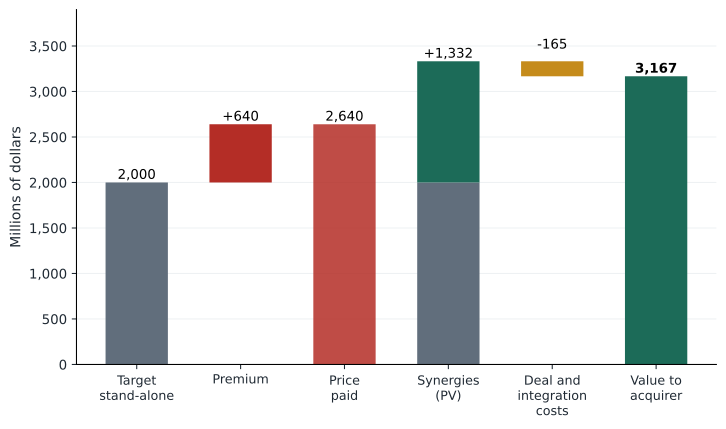
# Does the acquisition create value for the acquirer? (illustrative, $ millions)
import random
random.seed(7)
target_value = 2_000         # stand-alone market value of the target
premium_rate = 0.32          # control premium
transaction_costs = 45
integration_costs = 120      # one-time, present value
cost_synergy_annual = 95     # expected, pre-tax
revenue_synergy_annual = 40  # margin on extra revenue, pre-tax
tax, wacc, growth = 0.26, 0.085, 0.01
annual = (cost_synergy_annual + revenue_synergy_annual) * (1 - tax)
pv_synergies = annual / (wacc - growth)      # growing perpetuity
premium = target_value * premium_rate
npv = pv_synergies - premium - transaction_costs - integration_costs
print(f"PV of synergies {pv_synergies:,.0f}; premium {premium:,.0f}; NPV to acquirer {npv:,.0f}")
# Synergies are uncertain: simulate realization rates
results = []
for _ in range(10_000):
    realized = random.triangular(0.4, 1.1, 0.8)   # share of expected synergies achieved
    delay = random.choice([0, 1, 2])              # years before synergies start
    pv = annual * realized / (wacc - growth) / (1 + wacc) ** delay
    results.append(pv - premium - transaction_costs - integration_costs)
results.sort()
print(f"Mean NPV {sum(results)/len(results):,.0f}; probability NPV < 0: {sum(r < 0 for r in results)/len(results):.0%}")PV of synergies 1,332; premium 640; NPV to acquirer 527 Mean NPV 137; probability NPV < 0: 25%
With every assumption met, the deal adds value, but once realistic uncertainty about how much of the synergy is achieved and when is introduced, the expected NPV falls and there is a substantial probability of destroying value. Revenue synergies are usually less certain than cost synergies, and integration costs are often underestimated. Disciplined acquirers set a walk-away price based on conservative synergy estimates and stick to it, a discipline that is hard to maintain in a competitive auction.
Integration
Most acquisition failures are failures of integration rather than of strategy. Haspeslagh and Jemison classified integration approaches by two dimensions: the need for strategic interdependence (how much the businesses must share resources to create value) and the need for organizational autonomy (how much the target's distinctive capabilities depend on its independence). Absorption fully merges the target, suitable when interdependence is high and autonomy unimportant, as in cost-driven consolidation. Preservation keeps the target largely independent, suitable when its value lies in a culture or capability that integration would destroy, such as a creative studio or a technology start-up. Symbiosis combines both, gradually building links while protecting what matters. Holding arrangements involve little integration.
Integration requires decisions on leadership, structure, systems, branding, customers and people, made quickly to reduce uncertainty. Culture clashes are a frequent cause of lost value: differences in decision-making speed, risk tolerance, hierarchy and norms. Key talent often leaves within the first year if uncertainty persists. Serial acquirers build integration capabilities: playbooks, dedicated integration teams and learning from past deals. Couche-Tard, which grew from a single store in Quebec into a global convenience retailer largely through acquisitions, is often cited for such a capability, though even serial acquirers face limits, as its withdrawn bid for Seven & i Holdings, the Japanese owner of 7-Eleven, showed in July 2025.
Strategic alliances and joint ventures
An alliance is a cooperative arrangement in which firms pool or exchange resources while remaining independent. Forms range from non-equity contracts (licensing, supply agreements, co-marketing, research partnerships) through minority equity stakes to joint ventures, separate entities jointly owned by two or more parents. Alliances can give access to markets, technology and capabilities, share risks and costs, set standards, and allow learning. They are common in pharmaceuticals (biotech firms partnering with large drug companies), airlines (code-sharing and global alliances, subject to antitrust approval), automotive technology and international entry, where a local partner provides market knowledge and relationships.
Alliances fail frequently, with many studies finding failure rates around half, though definitions vary. Causes include mismatched goals, unequal contributions, learning races in which one partner absorbs the other's knowledge and leaves, cultural differences, and poor governance. Success factors include clear objectives, careful partner selection, governance structures with decision rights and dispute resolution, protection of core knowledge, and exit provisions. Some firms develop an alliance capability with dedicated alliance managers and repeatable processes.
Competition review of mergers
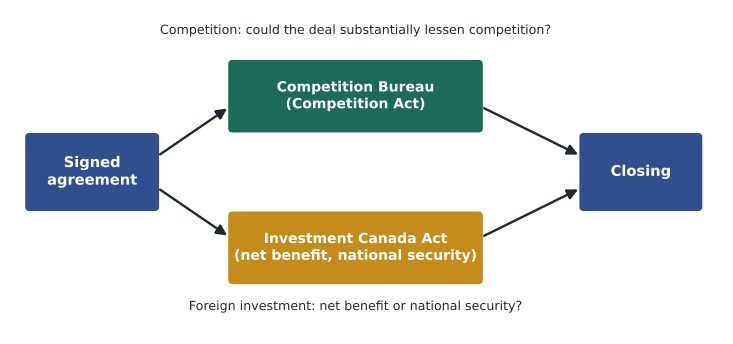
Large mergers and acquisitions must be reviewed by competition authorities, which can block deals or require remedies such as divesting overlapping businesses. Both countries require pre-merger notification above size thresholds and assess whether a deal is likely to substantially lessen or prevent competition. The analysis uses the market definition and concentration tools from lesson 2, along with evidence on closeness of competition, entry, buyer power and efficiencies. ECON-101 lesson 11 covered competition policy in general; here are the merger-specific rules that a strategist must anticipate.
In Canada, the Competition Bureau reviews mergers under the Competition Act, and contested cases go to the Competition Tribunal. The Act was substantially amended between 2022 and 2024. The efficiencies defence, which allowed anti-competitive mergers to proceed if efficiency gains outweighed the harm, was repealed in December 2023. Amendments in force from June 2024 created a rebuttable structural presumption: a merger is presumed likely to harm competition if it raises concentration by more than 100 HHI points and results in either a combined market share above 30 per cent or a post-merger HHI above 1,800. The Commissioner also gained up to three years after closing to challenge non-notifiable mergers. The Bureau's approval of the Rogers–Shaw merger in 2023 was conditional on the sale of Freedom Mobile to Quebecor's Videotron. Updated merger enforcement guidelines were under consultation in 2025 and 2026; check the Bureau's site for the current version.
Foreign investment review
Acquisitions by foreign buyers face an additional review in both countries, focused on net benefit or national security rather than competition. These reviews have become more frequent and more stringent, particularly for investments by state-owned enterprises and in sensitive technologies, critical minerals, infrastructure and personal data.
Canada's Investment Canada Act requires notification of foreign acquisitions of Canadian businesses and, above financial thresholds, review to determine whether the investment is likely to be of net benefit to Canada. Separately, any foreign investment, regardless of size, can be reviewed on national security grounds. Amendments enacted in March 2024 strengthened the national security regime, including powers to impose interim conditions during reviews, stiffer penalties, and a framework for mandatory pre-closing filings in prescribed sensitive sectors; check whether the regulations implementing pre-closing filing are in force. Government policy statements have also signalled strict scrutiny of state-owned investors in critical minerals.
Divestitures and spin-offs
Divesting businesses is the mirror image of acquiring them. Firms sell or spin off businesses that no longer fit, that another owner could run better (lesson 7's parenting test), that distract management, or that must be sold to satisfy competition remedies. A sale to another firm or private equity investor brings cash; a spin-off distributes shares of the unit to existing shareholders, creating an independent public company, and in both countries can often be structured to be tax-free if conditions are met. Research generally finds positive market reactions to spin-offs, consistent with the conglomerate discount.
Worked problem
Evaluating an acquisition proposal
An invented regional bakery chain (market value $600 million) proposes to acquire a smaller rival (market value $250 million) for $340 million. Management expects cost synergies of $12 million a year after tax from shared distribution and purchasing, starting in year 2, growing 1 % a year. Integration costs are $15 million now. The cost of capital is 9 %. The combined firm would hold 38 % of the regional market. Evaluate.
Show solution
- Premium: 340 − 250 = $90 million (36 %).
- PV of synergies at the start of year 2: 12 ÷ (0.09 − 0.01) = $150 million; discounted one year: 150 ÷ 1.09 = $137.6 million.
- NPV to acquirer: 137.6 − 90 − 15 = $32.6 million, before any revenue synergies, if the cost savings materialize.
- Risks: a share above 30 % triggers the structural presumption in both countries if concentration also rises enough, so a competition review and possible divestiture of some stores are likely. Integration of bakery cultures and routes must be planned.
- Recommendation: proceed only with conservative synergy estimates, a walk-away price below about $370 million, and an early competition-law assessment.
Answer: The deal can create value if synergies are realized and competition approval is obtained, but the margin for error is modest.
Common mistakes
MistakeAcquisitions reliably create value for acquiring shareholders.
InsteadOn average, target shareholders capture most of the gains; acquirers earn about zero or negative returns.
MistakeIf synergies exist, any price is justified.
InsteadThe acquirer gains only if the PV of synergies exceeds the premium plus transaction and integration costs.
MistakeEvery acquired company should be fully absorbed.
InsteadIntegration should match interdependence and autonomy needs; absorbing a creative target can destroy its value.
MistakeAlliances are a low-risk alternative to acquisitions.
InsteadAlliances often fail because of mismatched goals, learning races and weak governance.
MistakeCompetition review only matters for deals between giant firms.
InsteadLocal and regional mergers can raise concentration enough to trigger review and remedies.
Summary and key terms
- Firms can build, borrow or buy; the right mode depends on capabilities, speed and integration needs.
- Acquisition motives include market power, synergies, capabilities and talent, but also managerial self-interest and hubris.
- Acquirers create value only when synergies exceed the premium and costs; on average, targets capture most gains.
- Integration approaches range from absorption to preservation, and culture and talent retention are frequent failure points.
- Alliances and joint ventures share resources and risks but need clear goals, governance and protection of knowledge.
- Both countries presume harm from mergers above similar concentration thresholds, with Canada's regime strengthened since 2023.
- Foreign acquisitions face net-benefit or national security review under the Investment Canada Act or CFIUS.
- Acquisition
- The purchase of a controlling interest in another firm.
- Control premium
- The amount paid above a target's stand-alone market value to gain control.
- Synergy
- Value created by combining firms that would not exist separately.
- Hubris hypothesis
- The idea that overconfident managers overpay for acquisitions.
- Absorption
- An integration approach that fully merges the target into the acquirer.
- Preservation
- An integration approach that keeps the target largely autonomous.
- Strategic alliance
- A cooperative arrangement between independent firms.
- Joint venture
- A separate entity jointly owned by two or more parent firms.
- Structural presumption
- A rule presuming that mergers above concentration thresholds harm competition.
- Spin-off
- Distributing shares of a business unit to existing shareholders as an independent company.
Practice problems
Work each problem on paper first, then reveal the answer to check.
Target value $500 million; price $650 million. What is the premium?
Show answer
$150 million, or 30 %.
Synergies of $20 million a year after tax forever, cost of capital 10 %. PV?
Show answer
$200 million.
With that PV and the premium above, plus $20 million of costs, what is the acquirer's NPV?
Show answer
200 − 150 − 20 = $30 million.
Why do target shareholders usually gain most?
Show answer
Competition among bidders bids the price up toward the full synergy value.
When is preservation the right integration approach?
Show answer
When the target's value depends on autonomy, such as a creative or entrepreneurial culture.
Name two causes of alliance failure.
Show answer
Mismatched goals; learning races; weak governance; cultural differences.
State the structural presumption thresholds used in both countries.
Show answer
HHI increase above 100 and either a post-merger HHI above 1,800 or a combined share above 30 %.
What does foreign investment review focus on?
Show answer
Net benefit or national security, not competition.
Why might a firm spin off a business?
Show answer
Another structure or owner would add more value, and focused firms are often valued more highly.
Portfolio task: analyse a recent acquisition, estimating the premium and the synergies needed to justify it.
Show answer
Answers vary; use public data and state assumptions.
Lesson quiz · 5 questions
Score 60% or more to complete this lesson.
Create a free account to save your progress, take quizzes and earn a certificate.