
BUS-450 · Lesson 1 of 12 · 27 min
What strategy is
Every organization makes choices about where it will compete and how it will win, whether or not anyone writes them down. Strategic management is the discipline of making those choices deliberately, testing them against evidence, turning them into action and revising them as the world changes. This course brings together the business core: marketing (BUS-220), operations (BUS-230), finance (FIN-201), organizational behaviour (BUS-130), ethics and governance (BUS-310) and economics (ECON-101 and ECON-102). Strategy is where those subjects meet, because a strategy is only as good as its fit with customers, costs, capital, people and rules. This first lesson defines strategy, separates it from things that are often mistaken for it, and sets out the process the rest of the course follows.
Strategy as a set of choices
There are many definitions of strategy, but most share a core idea: a strategy is an integrated set of choices that positions an organization to create more value than its rivals, in a way that is hard to copy. Three words in that sentence matter. Integrated means the choices reinforce each other: a discount airline's single aircraft type, quick turnarounds, point-to-point routes and no-frills service each make the others cheaper. Choices means saying no as well as yes; a strategy that tries to serve every customer with every product at every price point is a wish list, not a strategy. Value means the gap between what customers are willing to pay and what it costs to serve them, which lesson 5 develops in detail.
Michael Porter argued in an influential 1996 article that operational effectiveness, doing the same things better than rivals, is necessary but not sufficient. Best practices diffuse quickly: when every firm adopts the same software, lean methods and outsourcing, costs fall for all of them and no one gains a lasting edge. Strategy, by contrast, is about performing different activities, or similar activities in different ways, and accepting trade-offs that rivals are unwilling to make. A trade-off exists when more of one thing means less of another, such as a premium brand image that would be damaged by discount channels, or a low-cost operation that cannot offer custom features.
Richard Rumelt's book on good and bad strategy offers a practical test. A good strategy has a kernel of three parts: a diagnosis that defines the challenge, a guiding policy for dealing with it, and coherent actions that carry out the policy. Bad strategy, in his account, shows up as fluff (impressive words with no content), failure to face the real problem, mistaking goals for strategy ("grow revenue 20 per cent a year" is a target, not a plan) and lists of unrelated objectives. The test is useful when you read company reports and when you write your own plan in lesson 12.
Mission, vision, values and objectives
Strategy sits inside a hierarchy of statements that organizations use to set direction. A mission says what the organization does and for whom: its purpose. A vision describes a desired future state, usually five to ten years out. Values describe how people are expected to behave on the way. Objectives turn the vision into measurable targets, and strategy is the set of choices for reaching them. BUS-220 lesson 2 introduced mission statements and objectives from a marketing point of view; here the emphasis is on how they constrain and guide strategic choices.
Mission and vision statements are often criticized as interchangeable slogans. A useful statement is specific enough to rule things out. Compare "We delight our customers through innovation" with a statement such as "We help small independent retailers sell online without hiring developers." The second tells managers which customers to serve, which needs to address and which opportunities to decline, such as building tools for large enterprises. Values matter when they are tested by real trade-offs: a company that claims to value safety but rewards supervisors only for output will get output. BUS-310 discusses how codes and values become real through governance and incentives.
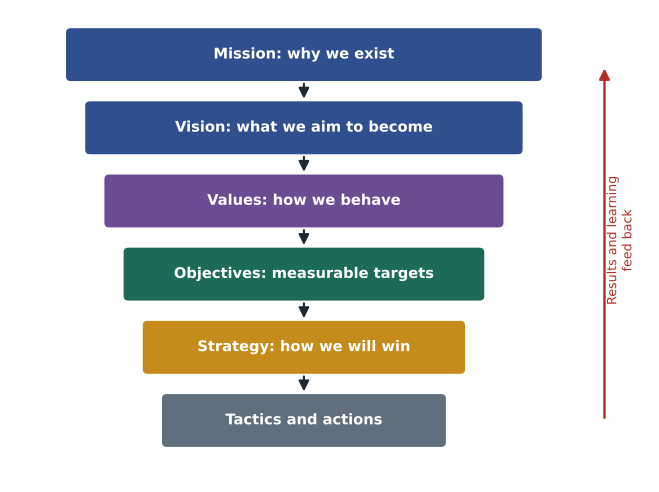
| Statement | Question it answers | Example (invented outdoor retailer) |
|---|---|---|
| Mission | Why do we exist and whom do we serve? | Equip families to spend more time outdoors, safely and affordably. |
| Vision | What do we want to become? | The first stop for family outdoor gear in our region within eight years. |
| Values | How will we behave? | Honest advice, repair before replace, respect for land and communities. |
| Objectives | What will we achieve, by when? | Same-store sales growth of 4 % a year; repair service in every store by 2029. |
| Strategy | How will we win? | Expert staff, rentals and repairs that big-box rivals do not match, in mid-sized towns. |
Levels of strategy
Strategy operates at several levels. Corporate strategy asks which businesses the firm should be in and how the parent adds value to them; lessons 7 and 8 cover diversification, vertical integration, acquisitions and alliances. Business-level or competitive strategy asks how a particular business will compete in its market: on cost, on differentiation, or by focusing on a niche, the subject of lesson 5. Functional strategies in marketing, operations, finance and human resources translate the business strategy into the work of each department. A firm with a single business has only the business and functional levels; a conglomerate such as a diversified holding company has all three.
The levels must fit together. A business strategy built on premium service fails if the operations strategy (BUS-230 lesson 2) chases the lowest cost, or if human resources pays front-line staff the least in the market. Fit across levels is one reason strategy is hard to copy: a rival can imitate one practice, but imitating an entire system of mutually reinforcing activities is far harder.
Stakeholders and the purpose of the firm
Whose interests should strategy serve? FIN-201 lesson 1 justified maximizing the value of the firm as a working goal for financial decisions, and BUS-310 lesson 4 examined the debate between shareholder primacy and stakeholder approaches. For strategy, a practical position is that sustained value creation requires attention to customers, employees, suppliers, communities and regulators, because a firm that alienates them will find its costs rising and its options narrowing. Stakeholder mapping, which ranks groups by their power and interest, helps managers anticipate who can block or enable a strategy. The legal context differs between the two countries.
In Canada, the Supreme Court's decision in BCE (2008) held that directors owe their duty to the corporation and may consider the interests of shareholders, employees, creditors, consumers, governments and the environment, and the Canada Business Corporations Act was amended in 2019 to say so explicitly. Strategy discussions at Canadian boards therefore often frame choices in terms of the corporation's long-term interests rather than any single group. BUS-210 lesson 9 covers directors' duties in more detail.
Intended and emergent strategy
Henry Mintzberg distinguished intended strategy, the plan managers set out to follow, from realized strategy, what the organization actually does. Some intended strategy is never realized because circumstances change or execution fails. Some realized strategy was never planned: it emerges from decisions made by people throughout the organization in response to opportunities. A classic example is how a motorcycle maker's entry into a foreign market succeeded not with the large bikes it planned to sell but with small bikes that its own staff rode around town and that customers asked to buy.
The lesson is not that planning is useless but that strategy is a learning process. Good strategic management sets a clear direction, watches for emerging patterns, and decides deliberately which experiments to scale and which to stop. Planning cycles that produce thick binders and change nothing are a waste; so is pure improvisation without direction. Many firms now combine an annual strategic review with quarterly check-ins on assumptions and key initiatives, an approach lesson 11 returns to under strategic control.
The strategic management process
The rest of the course follows a common process model. Analysis comes first: the external environment (lessons 2 and 3) and the firm's internal resources and capabilities (lesson 4). Formulation follows: choosing a business-level strategy (lesson 5), dealing with technology and platforms (lesson 6), and making corporate and international choices (lessons 7 to 9). Implementation turns choices into action through structure, culture, control and change (lesson 10). Evaluation measures results and adjusts the strategy (lesson 11). The capstone in lesson 12 runs through the whole cycle for a single case.
In practice the stages overlap. Analysis keeps going during implementation, and the experience of implementing a strategy reveals what the analysis missed. The model is a checklist for thinking, not a rigid sequence. BUS-220 lesson 2 introduced PESTEL, SWOT and the Ansoff matrix as tools for marketing planning; in this course they reappear as inputs to a broader strategic analysis, and we add tools that go deeper into industry economics, capabilities and competitive interaction.
Worked problem
Testing a strategy statement
An invented regional grocery chain announces its new strategy: "To be the best grocer in the region, delighting customers with quality, value and convenience while growing profitably and sustainably." Apply Rumelt's kernel test and suggest an improvement.
Show solution
- Diagnosis: the statement names no challenge. What is the chain up against? Suppose analysis shows discount rivals are taking price-sensitive shoppers while online delivery is taking busy professionals.
- Guiding policy: the statement promises quality, value and convenience together, which avoids any trade-off. A guiding policy might be to concentrate on fresh food and local products for households that cook at home, conceding the cheapest dry goods to discounters.
- Coherent actions: none are given. Actions might include expanding fresh departments, building direct contracts with nearby farms, redesigning stores for faster fresh-food shopping, and ending price matching on national brands.
- Revised statement: "Discounters win on packaged goods and delivery apps win on convenience; we will win households that cook at home by offering the freshest local food in the region, through farm partnerships, larger fresh departments and expert staff, while no longer matching discount prices on packaged brands."
Answer: The original is a goal dressed as a strategy. The revision names the challenge, makes a choice that rules things out, and lists actions that reinforce one another.
Who makes strategy
In large firms the chief executive and senior team are responsible for strategy, and the board of directors approves it and monitors its execution. Strategy departments, consultants and investment bankers provide analysis. But many strategic decisions are made further down: a product manager who chooses which customers to serve, a plant manager who decides how to respond to a new competitor, a sales team that discovers a new use for a product. Organizations that treat strategy as the exclusive work of a planning department tend to produce plans that the people who must carry them out neither understand nor believe.
In small and medium-sized enterprises, which employ most private-sector workers in both Canada and the United States, the owner-manager usually makes strategy informally. The tools in this course scale down: a five-forces sketch on one page, a list of the three capabilities that win customers, and a simple scorecard of a few measures can sharpen an owner's thinking without bureaucracy.
Strategy in Canadian firms
Canadian firms face strategic conditions that differ from those of American firms in degree. The domestic market is about a tenth the size of the US market and spread across a large territory, so scale economies are harder to reach at home and many firms must export or expand abroad early. Several important industries, including telecommunications, banking, grocery and airlines, are concentrated among a few large firms, partly because of regulation and geography. Trade with the United States accounts for most of Canada's exports, which makes trade policy a strategic variable, as lessons 8 and 9 discuss. Firms such as Shopify, Canadian Tire and Alimentation Couche-Tard show different responses: building a global software platform from Ottawa, defending a domestic retail franchise with a loyalty ecosystem, and growing through serial acquisitions across countries.
| Common confusion | Why it is not a strategy | What a strategy adds |
|---|---|---|
| A goal ("double revenue") | States a desired result, not how to get it | Choices about customers, offering and activities |
| A budget | Allocates money for a year based on last year | A logic for where resources create advantage |
| A vision statement | Describes a future state | A diagnosis of obstacles and a path around them |
| Operational excellence | Best practice that rivals can copy | Different activities and trade-offs rivals avoid |
| A list of initiatives | Unconnected projects compete for resources | Actions that reinforce one another |
Common mistakes
MistakeA strategy should aim to satisfy every customer segment.
InsteadStrategy requires choosing whom not to serve; trying to please everyone usually means winning no one.
MistakeOur goal of 15 % annual growth is our strategy.
InsteadA growth target is an objective; the strategy is the set of choices that will produce the growth.
MistakeCopying industry best practices will give us a competitive advantage.
InsteadBest practices diffuse to rivals; lasting advantage comes from distinctive activities and trade-offs.
MistakeStrategy is set once every five years by senior management.
InsteadStrategy is reviewed continually, and emergent strategy from throughout the firm matters.
MistakeMission statements are just public relations.
InsteadA specific mission rules choices in and out; vague ones are useless, but good ones guide decisions.
Summary and key terms
- A strategy is an integrated set of choices about where to compete and how to win that creates more value than rivals and is hard to copy.
- Operational effectiveness is necessary but not sufficient; strategy involves distinctive activities and trade-offs.
- Good strategy has a diagnosis, a guiding policy and coherent actions; goals and slogans are not strategy.
- Mission, vision, values and objectives frame strategy; specific statements rule options out.
- Corporate, business and functional strategies must fit together.
- Realized strategy combines intended plans and emergent patterns; strategic management is a learning process.
- The process runs through analysis, formulation, implementation and evaluation, with constant overlap.
- Strategy
- An integrated set of choices that positions an organization to create superior value in a way that is hard to imitate.
- Operational effectiveness
- Performing similar activities better than rivals.
- Trade-off
- A situation in which more of one attribute or activity requires less of another.
- Mission
- A statement of an organization's purpose and whom it serves.
- Vision
- A statement of a desired future state.
- Corporate strategy
- Choices about which businesses to be in and how the parent adds value.
- Business-level strategy
- How a single business competes in its market.
- Emergent strategy
- A realized pattern of action that was not planned in advance.
- Kernel of strategy
- Rumelt's three parts: diagnosis, guiding policy and coherent actions.
- Stakeholder mapping
- Ranking groups by power and interest to anticipate their influence on a strategy.
Practice problems
Work each problem on paper first, then reveal the answer to check.
Define strategy in one sentence.
Show answer
An integrated set of choices about where to compete and how to win that creates superior value and is hard to copy.
Why is operational effectiveness not enough?
Show answer
Best practices spread to rivals, so improvements raise the industry standard without creating a lasting edge.
Give an example of a trade-off.
Show answer
A luxury brand avoids discount retailers because selling there would weaken its image.
What are the three parts of Rumelt's kernel?
Show answer
Diagnosis, guiding policy and coherent actions.
Distinguish mission from vision.
Show answer
Mission is the present purpose; vision is the desired future state.
Name the three levels of strategy.
Show answer
Corporate, business and functional.
What is emergent strategy?
Show answer
A pattern of action that develops without having been planned.
Why might a stakeholder map matter for a mine expansion?
Show answer
Communities, Indigenous nations, regulators and lenders have power to delay or block it, so their interests must be addressed early.
Rewrite "be the best bank in the country" as a strategy.
Show answer
Answers vary; it should name a challenge, choose customers and an offer, and list reinforcing actions.
Portfolio task: find a company's published strategy and apply the kernel test.
Show answer
Answers vary; identify whether each of the three parts is present and specific.
Lesson quiz · 5 questions
Score 60% or more to complete this lesson.
Create a free account to save your progress, take quizzes and earn a certificate.