
BUS-450 · Lesson 4 of 12 · 26 min
Internal analysis: resources, capabilities and VRIO
Industry structure explains why average profits differ across industries, but profits also differ widely among firms in the same industry, often by more than they differ across industries. Two grocery chains facing the same suppliers, customers and rivals can earn very different returns. The resource-based view of the firm explains these differences by looking inward: firms differ in the resources and capabilities they control, and some of those differences are valuable, rare and hard to copy. This lesson builds the tools of internal analysis: the value chain, the distinction between resources and capabilities, the VRIO framework and the dynamic capabilities that let firms renew their advantages over time.
Resources and capabilities
Resources are the assets a firm owns or controls. Tangible resources include physical assets (plants, stores, land, networks), financial assets (cash, borrowing capacity) and natural resources (mining rights, spectrum licences, water rights). Intangible resources include brands, reputation, patents, copyrights, proprietary data, relationships with customers and suppliers, and organizational culture. Human resources, the skills and knowledge of employees, sit in between: the firm does not own its people, but it can attract, develop and organize them.
Capabilities are what the firm can do by combining resources through routines and processes: designing products customers love, launching new stores efficiently, managing a global supply chain, integrating acquisitions, developing software quickly. Capabilities are often more important than individual resources, because they are built over time through learning, embedded in teams and processes, and hard to observe from outside. A rival can buy the same equipment; it cannot easily buy the way a well-run firm uses it. The most important capabilities, those central to a firm's competitive advantage, are often called core competencies, a term popularized by Prahalad and Hamel.
| Category | Examples | Why it can matter |
|---|---|---|
| Physical | Store locations, pipelines, fibre networks, fleets | Scarce locations and networks are costly to duplicate |
| Financial | Cash reserves, credit rating, access to capital | Funds investment and absorbs shocks; rarely a lasting edge alone |
| Intangible | Brands, patents, data, reputation, licences | Often rare and protected by law or history |
| Human | Engineering talent, store managers, sales relationships | Knowledge is tacit and hard to transfer |
| Organizational capabilities | Product development, logistics, acquisition integration | Built over years; embedded in routines and culture |
The value chain
Porter's value chain is a way to break a business into the activities that create value and incur cost, so that each can be examined for its contribution to advantage. Primary activities are inbound logistics, operations, outbound logistics, marketing and sales, and service. Support activities are firm infrastructure (management, finance, legal), human resource management, technology development and procurement. Margin is the difference between the value customers pay for and the total cost of the activities. For services and digital businesses, analysts often adapt the chain: a software firm's chain might run from product development to cloud operations, customer acquisition, onboarding and customer success.
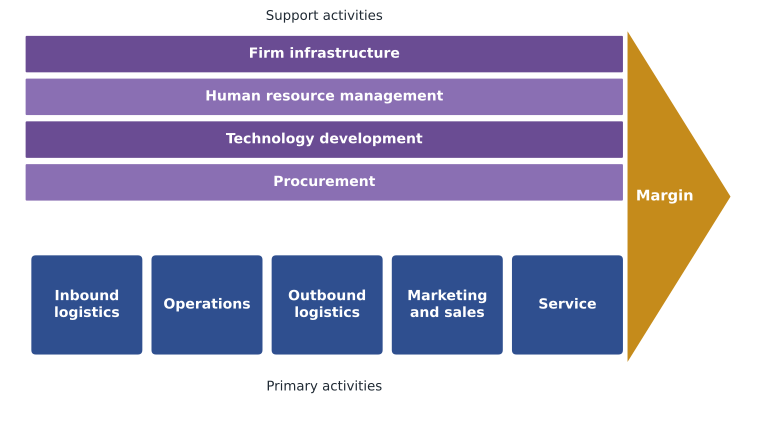
Value chain analysis has two uses. First, it locates cost: by assigning costs to activities and comparing them with rivals', a firm finds where it is efficient and where it is not. Second, it locates differentiation: by asking which activities shape what customers value, a firm finds where it stands out. Linkages between activities matter as much as the activities themselves: better product design can lower manufacturing and service costs; tight coordination between purchasing and operations can reduce inventory. The value chain also extends beyond the firm into a value system that includes suppliers, channels and customers, which lesson 7 uses to analyse vertical integration.
# Value chain cost comparison for two invented furniture makers ($ per unit)
activities = ["Inbound logistics", "Operations", "Outbound logistics",
              "Marketing and sales", "Service", "Support activities"]
firm  = [38, 210, 55, 70, 15, 62]
rival = [41, 182, 48, 95, 22, 58]
price_firm, price_rival = 520, 500
print(f"{'Activity':<22}{'Firm':>7}{'Rival':>7}{'Gap':>7}")
for a, f, r in zip(activities, firm, rival):
    print(f"{a:<22}{f:>7}{r:>7}{f - r:>+7}")
tf, tr = sum(firm), sum(rival)
print(f"{'Total cost':<22}{tf:>7}{tr:>7}{tf - tr:>+7}")
print(f"Margin per unit: firm {price_firm - tf}, rival {price_rival - tr}")Activity Firm Rival Gap Inbound logistics 38 41 -3 Operations 210 182 +28 Outbound logistics 55 48 +7 Marketing and sales 70 95 -25 Service 15 22 -7 Support activities 62 58 +4 Total cost 450 446 +4 Margin per unit: firm 70, rival 54
In this invented example the firm's operations cost 28 dollars more per unit than the rival's, but it spends less on marketing, sales and service and earns a higher price, perhaps because of better design or reputation. The comparison points managers to a specific question: why are operations costly, and can that be fixed without losing the features customers pay for? Cost data for rivals are rarely available in this detail; analysts estimate them from annual reports, industry studies, teardowns of products and interviews.
The VRIO framework
Jay Barney's VRIO framework asks four questions about each resource or capability. Is it Valuable: does it let the firm exploit an opportunity or neutralize a threat, raising willingness to pay or lowering cost? Is it Rare: do few competitors have it? Is it costly to Imitate: would rivals face a cost disadvantage in obtaining or developing it? Is the firm Organized to capture its value: do structure, systems, incentives and culture let the firm use it? The answers determine the competitive implication.
| Valuable? | Rare? | Costly to imitate? | Organized? | Competitive implication |
|---|---|---|---|---|
| No | – | – | – | Competitive disadvantage |
| Yes | No | – | – | Competitive parity |
| Yes | Yes | No | – | Temporary advantage |
| Yes | Yes | Yes | Partly | Advantage at risk of not being captured |
| Yes | Yes | Yes | Yes | Sustained competitive advantage |
Imitation can happen by duplication (building the same resource) or by substitution (achieving the same result another way). Resources are costly to imitate when they depend on unique historical conditions (a location secured decades ago, a culture formed by founders), when causal ambiguity makes it unclear which of many factors produce the advantage, when they are socially complex (relationships, trust, reputation), or when they are protected by patents, copyrights, licences or contracts. Time compression diseconomies also matter: some capabilities cannot be built faster by spending more, just as a brand's decades of reputation cannot be bought in a year.
# VRIO screen for an invented regional retailer's resources
resources = {
    "Prime downtown store leases": (True, True, True, True),
    "Point-of-sale software":      (True, False, False, True),
    "Loyalty data (10 years)":     (True, True, True, False),
    "Expert repair technicians":   (True, True, True, True),
    "Website":                     (True, False, False, True),
}
def implication(v, r, i, o):
    if not v: return "disadvantage"
    if not r: return "parity"
    if not i: return "temporary advantage"
    return "sustained advantage" if o else "unrealized advantage"
for name, ans in resources.items():
print(f"{name:<30} {implication(*ans)}")Prime downtown store leases sustained advantage Point-of-sale software parity Loyalty data (10 years) unrealized advantage Expert repair technicians sustained advantage Website parity
The loyalty data are valuable, rare and hard to imitate, but the retailer has not organized to use them: there are no analysts, no linkage to promotions and no incentives for store managers to act on the insights. That is a common situation. The framework's fourth question is easy to skip, yet many firms sit on valuable assets they fail to exploit.
Capabilities in practice: a Canadian example
Canadian Tire is often cited for a capability built around its loyalty ecosystem. Its Triangle Rewards program links purchases across its banners, which include sporting goods and apparel chains and gas bars, and its own financial services arm issues credit cards. The resulting data on millions of members are valuable for targeting, rare in Canadian retail, hard to imitate because they depend on decades of store locations, brand trust and an integrated card business, and organized through dedicated analytics and marketing functions. A rival could launch a loyalty program, but replicating the combination of national store coverage, product range and financial services would take years. Treat specific membership figures as changing over time.
Dynamic capabilities
Advantages based on today's resources erode as markets and technologies change. David Teece and colleagues introduced dynamic capabilities: the firm's ability to integrate, build and reconfigure its resources to address changing environments. Teece breaks them into sensing (spotting opportunities and threats, for example through research, customer contact and scanning start-ups), seizing (mobilizing resources to capture opportunities, through investment decisions and business model design) and transforming (continually renewing the organization, including its structure and culture). Firms with strong dynamic capabilities can move from one advantage to the next, which matters most in fast-changing industries.
A related idea is the risk of core rigidities, described by Dorothy Leonard-Barton: capabilities that once created advantage can become traps when the environment shifts. A firm superb at engineering complex hardware may struggle when value moves to software; a newspaper skilled at selling print advertising may struggle when audiences move online. The routines, incentives and identity built around the old capability resist change. Lesson 10 discusses how leaders manage strategic change in the face of such rigidities.
SWOT revisited
BUS-220 lesson 2 introduced SWOT analysis. With the tools of lessons 2 to 4, SWOT becomes more rigorous. Strengths and weaknesses should be judged with VRIO and value chain comparisons, not lists of adjectives; opportunities and threats should come from the five forces, competitive dynamics and the life cycle. The output should be choices, not a four-box list. One method is the TOWS matrix, which pairs internal and external factors: strategies that use strengths to seize opportunities, use strengths to counter threats, overcome weaknesses by exploiting opportunities, and minimize weaknesses to avoid threats.
Benchmarking and gathering evidence
Internal analysis needs evidence about rivals, which is rarely published in the detail managers would like. Benchmarking compares a firm's performance and practices with those of competitors or of leading firms in other industries that perform a similar activity, such as comparing a hospital's patient scheduling with an airline's reservation system. Sources include annual reports and regulatory filings, industry associations and statistics agencies, trade press, customer and supplier interviews, product teardowns, job postings (which reveal where rivals are building capabilities), patent filings and former employees' public statements, always within legal and ethical limits on confidential information. Evidence should be triangulated from several sources, and judgements about rarity and imitability should be tested by asking what a well-funded rival would need to do, and how long it would take, to match the firm.
Worked problem
Applying VRIO to a professional services firm
An invented engineering consultancy has 400 staff, a reputation for bridge inspections built over 40 years, licensed engineers in four provinces or states, a standard project-management software package, and long relationships with three government transportation departments. Which resources could give sustained advantage, and what must the firm do to capture it?
Show solution
- Reputation for bridge inspections: valuable (wins bids), rare (few firms have the track record), costly to imitate (built over decades, socially complex). Potential sustained advantage.
- Licensed engineers: valuable and fairly rare, but rivals can hire licensed engineers, so likely a temporary advantage unless tied to the firm's methods and culture.
- Project-management software: valuable but widely available; parity.
- Government relationships: valuable and rare, partly imitable through competitive bidding rules that require open procurement; at most a temporary advantage.
- Organization: to capture the reputation's value, the firm should codify its inspection methods, train younger engineers, publish technical work and price premium services accordingly.
Answer: The reputation and the capability behind it are the source of sustained advantage; the firm must organize to protect and exploit them.
Common mistakes
MistakeOur financial resources are our competitive advantage.
InsteadCash is valuable but rarely rare or hard to imitate; advantage comes from what the money builds.
MistakeA resource that is valuable and rare gives lasting advantage.
InsteadIt must also be costly to imitate and the firm must be organized to exploit it.
MistakeCapabilities are the same as resources.
InsteadCapabilities are what the firm can do by combining resources through routines and processes.
MistakeStrong capabilities protect a firm indefinitely.
InsteadCapabilities can become core rigidities when the environment changes; dynamic capabilities are needed to renew them.
MistakeSWOT strengths can be listed without evidence.
InsteadJudge strengths with VRIO and value chain comparisons against rivals.
Summary and key terms
- Firms in the same industry earn different returns because they control different resources and capabilities.
- Resources are assets; capabilities are what firms can do by combining resources through routines.
- The value chain locates cost and differentiation in primary and support activities and their linkages.
- VRIO asks whether a resource is valuable, rare, costly to imitate and supported by organization.
- Imitation is costly when resources depend on history, causal ambiguity, social complexity or legal protection.
- Dynamic capabilities let firms sense, seize and transform; core rigidities trap firms in old strengths.
- SWOT becomes useful when it draws on rigorous internal and external analysis and leads to choices.
- Resource-based view
- The theory that differences in firm performance stem from differences in resources and capabilities.
- Resource
- An asset a firm owns or controls.
- Capability
- A firm's capacity to perform an activity by combining resources.
- Core competence
- A capability central to a firm's competitive advantage.
- Value chain
- The set of primary and support activities through which a firm creates value.
- VRIO
- Valuable, rare, costly to imitate and organized: tests for sustained advantage.
- Causal ambiguity
- Uncertainty about which factors produce a firm's advantage, which hinders imitation.
- Time compression diseconomies
- Higher costs or failure when trying to build a capability faster than normal.
- Dynamic capabilities
- The capacity to integrate, build and reconfigure resources as environments change.
- Core rigidity
- A former strength that hinders adaptation to change.
Practice problems
Work each problem on paper first, then reveal the answer to check.
Distinguish a resource from a capability.
Show answer
A resource is an asset; a capability is what the firm can do with its resources.
Name the five primary activities in Porter's value chain.
Show answer
Inbound logistics, operations, outbound logistics, marketing and sales, service.
A firm's operations cost $15 more per unit than a rival's, but its price is $30 higher. Is it at a disadvantage?
Show answer
Not overall: its margin is $15 higher, if other activities are equal; but operations deserve scrutiny.
What does a valuable but common resource provide?
Show answer
Competitive parity.
Give three reasons a resource may be costly to imitate.
Show answer
Unique history, causal ambiguity, social complexity, or legal protection.
What is the "O" in VRIO and why does it matter?
Show answer
Organization; without supporting structure, systems and incentives the firm cannot capture the resource's value.
Name Teece's three parts of dynamic capabilities.
Show answer
Sensing, seizing and transforming.
Give an example of a core rigidity.
Show answer
A print publisher's advertising-sales strength hindering its move to digital subscriptions.
How does TOWS improve on SWOT?
Show answer
It pairs internal and external factors to generate strategies rather than lists.
Portfolio task: apply VRIO to five resources of a company you know and recommend one organizational change.
Show answer
Answers vary; justify each answer with evidence.
Lesson quiz · 5 questions
Score 60% or more to complete this lesson.
Create a free account to save your progress, take quizzes and earn a certificate.