
BUS-450 · Lesson 2 of 12 · 27 min
External analysis: industry structure and the five forces
Why do some industries earn high returns year after year while others struggle to cover their cost of capital? Average returns on invested capital differ widely across industries: software, branded consumer goods and some medical products have historically earned well above the cost of capital, while airlines, many commodity producers and restaurants have often earned below it. Differences in management matter, but so does the structure of the industry itself. This lesson builds the main tool for analysing industry structure, Porter's five forces, and connects it to the economics of market structure from ECON-101 lessons 9 to 11. BUS-220 lesson 2 covered the broader marketing environment and PESTEL; here we narrow the focus to the forces that set how much value an industry's firms can capture.
Defining the industry
Before analysing an industry you must define it, and the definition changes the answer. Is a ride-hailing service in the taxi industry, the urban transportation industry or the mobile platform industry? The useful test is substitution from the customer's point of view and from the producer's: which products do customers treat as close alternatives, and which firms could easily switch their capacity to serve the same customers? Define the industry too broadly and the analysis becomes vague; define it too narrowly and you miss the substitutes and entrants that will discipline prices. A practical approach is to start with the product and geographic scope where firms compete directly, and then treat neighbouring products as substitutes and neighbouring firms as potential entrants.
Geography matters as much as product. Cement and ready-mix concrete are local industries because transport costs limit how far a plant can ship; a cement plant's rivals are those within a few hundred kilometres. Software and financial information compete globally. Grocery retail is regional: a chain's competitors are the stores its customers can reach. Getting the geographic scope right is also central to competition law, which lesson 8 discusses for mergers.
The five forces
Porter's framework, first published in 1979 and refined in 2008, holds that the profitability of an industry depends on five forces: rivalry among existing competitors, the threat of new entrants, the threat of substitutes, the bargaining power of buyers and the bargaining power of suppliers. The stronger the forces, the more of the value created in the industry is competed away to customers or captured by suppliers, and the lower the average return. The framework is a structured way to ask where the profits in an industry go.
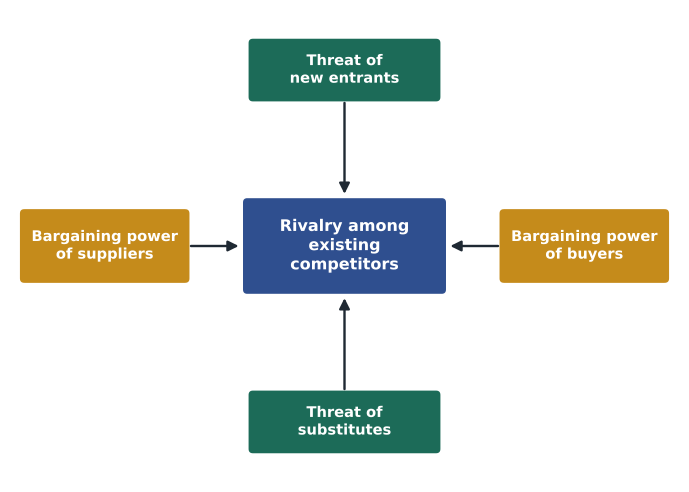
Rivalry among existing competitors
Rivalry is intense when competitors are numerous or roughly equal in size, when industry growth is slow so firms can grow only by taking share, when products are undifferentiated and switching costs are low, when fixed costs are high relative to variable costs so firms cut prices to fill capacity, when capacity must be added in large lumps, and when exit barriers such as specialized assets, labour agreements or government pressure keep losing firms in the market. Rivalry on price is the most damaging, because it transfers value directly to customers. Rivalry on product features, service or innovation can expand the market and may raise everyone's returns.
Concentration is one indicator. The concentration ratio CR4 is the combined market share of the four largest firms. The Herfindahl–Hirschman index (HHI) is the sum of the squared market shares of all firms, measured in percentage points, so it ranges from near zero for a fragmented industry to 10,000 for a monopoly. ECON-101 lesson 11 introduced the HHI for competition policy. A higher HHI suggests less intense rivalry, but concentration is not the whole story: a concentrated industry with high fixed costs and perishable capacity, such as airlines, can still have fierce price wars.
# Concentration of two invented industries (market shares, %)
industries = {
    "Industry A": [34, 28, 21, 9, 5, 3],
    "Industry B": [12, 10, 9, 8, 8, 7, 7, 6, 6, 5, 5, 5, 4, 4, 4],
}
for name, shares in industries.items():
    shares = sorted(shares, reverse=True)
    cr4 = sum(shares[:4])
    hhi = sum(s * s for s in shares)
    level = "highly concentrated" if hhi > 2500 else "moderately concentrated" if hhi > 1500 else "unconcentrated"
print(f"{name}: firms={len(shares)} CR4={cr4}% HHI={hhi} ({level})")Industry A: firms=6 CR4=92% HHI=2496 (moderately concentrated) Industry B: firms=15 CR4=39% HHI=746 (unconcentrated)
The thresholds in the code follow the conventional US agency bands of the 2010 guidelines (below 1,500 unconcentrated, 1,500 to 2,500 moderately concentrated, above 2,500 highly concentrated); the 2023 US merger guidelines and the 2024 Canadian amendments use 1,800 as a key threshold for presuming harm from a merger, as lesson 8 explains. For industry analysis the precise cut-off matters less than the comparison and the trend.
The threat of new entrants
Profitable industries attract entry, and the threat of entry caps prices even if no entrant appears. Barriers to entry include economies of scale on the supply side (a new entrant must either come in large and risk a price war or come in small at a cost disadvantage), demand-side economies of scale or network effects (lesson 6), customer switching costs, capital requirements, access to distribution channels and shelf space, incumbency advantages unrelated to size such as patents, proprietary technology, favourable locations and brand reputation, government policy such as licensing, spectrum allocation or foreign ownership limits, and expected retaliation from incumbents. Lesson 3 examines how incumbents use pricing and capacity to deter entry.
Barriers are not permanent. Cloud computing lowered the capital needed to start a software company; online channels lowered the cost of reaching customers for consumer brands; reusable rockets changed the economics of launching satellites. When analysing entry, ask not only how high the barriers are today but which technologies or policy changes could lower them.
The threat of substitutes
A substitute performs the same or a similar function by a different means: video calls for business travel, plant-based drinks for dairy milk, streaming for cable television, home fitness apps for gyms. Substitutes place a ceiling on prices, because if the industry's price rises too far customers switch. The threat is high when the substitute offers an attractive price-performance trade-off and switching costs are low. Substitutes are easy to overlook because they come from outside the industry as normally defined, which is why careful industry definition matters.
The bargaining power of buyers
Powerful buyers force prices down, demand higher quality or more service, and play suppliers against each other. Buyers are powerful when they are few or buy in large volumes relative to a seller's sales, when the product is standardized, when switching costs are low, when buyers could credibly integrate backward and make the product themselves, when the product is a large share of the buyer's costs (so the buyer shops hard), and when the buyer's own profits are thin. Large retailers have strong power over many consumer-goods makers; automakers over parts suppliers; governments over defence contractors. Consumers individually have little bargaining power, but price sensitivity and easy comparison shopping online can have similar effects.
The bargaining power of suppliers
Powerful suppliers capture value by charging more, limiting quality or shifting costs onto the industry. Suppliers are powerful when they are more concentrated than the industry they sell to, when they do not depend heavily on the industry for revenue, when switching suppliers is costly, when they offer differentiated or unique inputs, when there are no substitutes for what they supply, and when they could integrate forward into the industry. Labour can be a powerful supplier: skilled workers in short supply, or unions in industries with high fixed costs, capture a share of value. The power of a few chip designers over device makers, of pilots' unions over airlines, and of a single specialized software vendor over hospitals are examples.
Complements and the role of government
Two refinements are widely used. First, complements, products that are more valuable together, affect industry profitability: smartphones and apps, electric vehicles and charging networks, printers and ink. Complements are not a sixth force in Porter's view, because their effect works through the other forces, but they deserve explicit analysis because firms can shape them. Second, government is not a force in itself but affects every force: licensing changes entry barriers, competition law limits rivalry-reducing agreements, procurement makes government a powerful buyer, and regulation can create or remove substitutes.
Applying the forces: Canadian wireless
Canadian wireless is a frequently discussed example. Three national carriers have historically held most subscribers, with a fourth national competitor strengthened after Quebecor acquired Freedom Mobile in 2023 as a condition of the Rogers–Shaw merger approval. Entry barriers are high: spectrum must be bought at auction, networks cost billions to build across a large territory, and customers are reluctant to switch. Substitutes such as Wi-Fi calling limit some uses but not mobility. Buyers are individually weak, though price comparison and regulatory pressure have grown. Suppliers of handsets and network equipment are concentrated globally. The result has been an industry with historically strong margins and frequent political debate about prices, with regulators using spectrum set-asides and mandated wholesale access to encourage competition. Shares and margins change, so treat any figures as a snapshot.
# A simple five-forces scoring sheet (1 = weak force, 5 = strong force)
# Weights reflect how important the analyst considers each force.
forces = {
    "Rivalry":            (4, 0.30),
    "Threat of entry":    (2, 0.20),
    "Substitutes":        (3, 0.15),
    "Buyer power":        (3, 0.20),
    "Supplier power":     (4, 0.15),
}
total_weight = sum(w for _, w in forces.values())
score = sum(s * w for s, w in forces.values()) / total_weight
for name, (s, w) in forces.items():
    print(f"{name:<18} score {s}  weight {w:.2f}  " + "#" * s)
print(f"Weighted force intensity: {score:.2f} out of 5")
print("Attractiveness:", "low" if score >= 3.5 else "moderate" if score >= 2.5 else "high")Rivalry score 4 weight 0.30 #### Threat of entry score 2 weight 0.20 ## Substitutes score 3 weight 0.15 ### Buyer power score 3 weight 0.20 ### Supplier power score 4 weight 0.15 #### Weighted force intensity: 3.25 out of 5 Attractiveness: moderate
Scoring sheets like this are useful for organizing a discussion and comparing industries, but the numbers are judgements. The analytical value lies in the reasoning behind each score and in identifying which force is changing.
Worked problem
Five forces for an invented industry
A region has six craft breweries, two national brewers selling through the same stores, a fast-growing market for ready-to-drink canned cocktails, three large grocery and liquor chains that sell most of the volume, and one can manufacturer supplying all of them. Assess the forces and the likely profitability of a new craft brewery.
Show solution
- Rivalry: high. Many small brewers with similar products, slow growth in beer overall, and frequent promotions.
- Entry: moderate. Small brewing equipment is affordable, but shelf space at the big chains is scarce and national brewers retaliate with discounts.
- Substitutes: high and rising. Canned cocktails, wine and non-alcoholic drinks compete for the same occasions.
- Buyers: strong. Three chains control most volume and can demand promotional payments and low prices.
- Suppliers: strong for cans. A single can supplier with little competition can raise prices or ration supply.
- Conclusion: average profitability is likely to be low. A new brewery would need a way to escape the forces, for example direct sales through a taproom and events, which reduces buyer power and builds loyalty.
Answer: The forces are mostly strong, so the industry as a whole is unattractive; a position that sidesteps buyer power is the main opportunity.
Using the analysis
Five-forces analysis is a starting point, not an answer. Use it to explain current profitability, to anticipate changes (for example, a new technology that lowers entry barriers or a merger among suppliers), to find positions where the forces are weakest, and to identify actions that could reshape the structure in your favour, such as building switching costs, standardizing complements or consolidating a fragmented industry. Common errors include treating the framework as a checklist that ends with a list of 'high' and 'medium' labels, ignoring the industry definition, analysing a whole economy rather than an industry, and forgetting that the forces change over time. Lesson 3 adds the dynamics: how rivals interact and how industries evolve.
| Force | Strong when | Typical strategic response |
|---|---|---|
| Rivalry | Many equal rivals, slow growth, high fixed costs, undifferentiated products | Differentiate, avoid price wars, focus on segments, consolidate |
| Entry | Low scale economies, low switching costs, easy access to channels | Build scale, switching costs, brand and exclusive channels |
| Substitutes | Better price-performance outside the industry | Improve value, reposition, or move into the substitute |
| Buyers | Concentrated, price-sensitive, can integrate backward | Diversify customers, differentiate, raise switching costs |
| Suppliers | Concentrated, unique inputs, can integrate forward | Multiple sourcing, standardize inputs, integrate backward |
Common mistakes
MistakeHigh concentration always means low rivalry.
InsteadConcentrated industries with high fixed costs and perishable capacity can still have intense price competition.
MistakeSubstitutes are the competitors in our industry.
InsteadSubstitutes come from outside the industry and meet the same need by a different means.
MistakeGovernment is the sixth force.
InsteadGovernment acts through all five forces, for example by setting entry rules or acting as a buyer.
MistakeA five-forces analysis is done when each force is labelled high, medium or low.
InsteadThe point is to explain profitability, anticipate change and find positions or actions that weaken the forces.
MistakeAn attractive industry guarantees a profitable firm.
InsteadIndustry structure sets the average; a firm's position and execution determine whether it beats the average.
Summary and key terms
- Industry structure explains much of the difference in average profitability across industries.
- Define the industry by product and geographic substitution before analysing it.
- The five forces are rivalry, entry, substitutes, buyer power and supplier power; stronger forces mean lower average returns.
- CR4 and the HHI measure concentration, but concentration alone does not determine rivalry.
- Entry barriers include scale, network effects, switching costs, capital, channels, incumbency advantages and policy.
- Complements and government shape the forces and deserve explicit attention.
- Use the analysis to explain profits, anticipate change and find or shape favourable positions.
- Five forces
- Rivalry, threat of entry, threat of substitutes, buyer power and supplier power.
- Industry definition
- The product and geographic scope within which firms compete directly.
- CR4
- The combined market share of the four largest firms.
- Herfindahl–Hirschman index
- The sum of the squared market shares of all firms in a market.
- Barrier to entry
- A factor that makes entry costly or risky for a new firm.
- Switching cost
- The cost a customer bears to change suppliers.
- Substitute
- A product from outside the industry that meets the same need.
- Complement
- A product that increases the value of another when used together.
- Exit barrier
- A factor that keeps firms in an industry even when returns are poor.
- Backward integration
- A buyer producing the inputs it used to purchase.
Practice problems
Work each problem on paper first, then reveal the answer to check.
Shares are 40, 30, 20 and 10 per cent. Compute the HHI.
Show answer
1,600 + 900 + 400 + 100 = 3,000.
What is the CR4 in the previous question?
Show answer
100 %.
Why do high fixed costs intensify rivalry?
Show answer
Firms cut prices to cover fixed costs and fill capacity, since each extra sale adds margin above variable cost.
Give two entry barriers in banking.
Show answer
Regulatory licensing and capital requirements; customer switching costs and brand trust.
Name a substitute for commercial air travel on short routes.
Show answer
High-speed or intercity rail, driving, or video meetings.
When is a buyer group powerful?
Show answer
When concentrated, price-sensitive, facing standardized products and able to integrate backward.
How can labour be a powerful supplier?
Show answer
When skills are scarce or workers are unionized in an industry with high fixed costs.
Why must you define the industry carefully?
Show answer
The definition determines which firms are rivals and which are substitutes or entrants, changing the conclusions.
How do complements affect profitability?
Show answer
Through the other forces, for example by raising willingness to pay or creating switching costs.
Portfolio task: analyse the five forces for an industry you know and identify the force most likely to change in five years.
Show answer
Answers vary; justify each force with evidence and explain the driver of change.
Lesson quiz · 5 questions
Score 60% or more to complete this lesson.
Create a free account to save your progress, take quizzes and earn a certificate.