
BUS-450 · Lesson 5 of 12 · 27 min
Competitive advantage and business-level strategy
A firm has a competitive advantage when it creates more economic value than its rivals. That simple statement hides the central puzzle of business-level strategy: how can one firm in an industry consistently create more value than others facing the same customers, suppliers and technology? This lesson defines economic value precisely, shows how it splits between customers, the firm and suppliers, and examines the generic routes to advantage: cost leadership, differentiation and focus. It also considers the debate over whether firms can combine low cost and differentiation, the experience curve, and the blue ocean approach. BUS-220 lessons 6 and 9 covered positioning and pricing from a marketing perspective; here the emphasis is on the economics of advantage and the activity systems that sustain it.
Economic value created
For any product, economic value created equals the customer's willingness to pay (WTP) minus the cost of producing and delivering it, including the opportunity cost of the inputs. Willingness to pay is the most a customer would pay before walking away; cost is what the firm must pay suppliers, including employees and capital providers. Price divides the value: the gap between willingness to pay and price is the customer's surplus, and the gap between price and cost is the firm's margin. Some writers also include a supplier surplus, the gap between what suppliers are paid and the least they would accept, giving a value stick that runs from willingness to pay at the top to supplier willingness to sell at the bottom.
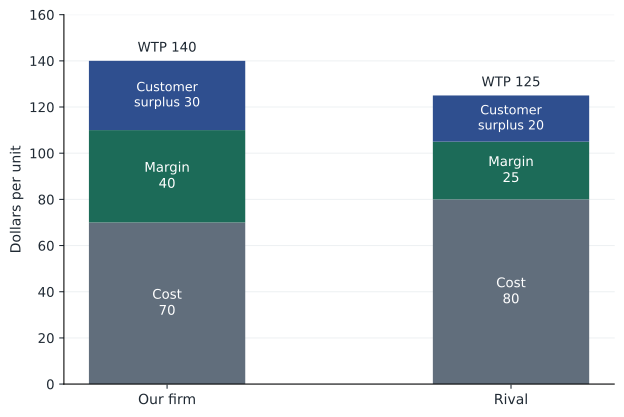
A firm with a competitive advantage has a bigger wedge than its rivals. It can get there by raising willingness to pay at similar cost (differentiation), by lowering cost at similar willingness to pay (cost leadership), or by some combination. Note that advantage is defined by value created, not by profit: a firm can choose to pass much of its advantage to customers through low prices to grow share, as many platform businesses have done, and still have an advantage. Profit depends on how the value is divided, which in turn depends on the industry forces from lesson 2.
# Value created and how it is divided (dollars per unit, illustrative)
firms = {
    "Our firm":   {"wtp": 140, "price": 110, "cost": 70},
    "Rival":      {"wtp": 125, "price": 105, "cost": 80},
}
for name, f in firms.items():
    value = f["wtp"] - f["cost"]
    cs = f["wtp"] - f["price"]
    margin = f["price"] - f["cost"]
    print(f"{name:<9} value created {value:>4}  customer surplus {cs:>3}  margin {margin:>3}")
gap = (firms["Our firm"]["wtp"] - firms["Our firm"]["cost"]) - (firms["Rival"]["wtp"] - firms["Rival"]["cost"])
print("Competitive advantage (extra value created per unit):", gap)Our firm value created 70 customer surplus 30 margin 40 Rival value created 45 customer surplus 20 margin 25 Competitive advantage (extra value created per unit): 25
In the example, our firm creates 70 dollars of value per unit against the rival's 45. It gives customers 30 dollars of surplus, more than the rival's 20, so customers prefer it, and still earns a margin of 40 against the rival's 25. Customers choose the product that offers them the highest surplus, which is why a firm with higher willingness to pay can charge more and still win.
Cost leadership
A cost leader aims to have the lowest cost in its industry while offering a product customers find acceptable, so that it earns above-average margins at industry prices or wins share at lower prices. Sources of cost advantage include economies of scale (spreading fixed costs over more units, buying in bulk), learning and experience (doing things better with cumulative practice), process technology and design for manufacture, access to low-cost inputs, location, capacity utilization, and simplicity, such as a narrow product range. Cost leaders must keep willingness to pay close enough to rivals' that the cost advantage is not eaten by price cuts; a product that is cheap but unacceptable is not a cost leader, it is a failure.
The experience curve
The experience curve, popularized by the Boston Consulting Group in the 1960s, describes how unit costs fall by a roughly constant percentage each time cumulative output doubles. An 80 % curve means each doubling cuts unit cost to 80 % of its previous level. Learning by workers, process improvements, product redesign and scale all contribute. The curve suggested a strategy of building share early to move down the curve faster than rivals, a logic still visible in industries such as solar panels, batteries and semiconductors, where costs have fallen dramatically with cumulative production.
# Unit cost on an 80 % experience curve, starting at $1,000 for the first unit
import math
c1, rate = 1000.0, 0.80
b = math.log(rate, 2)
for n in (1, 2, 4, 8, 16, 100, 1000, 10000):
    print(f"cumulative unit {n:>6}: unit cost ${c1 * n ** b:,.2f}")
# Compare a leader with 4x the cumulative volume of a follower
leader, follower = 40000, 10000
print(f"Leader cost ${c1 * leader ** b:,.2f} vs follower ${c1 * follower ** b:,.2f}")cumulative unit 1: unit cost $1,000.00 cumulative unit 2: unit cost $800.00 cumulative unit 4: unit cost $640.00 cumulative unit 8: unit cost $512.00 cumulative unit 16: unit cost $409.60 cumulative unit 100: unit cost $227.06 cumulative unit 1000: unit cost $108.20 cumulative unit 10000: unit cost $51.56 Leader cost $33.00 vs follower $51.56
Two doublings separate the leader at 40,000 cumulative units from the follower at 10,000, so the leader's unit cost is 0.8 × 0.8 = 64 % of the follower's. The experience curve has limits. Learning can spill over to rivals through suppliers, employees and published research; a new technology can start a new curve and leave the old leader stranded; and building share by pricing below cost destroys value if the expected cost advantage does not appear. Use the curve as a hypothesis to test, not a law.
Differentiation
A differentiator offers something customers value enough to pay a premium that exceeds the extra cost of providing it. Differentiation can come from product features and performance, quality and reliability, design, brand image, service and support, convenience, customization, speed of delivery, or the experience of buying and using the product. The key test is that customers, not managers, value the difference, and that the premium exceeds the cost. Differentiation sustained by brand, design capability, service culture or patents can be hard to imitate; differentiation based on a feature that rivals can add next year is not.
Differentiation is not only for luxury goods. An industrial supplier that guarantees delivery within four hours, a bank with exceptional small-business advice, and a hardware store with expert staff all differentiate. Analysis of the customer's value chain helps: a supplier creates willingness to pay by lowering the customer's costs (less downtime, lower inventory, easier installation) or raising the customer's own performance. Business customers will pay for products that make them money.
Focus strategies
A focus strategy targets a narrow segment, such as a type of customer, a product niche or a region, and serves it better than broad competitors can. Focused cost strategies serve a segment with unusually low costs, for example a simple no-frills product for price-sensitive buyers; focused differentiation serves a segment with special needs that broad rivals underserve, for example equipment for professional climbers. Focus works when the segment's needs differ enough that broad competitors serve it poorly, and when the segment is large enough to support the focused firm. The risk is that the segment shrinks, broad rivals adapt, or the focused firm is tempted to broaden and loses its edge.
| Strategy | Source of advantage | Key risks |
|---|---|---|
| Cost leadership | Scale, experience, process, simplicity, low-cost inputs | Technological change, imitation, losing acceptable quality |
| Differentiation | Features, quality, brand, service, design, experience | Premium exceeds what customers will pay; imitation; cost creep |
| Focused cost | Low cost for a specific segment's needs | Segment shrinks; broad rivals cut costs |
| Focused differentiation | Tailored offering for a segment's special needs | Broad rivals adapt; segment too small |
| Integrated (best-cost) | Good value from activities that lower cost and raise WTP together | Being stuck in the middle with neither advantage |
Stuck in the middle, or integrated strategies?
Porter originally argued that firms trying to pursue cost leadership and differentiation together risk being stuck in the middle, with neither the lowest cost nor a meaningful premium, because the activities required conflict. Evidence since then is mixed. Some firms achieve both, because quality improvements reduce waste and rework (the lesson of total quality management), because scale lets a large firm spread the cost of brand building and innovation, or because new technology shifts the trade-off frontier. Toyota's production system, which lowered cost and raised reliability at the same time, is the classic example. The practical conclusion is that trade-offs are real at the frontier of what is technically possible, but many firms operate well inside the frontier and can improve both cost and value by becoming more effective. Once a firm reaches the frontier, it must choose.
Examples from Canadian retail
Canadian retail offers clear contrasts. Dollarama built a cost-leadership position on a narrow assortment of low fixed price points, direct sourcing, small-format stores and lean operations, and expanded into Latin America and, through its 2025 acquisition of The Reject Shop, Australia. Lululemon, founded in Vancouver, built differentiation around technical fabrics, community events and a premium brand, and earns a substantial price premium over mass-market athletic wear. Couche-Tard, through its Circle K stores, combines a convenience focus with an acquisition and integration capability that spreads best practices across countries. Each has a different activity system that fits its chosen position. Business details change, so check recent annual reports before relying on specific figures.
Activity systems and fit
Porter's later work stressed that sustainable advantage comes from fit among many activities, not from any single one. He used activity-system maps to show how a firm's choices reinforce each other. In a discount airline, a single aircraft type lowers maintenance and training costs and allows crews to work any flight; point-to-point routes avoid congested hubs and allow quick turnarounds; quick turnarounds keep aircraft flying more hours; and no assigned seats speeds boarding. A rival that copies one element gains little, because the benefit depends on the whole system. Fit can be consistency (each activity supports the positioning), reinforcement (activities strengthen each other) or optimization of effort (coordination eliminates waste).
Blue ocean strategy
Kim and Mauborgne's blue ocean strategy urges firms to create uncontested market space rather than fight in crowded red oceans. Their tools include the strategy canvas, which plots how an industry's offerings perform on the factors competitors compete on, and the four actions framework: which factors to eliminate, reduce, raise and create. Their examples include a circus that dropped animal acts and star performers but added theatre and storytelling, reaching adults willing to pay theatre prices. The approach is a useful prompt for creativity and for questioning industry assumptions. Critics note that many blue oceans quickly attract imitators, that the examples are chosen after the fact, and that the approach says little about how to defend a new space once found. Used alongside VRIO and five-forces analysis, it can help generate options that are then tested.
Worked problem
Choosing a business-level strategy
An invented coffee chain has 60 cafés in mid-sized cities. Its costs are about average; customers rate its coffee as good but not distinctive. A national chain dominates on convenience and price, and independent cafés win on atmosphere and specialty coffee. Using value created, suggest two possible strategies and the activity changes each would require.
Show solution
- Diagnosis: the chain is stuck in the middle, with average cost and average willingness to pay.
- Option 1, focused cost: become the fastest, cheapest option for commuters. Simplify the menu, add drive-through and app ordering, standardize equipment, locate near transit and highways. WTP stays similar while cost falls.
- Option 2, focused differentiation: become the local specialty café with consistent quality at scale. Train baristas, source directly from farms, redesign cafés for longer stays, add events. WTP rises; cost rises less than the premium if training and sourcing are managed well.
- Test each option: does the segment exist in its cities, can rivals copy it quickly, and does the chain have or can it build the capabilities required?
Answer: Either option can work if the chain commits to it and reshapes activities to fit; trying to do both risks staying stuck in the middle.
Common mistakes
MistakeCompetitive advantage means having higher profits than rivals.
InsteadAdvantage means creating more value; profit depends on how that value is divided and on industry forces.
MistakeDifferentiation means adding as many features as possible.
InsteadDifferentiate only where customers value the difference more than it costs to provide.
MistakeA cost leader can sell a poor product as long as it is cheap.
InsteadWillingness to pay must stay close to rivals'; otherwise the cost advantage is consumed by lower prices.
MistakeMoving down the experience curve guarantees a lasting cost advantage.
InsteadLearning spills over, and new technologies can start new curves.
MistakeCopying a rival's most visible practice will copy its advantage.
InsteadAdvantage often comes from fit among many activities, not any one practice.
Summary and key terms
- Economic value created equals willingness to pay minus cost; price divides it between customers and the firm.
- A competitive advantage means creating more value than rivals, by raising willingness to pay, lowering cost or both.
- Cost leadership relies on scale, experience, process and simplicity while keeping willingness to pay acceptable.
- The experience curve shows unit cost falling by a constant percentage with each doubling of cumulative output.
- Differentiation requires a premium that exceeds the extra cost; focus serves a segment better than broad rivals.
- Trade-offs bind at the efficiency frontier, but firms inside it can improve cost and value together.
- Sustainable advantage comes from fit among activities; blue ocean tools help generate options to test.
- Economic value created
- Willingness to pay minus the cost of providing a product.
- Willingness to pay
- The maximum a customer would pay for a product.
- Customer surplus
- Willingness to pay minus price.
- Competitive advantage
- Creating more economic value than rivals.
- Cost leadership
- A strategy of having the lowest cost in the industry with acceptable value.
- Differentiation
- A strategy of offering something customers value enough to pay a premium exceeding its cost.
- Focus strategy
- Serving a narrow segment with a cost or differentiation advantage.
- Experience curve
- The decline in unit cost by a constant percentage with each doubling of cumulative output.
- Stuck in the middle
- Having neither a cost nor a differentiation advantage.
- Activity system
- The set of mutually reinforcing activities that delivers a strategy.
Practice problems
Work each problem on paper first, then reveal the answer to check.
WTP $90, price $70, cost $50. Find value created, customer surplus and margin.
Show answer
40, 20 and 20.
A rival has WTP $80 and cost $45. Which firm has the advantage?
Show answer
The first firm creates 40 against 35, so it has the advantage.
On a 90 % curve, the first unit costs $500. What does unit 4 cost?
Show answer
500 × 0.9 × 0.9 = $405.
Name three sources of cost advantage.
Show answer
Economies of scale, experience, process technology, simplicity, low-cost inputs.
When does differentiation create value?
Show answer
When the extra willingness to pay exceeds the extra cost.
Give an example of focused differentiation.
Show answer
A maker of specialized equipment for professional climbers.
Why might quality improvements lower cost?
Show answer
Less scrap, rework, warranty claims and inspection.
What are the four actions in blue ocean strategy?
Show answer
Eliminate, reduce, raise and create.
Why is fit among activities hard to copy?
Show answer
A rival must replicate the whole system to get the benefit of any part.
Portfolio task: draw an activity-system map for a company you admire and explain how three activities reinforce each other.
Show answer
Answers vary; show the links and their effect on cost or willingness to pay.
Lesson quiz · 5 questions
Score 60% or more to complete this lesson.
Create a free account to save your progress, take quizzes and earn a certificate.