
BUS-450 · Lesson 3 of 12 · 26 min
Competitive dynamics, game theory and industry evolution
Lesson 2 treated industry structure as a snapshot. Real markets move: rivals respond to each other's price cuts, product launches and capacity additions; entrants arrive and incumbents fight back; industries grow, mature and decline; and technologies reshape the forces. This lesson adds the dynamics. It uses game theory to reason about competitive interaction, examines first-mover advantages and entry deterrence, and traces how industries evolve over their life cycle. ECON-101 lesson 11 introduced the prisoner's dilemma, Nash equilibrium and the economics of cartels; here we apply those ideas to strategic decisions managers actually face, and add sequential games, commitment and signalling.
Competitive interaction
Competitive dynamics research studies actions and responses. An action is a move such as a price cut, a new product, a new market entry or an acquisition; a response is a rival's counter-move. Several factors predict whether and how quickly rivals respond. Awareness: does the rival notice? Motivation: does the action threaten something the rival cares about, such as its core market? Capability: can the rival respond, given its resources? The more visible, threatening and easy to match an action is, the faster the response. Price cuts are matched quickly because they are visible and easy; new capabilities, such as a superior logistics network, take years to match.
Market commonality and resource similarity help predict rivalry between two specific firms. Firms that meet in many of the same markets, a situation called multimarket contact, often compete less aggressively because an attack in one market invites retaliation in others, a pattern sometimes called mutual forbearance. Airlines that overlap on many routes and cement companies that face each other in several regions show this. Competition law watches such situations closely, because forbearance can shade into tacit coordination.
Strategic moves as games
Game theory models situations where each player's best choice depends on what others do. A game has players, the strategies available to each, the payoffs for each combination of strategies, and the order of moves and information. In a simultaneous game, players choose without seeing each other's choices; in a sequential game, one player moves first and the other observes before responding. ECON-101 showed that in the one-shot prisoner's dilemma both firms cut prices even though both would be better off holding prices high. In repeated games, the shadow of the future can sustain cooperation through strategies such as tit-for-tat, but legal cooperation must stop short of collusion, which is illegal in both Canada and the United States.
Sequential games are solved by backward induction: start at the last move, determine what the player moving then would choose, and work back to the first move knowing how later players will respond. The solution is called a subgame-perfect equilibrium. The key insight for strategy is that a threat is credible only if carrying it out is in the threatener's interest when the time comes. An incumbent that threatens a price war to deter entry will be ignored if, once the entrant is in, fighting costs the incumbent more than accommodating.
Entry deterrence and commitment
Consider an incumbent facing a potential entrant. If the entrant stays out, the incumbent earns monopoly profit. If the entrant comes in, the incumbent can fight with a price war or accommodate by sharing the market. If fighting is less profitable for the incumbent than accommodating, the entrant knows the threat is empty and enters. To make deterrence credible, the incumbent must change its own payoffs before the entrant decides, by making a commitment: an irreversible investment that makes fighting the profitable response. Building excess capacity that would only be used in a price war, signing long-term contracts with key customers, or investing heavily in a brand are examples.
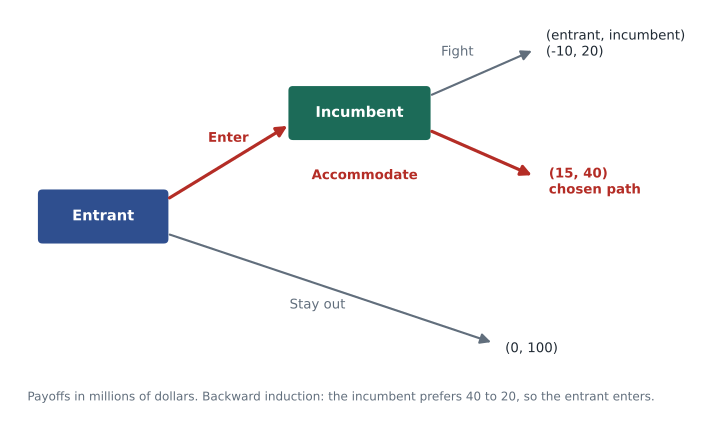
# Entry game solved by backward induction (payoffs in $ millions: entrant, incumbent)
def solve(fight, accommodate, stay_out):
    # Incumbent chooses after entry
    inc_choice = "fight" if fight[1] > accommodate[1] else "accommodate"
    after_entry = fight if inc_choice == "fight" else accommodate
    # Entrant compares entering (anticipating the response) with staying out
    ent_choice = "enter" if after_entry[0] > stay_out[0] else "stay out"
    outcome = after_entry if ent_choice == "enter" else stay_out
    return ent_choice, inc_choice, outcome

base = dict(fight=(-10, 20), accommodate=(15, 40), stay_out=(0, 100))
print("Without commitment:", solve(**base))
# Incumbent pre-commits to extra capacity costing 30 unless used in a price war:
# accommodating now leaves the idle capacity as a pure cost.
committed = dict(fight=(-10, 20), accommodate=(15, 40 - 30), stay_out=(0, 100 - 30))
print("With commitment: ", solve(**committed))Without commitment: ('enter', 'accommodate', (15, 40))
With commitment: ('stay out', 'fight', (0, 70))In the example, without commitment the incumbent would accommodate (40 is better than 20), so the entrant enters and earns 15. With a commitment that makes accommodation worse than fighting (10 versus 20), the threat becomes credible and the entrant stays out; the incumbent earns 70 rather than 40, even after paying for the capacity. Commitment works only if it is visible, understood and hard to reverse. The numbers are illustrative; real decisions involve uncertainty about the entrant's costs and the incumbent's resolve, which is where signalling and reputation come in.
Signalling, reputation and limit pricing
When information is incomplete, firms send signals. An incumbent that fought a past entrant hard builds a reputation that may deter future entrants even when fighting is costly in a single case. Limit pricing, keeping prices below the short-run profit-maximizing level so that entry looks unattractive, can work if potential entrants infer low costs from low prices. Announcements of future capacity or products can deter or pre-empt rivals, though announcing products that never appear risks credibility and, in extreme cases, competition law or securities law problems. Predatory pricing, pricing below cost to drive out a rival with the expectation of recouping losses later, is illegal under the abuse-of-dominance provisions of Canada's Competition Act and under section 2 of the US Sherman Act, though courts set a high bar for proving it.
First-mover advantages and disadvantages
Being first into a market can create advantages: pre-empting scarce assets such as the best locations, spectrum or supply contracts; building switching costs and network effects before rivals arrive; moving down the learning curve first (lesson 5); and building a brand that becomes the category name. But followers also have advantages: they learn from the pioneer's mistakes, free-ride on its investment in educating customers, wait for technology and customer needs to settle, and enter with a better product. Research suggests that early entrants often have higher market share in surviving firms, but many pioneers fail, and the advantages of being first depend on whether the technology is changing rapidly and whether customers' needs are clear.
| Condition | Favours first movers | Favours fast followers |
|---|---|---|
| Network effects or switching costs | Strong | Weak |
| Scarce assets (locations, spectrum, talent) | Can be pre-empted | Plentiful |
| Technology | Stable, patentable | Changing quickly; standards not settled |
| Customer needs | Clear and known | Uncertain; learning from the pioneer helps |
| Imitation | Difficult and slow | Easy and cheap |
The industry life cycle
Industries tend to pass through stages, though not every industry follows the pattern and durations vary enormously. In the introduction stage, products are new, designs vary, customers are early adopters and growth is slow; competition focuses on proving the product works. In the growth stage, a dominant design often emerges, demand rises quickly, entry is common and firms compete to scale up. In the shake-out, growth slows, overcapacity appears, and weaker firms exit or are acquired. In maturity, demand grows with the population or economy, products become standardized and competition shifts to cost, efficiency and segmentation. In decline, demand falls because of substitutes or changing tastes, and firms must choose whether to harvest, consolidate, find a profitable niche or exit.
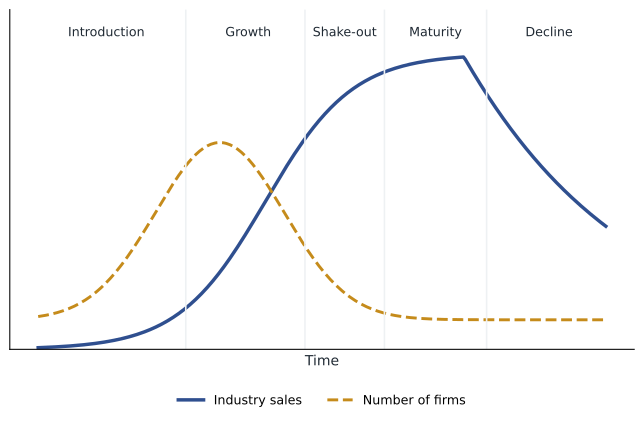
The dominant design concept, from research by Abernathy and Utterback, explains much of the shake-out. Before a dominant design emerges, firms experiment with product innovation; after it emerges, competition shifts to process innovation and cost, scale becomes decisive, and firms that bet on losing designs exit. Early automobiles, personal computers and smartphones all followed this pattern. Recognizing when an industry is moving from one stage to the next is a central strategic skill, because the capabilities that win in growth (product innovation, rapid scaling) differ from those that win in maturity (cost discipline, segmentation).
Strategies for mature and declining industries
In mature industries, growth comes mainly from taking share, so rivalry intensifies. Successful strategies include cost reduction through scale and process improvement, segmentation and focus on profitable niches, consolidation through acquisition to reduce capacity, and innovation that reopens growth, such as new uses or business models. In declining industries, Harrigan and Porter identified four broad options: leadership (become one of the last firms standing and earn returns from a smaller but less competitive market), niche (serve a pocket of durable demand), harvest (cut investment and extract cash), and quick divestment (sell early while buyers still value the business). The right choice depends on how predictable the decline is, the height of exit barriers, and the firm's strengths relative to rivals.
Worked problem
Choosing a strategy in a declining industry
An invented company makes film-based camera supplies. Demand has fallen 12 % a year for a decade, but a loyal group of hobbyists and art schools still buys specialty film. Two rivals remain; one is a division of a large firm that wants out. Recommend a strategy.
Show solution
- Predictability: the decline is steady and well understood, which favours deliberate positioning rather than panic.
- Pockets of demand: hobbyists and schools value quality and are less price-sensitive, a durable niche.
- Exit barriers: the rival division faces corporate pressure to exit; its customers and equipment could be acquired cheaply.
- Recommendation: pursue leadership through a niche. Buy the departing rival's brand and customer list, consolidate production in one plant, raise prices modestly for specialty products, and invest in community and education to sustain demand.
Answer: A planned leadership-in-niche strategy can earn good returns in decline when demand is predictable and rivals are leaving.
Disruptive change
Some changes do not follow the gradual life-cycle pattern. Clayton Christensen's theory of disruptive innovation describes how entrants with simpler, cheaper offerings, initially aimed at overlooked customers, improve until they meet the needs of mainstream customers, while incumbents focus on their most profitable customers and miss the threat. Lesson 6 develops disruption and platform dynamics in detail. For now, note that industry analysis should look for technologies or business models that could change the basis of competition, not only for the next move of current rivals.
Scenario thinking
Because the future is uncertain, many firms use scenarios to test strategies. A scenario is a coherent, plausible story about how the environment might develop, built around a few critical uncertainties. For example, an electricity retailer might build scenarios around two uncertainties: how quickly rooftop solar and batteries spread, and how strictly governments price carbon. Each combination gives a different future, and the firm asks which strategies hold up across most scenarios and which early signals would tell it which scenario is unfolding. Scenario planning was popularized by Royal Dutch Shell in the 1970s and is now common in energy, utilities, finance and government. Lesson 12 uses a simple scenario analysis in the capstone.
Common mistakes
MistakeA threat to start a price war will deter entry.
InsteadA threat deters only if carrying it out would be in the incumbent's interest; otherwise entrants ignore it.
MistakeBeing first to market always wins.
InsteadFirst movers win when they can pre-empt assets or build network effects; followers win when technology and needs are uncertain.
MistakeAll industries pass through the same life-cycle stages at the same pace.
InsteadThe life cycle is a tendency; durations vary and some industries are revived by innovation.
MistakeIn a declining industry, the only option is to exit.
InsteadLeadership, niche and harvest strategies can be profitable, depending on predictability and exit barriers.
MistakeCooperating with rivals to keep prices high is a legitimate strategy.
InsteadAgreements to fix prices or divide markets are illegal; firms may only respond independently to market conditions.
Summary and key terms
- Rivals respond to actions they notice, feel threatened by and can match; visible price moves draw the fastest responses.
- Multimarket contact can soften rivalry through mutual forbearance, under the watch of competition law.
- Sequential games are solved by backward induction; threats must be credible to influence rivals.
- Commitment changes payoffs so that threats become credible; signalling and reputation work under uncertainty.
- First-mover advantages depend on pre-emptable assets, network effects and the stability of technology and needs.
- Industries tend to move through introduction, growth, shake-out, maturity and decline, with dominant designs shifting competition to cost.
- Declining industries offer leadership, niche, harvest and divestment options; scenarios help test strategies under uncertainty.
- Competitive dynamics
- The study of competitive actions and responses among rivals.
- Multimarket contact
- Competition between firms that meet in several markets at once.
- Backward induction
- Solving a sequential game by reasoning from the last move to the first.
- Credible threat
- A threat the threatener would actually carry out when the time comes.
- Commitment
- An irreversible action that changes a firm's own future incentives.
- Limit pricing
- Setting prices low to make entry look unattractive.
- First-mover advantage
- A benefit gained by entering a market before rivals.
- Dominant design
- A product architecture that becomes the accepted standard in an industry.
- Shake-out
- The stage when slowing growth forces many firms to exit.
- Scenario
- A coherent, plausible story about how the environment might develop.
Practice problems
Work each problem on paper first, then reveal the answer to check.
Why are price cuts matched faster than service improvements?
Show answer
They are visible, threatening and easy to copy.
Define mutual forbearance.
Show answer
Restrained competition between firms that meet in several markets and fear retaliation.
In the entry game, fighting gives the incumbent 20 and accommodating 40. Is the threat to fight credible?
Show answer
No; once entry happens the incumbent prefers to accommodate.
Give an example of a commitment that deters entry.
Show answer
Building capacity in advance or signing long-term exclusive contracts with key customers.
Name two first-mover advantages.
Show answer
Pre-empting scarce assets; building network effects or switching costs first.
Name two follower advantages.
Show answer
Learning from the pioneer's mistakes; entering once the technology and standards settle.
What happens to competition after a dominant design emerges?
Show answer
It shifts from product innovation to process innovation, cost and scale; weaker firms exit.
List four strategies for a declining industry.
Show answer
Leadership, niche, harvest, quick divestment.
What is the purpose of scenario planning?
Show answer
To test strategies against several plausible futures and identify early signals.
Portfolio task: map the life-cycle stage of an industry of your choice and explain how competition has changed as it moved between stages.
Show answer
Answers vary; use evidence on growth, number of firms and the basis of competition.
Lesson quiz · 5 questions
Score 60% or more to complete this lesson.
Create a free account to save your progress, take quizzes and earn a certificate.