
BUS-310 · Lesson 7 of 12 · 28 min
ESG, sustainability reporting and accountability
Few business ideas have risen and divided opinion as quickly as ESG, shorthand for environmental, social and governance factors. In the late 2010s, asset managers rushed to launch ESG funds, companies published glossy sustainability reports and regulators around the world began drafting mandatory disclosure rules. By the mid-2020s the picture had become more contested: some US states passed laws penalizing financial firms for considering ESG factors, regulators in Canada and the United States paused or abandoned climate disclosure rules, and inflows to ESG funds slowed. Yet at the same time, international sustainability reporting standards were adopted in dozens of jurisdictions, California began requiring large companies to report greenhouse gas emissions, and investors continued to ask how climate change and social issues affect long-term value. This lesson explains what ESG means, how sustainability reporting works, why ESG ratings disagree, and how to think about the debate.
Marketing claims about environmental benefits, and the competition and consumer protection rules on greenwashing, are covered in BUS-220 lesson 12; forced-labour and supply chain reporting laws are covered in BUS-230 lesson 12. This lesson focuses on governance and reporting: what companies disclose to investors and other stakeholders, and how boards oversee it.
What ESG is and is not
ESG is a set of factors that investors and companies use to assess risks and opportunities not fully captured in traditional financial statements. Environmental factors include greenhouse gas emissions, climate risk, energy and water use, pollution, waste and biodiversity. Social factors include labour practices, health and safety, human rights in supply chains, diversity and inclusion, product safety, data privacy and community relations. Governance factors include board structure, executive pay, shareholder rights, business ethics, tax practices and anti-corruption controls.
It is important to distinguish two different ideas that are often mixed together. ESG integration means considering ESG factors because they are financially material: they can affect a company's risk, cash flows and value. A pension fund that examines a utility's exposure to wildfire liability or a bank's exposure to climate-related loan losses is doing ESG integration for financial reasons. Values-based or impact investing means pursuing social or environmental outcomes, or avoiding certain industries, because of investors' values, even at some financial cost. Much of the confusion and political conflict over ESG comes from blurring these purposes.
Materiality
Materiality determines what a company should report. Financial materiality, used by investor-focused standards, asks whether information could reasonably be expected to influence investors' decisions about the company. Impact materiality asks how the company affects people and the environment. Double materiality, used in the European Union's sustainability reporting rules, requires both. A materiality assessment typically identifies potential topics, consults stakeholders, assesses each topic's importance to the business and its impact, and plots the results on a matrix to prioritize.
Worked problem
Building a simple materiality matrix
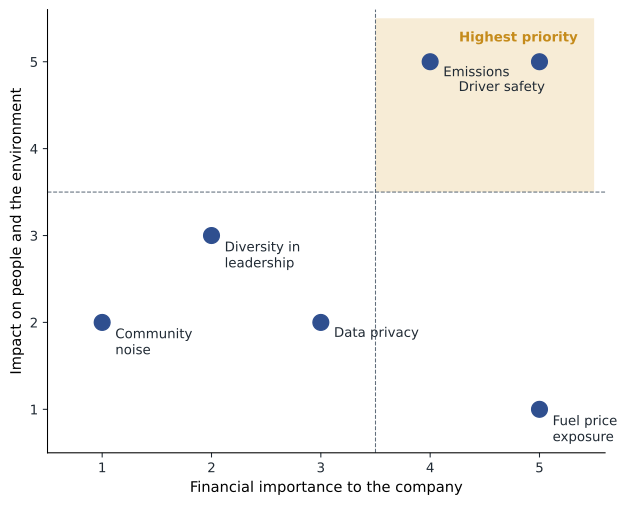
A trucking company scores six topics from 1 (low) to 5 (high) on financial importance and on impact: greenhouse gas emissions (financial 4, impact 5); driver safety (5, 5); data privacy (3, 2); diversity in leadership (2, 3); community noise (1, 2); fuel price exposure (5, 1). Which topics are priorities under financial materiality only, and which under double materiality, using a threshold of 4?
Show solution
- Financial materiality (financial score ≥ 4): emissions, driver safety, fuel price exposure.
- Impact materiality (impact score ≥ 4): emissions, driver safety.
- Double materiality (either dimension ≥ 4): emissions, driver safety and fuel price exposure.
- Data privacy, diversity and community noise fall below the threshold on both dimensions but should be monitored, since materiality changes over time.
Answer: Emissions, driver safety and fuel price exposure are priorities; the double-materiality list here matches the financial list because the high-impact topics are also financially important.
Measuring greenhouse gas emissions
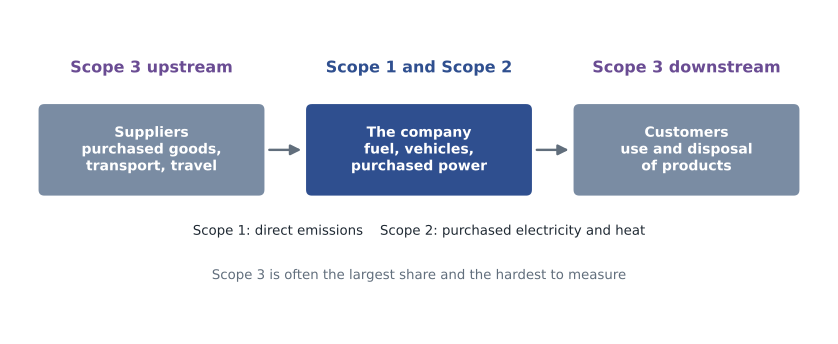
The Greenhouse Gas Protocol, the most widely used accounting framework, divides emissions into three scopes. Scope 1 covers direct emissions from sources the company owns or controls, such as fuel burned in its vehicles and boilers. Scope 2 covers indirect emissions from purchased electricity, steam, heating and cooling. Scope 3 covers all other indirect emissions in the value chain, upstream (purchased goods, business travel, transport by suppliers) and downstream (use and disposal of sold products). For many companies, Scope 3 is by far the largest category and the hardest to measure, because it depends on data from suppliers and customers.
Worked problem
Calculating Scope 1 and Scope 2 emissions
A distribution company burns 1.2 million litres of diesel in its own trucks and uses 8,000 MWh of grid electricity in its warehouses. Using illustrative emission factors of 2.7 kg CO₂e per litre of diesel and 0.12 t CO₂e per MWh of electricity, calculate Scope 1, Scope 2 and the total. How would the electricity figure change in a region with a coal-heavy grid at 0.70 t CO₂e per MWh?
Show solution
- Scope 1 = 1,200,000 L × 2.7 kg = 3,240,000 kg = 3,240 t CO₂e.
- Scope 2 = 8,000 MWh × 0.12 t = 960 t CO₂e.
- Total Scope 1 and 2 = 4,200 t CO₂e.
- With a coal-heavy grid, Scope 2 = 8,000 × 0.70 = 5,600 t CO₂e, nearly six times higher.
Answer: Scope 1 is 3,240 t and Scope 2 is 960 t, for 4,200 t CO₂e; the grid emission factor strongly affects Scope 2.
Emission factors vary by fuel and by electricity grid. Grids that rely mainly on hydroelectric or nuclear power have much lower factors than grids that rely on coal or natural gas. Companies must disclose the factors and methods they use, and reported figures are increasingly subject to independent assurance.
Sustainability reporting standards
For years, companies reported sustainability information under a patchwork of voluntary frameworks, including the Global Reporting Initiative (GRI), which focuses on impacts for a broad range of stakeholders; the Sustainability Accounting Standards Board (SASB), which developed industry-specific, investor-focused standards; and the Task Force on Climate-related Financial Disclosures (TCFD), which organized climate disclosure around governance, strategy, risk management, and metrics and targets. In 2023 the International Sustainability Standards Board (ISSB), created by the IFRS Foundation, issued IFRS S1 on general sustainability-related disclosures and IFRS S2 on climate-related disclosures, consolidating the investor-focused frameworks. An S&P Global review reported that, as of July 2026, 35 jurisdictions had adopted the ISSB standards on a voluntary or mandatory basis and 11 more planned to.
In December 2024 the Canadian Sustainability Standards Board (CSSB) issued Canadian Sustainability Disclosure Standards CSDS 1 and CSDS 2, adapted from IFRS S1 and S2 with transition relief, available for voluntary use for periods beginning on or after 1 January 2025. In April 2025 the Canadian Securities Administrators paused work on a mandatory climate disclosure rule for listed companies, citing changes in the United States and international markets, and as of 2026 no revised proposal had been published. Federally regulated banks and insurers, however, must make climate disclosures under the Office of the Superintendent of Financial Institutions' Guideline B-15, phased in from fiscal 2024, and many large Canadian companies report voluntarily. Bill C-59 (2024) and later amendments to the Competition Act also affect environmental claims, as BUS-220 explains.
Outside North America, the European Union's Corporate Sustainability Reporting Directive (CSRD) requires detailed double-materiality reporting under European Sustainability Reporting Standards; in 2025–2026 the EU narrowed its scope and delayed some requirements through a simplification ('omnibus') package. Many Canadian and US multinationals with large European operations are still affected.
ESG ratings and their limits
ESG rating agencies, such as MSCI, Sustainalytics and S&P Global, score companies on ESG performance, and investors use the ratings to build funds and screen investments. The ratings disagree strikingly. Florian Berg, Julian Kölbel and Roberto Rigobon, studying six major raters, found correlations between their ratings ranging from about 0.38 to 0.71, compared with correlations of about 0.99 between credit ratings from different agencies. Disagreement arises from scope (which issues are included), measurement (how each issue is measured) and weighting (how much each issue counts). A company can be a leader in one rating and a laggard in another.
The short program below simulates two raters who observe the same underlying performance but measure it with different noise and weight different issues, and shows how weakly their ratings can correlate.
import random, statistics
random.seed(7)
n = 300
env  = [random.gauss(0, 1) for _ in range(n)]   # true environmental performance
soc  = [random.gauss(0, 1) for _ in range(n)]   # true social performance
gov  = [random.gauss(0, 1) for _ in range(n)]   # true governance performance
# Rater A weights environment heavily; rater B weights governance heavily; each measures with noise
a = [0.6*e + 0.2*s + 0.2*g + random.gauss(0, 0.6) for e, s, g in zip(env, soc, gov)]
b = [0.2*e + 0.2*s + 0.6*g + random.gauss(0, 0.6) for e, s, g in zip(env, soc, gov)]
print(f"correlation between raters: {statistics.correlation(a, b):.2f}")
top_a = set(sorted(range(n), key=lambda i: -a[i])[:30])
top_b = set(sorted(range(n), key=lambda i: -b[i])[:30])
print(f"companies in both top-10% lists: {len(top_a & top_b)} of 30")correlation between raters: 0.36 companies in both top-10% lists: 7 of 30
In this simulation the two raters' scores correlate at only about 0.36, and only 7 of the 30 companies in one rater's top 10 % also appear in the other's, even though both are measuring the same underlying performance.
Rating divergence means investors should understand what a rating measures before relying on it, and companies should be cautious about advertising a single rating as proof of sustainability. Regulators have begun to respond: the European Union adopted a regulation on ESG rating providers that applies from July 2026, and other jurisdictions have issued codes of conduct.
The ESG debate
The case for ESG integration is that environmental and social factors, such as climate policy, physical climate risk, labour relations and product safety, can affect long-term value; that long-term, diversified investors such as pension funds are exposed to economy-wide risks; and that disclosure helps markets price those risks. Supporters point to cases where neglect of such factors destroyed value, such as major industrial accidents, data breaches and governance failures.
Critics raise several objections. Some argue that ESG mixes financial analysis with political goals and that asset managers should not use other people's savings to pursue social agendas. Others argue that ESG funds have charged higher fees without delivering better returns or real-world impact, that ratings are inconsistent, and that companies use ESG reports for public relations. A third group, often on the left, argues that voluntary ESG is too weak and that regulation, not disclosure, is needed to cut emissions. In the United States, more than 475 anti-ESG bills have been introduced in state legislatures, and several states restrict state contracts or pension investments with financial firms that 'boycott' fossil fuel industries; a federal court struck down Texas's 2021 law of this kind (SB 13) in February 2026, and the state said it would appeal. Other states have taken the opposite approach, requiring climate risk to be considered in public pension investing or adopting climate disclosure laws.
A balanced view separates the questions. Whether a particular ESG factor is financially material is an empirical question that varies by industry and company. Whether investors should pursue non-financial goals is a question about the duties fund managers owe their clients and beneficiaries, which depends on their mandates. Whether governments should regulate emissions or labour practices is a political question for legislatures. Clear thinking about which question is being asked reduces confusion.
Board oversight of sustainability
Boards oversee sustainability matters as part of their responsibility for strategy and risk. Good practice includes assigning oversight to the full board or a committee, ensuring directors have relevant expertise, integrating material sustainability risks into enterprise risk management, approving targets and capital plans that are consistent with them, linking pay to sustainability measures only where they are material and measurable, and ensuring that sustainability disclosures receive the same controls and scrutiny as financial reporting. Greenwashing risk, the risk that sustainability claims are misleading, is now a legal and reputational risk in both countries, which is a strong reason for the audit committee to review sustainability disclosures.
Common mistakes
MistakeTreating ESG integration and values-based investing as the same thing.
InsteadDistinguish financially material factors from investors' value preferences.
MistakeRelying on one ESG rating as proof of sustainability.
InsteadUnderstand what each rating measures; ratings diverge widely.
MistakeIgnoring Scope 3 because it is hard to measure.
InsteadEstimate it with disclosed methods and improve data over time.
MistakeReporting sustainability data without controls or assurance.
InsteadApply financial-reporting discipline, including review by the audit committee.
MistakeAssuming disclosure rules are settled.
InsteadTrack jurisdiction-specific changes, which moved quickly in 2024–2026.
Summary and key terms
- ESG covers environmental, social and governance factors that affect risk, value and impact.
- ESG integration for financial reasons differs from values-based or impact investing.
- Financial materiality concerns investors; impact materiality concerns effects on people and the environment; double materiality requires both.
- The Greenhouse Gas Protocol divides emissions into Scopes 1, 2 and 3; Scope 3 is often largest.
- ISSB standards IFRS S1 and S2 are adopted in dozens of jurisdictions; Canada's CSDS are voluntary while the CSA rule is paused.
- The SEC climate rule did not take effect; California's SB 253 requires emissions reports from November 2026, and SB 261 is enjoined.
- ESG ratings diverge because of scope, measurement and weighting differences.
- The ESG debate mixes empirical, fiduciary and political questions that are clearer when separated.
- ESG
- Environmental, social and governance factors used to assess risks, opportunities and impacts.
- ESG integration
- Considering financially material ESG factors in investment and business decisions.
- Financial materiality
- Information that could reasonably influence investors' decisions about a company.
- Double materiality
- Reporting both financial effects on the company and the company's impacts on people and the environment.
- Scope 1 emissions
- Direct emissions from sources a company owns or controls.
- Scope 2 emissions
- Indirect emissions from purchased electricity, steam, heating and cooling.
- Scope 3 emissions
- All other indirect emissions in a company's value chain.
- ISSB
- The International Sustainability Standards Board, which issues IFRS sustainability disclosure standards.
- Emission factor
- The quantity of greenhouse gases emitted per unit of activity, such as per litre or per MWh.
- Greenwashing
- Making misleading claims about environmental performance or benefits.
Practice problems
Work each problem on paper first, then reveal the answer to check.
Give one example each of an E, an S and a G factor.
Show answer
E: emissions; S: workplace safety; G: board independence.
What is the difference between financial and impact materiality?
Show answer
Financial materiality concerns effects on the company's value; impact materiality concerns effects on people and the environment.
A firm burns 500,000 L of diesel at 2.7 kg CO₂e/L. What are its Scope 1 emissions?
Show answer
1,350 t CO₂e.
It also uses 2,000 MWh at 0.40 t/MWh. What is Scope 2?
Show answer
800 t CO₂e.
Into which scope do emissions from customers using a company's cars fall?
Show answer
Scope 3 (downstream use of sold products).
What did IFRS S1 and S2 consolidate?
Show answer
Investor-focused frameworks such as TCFD and SASB into global baseline standards.
What is the status of Canada's CSDS 1 and 2?
Show answer
Voluntary; the CSA paused its mandatory climate rule in April 2025.
Why do ESG ratings disagree?
Show answer
Differences in scope, measurement and weighting.
Separate the three questions mixed in the ESG debate.
Show answer
Empirical (is a factor material?), fiduciary (may managers pursue non-financial goals?), political (should governments regulate?).
Portfolio task: review a company's sustainability report and identify its material topics, standards used and assurance.
Show answer
Answers vary; should identify framework, topics and whether assurance was obtained.
Lesson quiz · 5 questions
Score 60% or more to complete this lesson.
Create a free account to save your progress, take quizzes and earn a certificate.