
BUS-310 · Lesson 5 of 12 · 25 min
Corporate governance structures and boards
Corporate governance answers a basic problem. In a large company, the people who supply the capital, the shareholders, are not the people who run the business, the managers. Managers know far more about the company than shareholders do and may pursue their own interests: larger empires, higher pay, a quieter life or short-term results that protect their jobs. Economists call this the agency problem. The board of directors sits between owners and managers, hiring, advising, monitoring and if necessary replacing the chief executive. This lesson examines how boards are structured and how they work in practice. BUS-210 covered the legal duties of directors, the business judgment rule and shareholder remedies; here the focus is on governance practice, the structures and habits that make boards effective or ineffective.
Agency theory and its limits
Agency theory, developed by Michael Jensen and William Meckling, sees the corporation as a nexus of contracts in which shareholders (principals) delegate decisions to managers (agents). Because agents' interests differ from principals' and agents have better information, principals incur agency costs: monitoring costs (audits, boards), bonding costs (agents' commitments, such as reporting) and residual loss (value lost despite these efforts). Governance mechanisms reduce agency costs. They include independent boards, executive pay linked to performance, the market for corporate control (takeovers), shareholder voting and activism, disclosure and audit, and legal duties enforced by courts.
Agency theory has shaped modern governance, but it has limits. Stewardship theory argues that many managers are motivated by achievement, responsibility and loyalty, not only self-interest, and that excessive monitoring can undermine those motives. Agency theory also focuses on conflicts between shareholders and managers, while in many Canadian and international companies the more important conflict is between a controlling shareholder and minority shareholders. And a narrow focus on shareholder value can encourage the very short-termism it was meant to cure, as when stock-based pay encourages managers to boost the share price temporarily.
What boards do
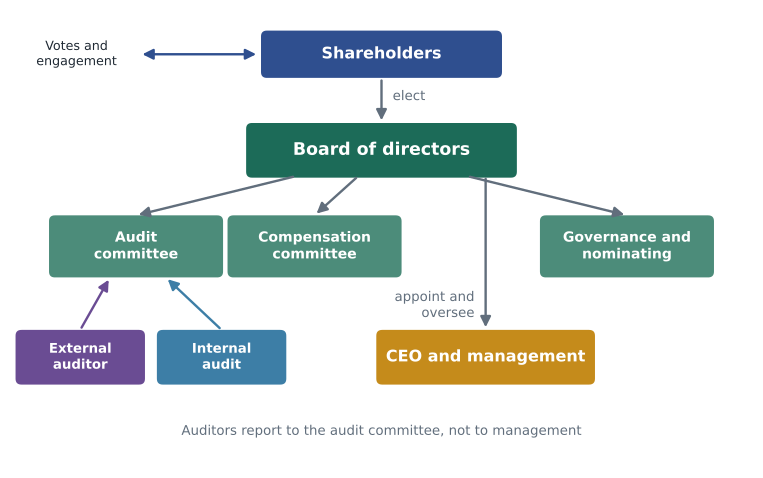
Boards have several core functions. They select, evaluate, compensate and, when necessary, replace the chief executive and plan for succession. They approve and oversee strategy, including major investments, acquisitions and financing. They oversee risk management and internal control, including compliance and ethics. They oversee financial reporting and the external audit. They set the tone at the top for ethics and culture. And they engage with shareholders and other stakeholders. Boards do not manage the company day to day; their role is often summarized as 'noses in, fingers out': ask probing questions, but leave execution to management.
Board composition and independence
An independent director has no material relationship with the company that could reasonably interfere with independent judgement. Relationships that typically disqualify include current or recent employment by the company, family relationships with executives, significant business relationships, and recent employment by the external auditor. Independence matters because directors who depend on management for income or status are less likely to challenge it. But independence alone does not make a good director; independent directors also need knowledge of the business, time and the willingness to ask hard questions.
In Canada, National Instrument 58-101 and National Policy 58-201 set out disclosure requirements and best-practice guidelines for corporate governance. Under the 'comply or explain' approach, reporting issuers disclose their practices against guidelines that recommend a majority of independent directors, an independent chair or lead director, regular meetings of independent directors without management, written mandates for the board and committees, position descriptions, orientation, assessments and a written code of conduct. National Instrument 52-110 requires audit committees of most listed issuers to consist of at least three directors, all independent and financially literate. Federally incorporated distributing corporations must also disclose the representation of women, Indigenous peoples, persons with disabilities and members of visible minorities on their boards and in senior management under the CBCA. The CSA's tenth annual review (2024) found that women held 29 % of board seats in its sample, 90 % of issuers had at least one woman director and 8 % had a woman as board chair.
Worked problem
Assessing board independence
A listed company has nine directors: (1) the CEO; (2) the former CFO, who retired two years ago; (3) a partner at the law firm that earns $3 million a year from the company; (4) the CEO's brother-in-law; (5)–(8) four directors with no relationships beyond their board fees; (9) a director who retired from the company's external audit firm five years ago and did not work on the audit. How many directors are independent, does the board have an independent majority, and who could sit on the audit committee?
Show solution
- Not independent: (1) the CEO; (2) the former CFO, an employee within the last three years; (3) a significant business relationship; (4) a family relationship with an executive.
- Likely independent: (5)–(8), and (9), because the auditor relationship ended more than three years ago (confirm under the applicable rule).
- Independent directors = 5 of 9, a narrow majority.
- Audit committee: at least three of (5)–(9), all financially literate; (9) may be well suited if financially expert.
Answer: Five of nine directors are independent, a bare majority; the board should consider strengthening independence, for example by replacing a related director.
Committees
Most boards delegate detailed work to committees, which report back to the full board. The audit committee oversees financial reporting, internal control, internal audit and the external auditor, including appointing and approving the fees of the auditor and pre-approving non-audit services. The compensation committee designs and approves executive pay (lesson 6). The governance or nominating committee recruits directors, assesses board performance and oversees governance practices. Many boards also have risk, safety, sustainability or technology committees, depending on their industry. Committees allow specialization, but the full board remains responsible.
Board leadership
Separating the roles of chair and chief executive is standard practice in Canada and the United Kingdom; in Canada, most large issuers have an independent chair, and those that do not usually appoint an independent lead director. In the United States, combining the roles has been more common, although the share of large companies with separate roles has risen and most combined-role boards appoint a lead independent director. Arguments for separation are that the board should not be led by the person it monitors and that an independent chair can manage the board's agenda. Arguments for combining are unified leadership and clear accountability. Evidence on performance is mixed; what matters most is that independent directors have real power over the agenda, information and executive sessions.
Board effectiveness and evaluation
Board structures are necessary but not sufficient. Enron's board was impressive on paper, with independent, accomplished directors, yet it approved the conflicts of interest that helped destroy the company. Effective boards combine the right mix of skills and perspectives, enough time and information, a culture of openness and constructive challenge, and good processes. A skills matrix maps directors' expertise against what the company needs, revealing gaps to fill when directors retire. Regular board evaluations, sometimes facilitated by outsiders, assess the board, committees and individual directors. Term limits and age limits are used to ensure renewal, although some argue they remove experienced directors arbitrarily.
| Skill or experience | Needed? | Directors with it | Gap? |
|---|---|---|---|
| Industry and operations | High | 3 | No |
| Accounting and audit | High | 2 | No |
| Cybersecurity and technology | High | 0 | Yes |
| Risk management | Medium | 2 | No |
| Human capital and compensation | Medium | 1 | Borderline |
| Sustainability and climate | Medium | 1 | Borderline |
| International markets | Low | 2 | No |
Information is the board's lifeblood and often its weakest point. Directors depend on management for most of what they know, and management controls how information is framed. Effective boards insist on concise board papers that highlight decisions and risks, receive information from sources other than the chief executive, such as internal audit, the chief compliance officer and site visits, meet regularly in executive session without management, and have the authority to hire their own advisers. A board that only receives polished presentations a day before meetings cannot exercise independent judgement, however independent its members are on paper.
Diversity of background and perspective helps boards avoid groupthink, one of the group decision problems discussed in BUS-130. Research generally finds that diverse boards ask more varied questions and make better-informed decisions, although evidence on financial performance is mixed. Diversity of gender, ethnicity and experience is one dimension; cognitive diversity, such as directors with different professional backgrounds, is another.
Controlling shareholders and dual-class shares
Many companies are controlled by a family, founder or parent company. Control can bring long-term commitment and close monitoring of management, but it creates a different agency problem: the controller may extract private benefits at minority shareholders' expense, through related-party transactions, excessive pay for family members or decisions that favour the controller's other businesses. Dual-class share structures give one class of shares multiple votes, letting founders keep control with a minority of the equity. Supporters argue they protect long-term strategies from short-term market pressure; critics argue they entrench management, weaken accountability and leave outside investors without a voice.
Dual-class structures are long-standing in Canada, used by family-controlled companies such as Bombardier and Power Corporation of Canada, and by newer founder-led firms. The Toronto Stock Exchange requires 'coattail' provisions for companies listed since 1987, so that holders of subordinate voting shares can participate in a takeover bid on equal terms. Institutional investors and proxy advisers increasingly ask for sunset clauses, which convert multiple-voting shares to single-voting shares after a set period or when founders leave; one major proxy adviser's 2026 Canadian guidelines treat a sunset of about seven years or less as reasonable. Related-party transactions with controllers are regulated by Multilateral Instrument 61-101, which requires independent valuation and minority approval in many cases.
Shareholders, proxy advisers and where to incorporate
Institutional investors such as pension funds, mutual funds and index funds now own most shares of large listed companies. Many rely on proxy advisory firms, mainly Institutional Shareholder Services and Glass Lewis, for voting research and recommendations. Supporters say proxy advisers help investors with thousands of votes to cast; critics say they have too much influence, apply one-size-fits-all policies and may have conflicts of interest. Regulators in both countries have issued guidance on proxy advisers, and in the United States several states and federal regulators have proposed or passed additional rules since 2025, some of them challenged in court.
Canadian companies can incorporate federally or in a province, and the choice mainly affects corporate law details such as residency requirements for directors and the availability of remedies; governance expectations for listed companies are largely the same because securities regulation and TSX requirements apply regardless. Large Canadian pension plans, such as those for Ontario teachers and public employees and the Canada Pension Plan Investment Board, are influential engaged investors, and the Canadian Coalition for Good Governance publishes guidance that shapes board practice.
Common mistakes
MistakeAssuming independence alone makes a board effective.
InsteadCombine independence with relevant skills, time, information and a culture of challenge.
MistakeLetting the CEO control the board agenda and information.
InsteadGive an independent chair or lead director real authority over agendas and executive sessions.
MistakeTreating governance codes as box-ticking exercises.
InsteadUse governance practices to improve oversight, and explain departures honestly.
MistakeIgnoring the controller–minority conflict in controlled companies.
InsteadUse independent committees, minority approval and careful review of related-party transactions.
MistakeNever refreshing the board.
InsteadUse skills matrices, evaluations and planned renewal to fill gaps.
Summary and key terms
- The agency problem arises because managers control capital supplied by shareholders and may pursue their own interests.
- Governance mechanisms include boards, pay, takeovers, voting, activism, disclosure, audit and legal duties.
- Stewardship theory and the controller–minority conflict show the limits of agency theory.
- Boards select and oversee the CEO, strategy, risk, reporting and culture; they do not manage day to day.
- Independence rules, committee requirements and comply-or-explain disclosure differ between Canada and the United States.
- Separate chair and CEO roles are standard in Canada and increasingly common in the United States.
- Skills matrices, evaluations and diversity help boards avoid gaps and groupthink.
- Dual-class shares and controlling shareholders create distinct governance risks, managed by sunsets, coattails and minority protections.
- Agency problem
- The conflict that arises when agents (managers) act for principals (shareholders) with different interests and more information.
- Agency costs
- Monitoring, bonding and residual-loss costs arising from the agency relationship.
- Stewardship theory
- The view that managers are often motivated to act as responsible stewards of the organization.
- Independent director
- A director with no material relationship with the company that could interfere with independent judgement.
- Audit committee
- A board committee of independent directors overseeing financial reporting, internal control and the auditor.
- Lead independent director
- An independent director who leads the independent directors when the chair is not independent.
- Skills matrix
- A table mapping directors' expertise against the board's needs.
- Dual-class shares
- A structure in which one class of shares carries more votes per share than another.
- Sunset clause
- A provision that ends a dual-class structure after a set time or event.
- Proxy adviser
- A firm providing voting research and recommendations to institutional investors.
Practice problems
Work each problem on paper first, then reveal the answer to check.
What is the agency problem?
Show answer
Managers may act in their own interests rather than those of the shareholders who supply capital.
Name three types of agency cost.
Show answer
Monitoring costs, bonding costs and residual loss.
How does the main governance conflict differ in a family-controlled company?
Show answer
It is often between the controlling shareholder and minority shareholders.
Is a director who is a partner in a law firm paid $2 million a year by the company independent? Why?
Show answer
Probably not, because of a material business relationship.
What are the three standard board committees?
Show answer
Audit, compensation and governance or nominating.
Give one argument for and one against separating the chair and CEO roles.
Show answer
For: the board should not be led by the person it monitors. Against: unified leadership.
What does a skills matrix reveal?
Show answer
Gaps between directors' expertise and the company's needs.
What is a coattail provision?
Show answer
A protection allowing subordinate shareholders to participate equally in a takeover bid.
Why might Enron's board have failed despite strong credentials?
Show answer
It approved conflicts of interest and did not challenge management or understand the risks.
Portfolio task: review a listed company's governance disclosure and assess its board independence and skills.
Show answer
Answers vary; should count independent directors and identify skills gaps.
Lesson quiz · 5 questions
Score 60% or more to complete this lesson.
Create a free account to save your progress, take quizzes and earn a certificate.