
BUS-310 · Lesson 3 of 12 · 26 min
Ethical decision making and moral psychology at work
Most people who take part in corporate wrongdoing do not think of themselves as wrongdoers. Engineers who approved a launch despite doubts, traders who marked positions optimistically, managers who signed off on misleading reports: interviewed later, many say they did not see the decision as an ethical one at the time, or that they believed they had no real choice. Knowing ethical theory, the subject of lesson 2, does not by itself make people act ethically. This lesson examines how ethical decisions are actually made, why good people do bad things, and what individuals and organizations can do to close the gap between knowing and doing.
BUS-130 introduced heuristics and biases, such as overconfidence, framing, anchoring and escalation of commitment, along with group pressures such as groupthink. This lesson builds on that foundation and focuses on the psychology specific to moral choices: recognizing that a situation has an ethical dimension, the ways people disengage their moral standards, the effect of goals and incentives, and practical tools for better decisions.
Rest's four components
Psychologist James Rest proposed that ethical action requires four distinct components, and that failure can occur at any of them. Moral awareness, or sensitivity, means recognizing that a situation involves ethical issues and affects others. Moral judgement means reasoning about what the right action is. Moral motivation, or intention, means placing ethical values above competing goals such as profit, career or loyalty. Moral character, or implementation, means having the courage, persistence and skill to follow through despite obstacles.
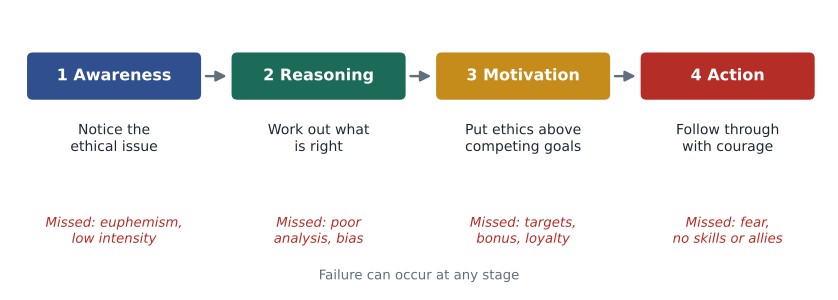
The model is useful because each component needs a different remedy. If people do not notice ethical issues, training with realistic cases and clear language helps. If they reason poorly, frameworks and access to advice help. If they notice and reason well but other goals win, incentives and leadership must change. If they intend to act but lack courage or skill, practice in raising concerns and protection from retaliation help. Many corporate ethics programs focus only on judgement, explaining rules, while most failures occur at awareness, motivation or action.
Moral intensity
Thomas Jones argued that people are more likely to recognize and act on an ethical issue when its moral intensity is high. Moral intensity has six dimensions: magnitude of consequences (how much harm), social consensus (how widely the act is seen as wrong), probability of effect (how likely the harm), temporal immediacy (how soon), proximity (how close, socially or physically, the victims are) and concentration of effect (whether harm falls heavily on a few). Issues with diffuse, distant, delayed and uncertain harms, such as small accounting adjustments, emissions or data practices, have low moral intensity and are often not seen as ethical issues at all.
| Dimension | Higher intensity when… | Low-intensity example |
|---|---|---|
| Magnitude of consequences | Harm is large | Rounding expense claims slightly |
| Social consensus | Most people agree the act is wrong | Aggressive but common tax planning |
| Probability of effect | Harm is likely | A small, uncertain safety risk |
| Temporal immediacy | Harm occurs soon | Emissions affecting future generations |
| Proximity | Victims are close to the decision maker | Workers at a distant supplier |
| Concentration of effect | Harm falls heavily on a few | A fee spread thinly over millions of customers |
Managers can raise the moral intensity of important issues by making consequences concrete: putting a face on the people affected, quantifying harm, shortening the time horizon and making clear that the organization regards the conduct as wrong. Conversely, euphemisms and abstraction lower moral intensity, which is why the language used inside organizations matters.
Ethical fading and moral disengagement
Ann Tenbrunsel and David Messick described ethical fading: the process by which the ethical aspects of a decision fade from view, replaced by business or technical framings. A decision about whether to disclose a product defect becomes a 'communications issue'; a decision to inflate revenue becomes 'managing the quarter'. Euphemistic language, numerical targets and the routine of daily work all contribute. Once a decision is framed as purely commercial, ethical considerations simply do not enter the analysis.
Albert Bandura identified eight mechanisms of moral disengagement by which people switch off their moral standards without feeling guilty. Moral justification portrays harmful conduct as serving a worthy purpose ('we are saving jobs'). Euphemistic labelling sanitizes it ('creative accounting'). Advantageous comparison makes it seem minor relative to worse conduct ('at least we are not as bad as our competitors'). Displacement of responsibility blames authority ('I was told to'). Diffusion of responsibility spreads blame across a group ('everyone signed off'). Disregard or distortion of consequences minimizes harm ('nobody really gets hurt'). Dehumanization strips victims of human qualities ('those customers are just numbers'). Attribution of blame faults the victims ('they should have read the fine print').
| Mechanism | What people tell themselves | Counter-question |
|---|---|---|
| Moral justification | "It is for a good cause." | Would the cause be served by honest means? |
| Euphemistic labelling | "It is just revenue management." | What would a plain description sound like? |
| Advantageous comparison | "Others do far worse." | Is this acceptable on its own terms? |
| Displacement of responsibility | "My manager decided." | Would I do this if I alone were accountable? |
| Diffusion of responsibility | "The whole team agreed." | What is my own share of the decision? |
| Distorting consequences | "No one is really harmed." | Who exactly bears the cost? |
| Dehumanization | "They are just accounts." | Would I say this to the person's face? |
| Attribution of blame | "They should have known." | Did we make it easy for them to know? |
The slippery slope and incrementalism
Serious misconduct often begins with small steps. A manager who accepts a slightly optimistic estimate one quarter finds it harder to refuse a larger adjustment the next, because refusing would expose the earlier step. Research by Francesca Gino and Max Bazerman found that people are more likely to accept unethical behaviour by others when it develops gradually rather than abruptly. Each step seems a small departure from the last, so the cumulative distance from the starting point goes unnoticed. Many accounting frauds, including WorldCom's, began as attempts to bridge a temporary shortfall and grew as the gap widened.
Goals, incentives and pressure
Goals focus effort and improve performance, but challenging goals can also motivate unethical behaviour. Studies by Maurice Schweitzer and colleagues found that people with specific, difficult goals were more likely to misreport performance than people asked simply to do their best, especially when they were close to the goal. Goals narrow attention, so ethical considerations outside the goal fade; they create pressure; and when tied to large rewards, they make cheating profitable. The bank sales scandal described in lesson 1 and the emissions-test cheating at a major car maker both involved demanding targets that people believed could not be met honestly.
The lesson for managers is not to abandon goals but to design them carefully: test whether a target can be met honestly, combine outcome goals with behaviour and quality measures, avoid all-or-nothing bonus thresholds, monitor how goals are achieved and not just whether, and make it safe to say a goal cannot be met. Pressure from authority adds to the problem. Stanley Milgram's obedience experiments showed how far ordinary people will go when an authority figure takes responsibility, and organizational hierarchies reproduce that dynamic.
Worked problem
Diagnosing a pressured decision
A regional sales manager tells a junior employee to record next month's confirmed orders in this quarter so the region hits its bonus threshold. The manager says, "Everyone does it at quarter end, the customer will buy anyway, and the CFO wants the numbers." Use Rest's model and Bandura's mechanisms to analyse the situation and suggest a response.
Show solution
- Awareness: the employee may see this as a timing question; it is in fact misstatement of revenue, an ethical and legal issue.
- Disengagement mechanisms present: advantageous comparison and diffusion ("everyone does it"), distorting consequences ("the customer will buy anyway"), displacement of responsibility ("the CFO wants it").
- Motivation: the bonus threshold and the manager's authority create pressure that competes with honesty.
- Action: the employee can ask for the instruction in writing, explain the revenue recognition rule, propose disclosing a shortfall honestly, and escalate to finance or the ethics line if pressed.
Answer: The situation shows failures waiting to happen at awareness and motivation; naming the mechanisms and having a planned response helps the employee act.
Bounded ethicality and blind spots
Max Bazerman and Ann Tenbrunsel coined the term bounded ethicality for systematic ways in which well-meaning people fail to see the ethical implications of their own decisions. People overestimate their own ethicality, predicting that they will act well in hypothetical situations but behaving worse when the situation arises. They engage in motivated reasoning, interpreting evidence in ways that favour their interests, as when auditors paid by a client judge its accounts more favourably. Conflicts of interest bias judgement even among honest professionals, which is why disclosure alone is often not enough and independence rules matter (lesson 5). People also show bias in favour of their own group and discount harms to future people and distant strangers.
Tools for better ethical decisions
No technique guarantees good decisions, but several improve the odds. Pause and name the issue: ask explicitly whether a decision has an ethical dimension, and describe it in plain language. Identify the people affected and their interests. Generate more than two options; ethical dilemmas often look binary only because no one has searched for a creative third path. Apply the lenses from lesson 2. Use quick tests: the publicity test (would I be comfortable if this were reported on the front page?), the mirror test (could I look at myself in the mirror?), the role-model test (what would a person I admire do?) and the reversibility test (would I accept this if I were on the receiving end?). Seek counsel from someone outside the situation. Finally, plan the action, including what to say and to whom.
| Step | Question |
|---|---|
| 1. Recognize | Is there an ethical dimension? Describe it plainly. |
| 2. Get the facts | What do I know, what do I not know, and what assumptions am I making? |
| 3. Identify stakeholders | Who is affected, and how? |
| 4. Generate options | What are at least three possible actions? |
| 5. Evaluate | How does each option fare under the lenses and the quick tests? |
| 6. Decide and test | Which option is best? Would I defend it publicly? |
| 7. Act and reflect | How will I implement it, and what did I learn? |
Giving voice to values, an approach developed by Mary Gentile, shifts the focus from deciding what is right to rehearsing how to act on it. Most people already know what they think is right; what they lack is a script and practice. Rehearsing responses to common rationalizations, finding allies, framing the concern in terms of the organization's own goals and suggesting alternatives all make it more likely that people will speak up. Lesson 10 returns to speaking up and whistleblowing.
What organizations can do
Because moral psychology is predictable, organizations can design for it. Leaders can model ethical conduct and talk about ethics in ordinary business meetings, which raises moral awareness. Plain language in policies and reports reduces ethical fading. Incentive plans can include conduct and quality measures, and targets can be stress-tested. Decision processes can include checkpoints for significant ethical risks, such as product safety or customer impact reviews. Psychological safety, explored in BUS-130, makes it easier to raise concerns. Lesson 8 shows how these ideas are built into compliance and ethics programs.
Common mistakes
MistakeAssuming that knowing the rules is enough for ethical behaviour.
InsteadAddress awareness, motivation and courage as well as judgement.
MistakeUsing euphemisms that hide the ethical nature of a decision.
InsteadDescribe decisions in plain language that names who is affected and how.
MistakeSetting stretch targets without asking how they will be met.
InsteadStress-test goals and monitor how results are achieved, not just whether.
MistakeBelieving you are less biased than colleagues.
InsteadAssume your own judgement is affected by interests and seek independent views.
MistakeFraming every dilemma as a choice between two options.
InsteadSearch for creative alternatives before choosing.
Summary and key terms
- Ethical action requires awareness, judgement, motivation and action, and can fail at any stage.
- Moral intensity, including magnitude, consensus, probability, immediacy, proximity and concentration, affects whether people notice an issue.
- Ethical fading and euphemism replace ethical framing with business framing.
- Bandura's eight mechanisms of moral disengagement let people harm others without guilt.
- Misconduct often grows gradually, and difficult goals and authority pressure increase it.
- Bounded ethicality means honest people have predictable blind spots, especially under conflicts of interest.
- Structured frameworks, quick tests and rehearsing how to speak up improve ethical decisions.
- Organizations can design leadership, language, incentives and processes around predictable psychology.
- Moral awareness
- Recognizing that a situation has an ethical dimension.
- Moral intensity
- The degree of moral urgency of an issue, determined by six characteristics.
- Ethical fading
- The process by which ethical aspects of a decision disappear from view.
- Moral disengagement
- Cognitive mechanisms that allow people to act against their moral standards without guilt.
- Diffusion of responsibility
- Spreading blame across a group so no individual feels accountable.
- Slippery slope
- Gradual escalation of small wrongs into serious misconduct.
- Bounded ethicality
- Systematic limits on people's ability to see the ethics of their own decisions.
- Motivated reasoning
- Interpreting information in ways that serve one's interests or wishes.
- Publicity test
- Asking whether one would be comfortable if a decision were reported publicly.
- Giving voice to values
- An approach that rehearses how to act on values rather than only deciding what is right.
Practice problems
Work each problem on paper first, then reveal the answer to check.
Name Rest's four components.
Show answer
Moral awareness, moral judgement, moral motivation and moral character (action).
An employee knows inflating sales is wrong but does it to keep a bonus. Which component failed?
Show answer
Moral motivation.
Why do emissions decisions often have low moral intensity?
Show answer
The harm is diffuse, delayed, distant and uncertain.
Identify the mechanism: "Our competitors mislead customers far more than we do."
Show answer
Advantageous comparison.
Identify the mechanism: "Legal approved it, so it is not my responsibility."
Show answer
Displacement of responsibility.
How can difficult goals encourage misconduct?
Show answer
They narrow attention, create pressure and, tied to rewards, make cheating pay.
What is the reversibility test?
Show answer
Asking whether you would accept the decision if you were on the receiving end.
Why is disclosure of conflicts of interest often insufficient?
Show answer
Conflicts bias judgement unconsciously, even when disclosed.
Give two ways an organization can reduce ethical fading.
Show answer
Plain language, leaders discussing ethics in business meetings, ethical checkpoints in decisions.
Portfolio task: write a short script for raising a concern with a manager who asks you to backdate a document.
Show answer
Answers vary; should state the concern, the rule, an alternative and an escalation route.
Lesson quiz · 5 questions
Score 60% or more to complete this lesson.
Create a free account to save your progress, take quizzes and earn a certificate.