
BUS-310 · Lesson 12 of 12 · 28 min
Global business, human rights and Indigenous relations, and capstone: a governance and ethics review
Companies that operate across borders face ethical questions that domestic law does not settle. Factories in countries with weak labour protection, mines on land claimed by Indigenous peoples, technology sold to governments that may misuse it, and suppliers several tiers removed from the buyer all raise the question of what responsibilities a company has where the law is weak, unenforced or itself unjust. This lesson introduces the international framework for business and human rights, discusses the relationship between business and Indigenous peoples in Canada and the United States, and then brings the course together in a capstone: a governance and ethics review of an invented company.
Supply chain reporting laws on forced and child labour, such as Canada's Fighting Against Forced Labour and Child Labour in Supply Chains Act and the US Uyghur Forced Labor Prevention Act, are covered in BUS-230 lesson 12. This lesson focuses on the broader responsibility to respect human rights and on governance.
The UN Guiding Principles on Business and Human Rights
In 2011 the UN Human Rights Council unanimously endorsed the Guiding Principles on Business and Human Rights, developed by John Ruggie. They rest on three pillars. States have a duty to protect against human rights abuses by third parties, including businesses, through policy, regulation and adjudication. Businesses have a responsibility to respect human rights, meaning they should avoid infringing on the rights of others and address adverse impacts with which they are involved. Victims should have access to effective remedy, judicial and non-judicial. The corporate responsibility to respect applies to all companies regardless of size or location, and exists independently of whether states meet their own duties.
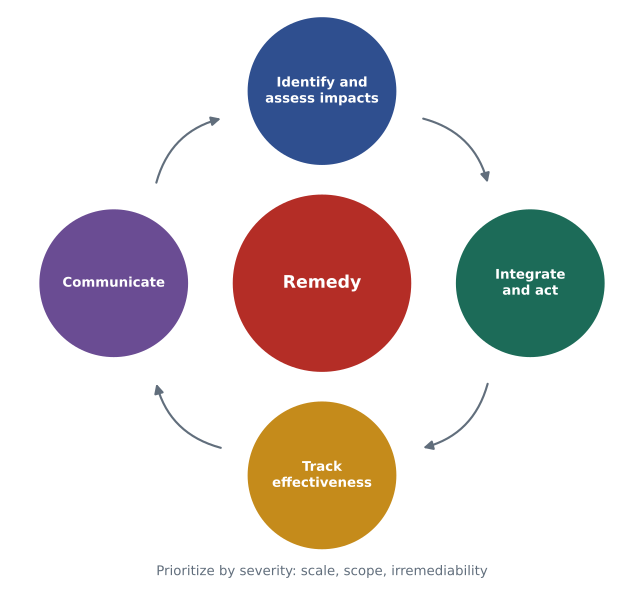
To meet the responsibility, companies should adopt a policy commitment approved at the most senior level, carry out human rights due diligence, and provide or cooperate in remediation. Due diligence means identifying and assessing actual and potential human rights impacts, integrating the findings and acting on them, tracking the effectiveness of responses and communicating how impacts are addressed. Companies should prioritize impacts by severity, judged by scale, scope and irremediability, rather than by risk to the company. The OECD Guidelines for Multinational Enterprises on Responsible Business Conduct, updated in 2023, apply a similar due diligence approach to human rights, labour, environment, bribery and other issues, and governments maintain National Contact Points to handle complaints.
Worked problem
Prioritizing human rights impacts by severity
A clothing retailer's assessment identifies three potential impacts in its supply chain: (a) excessive overtime at a tier 1 factory affecting 2,000 workers; (b) a risk of fire at a subcontracted facility with locked exits, affecting 300 workers; (c) delayed wage payments at a fabric mill affecting 800 workers. Rank the impacts by severity using scale, scope and irremediability, and suggest a first action for the highest priority.
Show solution
- Scale (gravity): fire with locked exits risks death, the gravest; overtime and delayed wages are serious but less grave.
- Scope (number affected): overtime affects the most people (2,000), wages 800, fire 300.
- Irremediability: death or serious injury cannot be remedied; lost wages can be repaid; excessive overtime is partly remediable.
- Ranking: (b) fire risk first, because of gravity and irremediability; then (a) overtime and (c) wages.
- First action for (b): require immediate unlocking of exits and an independent fire safety inspection, and suspend orders to the facility until fixed while working to protect workers' incomes.
Answer: The fire risk is most severe despite affecting the fewest people, because death is irremediable; it requires immediate action.
Responsible exit is part of due diligence. Terminating a supplier may seem the cleanest response to abuses, but it can harm the workers it is meant to protect by eliminating their jobs. The Guiding Principles encourage companies to use and increase their leverage, for example by working with other buyers, to bring about improvements, and to consider the human rights consequences of ending a relationship.
Canada created the Canadian Ombudsperson for Responsible Enterprise (CORE) in 2019 to review complaints about the human rights conduct of Canadian garment, mining and oil and gas companies abroad. Civil society groups have criticized its lack of power to compel documents and testimony. Canadian courts have also become more open to claims against Canadian companies over conduct abroad: in Nevsun Resources Ltd. v. Araya (2020), the Supreme Court of Canada allowed Eritrean workers' claims alleging forced labour at a mine partly owned by a Canadian company to proceed, holding that claims based on customary international law could go forward in Canadian courts.
Business and Indigenous peoples
The United Nations Declaration on the Rights of Indigenous Peoples (UNDRIP), adopted by the UN General Assembly in 2007, affirms Indigenous peoples' rights to self-determination, to their lands, territories and resources, to maintain their cultures and institutions, and to free, prior and informed consent (FPIC) before the adoption of measures that affect them, including projects on their lands. Free means without coercion or manipulation; prior means before decisions are made and authorizations granted; informed means with full information about the project and its impacts; and consent means the outcome of a genuine process of good-faith engagement. Whether FPIC amounts to a veto is debated: governments and many companies describe it as a standard requiring consultation aimed at agreement, while many Indigenous nations regard it as the right to say no.
Canada endorsed UNDRIP in 2016, and the United Nations Declaration on the Rights of Indigenous Peoples Act, which received royal assent in June 2021, commits the federal government to align its laws with the Declaration and to implement an action plan, published in 2023. British Columbia passed similar legislation in 2019. Section 35 of the Constitution Act, 1982 recognizes and affirms Aboriginal and treaty rights, and the courts have established a Crown duty to consult and, where appropriate, accommodate Indigenous peoples when contemplating conduct that may adversely affect asserted or established rights. Although the duty belongs to the Crown, governments often delegate procedural aspects of consultation to companies, and in practice projects without meaningful Indigenous support face delays, litigation and cancellation. The Truth and Reconciliation Commission's Call to Action 92 asks the corporate sector to adopt UNDRIP as a framework, to engage in meaningful consultation and obtain free, prior and informed consent before proceeding with economic development projects, to ensure equitable access to jobs, training and education, and to provide education for managers and staff on the history of Indigenous peoples. Impact benefit agreements, equity partnerships and federal and provincial loan guarantee programs supporting Indigenous ownership of major projects have become common. In 2025 federal legislation to speed approval of projects deemed in the national interest drew strong criticism from many First Nations, who argued that it weakened consultation; how it is implemented remains a key test of the government's commitments.
Good practice for companies includes engaging early, before key decisions are made; respecting Indigenous governance structures and decision-making processes and timelines; sharing complete information, including about risks; providing capacity funding so communities can obtain independent advice; negotiating agreements that share benefits through jobs, contracts, revenue and equity; respecting cultural heritage and sacred sites; and building long-term relationships rather than transactional ones. Boards should understand the company's relationships with Indigenous nations and oversee them as a strategic matter.
Capstone: a governance and ethics review of Northbank Foods
The capstone applies the course to an invented company. Northbank Foods is a listed food processor with annual revenue of about $2.4 billion, plants in three countries and suppliers worldwide. Its founder controls 58 % of the votes through multiple-voting shares while owning 14 % of the equity; there is no sunset clause. The founder is both chair and chief executive. The board has nine members: the founder, the founder's daughter (head of marketing), the chief financial officer, a retired partner from the company's audit firm who left the firm two years ago, the founder's long-time lawyer, and four independent directors. The audit committee consists of three of the independent directors.
Several issues have come to the board's attention. Executive pay rose 35 % last year while profits fell 10 %, because the board increased base salaries to the 75th percentile of a peer group of larger companies and paid discretionary bonuses after missed targets; the say-on-pay vote received 61 % support. The company's sustainability report highlights a top ESG rating from one agency but discloses no Scope 3 emissions and has no assurance. An investigative report alleges forced overtime and withheld passports at a seafood supplier's facility. The ethics hotline received 14 reports last year, down from 38, after a manager disciplined an employee who reported a food safety concern; two reports alleging retaliation were closed without investigation. A new AI pricing tool raises prices in neighbourhoods with fewer grocery competitors, which tend to have lower incomes. The company plans a new processing plant near a river on land within the traditional territory of an Indigenous nation, which has asked for consultation.
| Area | Finding | Assessment | Recommendation |
|---|---|---|---|
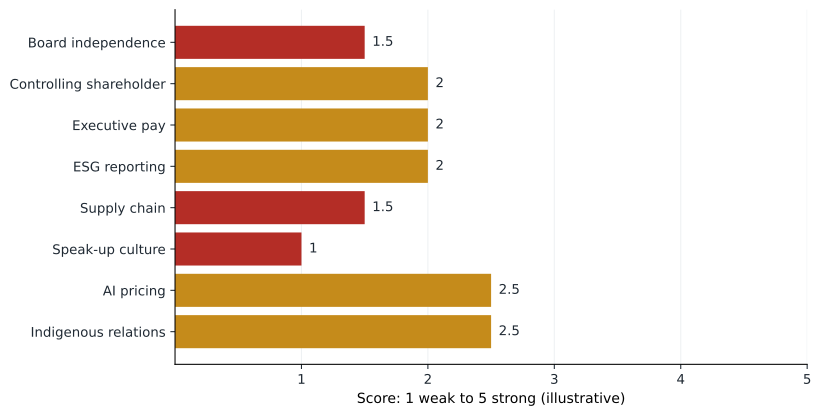
| Board independence | 4 of 9 independent; founder is chair and CEO | Weak: no independent majority | Add independent directors; appoint an independent lead director or chair |
| Controlling shareholder | 58 % of votes, 14 % of equity, no sunset | High risk to minority shareholders | Propose a sunset clause; independent review of related-party dealings |
| Executive pay | Pay up 35 % as profits fell; 61 % say-on-pay support | Pay not linked to performance | Revise peer group, remove discretionary bonuses, engage shareholders |
| ESG reporting | Single rating promoted; no Scope 3; no assurance | Greenwashing and credibility risk | Adopt ISSB-aligned reporting, estimate Scope 3, obtain assurance, audit committee review |
| Supply chain | Forced labour allegations at a supplier | Severe human rights impact | Independent investigation; remediation; use leverage before exit |
| Speak-up culture | Reports fell after retaliation; retaliation reports not investigated | Serious culture failure | Investigate retaliation independently; discipline; retrain managers; report to board |
| AI pricing | Higher prices in low-competition, lower-income areas | Fairness and reputational risk | Impact assessment; constraints on the model; human oversight; board reporting |
| Indigenous relations | New plant on traditional territory; consultation requested | Legal, ethical and project risk | Early engagement, capacity funding, aim for consent and a benefit agreement |
Worked problem
Prioritizing the capstone recommendations
The board can act on only three issues in the next 90 days. Using severity of harm, legal exposure, and the effect on other problems, choose three and justify your choice.
Show solution
- Forced labour allegations: the most severe harm to people, with legal exposure under supply chain and import laws; act immediately through investigation and remediation.
- Retaliation and the speak-up system: without a working early warning system, other problems will go undetected; investigate retaliation and protect reporters.
- Board independence: a structural fix that enables better oversight of pay, related-party issues and risk; begin by appointing an independent lead director and recruiting new independent directors.
- Other issues (pay, ESG reporting, AI pricing, plant consultation) should be scheduled with clear owners; consultation with the Indigenous nation should begin before any site decisions.
Answer: Act first on forced labour, retaliation and board independence, because they involve the gravest harm and enable progress on everything else.
Writing a governance and ethics review follows a consistent structure: summarize the company and its context; identify the stakeholders and their interests; assess each area against standards from law and best practice; analyse the ethical issues using the lenses of lesson 2; prioritize by severity and leverage; make specific, assigned and timed recommendations; and explain how the board will monitor progress. The best reviews connect findings: at Northbank, the weak board, the controlling founder, the pay problems and the retaliation are all symptoms of a governance system that does not hold leadership to account.
Common mistakes
MistakeRanking human rights impacts by risk to the company.
InsteadRank by severity to people: scale, scope and irremediability.
MistakeCutting off a supplier immediately after finding abuses.
InsteadUse leverage to remediate first, and consider the effect of exit on workers.
MistakeTreating consultation with Indigenous nations as a box to tick late in a project.
InsteadEngage early, fund capacity, respect governance and aim for agreement.
MistakeAddressing capstone issues one at a time without seeing links.
InsteadLook for root causes in governance that connect separate problems.
MistakeMaking vague recommendations.
InsteadMake recommendations specific, assigned, timed and monitored.
Summary and key terms
- The UN Guiding Principles set out the state duty to protect, the corporate responsibility to respect and access to remedy.
- Human rights due diligence identifies, acts on, tracks and communicates impacts, prioritized by severity.
- Responsible exit considers the effect of ending supplier relationships on workers.
- UNDRIP affirms Indigenous rights, including free, prior and informed consent; its legal status differs between Canada and the United States.
- In Canada, section 35, the duty to consult and the UNDRIP Act shape project approvals; TRC Call to Action 92 addresses business directly.
- In the United States, tribal sovereignty and federal consultation requirements shape projects needing federal approval.
- Good practice with Indigenous nations includes early engagement, capacity funding, benefit sharing and long-term relationships.
- A governance and ethics review assesses each area, prioritizes by severity and leverage, and connects symptoms to root causes.
- UN Guiding Principles
- The 2011 framework of state duty, corporate responsibility to respect and access to remedy.
- Human rights due diligence
- A process to identify, prevent, mitigate and account for human rights impacts.
- Severity
- The seriousness of a human rights impact, judged by scale, scope and irremediability.
- Leverage
- A company's ability to influence the conduct of a business partner.
- UNDRIP
- The UN Declaration on the Rights of Indigenous Peoples, adopted in 2007.
- Free, prior and informed consent
- The standard that Indigenous peoples' consent be sought freely, before decisions, with full information.
- Duty to consult
- In Canada, the Crown's obligation to consult and accommodate when its conduct may affect Aboriginal or treaty rights.
- Impact benefit agreement
- An agreement between a company and an Indigenous community setting out benefits and commitments for a project.
- Tribal sovereignty
- The inherent authority of tribes in the United States to govern themselves.
- Governance and ethics review
- A structured assessment of a company's governance and ethical practices with prioritized recommendations.
Practice problems
Work each problem on paper first, then reveal the answer to check.
Name the three pillars of the UN Guiding Principles.
Show answer
State duty to protect, corporate responsibility to respect, access to remedy.
What three factors determine the severity of a human rights impact?
Show answer
Scale, scope and irremediability.
Why might ending a supplier relationship harm workers?
Show answer
It can eliminate their jobs without fixing abuses; leverage may achieve more.
What does each element of FPIC mean?
Show answer
Free: without coercion; prior: before decisions; informed: with full information; consent: outcome of good-faith engagement.
What did Nevsun v. Araya (2020) decide?
Show answer
Claims by foreign workers based on customary international law against a Canadian company could proceed in Canadian courts.
What is Executive Order 13175?
Show answer
A US order requiring federal agencies to consult tribal governments on policies with tribal implications.
Give three elements of good practice in engaging Indigenous nations.
Show answer
Early engagement, capacity funding, benefit sharing, respect for governance, long-term relationships.
Why is retaliation at Northbank a priority?
Show answer
It disables the early warning system that would reveal other problems.
Calculate Northbank's board independence ratio.
Show answer
4 of 9 = 44 %, not a majority.
Portfolio task: write a two-page governance and ethics review of a real or invented company using the capstone structure.
Show answer
Answers vary; should assess areas, prioritize and give specific, assigned recommendations.
Lesson quiz · 5 questions
Score 60% or more to complete this lesson.
Create a free account to save your progress, take quizzes and earn a certificate.