
BUS-310 · Lesson 4 of 12 · 26 min
Stakeholders, corporate social responsibility and the purpose of the corporation
In 1970 the economist Milton Friedman wrote that the social responsibility of business is to increase its profits, so long as it stays within the rules of the game, which he described as open and free competition without deception or fraud. Almost fifty years later, in 2019, nearly two hundred chief executives of large American companies signed a Business Roundtable statement committing to deliver value to customers, employees, suppliers, communities and shareholders. Whether that statement changed corporate behaviour is debated, but it captured a long-running argument about what corporations are for. This lesson examines that argument, the stakeholder concept, corporate social responsibility (CSR) and the organizational forms designed to blend profit with purpose.
BUS-210 explained the legal position: directors owe fiduciary duties to the corporation, and Canadian courts in BCE (2008) allow directors to consider the interests of shareholders, employees, creditors, consumers, governments and the environment, while Delaware law emphasizes the long-term interests of the corporation for the benefit of its stockholders. This lesson takes up the ethical and strategic questions that the law leaves open.
The shareholder primacy view
Friedman's argument has several strands. Managers are agents of shareholders, who own the firm, and spending shareholders' money on social causes without their consent is a kind of taxation without representation. Managers have no special expertise or democratic mandate to decide social priorities. Competitive markets, by rewarding firms that serve customers efficiently, channel self-interest into social benefit. And clear profit goals make managers accountable, whereas vague social goals let them pursue their own preferences. Modern versions add that shareholders can pursue social aims themselves with their dividends, and that governments, not firms, should set rules for externalities such as pollution.
Critics respond that markets are imperfect: externalities, information asymmetries and market power mean that profit seeking can harm others even within the law. The 'rules of the game' are shaped by business lobbying, so relying on law alone can be circular. Shareholders are not the only parties who make firm-specific investments and bear risk; employees and communities do too. And many shareholders, such as pension funds holding diversified portfolios for decades, care about long-term systemic effects that short-term profit maximization may ignore.
Stakeholder theory
R. Edward Freeman's 1984 book on strategic management popularized the idea that managers should take account of all stakeholders: groups who can affect or are affected by the firm's objectives. The theory has three versions. Descriptive stakeholder theory observes that firms do in fact manage many relationships. Instrumental stakeholder theory claims that firms that manage stakeholder relationships well perform better. Normative stakeholder theory claims that stakeholders have legitimate interests that deserve consideration for their own sake. Freeman himself argued that the dichotomy between shareholders and stakeholders is false, because in the long run creating value for customers, employees, suppliers and communities is how value for shareholders is created.
Critics of stakeholder theory argue that serving many masters means serving none: without a single objective, managers cannot make trade-offs and are less accountable. Michael Jensen proposed 'enlightened value maximization', in which managers maximize long-run firm value while attending to stakeholders because doing so is necessary for that value. In practice, the gap between enlightened shareholder value and instrumental stakeholder theory is narrow; the sharp disagreements arise when stakeholder interests and long-run firm value genuinely conflict.
Identifying and prioritizing stakeholders
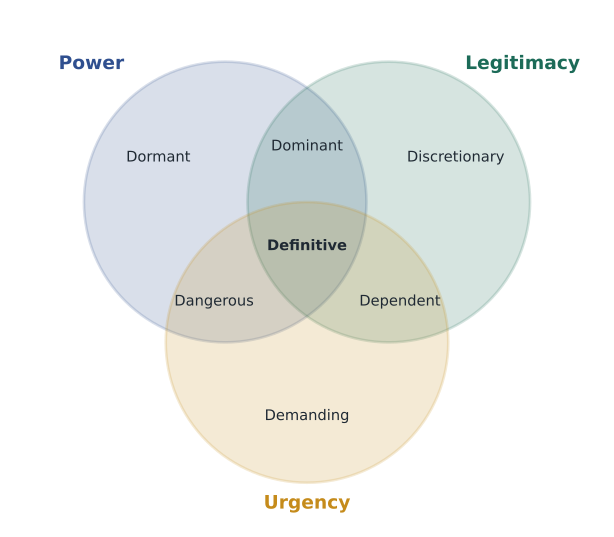
Ronald Mitchell, Bradley Agle and Donna Wood proposed that managers pay attention to stakeholders according to three attributes: power (the ability to impose their will), legitimacy (a socially accepted claim or relationship) and urgency (time sensitivity and criticality). Stakeholders with one attribute are latent; with two, expectant; with all three, definitive. A community group protesting a pipeline may begin with legitimacy alone, gain urgency when construction starts and gain power when it wins a court injunction or media attention, moving from latent to definitive.
Worked problem
Mapping stakeholder salience
A mining company plans a new open-pit mine near a river. Classify these stakeholders by salience: (a) a major institutional shareholder; (b) a nearby Indigenous nation asserting rights to the land and water, with a court challenge filed; (c) an environmental group running an online petition; (d) downstream farmers who have not yet organized; (e) the provincial or state environmental regulator reviewing permits.
Show solution
- (a) Power and legitimacy, low urgency: dominant stakeholder.
- (b) Legitimacy (recognized rights), urgency (court challenge) and power (litigation can halt the project): definitive stakeholder.
- (c) Urgency and some legitimacy but limited power: dependent or demanding stakeholder, depending on the strength of its claim.
- (d) Legitimacy only for now: discretionary (latent) stakeholder, who could become definitive if water is affected.
- (e) Power and legitimacy, and urgency during the permit decision: definitive stakeholder.
Answer: The Indigenous nation and the regulator are definitive stakeholders. Salience is dynamic, so the farmers deserve attention before they organize; ethically, legitimacy should matter even when power is low.
The salience model describes whom managers do attend to. Ethically, it carries a warning: if attention follows power, the legitimate claims of weak stakeholders, such as future generations, distant workers or unorganized communities, may be ignored until they become urgent and powerful. A responsible firm weighs legitimacy and the severity of impact, not only power.
Corporate social responsibility
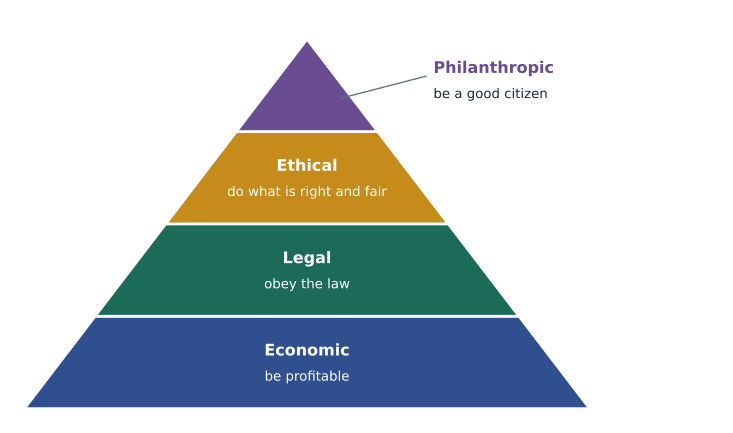
Archie Carroll's pyramid of corporate social responsibility describes four layers. Economic responsibilities, to be profitable, form the base, because a firm that cannot survive cannot meet any other obligations. Legal responsibilities require obeying the law. Ethical responsibilities require doing what is right, fair and just beyond the law. Philanthropic responsibilities, to be a good corporate citizen, involve contributing resources to the community. Carroll later emphasized that the layers are not a strict sequence and that all four should be met simultaneously.
CSR has evolved from philanthropy, which is often disconnected from the core business, towards integrating social and environmental considerations into strategy and operations. Michael Porter and Mark Kramer's concept of creating shared value argues that firms can find business opportunities in social problems, for example by redesigning products for underserved markets, improving supplier productivity and welfare, or reducing resource use. Critics note that shared value can understate real conflicts between profit and social good and overstate how often win–win solutions exist.
| Approach | Focus | Example | Main criticism |
|---|---|---|---|
| Philanthropy | Donations and sponsorship | Funding a local hospital wing | Disconnected from how profits are made |
| Strategic CSR | Social activities that support competitive advantage | Training programs that build a skilled local workforce | May neglect issues without business benefit |
| Shared value | Redesigning products and value chains to solve social problems | Affordable financial services for unbanked customers | Overstates win–win opportunities |
| Responsible business conduct | Avoiding and addressing harms across operations and supply chains | Human rights due diligence | Requires costly, ongoing effort |
Corporate purpose and hybrid forms
Corporate purpose statements describe why a company exists beyond making money. The British Academy's Future of the Corporation program summarized purpose as 'profitable solutions to the problems of people and planet, without profiting from causing problems'. Purpose can guide strategy and motivate employees, but statements that are not backed by decisions, incentives and governance become 'purpose washing'. The test of purpose is what a company gives up for it.
Some jurisdictions offer legal forms that build purpose into the corporate structure. British Columbia's benefit company provisions, in force since 2020, allow a company to adopt a benefit statement in its articles, requiring directors to balance shareholders' interests with the public benefits it commits to and to publish an annual benefit report. Community contribution companies in British Columbia and community interest companies in Nova Scotia limit dividends and asset distributions to protect community purposes. Separately, B Corp certification by the non-profit B Lab is a voluntary standard based on an assessment of social and environmental performance; many Canadian firms are certified. Certification is a private standard, not a legal status, and B Lab introduced revised standards in 2025 that require meeting minimum requirements across several impact topics.
Hybrid forms show that the law can accommodate purpose explicitly. But they are a small share of companies, and conventional corporations can also pursue purpose within the latitude that directors' duties allow. The bigger question is whether governance, incentives and reporting hold managers to their stated purpose.
Stakeholder engagement in practice
Taking stakeholders seriously requires more than mapping them. Stakeholder engagement is the ongoing process of informing, consulting and involving the groups a company affects, and responding to what it learns. Engagement ranges from one-way communication, such as publishing reports, through consultation, such as surveys, community meetings and advisory panels, to collaboration and shared decision making, such as joint committees with unions or communities, or agreements that give a community a formal role in monitoring a project. The appropriate level depends on how significantly the group is affected and how much influence it should have on the decision.
Good engagement starts early, before decisions are effectively made; is transparent about what is and is not open to influence; reaches groups that are hard to hear, such as workers in supply chains or people without internet access; closes the loop by explaining how input was used; and creates channels for grievances. Poor engagement, a presentation after the decision with no real prospect of change, often generates more conflict than no engagement at all, because it signals that the company is going through the motions. Boards increasingly ask management to report what stakeholders are saying and how the company has responded, treating engagement as a source of early warning about risks and opportunities.
Corporate political and social engagement
Firms increasingly face pressure to take public positions on social and political questions, from climate policy to civil rights and immigration. Supporters argue that companies affect these issues through their operations and lobbying anyway, that employees and customers expect consistency with stated values, and that silence can be a choice with consequences. Opponents argue that companies have no democratic mandate, that public positions alienate employees, customers and investors who disagree, and that firms should focus on their core business. Since 2023 many large companies have become more cautious about public statements, scaled back or renamed some diversity programs, and faced political and legal pressure from both sides.
A useful test is consistency and materiality: does the issue directly affect the business, its employees or customers, and is the position consistent with the company's own conduct, including its lobbying and political spending? Disclosure of political spending and lobbying, and board oversight of it, help align what companies say with what they do. Corporate political activity is itself an ethical question: using corporate resources to shape the rules that govern the corporation raises the risk that the 'rules of the game' Friedman relied on are bent towards private interests.
Reconciling the views
The debate between shareholder and stakeholder views is narrower than it appears. Both agree that firms must be profitable, obey the law and avoid fraud and deception. Most shareholder primacy advocates accept that treating employees, customers and suppliers well usually serves long-term value, and most stakeholder advocates accept that firms need a clear way to make trade-offs and be held accountable. The hard cases arise when doing right by a stakeholder costs shareholders money with no offsetting benefit, or when stakeholder interests conflict with each other. In those cases, the ethical lenses of lesson 2 and the governance mechanisms of lessons 5 to 7 matter most.
Common mistakes
MistakeTreating "stakeholder" as a synonym for "anyone with an opinion".
InsteadIdentify groups who affect or are materially affected by the firm, then assess salience and legitimacy.
MistakeAttending only to powerful stakeholders.
InsteadWeigh legitimacy and severity of impact, including on weak or future stakeholders.
MistakeEquating CSR with philanthropy.
InsteadIntegrate social and environmental responsibility into core operations and supply chains.
MistakePublishing a purpose statement without changing decisions or incentives.
InsteadBack purpose with strategy, metrics, incentives and board oversight.
MistakeAssuming shareholder and stakeholder views always conflict.
InsteadRecognize their broad overlap and focus analysis on the real trade-offs.
Summary and key terms
- Friedman argued that business should maximize profit within the rules; critics point to externalities, market power and lobbying.
- Stakeholder theory has descriptive, instrumental and normative versions; enlightened value maximization bridges the views.
- Mitchell, Agle and Wood's salience model uses power, legitimacy and urgency; salience changes over time.
- Attention that follows power alone can neglect legitimate but weak stakeholders.
- Carroll's pyramid includes economic, legal, ethical and philanthropic responsibilities.
- CSR has moved from philanthropy towards strategic CSR, shared value and responsible business conduct.
- Benefit companies and benefit corporations build purpose into law; B Corp is a voluntary certification.
- Corporate political engagement should be consistent with the company's conduct and lobbying, and overseen by the board.
- Shareholder primacy
- The view that a corporation's primary objective is to maximize value for shareholders.
- Stakeholder theory
- The view that managers should consider all groups who affect or are affected by the firm.
- Enlightened value maximization
- Maximizing long-run firm value while attending to stakeholders as a means to that end.
- Stakeholder salience
- The degree to which managers give priority to a stakeholder's claims.
- Definitive stakeholder
- A stakeholder with power, legitimacy and urgency.
- Corporate social responsibility
- A firm's responsibilities to society beyond profit and legal compliance.
- Creating shared value
- Pursuing business opportunities that also address social problems.
- Corporate purpose
- A statement of why a company exists beyond making money.
- Benefit corporation
- A corporate form that requires directors to balance profit with specified public benefits.
- B Corp certification
- A private certification of social and environmental performance by B Lab.
Practice problems
Work each problem on paper first, then reveal the answer to check.
Summarize Friedman's main argument in one sentence.
Show answer
Managers are agents of shareholders and should increase profits within the rules, leaving social goals to individuals and governments.
What is instrumental stakeholder theory?
Show answer
The claim that managing stakeholder relationships well improves firm performance.
A union threatening a strike over safety has which salience attributes?
Show answer
Power, legitimacy and urgency: a definitive stakeholder.
Why might salience-based attention be ethically problematic?
Show answer
It can neglect legitimate stakeholders who lack power, such as future generations.
Name the four layers of Carroll's pyramid.
Show answer
Economic, legal, ethical and philanthropic.
Give an example of shared value.
Show answer
Redesigning a product for low-income customers in a way that is profitable and meets a need.
How does a benefit corporation differ from a B Corp?
Show answer
A benefit corporation is a legal form; B Corp is a private certification.
What is purpose washing?
Show answer
Claiming a social purpose without backing it with decisions, incentives and governance.
Give one argument for and one against companies taking public positions on social issues.
Show answer
For: consistency with values and real effects on employees. Against: no democratic mandate and alienation of stakeholders.
Portfolio task: map the salience of five stakeholders for a company you know and explain one ethical implication.
Show answer
Answers vary; should classify by power, legitimacy and urgency.
Lesson quiz · 5 questions
Score 60% or more to complete this lesson.
Create a free account to save your progress, take quizzes and earn a certificate.