
BUS-310 · Lesson 1 of 12 · 26 min
Why business ethics matters
In 2016 regulators revealed that employees at one of the largest banks in the United States had opened millions of deposit and credit card accounts that customers had never asked for. Branch staff faced aggressive daily sales targets, managers tracked progress hour by hour, and people who missed their numbers were warned, shamed or fired. The bank eventually paid billions of dollars in penalties and settlements, its chief executive resigned, and a regulator capped the size of its balance sheet for years. None of the individual acts was complicated. Each was a small decision made under pressure inside a system that rewarded the wrong outcome. That pattern, ordinary people doing harmful things because the organization made it easy and failure to comply hard, is why business ethics is a management subject and not only a matter of personal character.
This course examines how organizations can make good ethical decisions consistently and how they are directed and held to account. It moves from ethical theory and moral psychology to the purpose of the corporation, boards and executive pay, sustainability reporting, compliance programs, fraud and corruption, whistleblowing, technology and human rights. It builds on BUS-130, which explains perception, bias and organizational politics, and on BUS-210, which sets out the corporate law framework of directors' duties, the business judgment rule and shareholder remedies. Where those courses explain what the law requires, this one asks what good governance and ethical management look like in practice, and why they often go further than the law.
What business ethics is
Ethics is the systematic study of right and wrong, good and bad, and what we owe to one another. Business ethics applies that study to commercial life: the decisions of individuals at work, the policies and cultures of organizations, and the rules of the economic system within which firms compete. It is both descriptive, asking how people and organizations actually behave, and normative, asking how they ought to behave. A manager who asks why salespeople cut corners is asking a descriptive question; a manager who asks whether a pricing practice is fair is asking a normative one. Good practice needs both.
Ethics is sometimes confused with three neighbouring ideas. Morality usually refers to the beliefs about right and wrong that a person or community actually holds; ethics is the reasoned reflection on those beliefs. Law is the set of rules a state enforces with penalties. Etiquette and custom are conventions about appropriate conduct that carry social rather than legal consequences. These overlap but are not the same. Much of the law reflects widely shared moral views, but the law is slow to change, varies between jurisdictions, is shaped by lobbying and compromise, and cannot anticipate every situation. Some legal conduct is unethical, such as exploiting a loophole to sell a product the seller knows will harm customers. Some illegal conduct may be ethical, such as civil disobedience against an unjust rule. Most of the time, though, ethics asks managers to go beyond legal minimums, not to break the law.
| Question | Legal? | Ethical? | Comment |
|---|---|---|---|
| Paying a supplier on time as agreed | Yes | Yes | Law and ethics agree |
| Delaying payments to small suppliers to the legal limit to improve your cash flow | Usually yes | Questionable | Lawful but shifts hardship to weaker parties; prompt payment laws now limit some delays |
| Selling a legal product you know fails often, without disclosure | Possibly | No | Consumer protection law may also be engaged |
| Refusing an unlawful order to falsify a safety record | Yes (and protected) | Yes | Law protects the refusal in most jurisdictions |
| Paying a customs official to speed up a routine clearance | Depends on jurisdiction | Doubtful | Canada no longer allows facilitation payments; US law has a narrow exception (lesson 9) |
Three levels of business ethics
Business ethics questions arise at three levels. At the individual level, a person decides whether to report an expense honestly, whether to raise a concern, or how to treat a colleague. At the organizational level, a company sets incentives, designs products, writes codes of conduct and builds (or neglects) a culture. At the systemic level, society sets the rules of the game: corporate law, securities regulation, competition law, labour standards, tax and international agreements. Problems at one level often come from another. The fake-accounts scandal involved thousands of individual wrongs, but its causes were organizational, in the incentive system and culture, and partly systemic, in how bank regulators supervised sales practices.
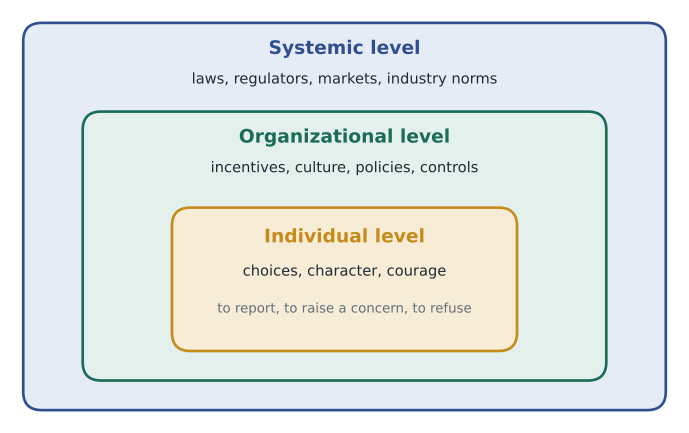
Recognizing the level matters because the remedy depends on it. Training an individual will not fix an incentive plan that rewards misconduct. A new code of conduct will not fix an industry-wide practice that competitors also use; that may need regulation or collective industry standards. Much of this course is about the organizational level, because that is where managers and boards have the most direct influence.
Why ethics pays, and when it does not
Managers often ask whether ethics pays. There are good reasons to think that, over time, it often does. Trust lowers transaction costs: customers, suppliers and employees who trust a firm need fewer contracts, inspections and guarantees. A good reputation is an asset that helps attract talent and customers and earns the benefit of the doubt when something goes wrong. Ethical cultures detect problems earlier, because people speak up, and that prevents small issues from becoming crises. Misconduct, by contrast, brings fines, legal costs, remediation, lost customers, higher borrowing costs, management distraction and sometimes the collapse of the firm, as at Enron, Arthur Andersen and FTX.
Research on the financial effects of corporate social and environmental performance is mixed but, on balance, finds a neutral to modestly positive relationship with financial performance, and a clearer negative effect from serious misconduct. Studies of stock price reactions find that announcements of fraud or regulatory enforcement typically cause losses far larger than the fines, because investors reassess management quality and future cash flows. These are averages: in a particular case, cutting corners may be profitable for a long time, especially if detection is unlikely and enforcement weak.
That is why the business case cannot be the only argument for ethics. If honesty were valuable only when it paid, it would not be honesty at all. Ethical commitments matter because they reflect obligations to people affected by business decisions: customers, workers, communities and future generations. A sound approach uses the business case where it holds, but does not abandon ethical commitments when a particular unethical act seems profitable.
The expected cost of misconduct
One way to see why organizations underestimate ethical risk is to think about expected cost. A decision maker tempted to cut a corner compares a fairly certain short-term gain against an uncertain, delayed cost. The expected cost is the probability of detection multiplied by the total cost if detected, which includes fines, remediation, lost business and reputational damage, not only the legal penalty.
People systematically underestimate both terms. They underestimate the probability of detection, because whistleblowers, data analytics, audits and journalists find more than they expect, and because misconduct that continues for years accumulates many chances of discovery. They underestimate the cost, because they think only of the fine and forget the larger indirect costs.
Worked problem
Comparing a shortcut with its expected cost
A product manager could skip an extra safety test, saving $400,000 and two months. Engineers estimate a 5 % chance that the untested failure mode causes injuries. If it does, the company expects $3 million in settlements and recalls, $6 million in lost profit from damaged sales, and $1 million in legal and investigation costs. Is skipping the test justified on expected cost alone? What does the calculation leave out?
Show solution
- Total cost if the failure occurs = 3 + 6 + 1 = $10 million.
- Expected cost = 0.05 × $10 million = $500,000.
- Expected cost ($500,000) exceeds the saving ($400,000), so skipping the test is not justified even in purely financial terms.
- The calculation leaves out the injuries themselves, which matter morally and are not fully captured by settlement amounts; the possibility of criminal liability for managers; and the effect on employees who learn that safety tests are optional.
Answer: Skipping the test has a higher expected cost than benefit, and the most important consideration, harm to people, is outside the calculation altogether.
The calculation can also be run over time. Misconduct that is repeated every year has a cumulative chance of detection that grows quickly, as the short program below shows.
# Probability that misconduct repeated each year is detected at least once
for p in (0.05, 0.10, 0.20):
    row = []
    for years in (1, 3, 5, 10):
        row.append(f"{1 - (1 - p) ** years:5.0%}")
print(f"annual detection {p:.0%}:", " ".join(row), " (1, 3, 5, 10 years)")annual detection 5%: 5% 14% 23% 40% (1, 3, 5, 10 years) annual detection 10%: 10% 27% 41% 65% (1, 3, 5, 10 years) annual detection 20%: 20% 49% 67% 89% (1, 3, 5, 10 years)
Even a modest annual probability of detection becomes a high cumulative probability within a few years. Long-running frauds such as the WorldCom accounting scheme or the Wells Fargo sales practices were eventually exposed; what varied was how much damage accumulated first.
Stakeholders and the reach of business decisions
Business decisions affect many groups. Shareholders provide capital and bear residual risk. Employees invest their skills and careers. Customers rely on products being safe and as described. Suppliers depend on fair dealing and payment. Communities bear environmental and social effects. Governments depend on taxes and compliance. Future generations inherit the consequences of today's resource use and emissions. Lesson 4 explores the debate about how far managers should weigh these interests; for now, notice that ethical analysis begins by identifying who is affected and how.
Corporate power raises the stakes. Large firms have more economic weight than many countries, shape markets and technologies, employ hundreds of thousands of people and influence public policy. With that power comes a responsibility to use it with care and to accept accountability. Governance, the subject of lessons 5 and 6, is the system that holds that power to account.
Business ethics in the Canadian and American context
Canadian business operates within a distinctive framework. Corporate law is federal (the Canada Business Corporations Act, CBCA) or provincial. Securities regulation is provincial, coordinated through the Canadian Securities Administrators (CSA). Canadian governance relies heavily on disclosure and 'comply or explain' guidance rather than detailed rules: issuers must describe their governance practices and explain departures from best-practice guidelines. Canada has many controlled and family companies, widely used dual-class share structures, and large pension plans that act as engaged long-term investors. The Supreme Court of Canada's decisions in Peoples Department Stores v. Wise (2004) and BCE Inc. v. 1976 Debentureholders (2008), discussed in BUS-210, confirm that directors owe their duty to the corporation and may consider the interests of various stakeholders. Canada's commitments to reconciliation with Indigenous peoples, including the United Nations Declaration on the Rights of Indigenous Peoples Act (2021), add a dimension explored in lesson 12.
How this course approaches ethics
Three habits run through this course. First, take ethical questions seriously as questions with better and worse answers, even when reasonable people disagree. Second, look for systems, not only villains: ask what incentives, structures and cultures produced a behaviour. Third, connect principle with practice: a good intention is not enough without the governance, controls and courage to act on it. Contested issues, such as the role of environmental, social and governance (ESG) investing or how far companies should take positions on social questions, are presented with the strongest arguments on more than one side so that you can reach your own reasoned view.
Common mistakes
MistakeTreating legal compliance as the whole of ethics.
InsteadTreat the law as a floor; ask what fairness, honesty and care require beyond it.
MistakeExplaining scandals only by individual greed.
InsteadLook for incentives, pressures, culture and weak controls that made misconduct easy.
MistakeJustifying ethics only by its profitability.
InsteadUse the business case where it holds, but keep obligations when a wrong seems profitable.
MistakeCounting only the fine when estimating the cost of misconduct.
InsteadInclude remediation, lost business, reputation, management time and harm to people.
MistakeAssuming misconduct that has gone undetected will stay hidden.
InsteadRepeated misconduct accumulates detection risk quickly; most long-running schemes are eventually exposed.
Summary and key terms
- Business ethics studies right and wrong in commercial life, descriptively and normatively.
- Ethics, morality, law and custom overlap but differ; the law is a floor, not a ceiling.
- Ethical problems arise at individual, organizational and systemic levels, and the remedy depends on the level.
- Trust, reputation and early detection of problems give ethics a business case, but it is not the only argument.
- Expected cost equals the probability of detection times the full cost; both are commonly underestimated.
- Repeated misconduct has a cumulative detection probability that rises quickly.
- Corporate power over many stakeholders is why governance and accountability matter.
- Business ethics
- The study of right and wrong conduct in commercial life at individual, organizational and systemic levels.
- Normative ethics
- Reasoning about how people and organizations ought to act.
- Descriptive ethics
- Study of how people and organizations actually behave in moral matters.
- Morality
- The beliefs about right and wrong that a person or community actually holds.
- Systemic level
- The rules, institutions and markets within which firms compete.
- Expected cost
- The probability of an event multiplied by the cost if it occurs.
- Reputation
- Stakeholders' beliefs about a firm's character and likely future conduct.
- Stakeholder
- Any group or individual who affects or is affected by an organization's decisions.
- Corporate governance
- The system by which companies are directed, controlled and held to account.
- Comply or explain
- A regulatory approach in which companies follow guidelines or disclose why they do not.
Practice problems
Work each problem on paper first, then reveal the answer to check.
Give an example of conduct that is legal but arguably unethical.
Show answer
Examples: exploiting a loophole to sell a harmful product; delaying payment to small suppliers to the legal limit.
Distinguish morality from ethics.
Show answer
Morality is the set of beliefs people hold; ethics is reasoned reflection on those beliefs.
Which level is involved when a sales incentive plan rewards misconduct?
Show answer
The organizational level.
Why might training individuals fail to stop misconduct?
Show answer
Because the cause may be organizational, such as incentives or culture, or systemic.
Shortcut saves $250,000; 4 % chance of $8 million total cost. What is the expected cost?
Show answer
0.04 × 8,000,000 = $320,000, more than the saving.
With a 10 % annual detection probability, what is the chance of detection within five years?
Show answer
1 − 0.9⁵ ≈ 41 %.
Name three costs of misconduct other than fines.
Show answer
Remediation, lost customers, legal fees, higher borrowing costs, management distraction, harm to morale.
Why is the business case for ethics insufficient on its own?
Show answer
Because obligations to people do not disappear when a wrong would be profitable.
What two Supreme Court of Canada cases address directors' duties and stakeholders?
Show answer
Peoples Department Stores v. Wise (2004) and BCE (2008).
Portfolio task: describe a business decision you have seen and identify the individual, organizational and systemic factors involved.
Show answer
Answers vary; should name at least one factor at each level.
Lesson quiz · 5 questions
Score 60% or more to complete this lesson.
Create a free account to save your progress, take quizzes and earn a certificate.