
BLR-340 · Lesson 8 of 12 · 20 min
Boilers, vessels and exchangers review
Desmond Pryce, who runs Ironbridge's exchanger shop, takes the equipment night, with a cutaway drawing of a packaged boiler and a bundle of old tube sections on the table. "Half the questions in this part are vocabulary," he says. "What's a mud drum, what's an economizer, what does AES mean on a nameplate. The other half are what you do to the thing: how you expand a tube, how you test it." Boilers, vessels and exchangers appear in new construction and in repair, major work activities C and D, which between them carry half the exam. This lesson reviews how boilers make steam, the types of boiler and their parts, pressure vessel construction, tubes and tube sheets, shell-and-tube and air-cooled exchangers, and pressure testing, as taught in BLR-220.
How a boiler makes steam
A boiler transfers heat from burning fuel, or from hot gas, to water until it boils. At a given pressure, water boils at one temperature, the saturation temperature, and stays at that temperature until all of it has become steam; the heat added while it boils is the latent heat. Saturated steam heated further, above the saturation temperature, becomes superheated steam, which carries more energy and does not condense on its way to a turbine. The higher the pressure, the higher the saturation temperature: water boils at 100 °C (212 °F) at atmospheric pressure but at about 311 °C (592 °F) at 10 MPa (1,450 psi). BLR-220 lesson 1 covers the steam cycle.
In a natural circulation water-tube boiler, water flows down from the steam drum through unheated downcomers to the mud drum or lower headers, and rises through the heated furnace wall and generating tubes as a mixture of water and steam, because the mixture is lighter than the water in the downcomers. In the steam drum the mixture is separated: steam goes up through separators and dryers to the superheater, and water goes back down. Boiler efficiency is the share of the fuel's heat that ends up in the steam; modern gas-fired units reach 80 to 90 percent.
Boiler types and parts
Fire-tube boilers pass the hot combustion gas through tubes surrounded by water in a shell. They are compact, hold a large volume of water, respond slowly and are limited to low pressures and moderate capacities; most packaged heating and small process boilers are fire-tube. Water-tube boilers pass water through tubes surrounded by the hot gas. They handle high pressures and large capacities and are used for power generation and large industrial plants. BLR-220 lessons 2 and 3 cover the two types.
The main parts of a water-tube boiler are the most frequently asked vocabulary. The steam drum, at the top, separates steam from water and holds the water level. The mud drum or lower drum, at the bottom, collects sediment that is removed by blowdown. Headers are large pipes that distribute water to, or collect steam from, rows of tubes. Waterwalls are furnace walls made of tubes joined by membrane bars. The superheater raises the steam above saturation, and in power plants a reheater heats steam returned from the turbine. The economizer heats the feedwater with the flue gas before it enters the drum, and the air heater heats the combustion air with the flue gas after the economizer. Recovery boilers in pulp mills burn the spent pulping liquor and recover its chemicals, and heat recovery steam generators, HRSGs, make steam from gas turbine exhaust. BLR-220 lessons 4 and 5 cover these.
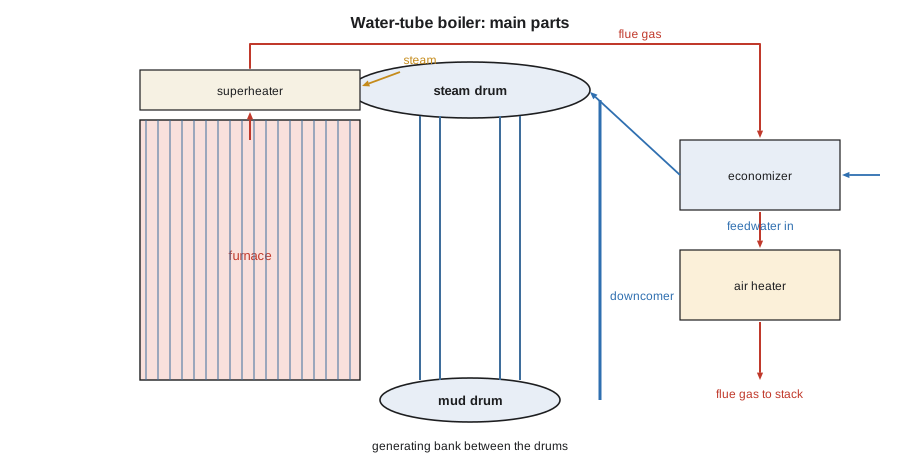
| Part | What it does |
|---|---|
| Steam drum | Separates steam from water; holds the water level |
| Mud drum | Collects sediment for blowdown |
| Downcomer | Carries water down from the steam drum |
| Superheater | Heats steam above its saturation temperature |
| Economizer | Heats feedwater with flue gas |
| Air heater | Heats combustion air with flue gas |
Pressure vessel construction
A pressure vessel is built from a shell, usually cylindrical, closed by heads, with nozzles for connections and supports such as skirts, saddles or legs. Shell courses are rolled and welded with long seams, and joined to each other and to the heads with circumferential seams. Nozzles are set into openings cut in the shell, and the metal removed by the opening is replaced where the code requires by reinforcement: a thicker nozzle neck, a thicker shell or a reinforcing pad welded around the nozzle. Reinforcing pads have a small threaded telltale hole that lets the space between pad and shell be tested for leaks and vented during heat treatment. BLR-220 lesson 7 covers vessel construction.
Tubes, tube sheets and expansion
In both boilers and shell-and-tube exchangers, tubes are fixed into thick plates or drums by expanding, rolling or welding. Expanding uses a roller expander inside the tube to enlarge it until it presses tightly against the tube sheet hole, making a joint that is tight and strong without welding. The amount of expansion is controlled by measuring the tube's inside diameter before and after rolling and calculating the wall reduction, the percentage by which the tube wall has been thinned once the tube has filled the clearance in the hole. For carbon steel tubes in carbon steel tube sheets the usual range is about 5 to 8 percent. Too little, under-rolling, gives a loose joint that leaks; too much, over-rolling, thins the wall and can crack the tube or distort the ligaments between holes. BLR-220 lesson 8 covers expansion.
Here c is the clearance between the tube's outside diameter and the hole, and t is the tube wall. The code below checks three rolled tubes, then works the log mean temperature difference for an exchanger and the hydrotest pressures for a vessel and a boiler.
import math
# Boilers and exchangers review: tube expansion, LMTD and test pressure
OD, WALL, HOLE = 25.4, 2.11, 25.6     # tube OD, wall, tube sheet hole diameter
ID0 = OD - 2 * WALL
for ID_after in [21.47, 21.62, 21.80]:
    clearance = HOLE - OD
    reduction = (ID_after - ID0 - clearance) / (2 * WALL) * 100
    verdict = "under-rolled" if reduction < 5 else "over-rolled" if reduction > 8 else "ok"
    print(f"ID after rolling {ID_after:.2f} {'mm'}: wall reduction {reduction:4.1f} %  {verdict}")

# Counterflow exchanger: log mean temperature difference
th_in, th_out, tc_in, tc_out = (150, 90, 30, 70)
dt1, dt2 = th_in - tc_out, th_out - tc_in
lmtd = (dt1 - dt2) / math.log(dt1 / dt2)
print(f"LMTD {lmtd:.1f} deg C")

MAWP = 2070
print(f"hydro test, Section VIII Div 1 (stress ratio 1): {1.3 * MAWP:.0f} kPa")
print(f"hydro test, Section I: {1.5 * MAWP:.0f} kPa")ID after rolling 21.47 mm: wall reduction 2.1 % under-rolled ID after rolling 21.62 mm: wall reduction 5.7 % ok ID after rolling 21.80 mm: wall reduction 10.0 % over-rolled LMTD 69.5 deg C hydro test, Section VIII Div 1 (stress ratio 1): 2691 kPa hydro test, Section I: 3105 kPa
Of the three tubes, the first is under-rolled at 2.1 percent and must be re-rolled, the second at 5.7 percent is within range, and the third at 10 percent is over-rolled; the usual fix is to replace that tube, because rolling cannot be undone. The exchanger's LMTD of 69.5 degrees C is the average temperature difference that drives heat across the tubes. And the test pressures show the difference between the vessel and boiler codes: 2,691 kPa for a Section VIII Division 1 vessel with a stress ratio of 1, and 3,105 kPa for a Section I boiler at the same maximum allowable working pressure of 2,070 kPa.
Heat exchangers
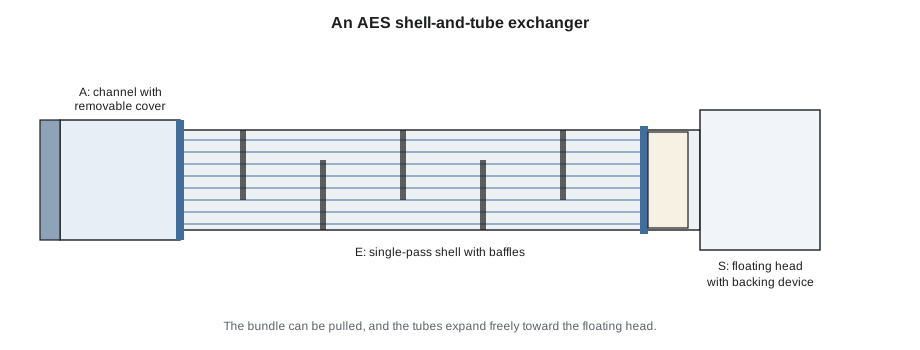
A shell-and-tube exchanger has a bundle of tubes inside a cylindrical shell; one fluid flows through the tubes and the other around them, guided by baffles. The Tubular Exchanger Manufacturers Association, TEMA, describes each exchanger with a three-letter code: the front head type, the shell type and the rear head type. A BEM is a fixed tube sheet exchanger with a bonnet front head and a single-pass shell, which cannot be cleaned on the shell side and needs an expansion joint if the shell and tubes grow differently. An AES has a removable channel cover, a single-pass shell and a floating head with a backing device, so the bundle can be pulled for cleaning and the tubes can expand freely. A U-tube exchanger, such as a BEU, has tubes bent into U shapes and only one tube sheet. TEMA also sets construction classes: R for severe refinery service, C for general commercial service and B for chemical service. BLR-220 lesson 9 covers exchangers, and the BLR-220 capstone retubed an AES bundle.
Air-cooled exchangers, or fin-fans, pass the process fluid through finned tubes over which fans blow air. Their tubes end in box headers, which have a threaded plug opposite each tube on the outer face so that each tube can be reached for cleaning, inspection, plugging or rolling. Plug headers are the commonest type and their plugs and gaskets are a common source of leaks after maintenance. BLR-220 lesson 10 covers air coolers.
Pressure testing
New and repaired pressure equipment is pressure tested to prove its strength and tightness. A hydrostatic test, with water, is preferred, because water stores little energy under pressure and a failure releases it harmlessly. For ASME Section VIII Division 1 vessels the hydrotest is at least 1.3 times the maximum allowable working pressure, adjusted by the ratio of the material's allowable stress at test temperature to that at design temperature. For Section I boilers it is 1.5 times the maximum allowable working pressure. A pneumatic test, with air or gas, is used only when water cannot be, and at a lower ratio, 1.1 times for Division 1, because compressed gas stores a great deal of energy and a failure is explosive. In every test, the pressure is held, then reduced for the close examination, gauges are calibrated and read within their range, commonly between one and a half and four times the test pressure for the gauge's full scale, and the water is warm enough to avoid brittle fracture of the metal. BLR-220 lesson 11 covers testing.
Worked problem
Test pressures
A vessel built to Section VIII Division 1 has an MAWP of 1,600 kPa and a stress ratio of 1. A small packaged boiler built to Section I has an MAWP of 1,000 kPa. What are their hydrotest pressures, and what pneumatic test pressure would apply to the vessel if water could not be used?
Show solution
- Division 1 hydrotest: 1.3 × MAWP × stress ratio.
- Section I hydrotest: 1.5 × MAWP.
- Division 1 pneumatic test: 1.1 × MAWP × stress ratio.
Answer: Vessel 2,080 kPa; boiler 1,500 kPa; vessel pneumatic 1,760 kPa.
Traps in equipment questions
Desmond's traps: confusing the economizer, which heats water, with the air heater, which heats air; confusing fire-tube and water-tube; thinking a BEM's shell side can be cleaned mechanically; using 1.5 for a vessel's hydrotest or 1.3 for a boiler's; choosing a pneumatic test because it is quicker; and fixing an over-rolled tube by rolling it again. Over-rolled tubes are replaced; under-rolled tubes are re-rolled.
Boiler water and safety devices
Boiler questions often turn to the water side and the safety devices, because they are what keep a boiler from failing. Feedwater is treated to remove hardness and oxygen, because scale on the tubes insulates them and lets the metal overheat, and dissolved oxygen pits the inside of the tubes and drums. Blowdown removes concentrated water and sludge: continuous blowdown from near the surface in the steam drum controls the dissolved solids, and bottom blowdown from the mud drum removes sludge. Low water is the most dangerous condition in a boiler, because tubes without water overheat and fail; low-water cut-offs shut down the burner, and gauge glasses and remote level indicators let operators see the level. Safety valves, sized to relieve the boiler's full steaming capacity, are set at or below the MAWP, and are tested, serviced and resealed only by organizations authorized to do so. A boilermaker never adjusts or gags a safety valve on an operating boiler.
Pressure vessels are protected in the same way by pressure relief devices, either relief valves or rupture disks, set at or below the MAWP. A common exam question asks what happens if a vessel's relief valve inlet is blinded during a turnaround and the blind is not removed: the vessel has no overpressure protection, which is why relief valve blinds are tracked on the blind list with extra care and checked before start-up.
Common mistakes
MistakeCalling the economizer an air preheater.
InsteadThe economizer heats feedwater; the air heater heats combustion air.
MistakeUsing 1.5 times MAWP for a Section VIII Division 1 hydrotest.
InsteadDivision 1 uses 1.3 times, adjusted for the stress ratio; Section I uses 1.5.
MistakeRe-rolling an over-rolled tube.
InsteadOver-rolling cannot be undone; replace the tube.
MistakeChoosing a pneumatic test to save time.
InsteadPneumatic tests store far more energy; use them only when water cannot be used.
Summary and key terms
- Water boils at the saturation temperature for its pressure; superheated steam is heated above it.
- Fire-tube boilers put gas in the tubes; water-tube boilers put water in the tubes.
- The steam drum separates steam; the mud drum collects sediment; the economizer heats feedwater.
- Wall reduction for rolled carbon steel tubes is usually 5 to 8 percent.
- TEMA codes name the front head, shell and rear head; AES has a floating head and a removable bundle.
- Hydrotests are 1.3 times MAWP for Division 1 vessels and 1.5 times for Section I boilers; pneumatic tests are a last resort.
- Saturation temperature
- The temperature at which water boils at a given pressure.
- Economizer
- A heat exchanger that heats boiler feedwater with flue gas.
- Telltale hole
- A small threaded hole in a reinforcing pad used to test and vent the space behind it.
- Wall reduction
- The percentage by which a tube wall is thinned in expanding, after the clearance is taken up.
- TEMA type
- The three-letter code for an exchanger's front head, shell and rear head.
- Stress ratio
- The ratio of a material's allowable stress at test temperature to that at design temperature.
Practice problems
Work each problem on paper first, then reveal the answer to check.
What does the second letter of a TEMA type describe?
Show answer
The shell type, for example E for a single-pass shell.
A tube's wall reduction is 3 percent. What should be done?
Show answer
It is under-rolled; re-roll it to bring it into the 5 to 8 percent range.
What is the Section I hydrotest pressure for a boiler with an MAWP of 4,000 kPa?
Show answer
6,000 kPa.
Why is water used for pressure tests whenever possible?
Show answer
Water stores little energy under pressure, so a failure releases it without an explosion.
Lesson quiz · 5 questions
Score 60% or more to complete this lesson.
Create a free account to save your progress, take quizzes and earn a certificate.