
BLR-340 · Lesson 12 of 12 · 18 min
Capstone: a full practice exam and career planning
Two weeks before her exam date, on a Saturday morning, Kiera sits a full practice exam in the Nisku yard's training room: 120 questions written by the study group over the winter, in the exam's proportions, under exam conditions. Dale invigilates. No phone, no notes, the formula sheet that the real exam provides, a basic calculator, and four hours on the wall clock. "Treat it as the real thing," Dale says, "right down to the coffee you drink beforehand." This capstone follows the practice exam from the first page to the error log, the last two weeks of study it shapes, the exam itself, and the decisions about the career that begins once the certificate arrives. It ties together the eleven review lessons and, through them, the nine courses of the boilermaker program.
Sitting the practice exam
Kiera follows the plan from lesson 1. In the first pass she reads every question to the end, answers the ones she is sure of, marks the ones she is not and moves on, and she keeps to about a minute and a half a question. She finishes the first pass in two and a half hours with 23 questions marked. The second pass takes 50 minutes: she works the marked calculations fully, eliminates the distractors she can, and chooses a best answer for every question. She leaves nothing blank. With 20 minutes left she checks that every answer on the sheet matches the question number, a mistake that costs people whole sections when they skip a question on paper and fail to skip its line.
The questions are original, written by the study group in the exam's style over the winter, and a selection is shown below with the answer and the lesson that reviews it. Each is a short version of the kind of question that appears in that part of the trade.
| Question | Answer | Review |
|---|---|---|
| In what order are oxygen, flammable and toxic gas tested before entry? | Oxygen, flammable, toxic | Lesson 3 |
| A two-leg bridle lifts 12,000 kg (26,000 lb) at 60 degrees. What is the tension per leg? | 6,928 kg (15,011 lb) | Lesson 4 |
| What is the stretchout of a shell, 1,500 mm (60 in) inside diameter, in 10 mm (3/8 in) plate? | 4,744 mm (189.67 in) | Lesson 5 |
| Which method develops an eccentric cone? | Triangulation | Lesson 6 |
| After how long without use does a welding process qualification lapse? | Six months | Lesson 7 |
| What is the Section I hydrotest pressure for a boiler with an MAWP of 2,000 kPa (300 psi)? | 3,000 kPa (450 psi) | Lesson 8 |
| What is the plumbness limit for a 15 m tank shell? | 75 mm | Lesson 9 |
| What joint efficiency applies to a spot-radiographed double-welded butt joint? | 0.85 | Lesson 10 |
| A remaining life of 14 years: when is the next internal inspection under API 510? | In 7 years | Lesson 11 |
Marking the practice exam
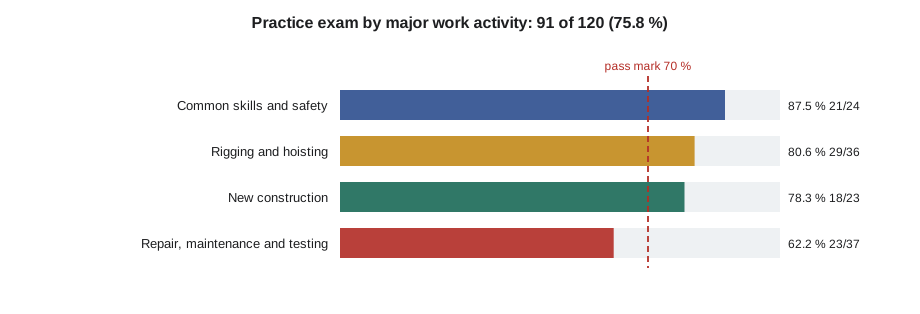
Dale marks the exam that afternoon and scores it by major work activity, just as the apprenticeship office will report the real one. The code below reproduces the scoring for a candidate with Kiera's strengths, and adds the logbook check that confirms she has the hours to book the exam.
import random
# Practice exam: score by topic, find the weak topics, and track apprenticeship hours
random.seed(7)
bank = {"Common skills and safety": (24, 0.84), "Rigging and hoisting": (36, 0.71), "New construction": (23, 0.78), "Repair, maintenance and testing": (37, 0.66)}   # topic: (questions on the practice exam, chance of a right answer for this candidate)
total = right = 0
for topic, (n, p) in bank.items():
    got = sum(random.random() < p for _ in range(n))
    total += n; right += got
    flag = "  <- review" if got / n < 0.70 else ""
    print(f"{topic:34} {got:2d}/{n:2d}  {100 * got / n:5.1f} %{flag}")
print(f"overall {right}/{total} = {100 * right / total:.1f} %", "pass" if right / total >= 0.70 else "not yet")

hours = [("Period 1", 1620, 1560), ("Period 2", 1588, 1560), ("Period 3", 1544, 1560)]        # (period or year, hours worked, hours required)
done = sum(h for _, h, _ in hours); need = sum(r for _, _, r in hours)
for label, h, r in hours:
    print(f"{label:8} {h:5d} of {r:5d} hours", "complete" if h >= r else f"{r - h} to go")
print(f"total {done} of {need} hours")Common skills and safety 21/24 87.5 % Rigging and hoisting 29/36 80.6 % New construction 18/23 78.3 % Repair, maintenance and testing 23/37 62.2 % <- review overall 91/120 = 75.8 % pass Period 1 1620 of 1560 hours complete Period 2 1588 of 1560 hours complete Period 3 1544 of 1560 hours 16 to go total 4752 of 4680 hours
Kiera scores 91 out of 120, or 75.8 percent: a pass, with a margin of seven questions. But the breakdown matters more than the total. Common skills and safety, rigging and new construction are all comfortably above 70 percent, while repair, maintenance and testing, the largest part of the exam, is at 62 percent. On the real exam a weak result there could pull her total below the line. Her logbook shows that period 3 is 16 hours short, two more shifts, which Rosa schedules for the coming week so that her employer can sign the hours off before she books.
The error log and the last two weeks
Kiera's error log from the practice exam has 29 entries. Sorting them by cause, as in lesson 2, shows the pattern clearly: 11 are repair and maintenance facts she did not know, mostly about equipment she has never worked on, such as recovery boiler floor tubes, air cooler plug headers and API 510 intervals; 6 are misread questions, four of them asking for the first step or the minimum; 5 are method errors, three of them in remaining life calculations where she used the long-term rate; 4 are arithmetic slips; and 3 were guesses on calculations she ran out of time to finish. Nothing in the log is about rigging, which is a pleasant surprise after the sling-angle trouble of February.
The last two weeks are built from the log. The unknown facts become flashcards, added to box 1 and reviewed daily. The remaining life method gets a worked-example session with Rosa, ending with five problems done under time. The misread questions get a simple fix: Kiera circles the key word of every practice question for the rest of her study, and the habit carries into the exam. And because two-thirds of the weak area is equipment she has not worked on, Desmond takes her through the exchanger shop and the plug headers on a cooler that is in for repair, so that the words in the questions have pictures behind them. A second, shorter practice set of 40 questions on repair and maintenance a week later gives her 78 percent in that area.
| Cause | Count | Fix in the last two weeks |
|---|---|---|
| Did not know the fact | 11 | Flashcards; shop visit to see the equipment |
| Misread the question | 6 | Circle the key word on every question |
| Wrong method | 5 | Worked examples on remaining life with Rosa |
| Arithmetic slip | 4 | Estimate the size of the answer first |
| Ran out of time | 3 | Keep to 1.5 minutes per question on the first pass |
Exam day
Kiera writes the Red Seal exam on a Tuesday in April at the apprenticeship office in Edmonton, after a normal night's sleep and a day off. The questions are different from the study group's, as they should be, but the kinds are the same, and she recognizes the traps: a sling angle question offering the answer measured from the vertical, a stretchout question offering the inside diameter answer, a corrosion rate question offering the long-term rate. She finishes the first pass with an hour to spare and uses most of it. The results come by email two weeks later: a pass, with her strongest result in rigging and her weakest, still above the pass mark, in repairs. Her journeyperson certificate with the Red Seal endorsement follows by mail.
Not everyone passes on the first try, and Dale makes sure the group knows what happens then. The results breakdown shows which activities to work on; the apprenticeship office sets a waiting period before the rewrite and may require more study or training; and the second attempt is usually stronger because the candidate knows exactly where the gaps are. Many good journeypersons needed two attempts.
Planning a career
With the certificate in hand, the question changes from passing to what comes next. The study group's last night is about careers, and Dale, Rosa, Harjit and Imran each describe the path that took them from apprentice to where they are. Most boilermakers spend their early journey years in the field, building experience across power, refining, pulp and paper, mining and tank work, and many travel to the large turnarounds and projects. From there the paths divide.
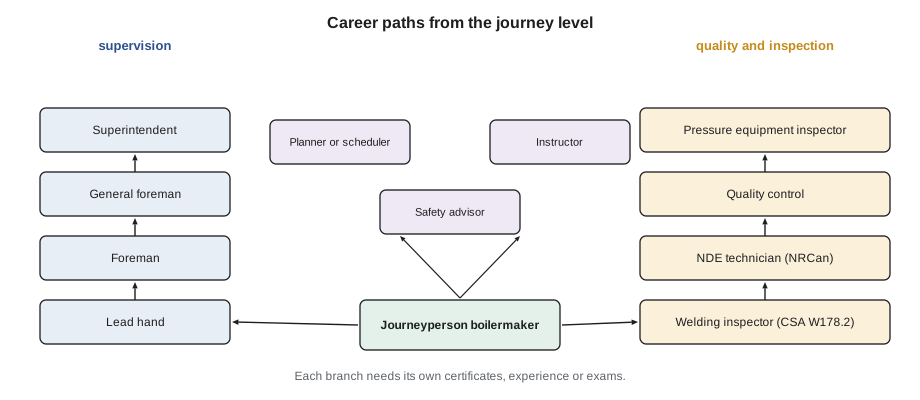
The supervisory path runs from lead hand to foreman, general foreman and superintendent, and depends on experience, leadership and the trust of the crews and the owner; Rosa started down it six years after her Red Seal. The quality path runs through welding inspection, for which the CWB and CSA W178.2 set the certification levels in Canada, nondestructive testing, certified through Natural Resources Canada, quality control, and eventually pressure equipment inspection with an owner or with ABSA, which has its own experience and examination requirements for safety codes officers; Harjit came that way. The planning path leads to turnaround planner and scheduler, and the safety path, which Imran followed, to safety advisor and manager. And some journeypersons become instructors in the technical training they once took.
Pay for boilermakers in Alberta is among the highest in the skilled trades, and union scales are set in the collective agreement for each sector, with premiums for camp work, overtime and travel. Work is cyclical: turnaround seasons in spring and fall are busy, and construction depends on large projects. A career plan that builds savings in the busy seasons and skills in the quieter ones is the one Dale recommends.
Worked problem
Comparing two offers
After her Red Seal, Kiera has two offers for the summer: a 14-week camp job in the oil sands at 60 hours a week, or 14 weeks of shop and local work in Nisku at 44 hours a week. The camp pays a living allowance; the local work leaves evenings free for a welding inspector course. How should she compare them?
Show solution
- Compare the total hours: 840 against 616, with overtime at a higher rate after the standard week.
- Add the allowances and subtract the costs of each: travel, lost time at home, course fees.
- Weigh the long-term value: the course moves her toward the quality path; the camp job builds savings and big-job experience.
- There is no single right answer; the plan should match her goals for the next five years.
Answer: She takes the camp job this summer and books the inspector course for the winter, when the work is slower.
The trade after the exam
Dale's last words to the group are about what does not change after the certificate. Safety rules apply to journeypersons exactly as to apprentices, and the people most often hurt are experienced workers who have stopped noticing hazards. Codes and standards change, so the habit of checking the current edition matters more than any number memorized for an exam. And the apprentices who follow need mentors, as Kiera did. Two weeks after her results, Rosa assigns her first apprentice to her crew.
Kiera's own plan, written on the back of her last error log, is short: two years in the field to build experience on every kind of equipment the exam asked about, a welding inspector course in the first quiet winter, and an apprentice of her own to mentor as soon as Rosa offers one. Dale reads it, nods, and adds one line at the bottom: keep the error log habit, on the job as well as on paper.
Common mistakes
MistakeTreating a passing practice score as a reason to stop studying.
InsteadLook at the breakdown; a weak area can sink the real exam.
MistakeStudying only the topics already strong.
InsteadUse the error log to aim the last two weeks at the weak areas.
MistakeBooking the exam before the logbook hours are signed off.
InsteadCheck the hours and get the employer's sign-off first.
MistakeThinking learning ends with the certificate.
InsteadCodes change and careers branch; keep learning and pass it on.
Summary and key terms
- A full practice exam under real conditions shows both the score and where it was lost.
- Score by area: a pass overall can hide an area below 70 percent.
- Sort the error log by cause and aim the last two weeks at the causes it shows.
- On the day, read to the key word, keep moving, mark and return, and leave nothing blank.
- After the certificate, careers branch into supervision, quality and inspection, planning, safety and teaching.
- Experience, further certification and mentoring the next apprentices are part of the trade.
- Practice exam
- A full-length set of questions written in the exam's proportions and taken under exam conditions.
- Error log
- A record of wrong answers in practice, sorted by their cause.
- Lead hand
- An experienced worker who leads a small crew under a foreman.
- General foreman
- The supervisor responsible for several crews and their foremen.
- Welding inspector
- A certified inspector who checks welding work against the code and procedures.
- Collective agreement
- The contract between the union and contractors that sets wages and conditions.
Practice problems
Work each problem on paper first, then reveal the answer to check.
Kiera scores 91 of 120 overall but 23 of 37 in repairs. What should she do?
Show answer
Aim the remaining study at that area, by cause from the error log, and test it again before the real exam.
Why check that each answer is on the right line of the answer sheet?
Show answer
Skipping a question without skipping its line shifts every later answer and can cost a whole section.
Name two career paths that need certification beyond the journey level.
Show answer
Welding inspection and nondestructive testing; also pressure equipment inspection.
What does the results breakdown tell a candidate who did not pass?
Show answer
Which areas to work on before the next attempt.
Lesson quiz · 5 questions
Score 60% or more to complete this lesson.
Create a free account to save your progress, take quizzes and earn a certificate.