
BLR-340 · Lesson 11 of 12 · 19 min
Maintenance and turnarounds review
The last review night belongs to Rosa Delgado, Ironbridge's general foreman, who ran the Northgate turnaround crews in BLR-330. Repair, maintenance, upgrading and testing is major work activity D, and at 31 percent it is the largest single part of the exam. "It's also the part you know best," Rosa tells Kiera, "which is the danger. You'll answer from what we did at Northgate, and the exam will ask about a plant that does it differently. Answer from the standard, then check it against your experience." This lesson reviews turnaround planning and scheduling, isolation and handover, opening and inspecting equipment, exchanger, column and boiler maintenance, damage mechanisms and remaining life, bolted joints, hold points, and measuring progress, as taught in BLR-330.
Planning and scheduling
A turnaround is a planned shutdown of a process unit for inspection, repair and upgrading that cannot be done while it runs. Its cost is the work plus the production lost for every day the unit is down, which is why planning starts a year or more ahead and why a day's overrun is so expensive. The scope is gathered from inspection plans, maintenance records, operations and projects, each item is ranked by risk, consequence times likelihood, and the scope is frozen at a set date, after which additions need approval. Work is broken into packages with steps, crews, materials and hold points. BLR-330 lessons 1 and 2 cover scope and planning.
The schedule is built by the critical path method: each activity has a duration and the activities that must come before it, and a forward pass gives each activity's earliest start and finish while a backward pass gives its latest. The difference between the latest and earliest start is the float, the time the activity can slip without delaying the finish. Activities with zero float form the critical path, and a delay to any of them delays the whole turnaround. Crews are then loaded onto the schedule shift by shift and levelled, by moving activities within their float, so that the number of people needed does not swing wildly. BLR-330 lesson 3 covers scheduling.
Worked problem
Float and the critical path
An exchanger package has four activities in sequence: isolate and blind, 4 hours; remove the channel cover, 6 hours; pull the bundle, 8 hours; clean the bundle, 12 hours. A parallel activity, inspect the shell, takes 6 hours and can start when the bundle is out and must finish before the bundle goes back in, which is when cleaning finishes. What is the float of the shell inspection?
Show solution
- The bundle is out at 4 + 6 + 8 = 18 hours, and cleaning finishes at 18 + 12 = 30 hours.
- The inspection can start at 18 and must finish by 30, a 12-hour window.
- It takes 6 hours, so it can slip 6 hours without delaying anything.
Answer: 6 hours of float. The four-step chain through cleaning has zero float and is critical.
Isolation, handover and opening
Before maintenance starts, the unit is shut down, drained, depressured, purged and freed of hazards by operations, then isolated. Valves alone are not enough for entry: equipment is positively isolated by inserting blinds at flanges or removing spool pieces, and every blind is recorded on a blind list with its location, size, rating, who installed it and who removed it. Electrical and mechanical energy is locked out under the plant's lockout procedure, with each worker's personal lock on the group lockbox. The equipment is then handed over to maintenance in writing, and handed back the same way when the work is done and every blind is out. Vessels are opened with the far-side bolts loosened first, in case of trapped pressure, ventilated, gas tested in every part, cleaned to bare metal for inspection, and closed after a written closing inspection and a count of everything that went in. BLR-330 lessons 4 and 5 cover isolation, handover and vessel work.
Exchangers, columns and boilers
Exchanger work on a turnaround usually means pulling the bundle with a bundle extractor, cleaning it with high-pressure water, inspecting the tubes with eddy current or similar methods, plugging tubes that have failed or are thin, and reassembling with new gaskets and controlled bolting. Plugging is limited, often to about 10 percent of the tubes, before the bundle is retubed or replaced, because each plugged tube reduces the exchanger's capacity. Column work means removing and replacing trays and packing through manways, checking tray levelness and the clearances the drawing specifies, and recording each tray's condition. Boiler outage work covers the fire side, such as tube thickness surveys, erosion shields and refractory, and the water side, such as drum internals and deposits, plus safety valve servicing by an authorized organization. BLR-330 lessons 6 to 8 cover this work.
Damage mechanisms and remaining life
The inspector's job is to find damage before it causes a failure, and API 571 describes the damage mechanisms found in refineries and chemical plants. The exam asks about the common ones: general and localized corrosion, which thin the wall; pitting; erosion, where fast flow or particles wear the metal away, often at bends and inlets; corrosion under insulation, where water trapped under insulation corrodes the outside of the metal, worst between about −4 and 175 °C (25 and 350 °F); high temperature hydrogen attack in hydrogen service; creep, slow deformation at high temperature, which affects superheater tubes; fatigue from cycling loads; and stress corrosion cracking, where a susceptible material, a stress and a specific environment act together. BLR-330 lesson 9 covers damage mechanisms.
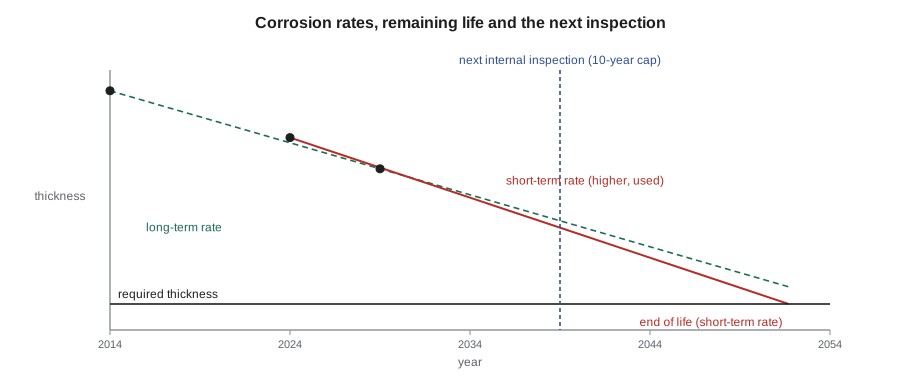
For thinning, the inspector measures thickness at the same condition monitoring locations at every inspection and calculates two corrosion rates: the long-term rate, from the first reading to the latest, and the short-term rate, from the previous reading to the latest. API 510 uses whichever rate best represents the current conditions, which in practice usually means the higher one. The remaining life is the current thickness minus the required thickness, divided by the corrosion rate, and API 510 sets the next internal inspection at no more than half the remaining life or 10 years, whichever is less. External inspections are at no more than 5 years or the internal interval, whichever is less.
# Maintenance review: remaining life and next inspection (API 510), bolt torque, earned value
t_now, t_req = 11.6, 9.0
readings = [(2014, 13.1), (2024, 12.2), (2029, 11.6)]          # (year, thickness)
(y0, t0), (y1, t1) = readings[0], readings[-1]
(ys, ts) = readings[-2]
lt = (t0 - t1) / (y1 - y0)
st = (ts - t1) / (y1 - ys)
rate = max(lt, st)
life = (t_now - t_req) / rate
print(f"long-term rate {lt:.3f}, short-term rate {st:.3f} mm per year; use {rate:.3f}")
print(f"remaining life {life:.1f} years; next internal inspection in {min(life / 2, 10):.1f} years")

K, Dn, F = 0.16, 0.0254, 200000          # nut factor, bolt diameter, target bolt load
print(f"target torque {K * Dn * F:.0f} N m")

BAC, pv, ev, ac = (6800, 3100, 3050, 3200)
print(f"SPI {ev / pv:.2f} CPI {ev / ac:.2f} forecast at completion {BAC / (ev / ac):.0f} hours")long-term rate 0.100, short-term rate 0.120 mm per year; use 0.120 remaining life 21.7 years; next internal inspection in 10.0 years target torque 813 N m SPI 0.98 CPI 0.95 forecast at completion 7134 hours
The short-term rate of 0.12 mm a year is higher than the long-term 0.10, so the inspector uses it. The remaining life is 21.7 years, half of which is more than 10, so the next internal inspection is due in 10 years. The code also gives a target torque of 813 N·m for a 25 mm bolt at a load of 200 kN, using a nut factor of 0.16, and an earned value check showing a crew slightly behind schedule and over its hours.
Bolted joints
Leaking flanges after start-up are among the commonest turnaround failures, and ASME PCC-1 sets out how pressure-boundary bolted joints should be assembled. The flange faces are cleaned and checked for damage, a new gasket of the specified type is used, bolts and nuts are lubricated on the threads and nut faces, and the bolts are tightened with calibrated tools to a target bolt load. The torque needed is found from the target load, the bolt diameter and a nut factor that depends mainly on the lubricant: torque equals the nut factor times the diameter times the load. Tightening follows a star or cross pattern in several passes at increasing torque, commonly about 30, then 60, then 100 percent of the target, followed by rotational passes at full torque until the nuts no longer turn. PCC-1 also describes alternative patterns that save time on large joints. The joint is recorded with its bolt load, tools and the assembler's name. BLR-330 lesson 6 and BLR-230 lesson 10 cover bolting.
Hold points and progress
Quality on a turnaround is controlled by inspection and test plans, which list each step of a job and mark the points where the inspector or owner must be involved. At a hold point, work stops until the inspector has inspected and released it; at a witness point, the inspector is notified and may attend, but work can continue if they do not; and a review point is a check of records. Hold points are typically set before a vessel is closed, before welding on pressure parts, before a pressure test and before the test is accepted. Work that does not meet the requirements is recorded on a nonconformance report and dispositioned by the engineer: use as is, repair, rework or reject. BLR-330 lesson 10 covers hold points.
Progress is measured with earned value. The planned value is the hours budgeted for the work scheduled to date; the earned value is the budgeted hours for the work actually completed; and the actual cost is the hours actually spent. The schedule performance index, earned value over planned value, shows whether the work is ahead or behind schedule, and the cost performance index, earned value over actual, shows whether it is under or over budget. A CPI below 1 means the work is costing more hours than planned, and the forecast at completion is the budget divided by the CPI. BLR-330 lesson 12 used earned value to bring Kiera's crew back on schedule.
| Index | Formula | Below 1 means |
|---|---|---|
| SPI | Earned value / planned value | Behind schedule |
| CPI | Earned value / actual hours | Over budget |
| Forecast at completion | Budget / CPI | Expected total hours |
Shutdown safety
Turnarounds put hundreds of contractors into a plant that is partly shut down and partly running. Simultaneous operations, work going on in one area while another is operating or starting up, are planned so that hazards from one, such as a flare release or a start-up purge, do not reach people working in another. Permits are coordinated through a central permit office, hot work is controlled area by area, and start-up is preceded by a pre-start-up safety review that checks the work is complete, the blinds are out, the equipment is tested and the people are trained. BLR-330 lesson 11 covers shutdown safety.
Traps in maintenance questions
Rosa's traps: using the long-term corrosion rate when the short-term rate is higher; setting the next inspection at the full remaining life; forgetting the 10-year cap; tightening flange bolts in a circle from the first bolt; treating a witness point as a hold point, or the other way round; confusing SPI and CPI; and relying on a closed valve for entry.
One more distinction is worth knowing. Lockout protects people from energy in machinery and electrical systems, and isolation with blinds protects them from process fluids in piping and vessels; a turnaround job usually needs both, and each has its own record. A question that offers a locked valve as the isolation for a vessel entry is testing whether you know the difference.
Common mistakes
MistakeUsing the lower corrosion rate because it gives a longer life.
InsteadUse the rate that represents current conditions, usually the higher.
MistakeSetting the next internal inspection at the full remaining life.
InsteadUse half the remaining life, never more than 10 years.
MistakeTightening flange bolts in order around the circle.
InsteadUse a star or cross pattern in increasing passes, then rotational passes.
MistakeContinuing past a hold point because the inspector is late.
InsteadWork stops at a hold point until the inspector releases it.
Summary and key terms
- Turnaround scope is ranked by risk and frozen; activities with zero float form the critical path.
- Entry needs positive isolation with blinds recorded on a blind list, and written handover.
- API 571 describes damage mechanisms; thinning is measured at condition monitoring locations.
- Remaining life is the thickness above the required thickness divided by the corrosion rate.
- API 510 sets the next internal inspection at half the remaining life or 10 years, whichever is less.
- Bolt torque is K times D times F; PCC-1 sets the pattern and passes. Hold points stop the work until released.
- Float
- The time an activity can slip without delaying the project finish.
- Blind list
- The record of every blind installed for a job, with who installed and removed it.
- Corrosion under insulation
- Corrosion of the outside of metal by water trapped under insulation.
- Remaining life
- The time until a component reaches its required thickness at the current corrosion rate.
- Hold point
- A point in a job where work stops until the inspector releases it.
- CPI
- Cost performance index: earned value divided by actual hours.
Practice problems
Work each problem on paper first, then reveal the answer to check.
A wall was 14.0 mm in 2015, 13.0 mm in 2025 and 12.4 mm in 2029. The required thickness is 10.0 mm. What are the rates, the remaining life and the next internal inspection?
Show answer
Long-term 1.6 / 14 = 0.114 mm a year; short-term 0.6 / 4 = 0.15 mm a year. Remaining life 2.4 / 0.15 = 16 years; next inspection in 8 years.
What is a witness point?
Show answer
A point where the inspector is notified and may attend; work can continue if they do not.
A crew has earned 900 hours, planned 1,000 and spent 1,050. What are SPI and CPI?
Show answer
SPI 0.90, behind schedule; CPI 0.86, over budget.
What torque gives 150 kN in a 20 mm bolt with a nut factor of 0.16?
Show answer
0.16 × 0.020 × 150,000 = 480 N·m.
Lesson quiz · 5 questions
Score 60% or more to complete this lesson.
Create a free account to save your progress, take quizzes and earn a certificate.