
BLR-340 · Lesson 7 of 12 · 18 min
Welding and cutting review
Marcel Beaudry, the lead tube welder from the Riverbend waterwall job in BLR-210, takes the welding night. Boilermakers are not welders by trade, he reminds the group, but they weld and cut every day, and on the exam welding and cutting turn up in all four major work activities: as common skills, as part of new construction, and as part of nearly every repair. "The exam won't ask you to run a bead," he says. "It will ask you which electrode, which polarity, what preheat, what went wrong when the weld cracked, and what the procedure lets you change." This lesson reviews oxyfuel and plasma cutting, air carbon arc gouging, shielded metal arc and flux-cored welding, tube welding, preheat and heat treatment, qualifications, and weld quality, as taught in BLR-210.
Oxyfuel and plasma cutting
Oxyfuel cutting works by heating steel to its kindling temperature, about 870 °C (1,600 °F), with the preheat flame, then directing a jet of pure oxygen at it, which burns the iron and blows the oxide out of the kerf. It cuts carbon and low-alloy steel well; it does not cut stainless steel or aluminum, because their oxides melt at higher temperatures than the metal and do not blow clear. Acetylene must never be used at more than 103 kPa (15 psi) gauge, because it becomes unstable above that pressure, and acetylene cylinders are always used and stored upright. Oxygen and fuel gas cylinders in storage are kept apart by the distance or fire-rated barrier the regulations require, and every torch set has flashback arrestors and check valves. BLR-210 lesson 2 and the welder program's WLD-110 cover oxyfuel.
Plasma cutting uses an electric arc constricted through a small nozzle to produce a jet of ionized gas hot enough to melt any conductive metal, with the gas flow blowing the melt out. It cuts stainless steel and aluminum, cuts thin and medium plate faster than oxyfuel with less heat distortion, and is the process used on most CNC tables. Tube cutting in boilers is usually done with mechanical cutters, such as orbital saws, abrasive wheels and clamshell lathes, which cut without heat and without sparks inside drums. BLR-210 lesson 3 covers plasma and tube cutting tools.
Air carbon arc gouging
Air carbon arc gouging uses an arc between a copper-coated carbon electrode and the work to melt the metal, and a jet of compressed air along the electrode to blow it away. It is used to remove defective welds, back-gouge the root of a double-welded joint to sound metal, and remove old welds and attachments. It is run on direct current with the electrode positive, the air is turned on before the arc is struck, and the electrode is held so that the air blows the molten metal away from the operator. It is loud, often over 110 dBA, throws molten metal a long way and needs a hot work permit. A gouged groove is ground to bright metal before welding, because the carbon-rich layer on its surface can cause cracking. BLR-210 lesson 4 covers gouging.
SMAW and FCAW
Shielded metal arc welding uses a flux-coated electrode; the flux melts to form a gas shield and a slag that protects the weld. Electrodes are classified by their strength, position and coating. In the Canadian system of CSA W48 an E4918 electrode has a minimum tensile strength of 490 MPa, can be used in all positions, and has a low-hydrogen basic coating with iron powder; it corresponds to the AWS E7018. Low-hydrogen electrodes are kept in a heated holding oven once their package is opened, typically at about 120 °C, and are returned to it within the time the procedure allows, commonly four hours for E4918, because moisture in the coating puts hydrogen in the weld and hydrogen causes cracking. Cellulosic electrodes such as E4310 are used for pipeline root passes and are not dried.
Flux-cored arc welding uses a continuous tubular wire with flux in its core, either with a shielding gas or, for self-shielded wires, without one. It deposits weld metal several times faster than SMAW and is widely used in the field for plate and structural work, with self-shielded wires preferred where wind would blow away a gas shield. BLR-210 lessons 5 and 6 cover SMAW and FCAW on plate.
| Process | Where boilermakers use it | Key points |
|---|---|---|
| SMAW | Plate, structural, repairs in all positions | Low-hydrogen electrodes in a holding oven; DC electrode positive for most |
| FCAW | Plate, tanks, structural, field work | High deposition; self-shielded wire for wind |
| GTAW | Tube roots, thin wall, stainless, alloy | High quality and control; slow; needs shelter from wind |
| GMAW | Shop work on plate and sheet | Fast; gas shield is easily disturbed outdoors |
Tube welding
Boiler tube butt welds are usually made with a gas tungsten arc root pass, for a smooth, fully penetrated inside surface that will not trap deposits, followed by SMAW or GTAW fill and cap passes. The tube ends are prepared with a bevel, typically 37.5 degrees with a small land, and fitted with a root gap set by the procedure; misalignment between the tube bores, called hi-lo, is held within the procedure's limit. Membrane walls, in which tubes are joined side by side by welded steel bars, need the membrane cut back and rewelded around any tube replaced. In tight spaces, a window weld is used: a window is cut in the far side of the tube so that the root of the near side can be welded from inside, then the window is welded back in. BLR-210 lessons 7 to 9 cover tube work, and the BLR-210 capstone replaced a section of Riverbend's waterwall.
Preheat, heat input and PWHT
Preheat slows the cooling of the weld and the heat-affected zone, which lets hydrogen escape and prevents hard, brittle microstructures that crack. It is set by the welding procedure, based on the material, its thickness and its carbon equivalent, and it is measured at a set distance from the joint, commonly 75 mm (3 in), with temperature-indicating crayons or a contact thermometer. Interpass temperature is the temperature of the weld between passes and has both a minimum, usually the preheat, and often a maximum. Heat input, the energy put into the weld per unit length, is calculated from the voltage, current and travel speed and is limited by many procedures because it affects toughness.
Post-weld heat treatment, PWHT, heats the completed weld to a set temperature below the lower transformation temperature, holds it there for a time based on thickness, and cools it at a controlled rate. It relieves residual stresses and tempers hard zones. The code sets when it is required, based on the material's P-number and thickness, and the procedure sets the temperature, hold time and heating and cooling rates. BLR-210 lesson 10 and BLR-320 lesson 5 cover preheat and PWHT.
# Welding review: heat input, electrodes needed for a joint, and a welder continuity check
V, A, SPEED = 24, 130, 150      # volts, amps, travel speed
heat = V * A * 60 / (SPEED * 1000)
print(f"heat input {heat:.2f} kJ/mm at {V} V, {A} A, {SPEED} mm/min")
print("within the procedure range" if 0.8 <= heat <= 1.6 else "outside the procedure range")

AREA = 120        # weld cross-section area
LEN = 2500         # joint length
DENS = 7.85e-06       # steel density in matching units
EFF = 0.60         # share of the electrode weight that ends up as weld metal (SMAW, typical)
metal = AREA * LEN * DENS
print(f"weld metal {metal:.2f} kg; electrodes needed {metal / EFF:.2f} kg")

from datetime import date
last_used = {"SMAW": date(2029, 11, 2), "FCAW": date(2029, 4, 20), "GTAW": date(2030, 1, 15)}
today = date(2030, 3, 1)
for process, d in last_used.items():
    months = (today.year - d.year) * 12 + today.month - d.month
print(f"{process}: last used {d} ({months} months) ->", "current" if months < 6 else "LAPSED: retest needed")heat input 1.25 kJ/mm at 24 V, 130 A, 150 mm/min within the procedure range weld metal 2.35 kg; electrodes needed 3.93 kg SMAW: last used 2029-11-02 (4 months) -> current FCAW: last used 2029-04-20 (11 months) -> LAPSED: retest needed GTAW: last used 2030-01-15 (2 months) -> current
The heat input of 1.25 kJ/mm is within the procedure's range of 0.8 to 1.6 kJ/mm. The joint takes about 2.4 kg of weld metal and, at 60 percent deposition efficiency for SMAW, about 3.9 kg of electrodes. And the continuity check shows the trap Kiera's study group least expected: her FCAW qualification has lapsed, because she has not used the process for more than six months, even though she has welded SMAW and GTAW all winter.
Qualifications and continuity
Welding on pressure equipment is done to a qualified welding procedure, written as a WPS and supported by a procedure qualification record, and by welders qualified for that process and range under ASME Section IX. In Alberta, welders on pressure equipment also hold a pressure welder certificate issued by ABSA, with a performance qualification card listing the processes and ranges they are qualified for. A welder's qualification for a process lapses if the welder has not used that process for six months; it is restored by welding a test under the procedure. BLR-320 lesson 5 covers Section IX.
Weld quality and defects
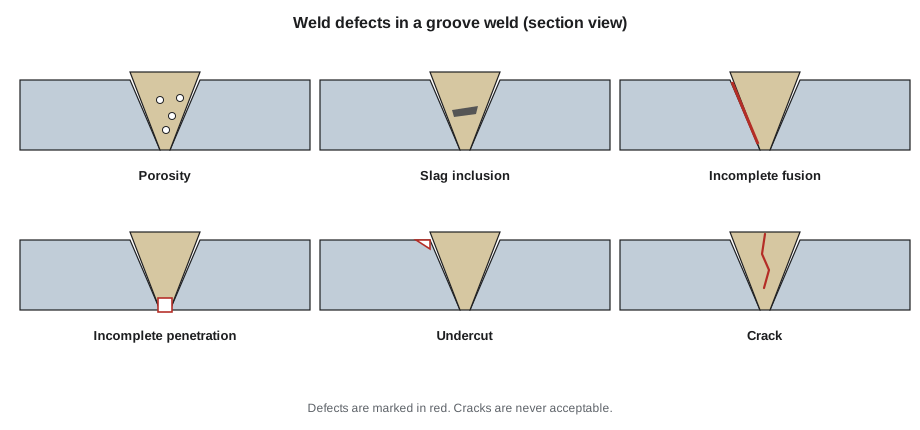
The exam asks about defects in two ways: what a defect is, and what caused it. Porosity, gas pockets in the weld, comes from moisture, contamination, lost shielding gas or too long an arc. Slag inclusions come from poor cleaning between passes or from a bead shape that traps slag. Incomplete fusion, where the weld metal has not fused to the base metal or the previous pass, comes from low current, the wrong angle or too fast travel. Incomplete penetration, where the root is not fully fused through, comes from too small a root gap, too large a root face or too low a current. Undercut, a groove melted into the base metal at the toe and not filled, comes from too high a current or the wrong angle. Cracks are the most serious defect and are never acceptable; hydrogen cracks, which can appear hours after welding, come from hydrogen in the weld, high restraint and a hard microstructure, and are prevented by low-hydrogen practice and preheat. BLR-210 lesson 11 covers weld quality and NDE.
| Defect | Common causes | Prevention |
|---|---|---|
| Porosity | Moisture, contamination, lost shielding, long arc | Dry electrodes, clean joint, shelter from wind |
| Slag inclusion | Poor interpass cleaning, bead shape | Clean every pass; correct technique |
| Incomplete fusion | Low current, wrong angle, fast travel | Follow the procedure's ranges |
| Incomplete penetration | Small gap, large root face, low current | Fit to the procedure; check the fit-up |
| Undercut | High current, wrong angle | Lower current; correct angle |
| Hydrogen crack | Hydrogen, restraint, hard zone | Low-hydrogen practice and preheat |
Traps in welding questions
Marcel's traps: thinking oxyfuel can cut stainless; turning the air on after striking the gouging arc; leaving low-hydrogen electrodes out of the oven over a break; taking the preheat reading right at the weld instead of at the set distance; thinking a welder's qualification lasts as long as the welder works in the trade, whatever process; and treating a small crack as acceptable because it is short. The answer about a crack is always that it is removed and the area repaired and re-examined.
Reading a welding procedure
Several exam questions give a short extract from a welding procedure specification and ask what the welder may or may not do. A WPS lists the process, the base metals by P-number and thickness range, the filler metal by classification and F-number, the joint design, the positions, the preheat and interpass temperatures, any PWHT, the shielding gas if used, and the electrical characteristics: current type and polarity, and ranges of amperage, voltage and travel speed for each pass and electrode size. Essential variables are those whose change requires the procedure to be requalified, such as a change of P-number outside the range, a different F-number or a lower preheat; non-essential variables, such as a change of groove design within limits, can be changed by revising the WPS without a new test.
The practical rule for the welder is simple: everything on the job must fall inside the ranges on the WPS, and anything outside them must be raised with the foreman or welding supervisor before welding, not after. A question that describes a welder lowering the preheat because the steel is already warm from the sun, or switching to a larger electrode than the WPS lists, wants you to recognize that the work is outside the procedure. Marcel's version: "If it isn't on the WPS, you don't do it."
| Change | Usually |
|---|---|
| Different base metal P-number outside the WPS | Essential: new or different procedure |
| Preheat below the WPS minimum | Essential: not allowed |
| Different filler F-number | Essential: new or different procedure |
| Groove angle within the WPS tolerance | Within the procedure |
Common mistakes
MistakeUsing oxyfuel to cut stainless steel.
InsteadUse plasma or mechanical cutting; stainless oxides do not blow clear.
MistakeMeasuring preheat at the weld itself.
InsteadMeasure at the distance the procedure sets, commonly 75 mm (3 in) from the joint.
MistakeAssuming a qualification lasts while the welder works in the trade.
InsteadEach process lapses after six months without use.
MistakeAccepting a short crack.
InsteadCracks are never acceptable; remove, repair and re-examine.
Summary and key terms
- Oxyfuel cuts carbon steel by burning it; it cannot cut stainless or aluminum.
- Acetylene is never used above 103 kPa gauge, and its cylinders are kept upright.
- Air carbon arc gouging runs DC electrode positive with the air on before the arc.
- E4918 low-hydrogen electrodes are held in an oven; moisture in the coating causes hydrogen cracking.
- Preheat, interpass temperature, heat input and PWHT are all set by the procedure.
- A welder's qualification for a process lapses after six months without using it.
- Kerf
- The gap left by a cut.
- Back-gouging
- Removing the root of a weld from the other side to reach sound metal before welding that side.
- Low-hydrogen electrode
- An electrode with a coating that adds very little hydrogen to the weld, kept dry in an oven.
- Heat input
- The arc energy put into the weld per unit length.
- PWHT
- Post-weld heat treatment: heating a completed weld to relieve stress and temper hard zones.
- Continuity
- The record showing a welder has used a process within the last six months.
Practice problems
Work each problem on paper first, then reveal the answer to check.
A pass is run at 22 V, 120 A and 180 mm/min. What is the heat input?
Show answer
22 × 120 × 60 / (180 × 1000) = 0.88 kJ/mm.
Why are tube root passes usually made with GTAW?
Show answer
It gives a smooth, fully penetrated inside surface and close control in the root.
A weld shows porosity after a windy afternoon. What is the most likely cause?
Show answer
Lost shielding: the wind disturbed the gas shield. Shelter the joint or use a self-shielded process.
Kiera last welded FCAW 11 months ago. Can she weld FCAW on a pressure part tomorrow?
Show answer
No. Her qualification has lapsed; she must requalify by welding a test first.
Lesson quiz · 5 questions
Score 60% or more to complete this lesson.
Create a free account to save your progress, take quizzes and earn a certificate.