
BIOL-499 · Lesson 4 of 12 · 20 min
The research proposal: question, hypotheses, aims and timeline
▶ Video coming soon A video version of this lesson is on the way.
A research proposal is a plan that persuades a reader that a project is worth doing and can be done. In a career in research, proposals are how scientists win grants, gain access to field sites and obtain approvals. In an honours project, the proposal is usually the first formal deliverable, often marked, and it is the document your supervisor, second reader and approval committees will use to judge your plans. Writing it forces you to make decisions you might otherwise postpone, and most of it, revised, becomes the introduction and methods of your thesis.
Priya's department required a proposal of no more than 2,500 words by the end of March, with a ten-minute oral presentation to her supervisor and second reader. This lesson walks through her proposal section by section and shows how she handled the parts students often find hardest: aims, the budget, the timeline and the plan for things going wrong.
The structure of a proposal
Proposal formats vary among departments and funding agencies, but most contain the same elements in roughly the same order.
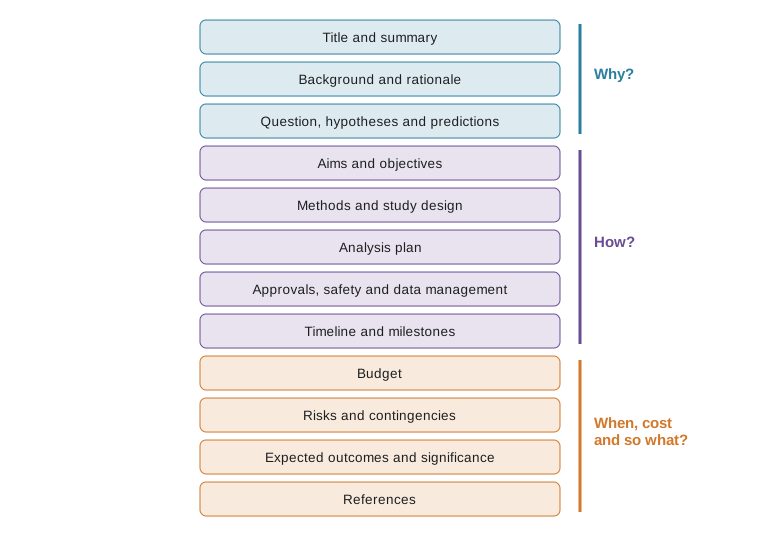
The sections answer four questions a reviewer always asks: why should this be done, how will it be done, can it be done in the time and budget, and what difference will the results make? A good proposal makes the answers easy to find. Headings that match the department's required sections, short paragraphs and a clear figure of the study design all help.
Title and summary
The title should state the question or system precisely. Priya's working title was Does cattle exclusion improve chorus frog breeding in prairie pothole wetlands? A question as a title is acceptable in a proposal; theses and papers more often use a statement. The summary, usually 150 to 250 words, gives the problem, the question, the approach and the expected significance in plain language. Write it last, when you know what the proposal says.
Background and rationale
The background is a condensed literature review, usually a third to a half of the proposal. It should establish three things: the problem matters, something important is unknown, and your project will address that unknown. Priya's background had three paragraphs on the importance of prairie pothole wetlands and their amphibians, the ways cattle alter wetland margins, and the mixed evidence on livestock effects on amphibians, ending with the gap: no paired test in prairie potholes and little measurement of mechanisms. She cited 24 sources, chosen from the 42 in her full review.
Aims and objectives
Aims are broad statements of what the project will achieve; objectives are the specific, measurable tasks that achieve them. Students often confuse the two or list too many. Two or three aims, each with two or three objectives, are enough for an honours project.
| Aim | Objectives |
|---|---|
| 1. Test whether cattle exclusion changes wetland margin habitat | 1a. Measure turbidity at 12 fenced and 12 paired grazed wetlands on four visits; 1b. Estimate emergent vegetation cover along fixed transects |
| 2. Test whether cattle exclusion changes chorus frog breeding activity and tadpole density | 2a. Record calling on 30 nights at each wetland with automated recorders; 2b. Count tadpoles with standardized dip-net sweeps on two visits |
| 3. Evaluate eDNA as a tool for detecting chorus frog breeding | 3a. Collect three water samples per wetland and test for chorus frog DNA by qPCR; 3b. Compare eDNA detections with calling records |
Each objective can be checked off: either Priya measured turbidity at 24 wetlands on four visits or she did not. Objectives written this way are also the backbone of the methods section and the timeline.
Methods and analysis plan
The methods section should give enough detail that a reader could judge whether the design answers the question: the study sites, the design and its replication, each measurement with its method and timing, and how the data will be analysed. Lesson 5 covers design in detail. In a proposal, an analysis plan matters as much as the field or lab methods, because the most common reason projects disappoint is that the data collected cannot answer the question. Priya's plan stated that the main comparison would be the mean within-pair difference in log tadpole density, fenced minus grazed, estimated with a 95 in 100 confidence interval and tested with a paired permutation test, and that the relationship between turbidity and tadpole density would be examined with a regression across all 24 wetlands.
Writing the analysis plan before collecting data has a further benefit. Researchers who decide on their analysis after seeing the data are tempted, often unconsciously, to choose the version that gives the most striking result. Stating the main analysis in advance, and labelling any additional analyses as exploratory, protects against this. Some researchers go further and publicly preregister their hypotheses and analysis plan, for example on the Open Science Framework, before collecting data. Priya did not formally preregister, but her dated proposal served the same purpose, and her thesis distinguished planned from exploratory analyses.
The timeline
A timeline shows when each objective will be done, how tasks depend on each other, and where the deadlines fall. A Gantt chart, with tasks as rows and time as columns, is the usual format. The critical path is the chain of dependent tasks that determines the earliest possible finish; any delay on it delays the whole project. For Priya, the critical path ran through approvals, fieldwork, lab analysis, data analysis and writing. Approvals had to be granted before the frogs began calling in late April, and lab analysis could not begin until the samples were collected.
# A simple critical-path check: each task has a duration (weeks) and the tasks it depends on.
tasks = {
    "Proposal":      (6, []),
    "Approvals":     (8, ["Proposal"]),
    "Field season":  (12, ["Approvals"]),
    "eDNA lab work": (10, ["Field season"]),
    "Recorder data": (6, ["Field season"]),
    "Analysis":      (8, ["eDNA lab work", "Recorder data"]),
    "Writing":       (14, ["Analysis"]),
}
finish = {}
def end(t):
    if t not in finish:
        dur, deps = tasks[t]
        finish[t] = dur + max((end(d) for d in deps), default=0)
    return finish[t]
for t in tasks:
    print(f"{t:14s} finishes at week {end(t):3d}")
print("Critical path length:", max(finish.values()), "weeks")Proposal finishes at week 6 Approvals finishes at week 14 Field season finishes at week 26 eDNA lab work finishes at week 36 Recorder data finishes at week 32 Analysis finishes at week 44 Writing finishes at week 58 Critical path length: 58 weeks
The script shows that the project, done strictly in sequence, needs 58 weeks. That is longer than an academic year, which is why real timelines overlap tasks. Priya began her data analysis on the recorder files in October while the eDNA lab work was still running, and she drafted her introduction and methods during the lab work, so that by the time the analysis was finished, only the results and discussion remained to be written. Planning these overlaps is one of the main reasons to make a timeline.
The budget
An honours budget is usually small, but it must be realistic and justified. List each item, its unit cost, the quantity and the total, and explain any item a reviewer might question. Remember costs that are easy to forget: shipping, safety equipment, mileage, replacement of broken equipment and the cost of repeating a failed analysis.
# Priya's proposal budget (Canadian or US dollars; amounts are illustrative).
items = [
    ("eDNA filters and sampling kits", 80, 6.50),     # 72 field samples plus 8 field blanks
    ("DNA extraction kits (per sample)", 80, 9.00),
    ("qPCR reactions incl. controls", 480, 2.10),
    ("Dip-net and field supplies", 1, 140.00),
    ("Turbidity meter calibration standards", 1, 95.00),
    ("Mileage to field station (km)", 2400, 0.30),
]
total = 0
for name, qty, unit in items:
    cost = qty * unit
    total += cost
    print(f"{name:38s} {qty:5d} x {unit:6.2f} = {cost:8.2f}")
print(f"{'Total':38s} {'':16s} {total:8.2f}")
print(f"With a 10 in 100 contingency: {total * 1.10:8.2f}")eDNA filters and sampling kits 80 x 6.50 = 520.00 DNA extraction kits (per sample) 80 x 9.00 = 720.00 qPCR reactions incl. controls 480 x 2.10 = 1008.00 Dip-net and field supplies 1 x 140.00 = 140.00 Turbidity meter calibration standards 1 x 95.00 = 95.00 Mileage to field station (km) 2400 x 0.30 = 720.00 Total 3203.00 With a 10 in 100 contingency: 3523.30
The total of about 3,200 dollars was within Dr. Okafor's limit. The number of qPCR reactions, 480, came from 72 field samples and 8 field blanks, each run in triplicate, plus extraction blanks, standards and no-template controls on each plate. Explaining that arithmetic in the proposal showed the reviewers that Priya understood her methods. The contingency line, an extra 10 in 100 for unexpected costs, proved wise: inhibition in the turbid samples meant that about 100 extra reactions were needed to rerun diluted extracts.
Risks and contingencies
Every project can go wrong, and a proposal that admits this is more convincing than one that does not. A risk table lists what could go wrong, how likely it is, how serious it would be and what you will do about it.
| Risk | Likelihood | Impact | Mitigation or fallback |
|---|---|---|---|
| Late spring or drought delays breeding or dries wetlands | Medium | High | Recorders deployed early; sample all wetlands that hold water; analyse calling even if tadpole counts fail |
| Recorder failure or theft | Low | Medium | Spare recorder; weekly checks; data offloaded each visit |
| Approvals delayed | Medium | High | Submit amendments in February; supervisor contacts committee early |
| eDNA contamination or failed qPCR | Medium | Medium | Field and lab blanks; repeat with duplicate samples stored frozen |
| Cattle break fences | Low | Medium | Rancher checks fences; record any breaches and analyse with and without affected pairs |
| Illness or personal emergency | Low | High | Supervisor and coordinator informed early; extension rules checked in advance |
Two kinds of fallback are especially valuable. First, design the project so that each aim produces results independently, so that the failure of one does not ruin the others. Priya's three aims shared sites but not methods: if the eDNA failed, the calling and tadpole data could still answer aims 1 and 2. Second, plan what you will do with the data if the main comparison shows nothing. A well-estimated small or zero effect, with a clear confidence interval, is a publishable result; Priya's proposal said so explicitly.
Expected outcomes and significance
The final section explains what the results could mean. Avoid promising a particular result. Instead, describe the possible outcomes and the value of each. Priya wrote that if fenced wetlands had more tadpoles and clearer water, the results would support fencing programs as amphibian conservation measures; if turbidity differed but tadpole density did not, the results would suggest that other factors limit chorus frogs; and if eDNA detections matched calling records, the method could be used to survey breeding more cheaply. She also noted who would use the results: the ranch, the provincial or state agency that supports fencing, and conservation organizations.
Presenting and revising the proposal
Priya's ten-minute presentation used six slides: the problem, the gap, the question and predictions, a map of the design, the timeline and the risks. Her second reader, Dr. Szabo, asked one hard question: with only 12 pairs, could she detect an effect of the size she expected? She had not calculated this. He suggested a power analysis, which lesson 5 describes, and her revised proposal included one. Feedback of this kind is the purpose of a proposal review, and the best response is to thank the reviewer and revise, not to defend the original plan.
Worked problem
Checking that objectives match the analysis
One of Tomás's draft objectives was: "Study how temperature affects Daphnia." His analysis plan stated: "Compare mean body length at 21 days among four temperatures with ANOVA." Rewrite the objective so it matches the analysis.
Show solution
- Identify what is measured: body length at 21 days.
- Identify the treatment and its levels: four temperatures.
- Identify the replication and units: individual Daphnia in separate jars, so state the number of jars per temperature.
- Combine them into a measurable objective with a method.
Answer: For example: "Measure the body length of Daphnia reared individually for 21 days at 16, 20, 24 and 28 degrees Celsius, with 18 jars per temperature, and compare mean lengths among temperatures." The objective now states the measurement, the treatment levels, the replication and the timing, and it matches the planned analysis.
Common mistakes
MistakeAims and objectives are the same thing.
InsteadAims are broad goals; objectives are specific, measurable tasks that achieve them.
MistakeThe analysis can be decided after the data are in.
InsteadPlan the main analysis before collecting data, and label later analyses as exploratory.
MistakeA proposal should present only the expected result.
InsteadDescribe the possible outcomes and the value of each, including a clear null result.
MistakeA budget only needs the big items.
InsteadInclude small and easily forgotten costs and a contingency for repeats and breakage.
Summary and key terms
- A proposal persuades readers that a project is worth doing and can be done, and it becomes the start of the thesis.
- Most proposals include background, question and hypotheses, aims and objectives, methods and analysis, approvals, timeline, budget, risks and significance.
- Objectives should be specific and measurable and should match the analysis plan.
- Planning the analysis in advance, or preregistering it, guards against choosing analyses after seeing the data.
- A timeline identifies dependencies and the critical path; overlapping tasks makes the schedule feasible.
- Budgets and risk tables should be realistic, and aims should be designed to succeed independently.
- Research proposal
- A document setting out a planned study, its rationale, methods, timeline and resources.
- Objective
- A specific, measurable task that contributes to a research aim.
- Gantt chart
- A chart showing tasks as bars against time, used to plan a project.
- Critical path
- The sequence of dependent tasks that determines the earliest possible completion date.
- Preregistration
- Publicly recording hypotheses and analysis plans before data are collected.
- Contingency
- An allowance of extra time or money for unexpected problems.
Practice problems
Work each problem on paper first, then reveal the answer to check.
A project has tasks A (4 weeks), B (6 weeks, after A) and C (5 weeks, after A). D (3 weeks) follows both B and C. How long is the critical path?
Show answer
A then B then D: 4 plus 6 plus 3, which is 13 weeks. The path through C is 12 weeks.
A budget totals 1,850 dollars. What is the total with a contingency of 10 in 100?
Show answer
1,850 times 1.10 is 2,035 dollars.
Turn the aim 'learn about soil bacteria' into a measurable objective.
Show answer
For example: Isolate bacteria from 10 manured and 10 unmanured soil samples and test each isolate for resistance to four antibiotics by disk diffusion.
Why should project aims be able to succeed independently?
Show answer
So that the failure of one method or measurement does not leave the project with no results.
Lesson quiz · 5 questions
Score 60% or more to complete this lesson.
Create a free account to save your progress, take quizzes and earn a certificate.