
BIOL-499 · Lesson 3 of 12 · 20 min
Reading the literature: finding, evaluating and synthesizing papers
▶ Video coming soon A video version of this lesson is on the way.
No research question is asked in a vacuum. Before Priya could design her study, she needed to know what was already known about cattle and amphibians, what methods others had used, which questions were still open and which mistakes earlier studies had made. The scientific literature, the body of published research papers, reviews and books, is where that knowledge lives. Learning to search it efficiently, read it critically and combine what it says into a coherent picture is a core research skill, and the literature review is usually the first major piece of writing in an honours project.
This lesson covers three tasks: finding the relevant literature, judging the quality of what you find, and synthesizing it into an argument that leads to your question. It uses Priya's search on cattle grazing and wetland amphibians as the running example.
Kinds of scientific literature
Not all sources carry the same weight. Primary research articles report original studies: their methods, data and conclusions. Review articles summarize and evaluate many primary studies on a topic, and systematic reviews and meta-analyses do so with explicit, repeatable methods, often combining effect sizes statistically. Books and book chapters provide background and theory. Grey literature, such as government reports, conservation agency assessments, theses and conference abstracts, is not formally published in journals but can contain valuable data, especially on applied topics such as grazing management.
For an honours literature review, a good strategy is to start with one or two recent reviews to learn the shape of the field, then read the primary studies that the reviews identify as most important or most relevant, and then search for anything newer than the reviews. Priya began with a review of livestock grazing effects on wetland biodiversity and a review of amphibian declines and their causes, which together pointed her to about 20 key primary studies.
Searching databases
General web searches return a mix of reliable and unreliable material and rank it by popularity, not quality. For scientific literature, use bibliographic databases. Web of Science and Scopus index thousands of peer-reviewed journals and let you follow citations forward and backward. Google Scholar covers more material, including theses and grey literature, but with less control over quality and search syntax. For biomedical and molecular topics, PubMed is essential. Your university library pays for access to most of these and to the journals themselves; logging in through the library avoids paywalls.
Effective searches combine terms with Boolean operators. AND narrows a search by requiring all terms; OR broadens it by accepting any of several synonyms; quotation marks search for an exact phrase; and an asterisk, where supported, matches word endings. Priya's main search in Web of Science was the following string, built up over several attempts.
# Priya's search string, assembled from concept blocks (shown here as Python strings).
grazing = '(cattle OR livestock OR grazing OR "grazing exclusion" OR fenc*)'
habitat = '(wetland* OR pond* OR pothole*)'
animals = '(amphibian* OR frog* OR anuran* OR tadpole* OR larva*)'
query = " AND ".join([grazing, habitat, animals])
print(query)
print("concept blocks:", 3, "| total characters:", len(query))(cattle OR livestock OR grazing OR "grazing exclusion" OR fenc*) AND (wetland* OR pond* OR pothole*) AND (amphibian* OR frog* OR anuran* OR tadpole* OR larva*) concept blocks: 3 | total characters: 159
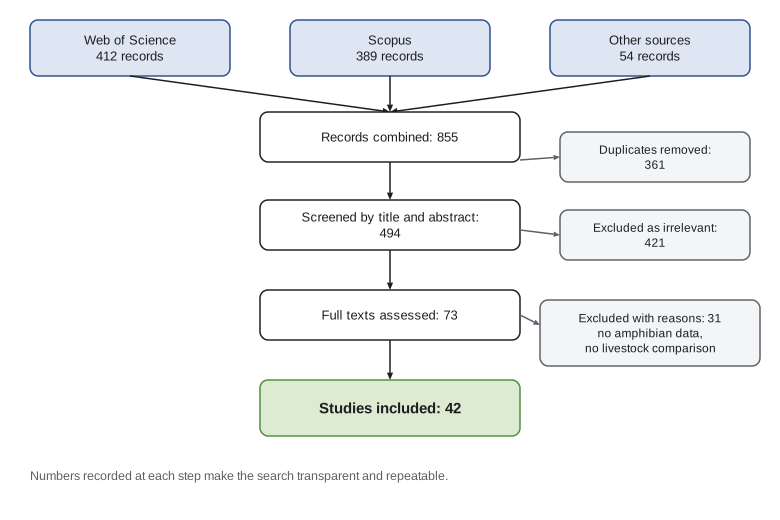
Each bracketed block holds synonyms for one concept, joined with OR, and the blocks are joined with AND. This structure finds papers that mention at least one term for each concept. The search returned 412 records. Adding the same search in Scopus and screening the first 200 Google Scholar results added more, and Priya also used citation chasing: checking the reference lists of the key papers (backward searching) and using the databases to find later papers that cited them (forward searching). Citation chasing often finds relevant studies that keyword searches miss because they used different terms.
Screening and recording what you find
A search that returns hundreds of records must be screened. Priya first read titles and abstracts and excluded records that were clearly irrelevant, such as studies of grazing in forests or of frogs in rice paddies with no livestock. She then read the full text of the remaining papers and kept those that reported data on livestock and amphibians or on how livestock affect wetland habitat. Systematic reviews report such screening with a flow diagram that shows how many records were found, removed as duplicates, excluded at each stage and finally included. An honours review need not be fully systematic, but recording your search terms, databases, dates and numbers makes the review transparent and repeatable.
A reference manager is essential from the first day. Programs such as Zotero, which is free, or Mendeley and EndNote store references, attach PDFs, record notes and insert citations into your word processor in any style. Priya created a Zotero collection for her project with sub-collections for grazing effects, chorus frog biology, eDNA methods and statistics, and tagged each paper with its study design and region. When she wrote her thesis a year later, she could find any paper in seconds.
Reading a paper efficiently
Few researchers read a paper from start to finish on the first pass. A common approach reads in three passes. In the first pass, read the title, abstract, figures and their captions, and the conclusions, which takes about 10 minutes and tells you whether the paper is relevant. In the second pass, read the introduction, methods and results more carefully, noting the design, sample sizes and main findings, and checking whether the figures support the claims. In the third pass, which you reserve for the most important papers, work through the methods and analysis in detail, as though you had to repeat the study, and look for assumptions or weaknesses.
For each paper she read in depth, Priya recorded the same information in a spreadsheet: the citation, region, wetland type, species, design (experiment, before-after, comparison of sites, survey), sample size, response measured, main result, and her own notes on strengths and weaknesses. This literature matrix made patterns visible. Most studies compared grazed and ungrazed sites without random assignment, a few were true experiments with fencing assigned at random, and almost all came from farm ponds in the southeastern United States or from rangelands in the western mountains, with few from prairie potholes.
| Citation (invented examples) | Region | Design | Sites | Main result for larvae |
|---|---|---|---|---|
| Study A (2008) | Southeastern US farm ponds | Comparison of grazed and fenced ponds | 6 and 6 | Lower survival of some species with cattle access |
| Study B (2012) | Western mountain meadows | Fencing experiment | 10 pairs | No detectable difference for one toad species |
| Study C (2016) | Northern prairie | Survey across grazing intensity | 48 wetlands | Calling declined with grazing intensity, but strongly confounded with crop cover |
| Study D (2019) | Coastal grassland ponds | Before-after-control-impact | 8 and 8 | Turbidity fell after fencing; tadpole counts rose for two of three species |
The literature on livestock and amphibians gives a mixed picture: work in farm ponds, such as studies in Tennessee in the late 2000s by Schmutzer, Burton, Gray and colleagues, reported that cattle access was associated with poorer water quality and lower abundance of some amphibian species but not others, and responses differed among species and life stages. That mixed picture was useful to Priya. It meant her question was genuinely open for her system, and it suggested that she should measure a mechanism, turbidity, rather than simply count frogs.
Judging the quality of a source
Being published does not make a study correct. When you evaluate a paper, ask several questions.
- Is the design capable of answering the question? A comparison of grazed and ungrazed sites can show an association, but if ranchers fenced the wetlands that were already in better condition, the comparison is confounded. Experiments with random assignment, or before-after designs with controls, give stronger evidence of cause.
- Is the replication adequate and at the right level? Ten tadpoles from one pond are ten measurements of one pond, not ten independent replicates. Lesson 5 returns to this problem, pseudoreplication.
- Do the results support the conclusions? Check whether the figures show what the text claims, whether effect sizes are given as well as p-values, and whether the authors overstate weak results.
- Is the journal reputable and the paper peer reviewed? Peer review is imperfect, but it filters out many errors. Predatory journals charge authors fees while providing little or no real review; check whether a journal is indexed in major databases and whether its editorial board and review process are transparent.
- Has the paper been corrected or retracted? Retraction notices appear on journal pages and in the Retraction Watch database, and reference managers such as Zotero can flag retracted papers in your library.
Primary sources should be cited for specific findings. If a review says that cattle reduce tadpole survival, find and read the study it cites before repeating the claim, because reviews sometimes simplify or misreport results. Priya found one case in which a review summarized a study as showing reduced survival when the original paper had found reduced survival for one species and no effect for two others.
Synthesizing: from summaries to an argument
The most common weakness in student literature reviews is that they summarize papers one at a time: Study A found this, Study B found that. A good review is organized by ideas, not by papers. It groups studies by the questions they address, compares their findings and designs, explains disagreements, and identifies what remains unknown. It ends by showing that the gap it has identified is exactly the gap your project will fill.
Priya organized her review into four sections: how livestock change wetland habitat, especially turbidity and emergent vegetation; how amphibians use wetlands for breeding, with emphasis on chorus frog egg attachment and tadpole development; what studies of livestock and amphibians have found, and why their findings differ; and methods for detecting amphibians, including call surveys and eDNA. Her final paragraph argued that there was little experimental evidence from prairie pothole wetlands, that most studies had measured abundance without measuring mechanisms, and that pairing fenced and grazed wetlands within pastures could reduce confounding. That paragraph led directly to her research question.
Worked problem
Turning summaries into synthesis
Priya's first draft read: "Study A found lower survival in grazed ponds. Study B found no effect of fencing. Study C found less calling with more grazing." Rewrite it as synthesis.
Show solution
- Identify the common question: do livestock reduce amphibian breeding success?
- Identify the pattern: results differ among studies.
- Look for an explanation of the differences: design, region and species. The study that found no effect was an experiment on a toad in mountain meadows; the studies finding effects were on frogs in warmer ponds or were observational.
- State what remains unknown: whether effects occur in prairie potholes and whether turbidity is the mechanism.
Answer: A synthesis might read: "Studies of livestock effects on amphibian breeding disagree, with reduced larval survival in some southeastern farm ponds but no detectable effect in a fencing experiment in mountain meadows. Differences in species, climate and study design may explain the contrast, and few studies have measured the habitat changes, such as turbidity, through which livestock might act. No experimental test exists for prairie pothole wetlands."
Citing and avoiding plagiarism
Every idea, finding or wording taken from a source must be cited. Paraphrasing means expressing an idea in your own words and sentence structure, with a citation; changing a few words of the original is not paraphrasing and counts as plagiarism even with a citation. Direct quotations are rare in biology writing and should be used only when the exact wording matters. Biology journals use several citation styles, most commonly name-year systems such as the style of the Council of Science Editors, or numbered systems. Your department will specify a style for the thesis, and a reference manager will format it for you.
Generative AI tools raise new questions. Many universities now allow limited use, such as checking grammar, but forbid using AI to write the thesis text and require students to disclose any use. AI tools can also invent references that look real but do not exist, so never cite a source you have not found and read yourself. Check your university's policy and your supervisor's expectations before using these tools at all.
Common mistakes
MistakeA search on a general web search engine is enough to find the literature.
InsteadUse bibliographic databases such as Web of Science, Scopus and PubMed, plus citation chasing, for scientific literature.
MistakeA published paper is reliable because it passed peer review.
InsteadEvaluate design, replication and whether results support conclusions; check for predatory journals and retractions.
MistakeA literature review summarizes each paper in turn.
InsteadA good review is organized by ideas, compares and explains findings, and identifies the gap your project fills.
MistakeCiting a review is enough for a specific finding.
InsteadFind and read the primary study, because reviews can simplify or misreport results.
Summary and key terms
- Primary articles, reviews, meta-analyses, books and grey literature play different roles in a literature review.
- Search databases with concept blocks of synonyms joined by OR and blocks joined by AND, and use citation chasing.
- Record search terms, databases, dates and screening numbers so the search is transparent.
- Read papers in passes and record key information in a literature matrix.
- Judge sources by design, replication, support for conclusions, journal quality and retraction status.
- Synthesize by ideas, explain disagreements and end with the gap your project fills; cite carefully and follow AI policies.
- Primary research article
- A paper reporting the methods, data and results of an original study.
- Meta-analysis
- A statistical combination of results from many studies of the same question.
- Grey literature
- Research and data produced outside commercial journals, such as government reports and theses.
- Boolean operators
- Words such as AND, OR and NOT that combine search terms.
- Citation chasing
- Finding studies by following the reference lists of papers and the later papers that cite them.
- Predatory journal
- A publication that charges authors fees while providing little or no genuine peer review or editorial service.
Practice problems
Work each problem on paper first, then reveal the answer to check.
Write a search string for studies of road salt effects on wood frog tadpoles.
Show answer
For example: (road salt OR deicing OR chloride OR salin*) AND (wood frog OR Lithobates sylvaticus OR Rana sylvatica) AND (tadpole* OR larva*).
A search finds 600 records; 150 are duplicates and 380 are excluded at the title stage. How many go on to full-text screening?
Show answer
600 minus 150 is 450; 450 minus 380 is 70 full texts.
What is backward and forward citation searching?
Show answer
Backward searching checks a paper's reference list; forward searching finds later papers that cite it.
Why should a review not be organized paper by paper?
Show answer
Because synthesis requires comparing findings by idea, explaining differences and identifying gaps, which a list of summaries does not do.
Lesson quiz · 5 questions
Score 60% or more to complete this lesson.
Create a free account to save your progress, take quizzes and earn a certificate.