
BIOL-499 · Lesson 11 of 12 · 19 min
Presenting research: posters, talks and the oral defence
▶ Video coming soon A video version of this lesson is on the way.
Research becomes part of science when it is communicated, and much scientific communication is spoken: posters at conferences, talks at seminars and meetings, and, for honours students, the oral defence. Speaking about research is a skill that improves dramatically with preparation and practice, and it is one of the skills employers mention most often when they describe what they value in graduates. This lesson follows Priya through three presentations in the spring of 2026: a poster at her department's honours poster day in March, a short talk for the ranch and community partners, and her oral defence in April.
Know your audience and your message
Every presentation starts with two questions: who is listening, and what is the one thing they should remember? The answers change everything else. At poster day, Priya's audience was faculty, other students and visitors from outside biology. At the community meeting, it was the rancher, the ranch manager, a conservation group and members of a nearby Indigenous community with an interest in the wetlands. At her defence, it was two experts who had read her thesis closely. The core message was the same for all three, fencing clearly reduced turbidity, its effect on frogs was uncertain, and turbid water can fool eDNA surveys, but the detail, vocabulary and emphasis differed.
A useful exercise is to write your message in one or two sentences before preparing anything else, then check that every slide or poster panel supports it. Priya's poster message was: Keeping cattle out of wetland margins halves turbidity, but 12 pairs were not enough to tell whether chorus frogs benefit, and muddy water can make frogs invisible to eDNA.
Posters
A research poster is a visual summary that a visitor can understand in about two minutes, and that you can explain in about five. Posters fail most often by containing too much text. Priya's first draft had almost 1,500 words; her final version had about 500, with the space given to figures.
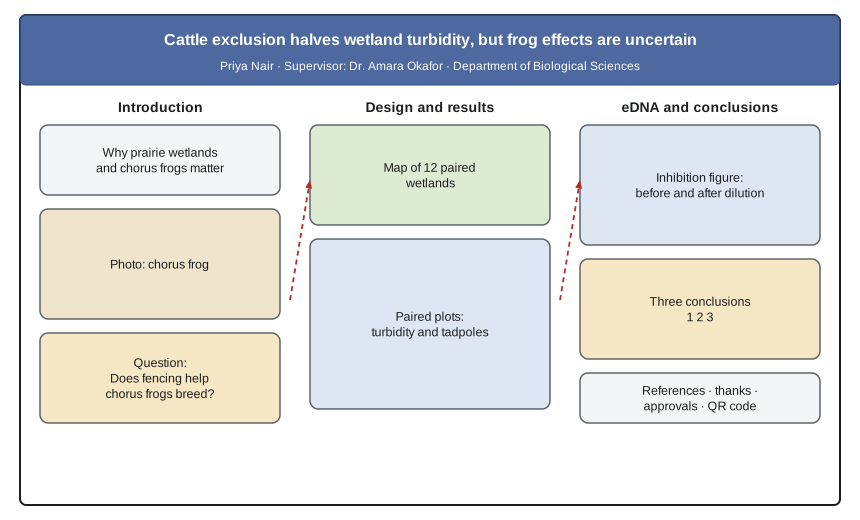
- Title: short, readable from several metres away, and ideally stating the finding.
- Layout: a clear reading order, usually in columns from top left, with generous white space.
- Figures: large and simplified from the thesis versions, with axis labels readable from about 2 metres.
- Text: short sections and bullet points; the question and conclusions highlighted so a passer-by can grasp them in seconds.
- Details: methods summarized in a diagram where possible; references, acknowledgements, approvals and a link or QR code to more information at the bottom.
At the poster, prepare a 30-second version and a 3-minute version of your explanation, starting with the question and the main finding, and invite questions. Stand beside the poster, not in front of it. Visitors who ask hard questions are giving you practice for the defence.
Talks
A research talk tells a story: the problem, the question, what you did, what you found and what it means. Priya's community talk was 10 minutes with 10 minutes for questions. She used about one slide per minute, a common rule of thumb, and built her talk around four figures: a photograph of a fenced and a grazed wetland side by side, the paired turbidity plot, the paired tadpole plot and the eDNA inhibition plot.
Good slides support the speaker rather than replace them. Each slide makes one point, stated in its title, such as Fencing halved turbidity rather than Turbidity results. Text is minimal and large, figures are simplified, and nothing appears that the speaker does not explain. Reading slides aloud loses an audience quickly. Before the community meeting, Priya replaced statistical terms with plain language: rather than a geometric mean ratio of 1.29 with a confidence interval of 0.78 to 2.20, she said fenced wetlands had on average about a quarter more tadpoles, but the numbers varied so much between wetlands that we cannot be sure fencing made the difference.
Practice is the single most effective preparation. Priya practised her talk aloud five times, twice in front of Tomás and Aisha and once for Dr. Okafor's lab group, timing each run. Practice reveals slides that take too long, transitions that confuse and points that need examples. Most people speak faster when nervous, so a talk that runs exactly to time in practice usually runs short in the room.
Presenting to non-specialists
The community meeting taught Priya that presenting to people outside science is a skill of its own. The rancher, the conservation group and the community members cared about different things: whether fencing was worth its cost, whether it helped wildlife, and whether the wetlands would stay healthy for future generations. She opened with a photograph of two wetlands from the same pasture, one fenced and one grazed, which made the question obvious without any words. She avoided acronyms, explained eDNA as tiny traces of DNA that animals leave in the water, and gave numbers in familiar forms, such as about half as muddy, rather than ratios and intervals.
She also listened. A community member described how the wetlands had looked decades earlier, before heavy grazing, and the rancher explained which wetlands cattle used most in dry years. Neither comment changed her results, but both gave her ideas for the discussion section and for future work. Sharing results with the people who own, manage or depend on a study site is part of responsible research, and it often improves the research itself.
Worked problem
Planning a talk to time
Priya has 15 minutes for her defence presentation. She plans an introduction of 3 minutes, methods of 3 minutes, results of 5 minutes and discussion and conclusions of 3 minutes, and estimates about 1 minute per slide. How long is the plan, and how many slides should she aim for?
Show solution
- Add the sections: 3 plus 3 plus 5 plus 3 is 14 minutes.
- That leaves 1 minute of slack in a 15-minute slot, which allows for questions of clarification or a slow start.
- At about 1 minute per slide, 14 minutes suggests about 14 content slides, plus a title slide and a final summary slide that stays on screen during questions.
- Dense results slides may take 2 minutes each, so she should check timing in practice and cut slides rather than speed up.
Answer: The plan uses 14 of 15 minutes, with about 14 content slides plus a title and summary slide. Practice runs will show whether any section needs trimming.
Questions after a talk are an opportunity, not a test to survive. Listen to the whole question, pause, and repeat or paraphrase it if the room is large or the question is complex. Answer briefly and directly. If you do not know, say so, and say how you might find out. If a question is really a comment, thank the person and respond to the point. At the community meeting, the rancher asked whether fencing was worth the cost if it did not clearly help the frogs. Priya answered that the turbidity reduction was clear and might benefit other species and water quality, that the frog result was uncertain rather than negative, and that a longer study with more wetlands would answer the question. It was an honest answer that did not overstate her results.
The oral defence
The oral defence, sometimes called an oral examination, is the final assessment in many honours programs. Formats vary. In Priya's department, the student gives a 15-minute presentation to the supervisor, the second reader and a chair, followed by about 40 minutes of questions, after which the committee meets privately and decides the outcome and the mark. The examiners have read the thesis, so the presentation summarizes it rather than presenting new material. The questions are the heart of the defence. They test whether you understand your project well enough to explain and justify every part of it, to recognize its limitations and to think about what it means.
| Kind of question | Example from Priya's defence | What it tests |
|---|---|---|
| Clarification | How exactly did you score the calling index? | Whether you know your methods in detail |
| Justification | Why did you use a permutation test rather than a t-test? | Whether your choices were reasoned |
| Interpretation | What does your interval for tadpoles rule out? | Whether you understand your results |
| Limitations | How might the non-random fencing have biased your comparison? | Whether you recognize weaknesses |
| Alternative explanations | Could predators explain why the turbidity mechanism was not supported? | Whether you can think beyond your hypothesis |
| Broader context | How do your findings relate to fencing programs across the prairies? | Whether you see the wider significance |
| Future work | If you had three more years, what would you do? | Whether you can design the next step |
Preparation for the defence starts with rereading the thesis carefully, at least a week before, and making a list of likely questions. Priya wrote out 40 questions, including every one she would least like to be asked, and drafted short answers. She went through her methods and analysis until she could explain each step without notes, reread the key papers she had cited, and made backup slides for topics she expected to come up but had not included in her presentation, such as the mixed model check and the sensitivity analysis. Dr. Okafor's lab ran a mock defence a week before, with two graduate students asking hard questions for half an hour.
Students often fear that examiners are trying to catch them out. In practice, examiners want to see that you understand your work and can think about it. A question you cannot answer is not a failure: saying I am not sure, but I think it may be because of this, and I could test it by doing that is a good answer. Bluffing, by contrast, is usually obvious and damages credibility. Defending every choice as perfect is also a mistake; when an examiner identifies a real weakness, acknowledging it and discussing its consequences shows exactly the judgement the defence is meant to assess.
Nerves are normal and usually fade once the questions begin. Practical steps help: arrive early to check the room and the projector, have water, slow your breathing before starting, and pause before answering each question. Bring a copy of the thesis with tabs on key pages, so you can find a table or figure quickly when asked.
After the defence
Common outcomes of an honours defence are acceptance as submitted, acceptance with minor revisions, acceptance with major revisions and, rarely, failure. Most theses require some revisions, such as correcting errors, clarifying a section or adding a limitation. Priya passed with minor revisions: Dr. Szabo asked her to add the mixed model results to an appendix and to clarify how the calling index was scored, and the chair noted two figures whose axis labels were too small. She completed the revisions in a week, submitted the final thesis, deposited her data and code, and sent a plain-language summary to the ranch and the community partners.
Many honours theses lead to presentations at regional or national conferences, and some to publications. Dr. Okafor and Priya planned to submit the inhibition finding as a short methods paper, because it would be useful to agencies running eDNA surveys in turbid wetlands, with Mei Chen as a co-author. Turning a thesis into a paper means shortening it, sharpening the focus and responding to peer review, a process that typically takes months. Priya's experience was a good introduction to how research continues beyond the honours year.
Common mistakes
MistakeA poster should include all the details from the thesis.
InsteadA poster is a two-minute visual summary; keep text short and figures large.
MistakeReading slides aloud ensures nothing is forgotten.
InsteadSlides support the speaker; reading them loses the audience. Practise until you can speak from the figures.
MistakeSaying 'I don't know' in a defence means failing.
InsteadAn honest uncertain answer with reasoning is far better than bluffing.
MistakeExaminers expect a perfect study with no weaknesses.
InsteadThey expect you to recognize weaknesses and explain their consequences.
Summary and key terms
- Decide your audience and your one or two sentence message before preparing any presentation.
- Posters need a clear reading order, large figures and little text; prepare 30-second and 3-minute explanations.
- Talks tell a story with one point per slide, plain language suited to the audience and repeated timed practice.
- Answer questions by listening fully, pausing, answering briefly and admitting uncertainty honestly.
- Defences test understanding, justification, interpretation, limitations and wider thinking; prepare with a list of likely questions and a mock defence.
- Most theses pass with revisions; afterwards, deposit data, share results with partners and consider publication.
- Research poster
- A visual summary of a study displayed at a conference or poster session.
- Oral defence
- An examination in which a student presents their thesis and answers examiners' questions.
- Backup slide
- A prepared slide shown only if a related question is asked.
- Mock defence
- A practice defence in which colleagues ask questions as examiners would.
- Minor revisions
- Small corrections or clarifications required before a thesis is accepted.
- Plain-language summary
- A short description of research results written for a non-specialist audience.
Practice problems
Work each problem on paper first, then reveal the answer to check.
A talk slot is 12 minutes. At about 1 minute per slide, how many content slides should you prepare?
Show answer
About 10 to 12, leaving a little slack, plus a title slide and a summary slide.
Rewrite the slide title 'Results 2' to state a point.
Show answer
For example: 'Tadpole densities favoured fenced wetlands, but varied widely.'
How should you respond to a defence question you cannot answer?
Show answer
Say you are not sure, offer your best reasoning, and explain how you could find out.
Why did Priya prepare backup slides?
Show answer
To answer expected questions on topics not in her main talk, such as the sensitivity analysis and the mixed model check.
Lesson quiz · 5 questions
Score 60% or more to complete this lesson.
Create a free account to save your progress, take quizzes and earn a certificate.