
BIOL-470 · Lesson 9 of 12 · 22 min
Agricultural biotechnology
▶ Video coming soon A video version of this lesson is on the way.
Agriculture has always been biotechnology. What changed in the 1990s was the ability to move a single chosen gene into a crop, and what changed again after 2012 was the ability to edit a crop's own genes without adding foreign DNA. Engineered crops are now grown on a large share of the world's maize, soybean, cotton and canola area, and they are among the most studied and most argued-about products of biotechnology. This lesson covers how plants are transformed, the main traits in use, the evidence on safety and effects, how animals and microbes fit in, and why the regulatory treatment of edited crops differs so much between countries.
Northfield's third product line is a diagnostic kit, but the company's agronomy group works with growers of canola in western Canada, so Lena is sent for a week to a field trial where edited and conventional lines are compared.
Transforming plants
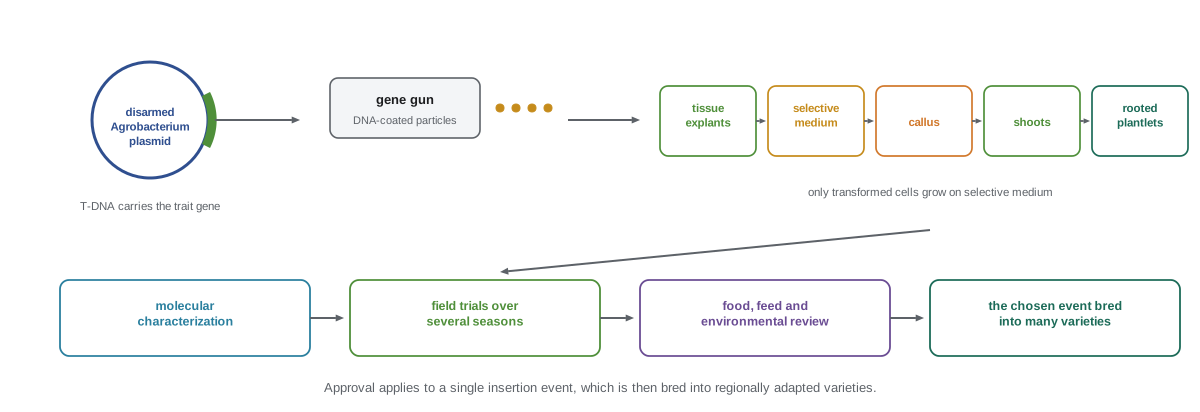
Plant cells have a great advantage for biotechnology: many are totipotent, able to regenerate a whole plant. A single transformed cell can be grown on hormone-containing media into a shoot and then a complete plant, a process called tissue culture. Two delivery methods dominate. Agrobacterium tumefaciens naturally infects wounded plants and transfers a segment of DNA, the T-DNA, from its tumour-inducing plasmid into the plant's chromosomes. Biotechnologists disarm the plasmid, removing the tumour genes, and replace them with the genes they want, so the bacterium becomes a precise delivery vehicle. Particle bombardment, or the gene gun, coats microscopic gold or tungsten particles with DNA and fires them into tissue; it works in cereals and other species that Agrobacterium infects poorly.
Transformation is followed by selection, usually with a marker that lets only transformed cells grow, and then by many generations of breeding. The insertion lands at a random site, so dozens or hundreds of independent events are made and the best, called the elite event, is chosen on the basis of expression, agronomic performance and a clean molecular characterization. That single event is then crossed into many varieties adapted to different regions. Because approval applies to the event, the long regulatory process is done once, which is part of why so few events are commercialized.
The main traits
Two traits account for most of the engineered crop area. Insect resistance uses genes from Bacillus thuringiensis, a soil bacterium whose crystal proteins, known as Bt proteins, are toxic to particular insect groups and harmless to mammals because they require specific receptors and an alkaline gut to act. Bt maize and cotton protect against caterpillars and corn rootworm. Herbicide tolerance lets a field be sprayed with a broad-spectrum herbicide that kills weeds but not the crop; the first and most widespread version uses a bacterial version of the EPSPS enzyme that is not inhibited by glyphosate. Later traits include tolerance to other herbicides, used in stacks to manage resistant weeds.
Other traits address different problems. Virus-resistant papaya, developed in public research, saved Hawaii's industry from ringspot virus. Non-browning apples and potatoes use RNA interference to silence the enzyme that darkens cut flesh, reducing food waste. Drought-tolerant maize and nitrogen-use-efficient lines aim at resource stress. Golden Rice, engineered to make beta-carotene in the grain to address vitamin A deficiency, was developed by public-sector scientists and donated for humanitarian use, and illustrates how long and contested the road to the field can be: after decades of development and approvals in several countries, a Philippine court in April 2024 revoked its biosafety permits following a petition by campaigners, and the case continued through appeals. Bt eggplant, by contrast, has been grown by many smallholders in Bangladesh.
| Trait | How it works | Crops |
|---|---|---|
| Insect resistance | Bt proteins toxic to specific insect groups | Maize, cotton, eggplant, soybean |
| Herbicide tolerance | An enzyme the herbicide cannot inhibit, or one that breaks it down | Soybean, maize, cotton, canola |
| Virus resistance | Viral coat protein or RNA interference against the virus | Papaya, squash, beans |
| Quality traits | Silencing or adding enzymes in a metabolic pathway | Non-browning apple and potato, high-oleic soybean |
| Nutritional traits | Added pathways, for example for beta-carotene | Golden Rice |
| Abiotic stress tolerance | Regulatory genes affecting drought or salt response | Maize, sugarcane |
Resistance management
Any pest control that is used widely selects for resistance, and Bt crops and herbicide-tolerant systems are no exception. Insect resistance management uses three main tactics: a high dose of toxin, so that insects surviving are rare; refuges of non-Bt crop nearby, so susceptible insects survive to mate with any resistant ones; and pyramiding, putting two or more Bt proteins with different modes of action in the same plant, so an insect must acquire two resistance traits at once. Where refuge rules have been followed poorly, resistance has evolved, as in some corn rootworm and pink bollworm populations. The same logic applies to weeds: heavy reliance on glyphosate alone produced glyphosate-resistant weeds across millions of hectares, and integrated management now combines herbicides with different modes of action, tillage, cover crops and crop rotation.
# A single-gene model of resistance evolution in a pest, with and without a refuge.
def run(p0, s_field, refuge, gens=15):
    # p = frequency of the resistance allele; resistant homozygotes survive the field, others do not
    p = p0
    out = []
    for g in range(1, gens + 1):
        # fitness: in field fraction (1 - refuge), only RR survive; in refuge all survive equally
        w_RR = (1 - refuge) * 1.0 + refuge * 1.0
        w_other = (1 - refuge) * (1 - s_field) + refuge * 1.0
        q = 1 - p
        num = p * p * w_RR + p * q * w_other
        den = p * p * w_RR + 2 * p * q * w_other + q * q * w_other
        p = num / den
        out.append(p)
    return out
for refuge in (0.0, 0.05, 0.20):
    traj = run(0.001, 0.99, refuge)
    print(f"refuge {refuge:4.2f}: resistance allele frequency after 5, 10, 15 generations: "
f"{traj[4]:.4f} {traj[9]:.4f} {traj[14]:.4f}")refuge 0.00: resistance allele frequency after 5, 10, 15 generations: 0.0018 0.0059 0.8615 refuge 0.05: resistance allele frequency after 5, 10, 15 generations: 0.0011 0.0012 0.0013 refuge 0.20: resistance allele frequency after 5, 10, 15 generations: 0.0010 0.0010 0.0011
The model is deliberately simple, but it makes the point behind refuge policy: with no refuge, a rare resistance allele rises quickly under strong selection, while even a modest refuge slows it markedly by letting susceptible insects contribute to the next generation.
What the evidence says
Engineered crops have been studied for three decades. Reviews by national science academies, including a 2016 report from the United States National Academies of Sciences, Engineering, and Medicine that examined more than 900 publications, have concluded that foods from the engineered crops then on the market are as safe to eat as their conventional counterparts, and that no substantiated evidence links them to human health problems. On the environment and agronomy, the picture is mixed and trait-specific. Bt crops have reduced insecticide applications in several systems and benefited some non-target insects; herbicide-tolerant systems reduced tillage, which can protect soil, but encouraged reliance on single herbicides and the spread of resistant weeds. Yields depend on whether the pest or weed being controlled was limiting yield in the first place.
Economic and social effects are also contested. Meta-analyses have found average yield and profit gains for adopters, especially in developing countries where pest pressure is high, while critics point to seed costs, patents and contracts that restrict seed saving, and the concentration of the seed industry in a few firms. Those questions are about agriculture and markets as much as about biology, and lesson 12 returns to them.
Coexistence and detection
Growers of conventional and organic crops, and exporters, need to limit the presence of engineered material. Pollen flow between fields is managed with isolation distances, buffer rows and differences in flowering time, and seed lots are tested. Detection uses the tools of lessons 3 and 4: PCR for the inserted DNA, with assays for the common promoter and terminator sequences used in many events as screening tests and event-specific assays for identification, and immunoassays for the protein in the field. Quantification by quantitative or digital PCR supports labelling thresholds, such as the European Union's requirement to label food above a threshold fraction of engineered material.
Worked problem
Reading a seed lot test
A canola seed lot is tested by quantitative PCR. The event-specific assay gives 1,820 copies of the event target and the reference gene assay gives 210,000 copies of a single-copy canola gene. The event is hemizygous in the seeds tested, contributing one copy per genome. Estimate the fraction of seeds carrying the event.
Show solution
- Each seed genome contributes about two copies of the reference gene, so 210,000 copies represent about 105,000 genomes.
- A hemizygous event contributes one copy per genome, so 1,820 copies come from about 1,820 genomes.
- Fraction = 1,820 / 105,000 = 0.0173.
- So about 17 seeds in 1,000 carry the event, above a 0.009 threshold but below a 0.05 one.
Answer: About 0.017, or 17 seeds in 1,000.
Edited crops and the regulatory divide
Genome editing changes a crop's own genes, and the editing machinery can be bred out, leaving a plant whose DNA differs from a conventional variety only by a small change that could in principle have arisen by mutation. This has split regulation. Canada regulates on the basis of the product, not the method: a plant is regulated as a plant with a novel trait if its characteristics are new and could affect food, feed or environmental safety, regardless of how it was made. In May 2023 the CFIA published updated guidance confirming that gene-edited plants with no foreign DNA and no novel trait are not treated as plants with novel traits, and Health Canada issued parallel guidance for foods, together with a transparency database for gene-edited varieties. The European Union, by contrast, has treated organisms made by newer techniques as genetically modified under a 2018 Court of Justice ruling, and has been considering legislation to change that for some edited plants.
Animals and microbes
Engineered animals have advanced slowly. AquAdvantage salmon, an Atlantic salmon carrying a growth hormone gene construct that lets it grow year-round, was approved in the United States in 2015 and in Canada in 2016 after a long review, and was the first engineered food animal sold; the company ceased salmon farming in 2024 and 2025 for commercial reasons rather than regulatory ones. Gene-edited pigs resistant to porcine reproductive and respiratory syndrome virus received US approval in 2025. Editing is also used to make hornless cattle, avoiding painful dehorning, and to study disease. Livestock vaccines, including engineered and vectored vaccines, are a large and less controversial part of agricultural biotechnology.
Microbial products matter too. Rhizobium inoculants help legumes fix nitrogen; engineered and naturally occurring biopesticides control insects and fungi; and Bt itself, sprayed as a microbial insecticide, is approved for organic farming. Dairy processing uses chymosin, the milk-clotting enzyme once taken from calf stomachs, now made by fermentation in engineered microbes for most of the world's cheese, an early and widely accepted application.
Common mistakes
MistakeThinking Bt toxins are broad-spectrum insecticides.
InsteadEach Bt protein affects particular insect groups that have the right receptors and gut conditions.
MistakeAssuming resistance cannot evolve to an engineered trait.
InsteadStrong selection favours resistance; refuges and pyramided traits slow it.
MistakeTreating all engineered crops as one thing.
InsteadSafety and environmental effects depend on the trait and the system, not on the method alone.
MistakeAssuming edited crops are regulated the same way everywhere.
InsteadProduct-based and process-based systems treat them very differently.
MistakeConfusing an event with a variety.
InsteadAn event is a single insertion, approved once and then bred into many varieties.
Summary and key terms
- Plants are transformed with disarmed Agrobacterium or by particle bombardment, then regenerated from single cells.
- A single insertion, the event, is characterized, approved and bred into many varieties.
- The dominant traits are Bt insect resistance and herbicide tolerance; others include virus resistance and quality and nutrition traits.
- Resistance management uses high dose, refuges and pyramided traits; the same logic applies to herbicide-resistant weeds.
- Science academy reviews find foods from marketed engineered crops as safe as conventional ones; environmental and economic effects are trait-specific.
- Detection and quantification use PCR, digital PCR and immunoassays.
- Canada regulates by product, the United States by a three-agency framework now in flux after the 2024 vacatur, and the EU by process.
- Agrobacterium tumefaciens
- A soil bacterium that transfers DNA into plant chromosomes, used as a transformation tool.
- T-DNA
- The segment of the Agrobacterium plasmid transferred into the plant genome.
- particle bombardment
- Firing DNA-coated particles into plant tissue to deliver genes.
- totipotency
- The ability of a single plant cell to regenerate a whole plant.
- event
- A single transformation insertion, the unit of regulatory approval.
- Bt protein
- An insecticidal crystal protein from Bacillus thuringiensis.
- refuge
- Non-Bt crop grown nearby so susceptible insects survive and dilute resistance.
- pyramiding
- Combining two or more traits with different modes of action in one plant.
- plant with a novel trait
- A Canadian regulatory category based on the plant's characteristics rather than the method used.
- coexistence
- Practices that let engineered, conventional and organic production occur side by side.
Practice problems
Work each problem on paper first, then reveal the answer to check.
Why can a single transformed plant cell become a whole plant?
Show answer
Many plant cells are totipotent and can regenerate shoots and roots in tissue culture.
Why is a disarmed Agrobacterium plasmid used?
Show answer
The tumour-inducing genes are removed so the bacterium delivers DNA without causing disease.
Why are Bt proteins harmless to mammals?
Show answer
They need specific gut receptors and alkaline conditions found in susceptible insects.
What are the three main tactics of insect resistance management?
Show answer
High dose, refuges of non-Bt crop and pyramided toxins.
Give one environmental benefit and one drawback reported for herbicide-tolerant crops.
Show answer
Less tillage, which protects soil; greater reliance on one herbicide, which selects for resistant weeds.
How is an engineered event detected in a seed lot?
Show answer
By event-specific PCR, often after screening assays, or by immunoassay for the protein.
How does Canadian regulation of an edited plant differ in principle from European regulation?
Show answer
Canada asks whether the plant has a novel trait; the EU asks how it was made.
Lesson quiz · 5 questions
Score 60% or more to complete this lesson.
Create a free account to save your progress, take quizzes and earn a certificate.