
BIOL-470 · Lesson 4 of 12 · 22 min
DNA sequencing and genomics
▶ Video coming soon A video version of this lesson is on the way.
Sequencing reads the order of bases in DNA. In biotechnology it is the final word on whether a clone is correct, the way new genes and enzymes are discovered, the tool that tracks pathogens and contaminants, and increasingly a routine medical test. The technology has changed faster than almost any other in science: the first human genome took about 13 years and roughly 2.7 billion US dollars, and a human genome can now be sequenced in about a day for a few hundred dollars. This lesson explains how the main methods work, how their reads are turned into genomes, how to plan the amount of sequencing needed, and how sequencing is used in industry.
Lena meets sequencing twice in her first month. Her phytase plasmid must be verified base by base before the strain team will use it, and the strain team itself sequences the genomes of new yeast production strains to confirm where and how many times the expression cassette has integrated.
Sanger sequencing
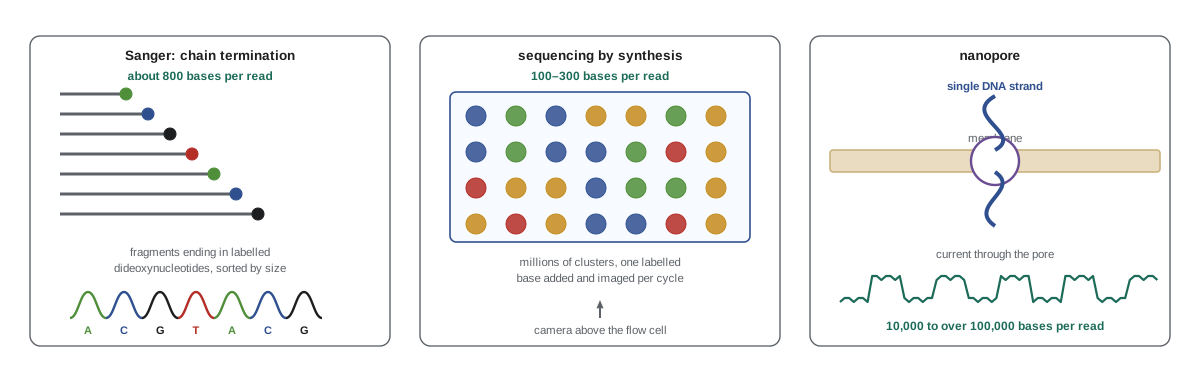
Frederick Sanger and his colleagues published the chain termination method in 1977, earning Sanger his second Nobel Prize in Chemistry. The method copies a single-stranded template with a DNA polymerase, starting from a primer, in the presence of normal deoxynucleotides and a small amount of dideoxynucleotides (ddNTPs). A ddNTP lacks the 3′ hydroxyl group needed to add the next nucleotide, so whenever one is incorporated, extension stops. The result is a set of fragments ending at every position of the template, each ending in a ddNTP that identifies the last base.
Modern Sanger sequencing labels each of the four ddNTPs with a different fluorescent dye and separates the fragments by size in a thin capillary filled with polymer. A laser excites the dyes as fragments pass a detector, giving a trace of coloured peaks, the chromatogram, from which software calls the sequence. A single Sanger read gives about 700 to 1,000 high-quality bases. Sanger is still the standard for checking a few specific sites, such as a mutation in a clone or a patient's known family variant, because it is accurate, simple and needs little analysis.
Each base call comes with a quality score. The Phred quality score \(Q\) relates to the probability \(p\) that the call is wrong:
A Q20 base has a 1 in 100 chance of being wrong, Q30 a 1 in 1,000 chance and Q40 a 1 in 10,000 chance. Sequencing platforms report the share of bases at or above Q30 as a headline measure of accuracy.
Short-read sequencing by synthesis
Massively parallel or next-generation sequencing, which became commercial in the mid-2000s, reads millions to billions of fragments at once. The dominant platform, developed by Solexa and then Illumina, uses sequencing by synthesis. DNA is broken into fragments a few hundred bases long and adapters are ligated to the ends, forming a library. Fragments bind to a glass flow cell coated with matching oligonucleotides, and each is amplified in place into a cluster of about a thousand identical copies. Sequencing then proceeds one base per cycle: the polymerase adds fluorescently labelled nucleotides that carry a removable block at the 3′ end, so only one is added; a camera images the colour of every cluster; and the label and block are cleaved before the next cycle.
Reads are short, typically 100 to 300 bases, and are often paired-end: the fragment is read from both ends, so the two reads are known to lie a few hundred bases apart. Accuracy is high, with most bases above Q30, and throughput is enormous: a large instrument can produce several terabases in a run. The cost per base has fallen faster than the cost of computing over the same years. Short reads are ideal for counting, as in measuring gene expression, and for finding single-base variants against a known reference, but they struggle with long repeats, because a read shorter than a repeat cannot show where it belongs.
Long-read sequencing
Two technologies read single molecules thousands of bases long. Pacific Biosciences watches a single polymerase copying a circular template in a tiny well, recording each fluorescent nucleotide as it is added. Because the template is a circle, the polymerase can go around many times, and combining the passes gives HiFi reads of about 15,000 to 20,000 bases with accuracy comparable to short reads. Oxford Nanopore threads a single DNA strand through a protein pore in a membrane; as bases pass, they change an electric current in characteristic ways, and software decodes the current into sequence. Nanopore reads can exceed 100,000 bases, the instruments range from a pocket-sized device to large benchtop machines, and they detect chemical modifications such as methylation directly. Raw single-pass accuracy is lower than for short reads but has improved greatly.
| Method | Typical read length | Strengths | Limitations |
|---|---|---|---|
| Sanger | 700–1,000 bases | Very accurate, simple, good for a few targets | Low throughput, high cost per base |
| Short-read sequencing by synthesis | 100–300 bases, often paired | Huge throughput, low cost per base, high accuracy | Cannot span long repeats or resolve complex structure alone |
| PacBio HiFi | 15,000–20,000 bases | Long and accurate, good for assembly | Higher cost per base, more input DNA |
| Nanopore | 10,000 to over 100,000 bases | Longest reads, portable, real time, detects modifications | Lower single-pass accuracy, though improving |
From reads to genomes
Reads are useful only once they are placed in context. If a reference genome exists, reads are aligned to it, and differences such as single-nucleotide variants, small insertions and deletions, and larger structural changes are called by comparing the reads that overlap each position. Without a reference, reads are assembled de novo: software finds overlaps between reads and builds them into longer contiguous sequences, or contigs. Long reads make assembly far easier because they span repeats; many bacterial genomes now assemble into a single circle from one nanopore run.
How much sequencing is enough? The key quantity is coverage, the average number of reads covering each base. If \(N\) reads of length \(L\) are taken from a genome of size \(G\), the coverage is:
Eric Lander and Michael Waterman showed in 1988 that if reads land at random, the number covering any base follows a Poisson distribution, so the probability that a base is not covered at all is \(e^{-C}\). At 5-fold coverage about 7 bases in 1,000 are missed; at 10-fold, fewer than 5 in 100,000. Real data are less even, so projects aim for more: around 30-fold for a human genome to call variants reliably, and often 50- to 100-fold or more for small genomes.
import math
G = 9.4e6          # genome size of the yeast K. phaffii, about 9.4 Mb
L = 150 * 2        # paired-end 2 x 150 base reads, counted as 300 bases per pair
for C in (5, 10, 30, 50):
    pairs = C * G / L
    missing = math.exp(-C)
    print(f"{C:3d}-fold coverage: {pairs:12,.0f} read pairs, expected uncovered fraction {missing:.2e}")
for q in (20, 30, 40):
print(f"Q{q}: error probability {10 ** (-q / 10):.4f}")5-fold coverage: 156,667 read pairs, expected uncovered fraction 6.74e-03 10-fold coverage: 313,333 read pairs, expected uncovered fraction 4.54e-05 30-fold coverage: 940,000 read pairs, expected uncovered fraction 9.36e-14 50-fold coverage: 1,566,667 read pairs, expected uncovered fraction 1.93e-22 Q20: error probability 0.0100 Q30: error probability 0.0010 Q40: error probability 0.0001
Preparing a library
Before any high-throughput platform can read DNA, the sample must be turned into a library of fragments with known sequences on their ends. Genomic DNA is broken up, either mechanically by sonication or by enzymes that cut at frequent sites, and the fragments are size-selected so that most fall in the range the platform reads best. Ends are repaired and adapters are ligated on: short synthetic sequences that let fragments bind the flow cell or pore, provide priming sites for sequencing, and carry an index, a short barcode unique to each sample. Indexing is what makes modern sequencing economical. Dozens to hundreds of indexed libraries are pooled and sequenced together, and the reads are sorted back to their samples computationally, so a small project need not waste a whole run. Library preparation is also where bias enters: amplification steps favour fragments of moderate length and balanced base composition, so regions very rich in G and C or in A and T can be under-represented. Methods that avoid amplification reduce this bias but need more input DNA.
The amount of input DNA matters as much as its quantity. Degraded DNA from old or fixed samples gives short fragments and uneven coverage, and long-read platforms need DNA that has been handled gently, with wide-bore tips and no vortexing, because shearing destroys exactly the length the method exists to exploit. Laboratories therefore check DNA integrity as well as concentration before committing a sample to a run.
Worked problem
Planning a strain sequencing run
The strain team wants 50-fold coverage of five new yeast strains, each with a genome of about 9.4 million bases, using paired 150-base reads. How many read pairs are needed in total?
Show solution
- Each pair gives 2 × 150 = 300 bases.
- One strain at 50-fold needs 50 × 9.4 × 10 to the power 6 = 4.7 × 10 to the power 8 bases.
- That is 4.7 × 10 to the power 8 / 300 = 1.57 million pairs per strain.
- Five strains need about 7.8 million pairs, a small fraction of one run on a benchtop instrument.
Answer: About 7.8 million read pairs, before adding a margin for uneven coverage.
Genomics in biotechnology
Sequencing underpins nearly every lesson in this course. In cloning, whole-plasmid sequencing by nanopore now costs little more than a few Sanger reads and checks the entire construct, not just the insert. In strain engineering, genome sequencing confirms that an expression cassette integrated where intended and finds unwanted mutations; Northfield's strain team found that one high-producing yeast strain had three tandem copies of the phytase cassette, explaining its yield. In discovery, sequencing environmental samples, or metagenomics, finds new enzymes in organisms that have never been grown in culture; many industrial enzymes, including some heat-stable phytases, came from such searches.
RNA sequencing, or RNA-seq, converts RNA to cDNA and sequences it, counting reads per gene to measure expression of every gene at once. Single-cell RNA-seq does the same in thousands of individual cells, revealing cell types and states. In medicine, sequencing diagnoses rare genetic diseases, matches cancers to targeted drugs, screens newborns in some programs and screens pregnancies through cell-free fetal DNA in maternal blood. In public health, genomic surveillance tracks outbreaks and the spread of variants, as it did at global scale for SARS-CoV-2.
The human genome and beyond
The Human Genome Project, an international public effort launched in 1990 with contributions from many countries, including the United States, the United Kingdom, Japan, France, Germany, China and Canada, published a draft in 2001 alongside a competing private draft from Celera Genomics and declared the sequence essentially complete in 2003. It used Sanger sequencing of cloned fragments. That reference still had gaps, mainly in highly repetitive regions such as centromeres. In 2022 the Telomere-to-Telomere consortium published the first truly complete sequence of a human genome, made possible by long reads. A pangenome reference built from many people of diverse ancestry followed in 2023, reflecting the fact that a single reference cannot represent human variation.
The flood of data raises its own challenges: storing and analysing petabytes, keeping analyses reproducible, protecting the privacy of people whose genomes are sequenced, and making sure the benefits reach populations that have been under-represented in genomic databases. Canadian law and policy on genetic privacy and discrimination are discussed in lesson 12.
Common mistakes
MistakeThinking that a Q30 base is 30 times more accurate than a Q1 base.
InsteadPhred scores are logarithmic; Q30 means a 1 in 1,000 chance of error.
MistakeAssuming 1-fold coverage reads every base once.
InsteadWith random reads, about 37 bases in 100 are missed at 1-fold coverage, since \(e^{-1} \approx 0.37\).
MistakeUsing short reads alone to resolve long repeats.
InsteadReads shorter than a repeat cannot place it; long reads or other methods are needed.
MistakeConfusing alignment with assembly.
InsteadAlignment maps reads to an existing reference; assembly builds sequence without one.
MistakeTreating Sanger as obsolete.
InsteadIt remains the simplest accurate check of specific sites.
Summary and key terms
- Sanger sequencing uses dideoxynucleotide chain termination and gives accurate reads of about 700 to 1,000 bases.
- Phred quality \(Q = -10\log_{10} p\); Q30 means a 1 in 1,000 error probability.
- Short-read sequencing by synthesis reads billions of fragments of 100 to 300 bases with high accuracy.
- Long-read methods, PacBio HiFi and nanopore, read single molecules thousands to over 100,000 bases long.
- Coverage \(C = NL/G\); the uncovered fraction for random reads is about \(e^{-C}\).
- Sequencing verifies constructs and strains, discovers enzymes, measures expression and supports medicine and public health.
- chain termination
- Stopping DNA synthesis by incorporating a dideoxynucleotide, the basis of Sanger sequencing.
- dideoxynucleotide
- A nucleotide lacking the 3′ hydroxyl group, which prevents further extension.
- Phred quality score
- A logarithmic measure of the probability that a base call is wrong.
- library
- A collection of DNA fragments prepared with adapters for sequencing.
- paired-end reads
- Reads taken from both ends of the same fragment.
- coverage
- The average number of reads overlapping each base of a genome.
- contig
- A continuous sequence assembled from overlapping reads.
- de novo assembly
- Building a genome sequence from reads without a reference.
- RNA-seq
- Sequencing of cDNA made from RNA to measure gene expression.
- metagenomics
- Sequencing DNA directly from environmental samples containing many organisms.
Practice problems
Work each problem on paper first, then reveal the answer to check.
Why does a ddNTP stop DNA synthesis?
Show answer
It lacks the 3′ hydroxyl needed to join the next nucleotide.
What error probability does Q20 represent?
Show answer
1 in 100.
Why are long reads better for assembly?
Show answer
They span repeats that short reads cannot place.
10 million reads of 100 bases are taken from a 5 Mb bacterial genome. What is the coverage?
Show answer
10 to the power 7 × 100 / 5 × 10 to the power 6 = 200-fold.
At 3-fold coverage, what fraction of bases is expected to be uncovered?
Show answer
e to the power −3, about 0.05.
Give one advantage of nanopore sequencing.
Show answer
Very long reads, portability, real-time data or direct detection of methylation.
What did the Telomere-to-Telomere consortium achieve in 2022?
Show answer
The first complete, gap-free sequence of a human genome.
Lesson quiz · 5 questions
Score 60% or more to complete this lesson.
Create a free account to save your progress, take quizzes and earn a certificate.