
BIOL-470 · Lesson 8 of 12 · 22 min
Genome editing with CRISPR
▶ Video coming soon A video version of this lesson is on the way.
Until about 2012, changing a specific sequence in a living genome was possible but slow, expensive and limited to a few laboratories. CRISPR genome editing made it something a graduate student can do in a week. The technique lets researchers cut DNA at a chosen site and let the cell's own repair machinery change the sequence there: knocking a gene out, correcting a mutation, inserting a new sequence or tuning expression. This lesson explains the biology CRISPR borrowed, how editing works and what it leaves behind, the newer variants that avoid cutting, and the applications and limits in medicine, agriculture and research.
Northfield's strain team uses CRISPR routinely. To raise phytase yield they deleted two yeast protease genes whose products were chewing up the secreted enzyme, and they repaired a mutation that had crept into a production strain. Lena is given a small editing project: knock out a single gene and confirm the result.
An immune system in bacteria
CRISPR stands for clustered regularly interspaced short palindromic repeats, a pattern first noticed in bacterial genomes in the late 1980s: short repeated sequences separated by unique spacers. Through the 2000s, researchers including Francisco Mojica, Ruud Jansen, Philippe Horvath and Rodolphe Barrangou showed that the spacers match sequences from bacteriophages, and that the system is an adaptive immune system. A bacterium that survives an infection stores a fragment of the invader's DNA as a new spacer. It transcribes the array into RNA, processes it into short guide RNAs, and uses them to direct a Cas nuclease to cut any DNA matching the stored sequence.
Emmanuelle Charpentier and Jennifer Doudna, with their colleagues, showed in 2012 that the system from Streptococcus pyogenes needs only three components to cut DNA in a test tube: the Cas9 protein, a CRISPR RNA carrying the targeting sequence and a second RNA called the trans-activating CRISPR RNA. They also showed the two RNAs could be fused into a single guide RNA, and that changing its sequence retargets the enzyme. Within months several groups showed editing in human cells. Charpentier and Doudna received the 2020 Nobel Prize in Chemistry.
How Cas9 finds and cuts its target
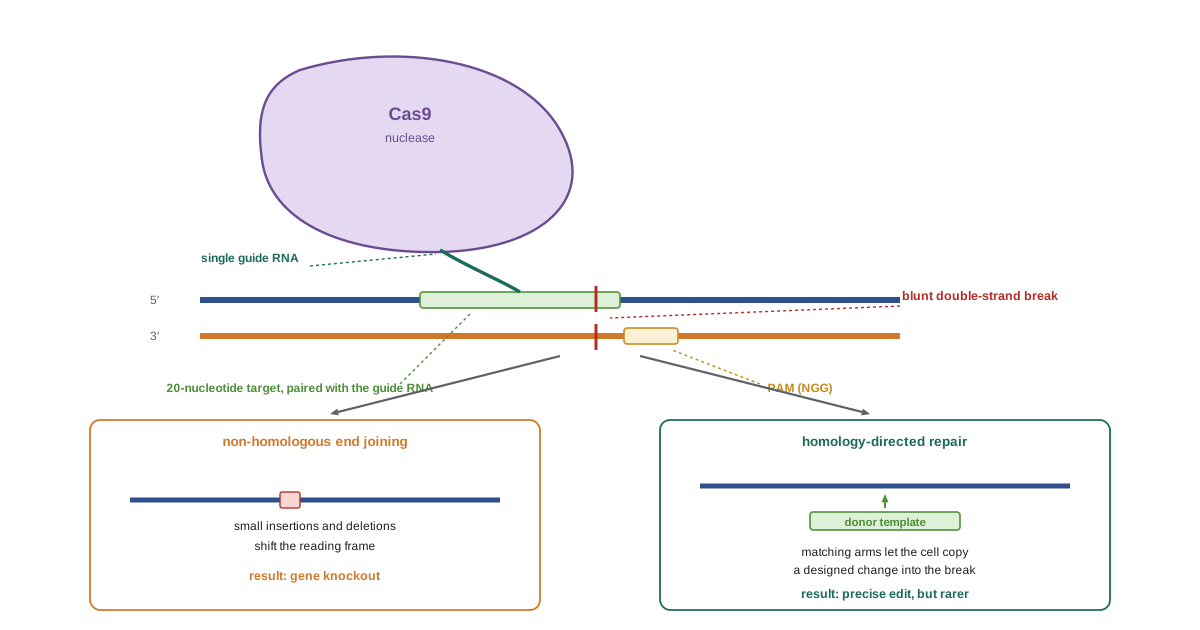
Cas9 carries a 20-nucleotide guide sequence that base-pairs with one strand of the target DNA. Pairing alone is not enough: next to the target, Cas9 also requires a short protospacer adjacent motif, or PAM. For S. pyogenes Cas9 the PAM is 5′-NGG-3′, where N is any base, lying immediately 3′ of the 20-base target on the non-paired strand. The PAM requirement is what stops the bacterium cutting its own CRISPR array, and it constrains where editors can cut: a site must have a suitable PAM nearby. Other Cas proteins have different PAMs, which widens the available sites; Cas12a, for example, uses a T-rich PAM and leaves staggered rather than blunt cuts.
When guide and PAM both match, Cas9 cuts both strands, making a double-strand break. The break is the whole point: Cas9 does not edit anything itself. Everything that follows is done by the cell's repair pathways.
Repair decides the outcome
Cells mend double-strand breaks in two main ways. Non-homologous end joining simply pushes the ends back together, often adding or losing a few base pairs. Inside a protein-coding sequence, an insertion or deletion that is not a multiple of three shifts the reading frame, usually producing a premature stop codon and a non-functional protein. This is the easiest kind of edit and the standard way to knock a gene out. Homology-directed repair instead copies a template with sequence matching both sides of the break. If researchers supply a donor DNA carrying a desired change flanked by matching arms, the cell can install it precisely. Homology-directed repair is far less frequent than end joining in most cells, and works mainly in dividing cells, so precise edits are harder to achieve than knockouts.
Editing is therefore a population process: a treated culture contains unedited cells, cells with various small insertions and deletions, and, if a donor was supplied, some with the intended change. Editing efficiency is measured by sequencing the target region in many molecules and counting outcomes, and single cells are then isolated and screened to find the ones with the wanted genotype on both chromosome copies.
# Classify sequencing reads at a target site and compute editing efficiency and frameshift rate.
reads = {"unedited": 418, "+1 bp": 162, "-1 bp": 149, "-3 bp": 44, "-9 bp": 11, "+2 bp": 71, "donor (precise)": 45}
total = sum(reads.values())
edited = total - reads["unedited"]
frameshift = sum(n for k, n in reads.items() if k[0] in "+-" and int(k.split()[0]) % 3 != 0)
for k, n in reads.items():
    print(f"{k:18s} {n:4d}   {n / total * 100:5.1f} of 100 reads")
print(f"total reads {total}")
print(f"editing efficiency: {edited / total:.3f}")
print(f"frameshift (likely knockout) fraction: {frameshift / total:.3f}")
print(f"precise donor edits: {reads['donor (precise)'] / total:.3f}")unedited 418 46.4 of 100 reads +1 bp 162 18.0 of 100 reads -1 bp 149 16.6 of 100 reads -3 bp 44 4.9 of 100 reads -9 bp 11 1.2 of 100 reads +2 bp 71 7.9 of 100 reads donor (precise) 45 5.0 of 100 reads total reads 900 editing efficiency: 0.536 frameshift (likely knockout) fraction: 0.424 precise donor edits: 0.050
The numbers are typical of a good experiment in cultured cells: most reads are edited, most edits are small frameshifting insertions and deletions, and precise donor-driven edits are a minority. Note that an in-frame deletion such as the 3 or 9 base pair ones may leave a partly working protein, so knockouts are confirmed by checking the protein, not just the DNA.
Delivering the editor
The editing machinery has to get inside cells. In the laboratory, plasmids encoding Cas9 and the guide, RNA encoding them, or preassembled Cas9 protein with guide RNA, called a ribonucleoprotein, are introduced by transfection or electroporation. Delivering the protein and RNA directly has advantages: editing starts immediately, nothing integrates into the genome, and the components disappear within a day or two, which reduces off-target cutting. In plants, editing machinery is delivered by Agrobacterium or particle bombardment and can later be bred out, leaving only the edit. For therapies, delivery is the central problem: lipid nanoparticles work well for the liver, AAV vectors reach some tissues, and cells can be edited outside the body and returned.
Specificity and off-target effects
A 20-base guide will occasionally tolerate mismatches, especially at the end farthest from the PAM, so Cas9 can cut similar sequences elsewhere, producing off-target edits. Risk is reduced by choosing guides with few close matches in the genome, using engineered high-fidelity Cas9 variants, delivering the editor briefly as a ribonucleoprotein, and using paired nickases, two Cas9 molecules each cutting one strand, so a break requires both to bind. Off-target sites are searched for by sequencing predicted sites, or without prediction by methods that capture break sites genome-wide. Large unintended changes also occur at the intended site, including long deletions and loss of a whole chromosome arm, so therapeutic programs examine structure as well as sequence.
Editing without cutting
Several newer tools avoid double-strand breaks. A catalytically dead Cas9, which binds but does not cut, can be fused to other proteins to make tools that do not change the sequence at all: fused to a repressor it silences a gene (CRISPR interference), fused to an activator it switches one on (CRISPR activation), and fused to enzymes that add or remove methyl groups it changes epigenetic marks. Base editors fuse a Cas9 nickase to a deaminase that chemically converts one base to another within a small window, changing C to T or A to G without a break. Prime editors fuse a nickase to a reverse transcriptase and use an extended guide that carries the new sequence, which the enzyme writes into the nicked strand; prime editing can make small insertions, deletions and all base changes.
| Tool | What it does | Typical use |
|---|---|---|
| Cas9 nuclease | Cuts both strands; repair gives indels or, with a donor, precise edits | Gene knockouts, knock-ins |
| Cas12a | Cuts with a T-rich PAM, leaving staggered ends | Targets where no NGG PAM is available; diagnostics |
| Dead Cas9 fusions | Binds without cutting; represses, activates or marks genes | Screens, gene regulation studies |
| Base editors | Converts C to T or A to G without a double-strand break | Correcting point mutations |
| Prime editors | Writes a new sequence from an extended guide | Small precise insertions, deletions and substitutions |
Applications
In research, CRISPR made genome-wide screens routine: libraries of guides targeting every gene are introduced into a cell population, cells are selected for a trait, and sequencing of the guides reveals which genes matter. In agriculture, editing has produced crops with traits such as improved disease resistance or oil composition, and because no foreign DNA need remain, several countries treat such plants differently from transgenic ones (lessons 9 and 12). In industry, editing speeds strain improvement, as in Northfield's protease deletions.
In medicine, the first approvals arrived in late 2023. Exagamglogene autotemcel, sold as Casgevy, treats sickle cell disease and transfusion-dependent beta thalassemia by editing a patient's own blood stem cells outside the body to switch on fetal hemoglobin, which compensates for the faulty adult form. It was authorized in the United Kingdom and the United States in late 2023, and Health Canada authorized it in September 2024. Trials are under way for other blood disorders, inherited blindness, hereditary amyloidosis treated with an in vivo lipid nanoparticle editor, and engineered cell therapies. Costs are very high, and access is a central concern.
Worked problem
Choosing a guide
Lena needs to knock out a yeast protease gene. Her software offers three guides in the first third of the coding sequence. Guide A: perfect NGG PAM, no genomic site with fewer than four mismatches, cuts 40 base pairs after the start codon. Guide B: NAG PAM, two sites with two mismatches. Guide C: perfect NGG PAM, no close matches, cuts 30 base pairs before the stop codon. Which should she use?
Show solution
- Guide B uses a non-canonical PAM, which lowers activity, and has close off-target matches: reject it.
- Guide C cuts near the end of the gene, where a frameshift may leave a nearly complete, possibly active protein: poor choice for a knockout.
- Guide A has a canonical PAM, good specificity and cuts early, so a frameshift destroys most of the protein.
- She will still confirm the edit by sequencing and check that protease activity is lost.
Answer: Guide A, then confirm by sequencing and by an activity assay.
Human germline editing
Editing somatic cells affects only the patient. Editing an embryo, egg or sperm, the germline, would change every cell of the resulting person and be inherited by their descendants. In November 2018 a Chinese researcher, He Jiankui, announced that he had edited embryos intending to disable the CCR5 gene and reduce HIV risk, and that twin girls had been born. The work was condemned worldwide as medically unjustified, poorly consented and scientifically reckless; he was convicted of practising medicine illegally and imprisoned. International bodies concluded that heritable human genome editing should not proceed without broad societal agreement and far better evidence of safety, and many countries prohibit it outright. In Canada, the Assisted Human Reproduction Act makes altering the genome of a cell or embryo in a way that could be transmitted to descendants a criminal offence. Lesson 12 returns to the ethics.
Common mistakes
MistakeThinking Cas9 itself edits the sequence.
InsteadCas9 only cuts; the cell's repair pathways produce the edit.
MistakeForgetting the PAM when designing a guide.
InsteadWithout a suitable PAM next to the target, Cas9 will not cut.
MistakeExpecting precise edits as easily as knockouts.
InsteadHomology-directed repair is much less frequent than end joining in most cells.
MistakeAssuming any insertion or deletion knocks out a gene.
InsteadIn-frame changes may leave a working protein; confirm loss of function.
MistakeTreating off-target risk as solved.
InsteadGuides can tolerate mismatches; specificity must be designed and tested.
Summary and key terms
- CRISPR systems are bacterial adaptive immunity; Cas9 with a single guide RNA cuts DNA matching the guide next to a PAM.
- S. pyogenes Cas9 requires an NGG PAM; other Cas proteins recognize other PAMs.
- End joining produces small insertions and deletions, giving knockouts; homology-directed repair with a donor gives precise edits but is rarer.
- Editors are delivered as plasmids, RNA or ribonucleoproteins; ribonucleoproteins reduce off-target activity.
- Specificity is managed by guide choice, high-fidelity variants, paired nickases and genome-wide off-target testing.
- Dead Cas9 fusions, base editors and prime editors change genes without double-strand breaks.
- The first CRISPR therapy, for sickle cell disease and beta thalassemia, was approved in late 2023; heritable germline editing is widely prohibited.
- CRISPR
- Clustered regularly interspaced short palindromic repeats, the basis of a bacterial adaptive immune system.
- Cas9
- An RNA-guided nuclease that cuts double-stranded DNA at a matching site.
- single guide RNA
- An engineered RNA combining the targeting and scaffold functions needed by Cas9.
- PAM
- A short motif next to the target that the Cas protein must recognize in order to cut.
- non-homologous end joining
- Repair that rejoins broken DNA ends, often adding or deleting a few bases.
- homology-directed repair
- Repair that copies a template with matching flanking sequence, allowing precise edits.
- indel
- A small insertion or deletion.
- off-target edit
- An edit at an unintended site that partially matches the guide.
- base editor
- A fusion that chemically converts one base to another without cutting both strands.
- prime editor
- A fusion that writes new sequence from an extended guide RNA.
Practice problems
Work each problem on paper first, then reveal the answer to check.
What two things must match for Cas9 to cut?
Show answer
The 20-base guide sequence and an adjacent PAM.
Why does end joining often knock out a gene?
Show answer
Indels that are not multiples of three shift the reading frame and create premature stop codons.
Why is a ribonucleoprotein delivery favoured for reducing off-target edits?
Show answer
The editor acts briefly and then disappears, and nothing integrates.
Name one way to improve guide specificity.
Show answer
Choose guides with few close matches, use high-fidelity Cas9, or use paired nickases.
What does a dead Cas9 fused to a repressor do?
Show answer
Silences the target gene without changing its sequence.
What does Casgevy do?
Show answer
Edits a patient's blood stem cells to switch on fetal hemoglobin, treating sickle cell disease and beta thalassemia.
Why is germline editing treated differently from somatic editing?
Show answer
Changes would be inherited by descendants who cannot consent.
Lesson quiz · 5 questions
Score 60% or more to complete this lesson.
Create a free account to save your progress, take quizzes and earn a certificate.