
BIOL-470 · Lesson 5 of 12 · 22 min
Protein production: expression systems and recombinant proteins
▶ Video coming soon A video version of this lesson is on the way.
Most biotechnology products are proteins or are made by proteins: hormones, antibodies, vaccines, enzymes for food and industry, and the enzymes used in molecular biology itself. A recombinant protein is one made from a gene introduced into a host cell, and the choice of host, the expression system, decides how much protein is made, whether it folds correctly, what modifications it carries and what it costs. This lesson compares the main hosts, explains the protein features that drive the choice, and works through the arithmetic of yield.
Northfield uses two hosts for its two main products. The phytase feed enzyme is secreted by the methylotrophic yeast Komagataella phaffii, which grows to very high density and exports the enzyme into the broth. The biosimilar antibody is made in Chinese hamster ovary cells, because antibodies need the folding, assembly and sugar chains that only animal cells provide reliably. Lena's question in her second month is simple to ask and hard to answer: why not make everything in E. coli, which is faster and cheaper?
What a protein needs to work
A gene encodes only a chain of amino acids. To work, many proteins must fold into a precise shape, form disulfide bonds between cysteines, assemble with other chains, and carry post-translational modifications. The most important modification for therapeutic proteins is glycosylation, the attachment of branched sugar chains, or glycans. N-linked glycans attach to asparagine in the motif asparagine, any amino acid except proline, then serine or threonine; O-linked glycans attach to serine or threonine. Glycans affect folding, stability, solubility, how long a protein survives in the bloodstream and how it interacts with the immune system. The glycans on an antibody's constant region, for example, tune how strongly it triggers immune cells to kill its target.
Cells differ in which of these steps they can do. Bacteria have no endoplasmic reticulum or Golgi apparatus, so they do not glycosylate proteins in the human way and form disulfide bonds poorly in the cytoplasm. Yeasts glycosylate, but with many mannose residues rather than the complex, branched glycans of human cells. Insect cells make simpler, shorter glycans. Mammalian cells make glycans closest to human ones, though not identical: CHO cells, for instance, can add a few sugar forms that human cells make little of, which developers monitor.
E. coli: fast, cheap and simple
E. coli remains the most used host for research proteins and an important one for therapeutics that need no glycosylation, such as insulin, human growth hormone, some interferons and many antibody fragments. It grows in inexpensive media, doubles in about 20 to 30 minutes, reaches high cell densities, and is genetically well understood. The most popular system places the gene behind a promoter from bacteriophage T7 in a host strain such as BL21(DE3), which carries the T7 RNA polymerase gene under a lac-controlled promoter. Adding IPTG, a molecule that mimics lactose but is not consumed, switches on T7 polymerase, which then transcribes the target gene so strongly that the protein can reach a large share of all cell protein.
Strong expression has costs. Protein made very fast often misfolds and aggregates into dense particles called inclusion bodies. Inclusion bodies are easy to collect by centrifugation and are relatively pure, but the protein must then be dissolved in strong denaturants such as urea or guanidine and refolded, often with low and unpredictable recovery. Producers fight aggregation by lowering the growth temperature after induction, using weaker promoters, co-expressing chaperones, fusing the target to a soluble partner, or exporting it to the periplasm, the space between the two membranes, where disulfide bonds can form. E. coli products made for injection must also be cleared of endotoxin, the lipopolysaccharide of the outer membrane, which causes fever and shock even in tiny amounts.
Yeasts and fungi
Yeasts combine microbial speed and cost with eukaryotic machinery for secretion, folding and disulfide bonds. Saccharomyces cerevisiae, baker's yeast, made the first recombinant vaccine, against hepatitis B, approved in the 1980s, and still makes insulin and other products. K. phaffii is often preferred for secreted proteins because it secretes few of its own proteins, simplifying purification, and grows to more than 100 grams of dry cells per litre in fed-batch culture. Its AOX1 promoter is tightly off on glucose or glycerol and strongly on with methanol, so cells can be grown to high density first and then induced. Because methanol is flammable and toxic, newer processes also use methanol-free promoters.
The main drawback of yeast for human therapeutics is high-mannose glycosylation, which can shorten a protein's life in the blood and may provoke immune responses. Strains with their glycosylation pathways re-engineered to make human-like glycans have been built. For industrial enzymes such as phytase, amylases and proteases, glycosylation rarely matters, and yeasts and filamentous fungi dominate. Fungi such as Aspergillus niger and Trichoderma reesei secrete enormous amounts of protein, in some industrial processes tens of grams per litre, and make most of the world's bulk enzymes, including the cellulases used to break down plant biomass (lesson 10).
Insect, mammalian and other hosts
Insect cells infected with an engineered baculovirus express proteins with most eukaryotic modifications and are used for several vaccines, including virus-like particle vaccines against human papillomavirus and a recombinant influenza vaccine. Mammalian cells are the hosts for most therapeutic proteins by value. CHO cells, first isolated in 1957, dominate because they grow in suspension in chemically defined media without serum, tolerate genetic manipulation, make human-compatible glycans and have a long safety record with regulators. Human embryonic kidney (HEK293) cells are used for some proteins and for making viral vectors for gene therapy. Over decades, improvements in media, feeding strategies and cell line selection have raised antibody titres from tens of milligrams per litre in the 1980s to several grams per litre today.
Some producers use whole organisms. Plants can be engineered to make proteins in leaves or seeds, an approach called molecular farming. A Quebec company, Medicago, made a COVID-19 vaccine in a relative of tobacco, Nicotiana benthamiana; Health Canada authorized it in February 2022, but the company was closed by its owner in 2023 and the vaccine was never widely used. Transgenic goats, rabbits and chickens have been engineered to secrete therapeutic proteins in milk or eggs. Cell-free systems, extracts containing the machinery for transcription and translation, make proteins in a test tube within hours and are used for rapid prototyping and for proteins toxic to living cells.
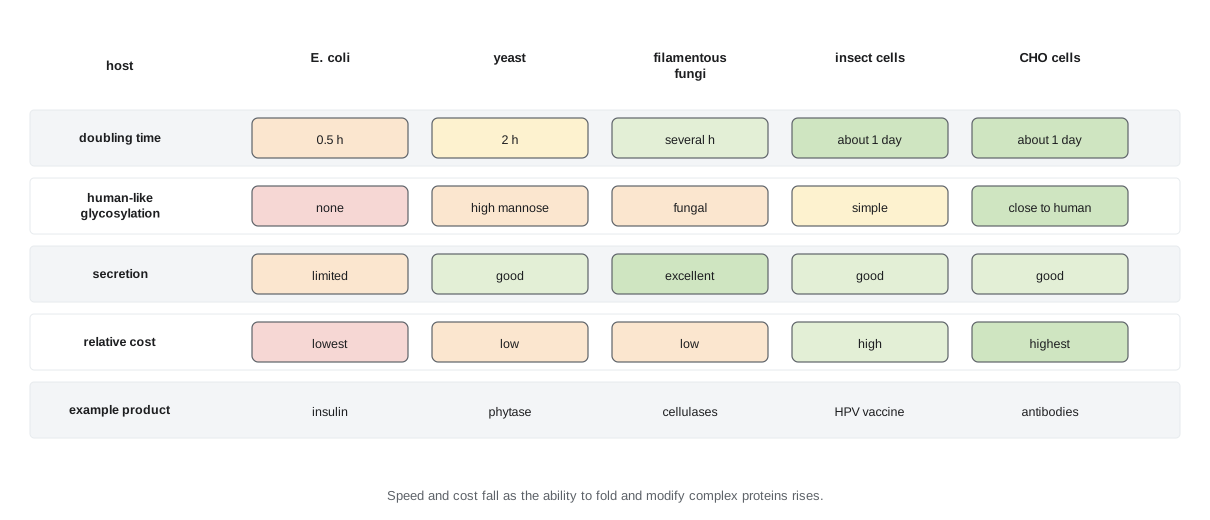
| Host | Strengths | Weaknesses | Typical products |
|---|---|---|---|
| E. coli | Fast, cheap, high yield, simple genetics | No human glycosylation, inclusion bodies, endotoxin | Insulin, growth hormone, antibody fragments, research enzymes |
| Yeasts (S. cerevisiae, K. phaffii) | Secretion, high density, eukaryotic folding | High-mannose glycans | Hepatitis B vaccine, insulin, feed and food enzymes |
| Filamentous fungi | Very high secretion of enzymes | Proteases, fungal glycans, slower genetics | Cellulases, amylases, food enzymes |
| Insect cells and baculovirus | Most eukaryotic modifications, flexible | Simpler glycans, virus removal | Virus-like particle and influenza vaccines |
| Mammalian cells (CHO, HEK293) | Human-compatible folding and glycosylation | Slow, expensive, sensitive to conditions | Monoclonal antibodies, clotting factors, viral vectors |
Designing for expression
Whatever the host, the construct shapes the result. Codon optimization (lesson 2) matches the gene to the host's preferred codons. A secretion signal, a short stretch of hydrophobic amino acids at the start of the protein, directs it into the secretory pathway; in yeast the alpha-mating factor signal from S. cerevisiae is commonly used. Purification tags make the protein easy to capture: a run of six histidines, the His-tag, binds tightly to nickel or cobalt ions held on a resin, so the tagged protein can be pulled out of a crude extract in one step and released with imidazole. A protease site between tag and protein allows the tag to be removed. Commercial therapeutics usually avoid tags altogether, because any extra sequence must be justified to regulators.
Expression level also depends on gene dose and integration site. In yeast and CHO cells, the expression cassette integrates into the chromosome, and cells with several copies or with integration into an actively transcribed region produce more. Producers therefore screen hundreds to thousands of clones and pick the best. For a therapeutic, the final cell line must be derived from a single cell, a requirement called clonality, so that the population is uniform and its behaviour reproducible over the life of the product.
The arithmetic of yield
Yield is described by the titre, the concentration of product in the culture, in grams per litre. Titre times working volume gives the mass of product made in a batch. Purification recovers only part of it, so the mass of purified product is lower:
where \(R\) is the fractional recovery through purification. For mammalian cultures, the rate at which cells make product is described by the specific productivity \(q_p\), usually in picograms per cell per day. The titre at the end of a run is approximately \(q_p\) times the integral of viable cell density over time, the cell-days the culture accumulated:
Worked problem
From titre to doses
Northfield's antibody process runs in a 2,000 litre single-use bioreactor and reaches a titre of 4.5 grams per litre. Purification recovers 0.72 of the antibody. Each patient dose contains 400 mg. How many doses does one batch provide?
Show solution
- Antibody made: 4.5 g/L × 2,000 L = 9,000 g.
- Purified antibody: 9,000 g × 0.72 = 6,480 g.
- Doses: 6,480 g / 0.400 g = 16,200 doses.
Answer: About 16,200 doses from one 2,000 litre batch.
# Specific productivity: estimate final titre from viable cell density measured each day.
days = list(range(0, 15))
Xv = [0.4, 0.8, 1.6, 3.1, 5.8, 9.5, 13.0, 15.5, 16.8, 17.0, 16.5, 15.6, 14.2, 12.4, 10.1]   # million viable cells per mL
ivcd = sum((Xv[i] + Xv[i + 1]) / 2 for i in range(len(Xv) - 1))   # trapezoid rule, million cell-days per mL
qp = 30   # picograms of antibody per cell per day
titre_g_per_L = ivcd * 1e6 * qp * 1e-12 * 1000   # cells/mL -> g/mL -> g/L
print(f"integral of viable cell density: {ivcd:.1f} million cell-days per mL")
print(f"estimated titre at qp = {qp} pg/cell/day: {titre_g_per_L:.2f} g/L")integral of viable cell density: 147.1 million cell-days per mL estimated titre at qp = 30 pg/cell/day: 4.41 g/L
The estimate shows why process scientists care about both numbers. A culture can raise its titre by keeping more cells alive for longer, which increases the cell-day integral, or by making each cell more productive, which raises \(q_p\). Feeding strategies, temperature shifts and media design (lesson 6) target both.
Lena's answer
By the end of the month Lena can answer her own question. Phytase needs no human glycosylation and must be cheap, so a microbe is right, and K. phaffii secretes it cleanly at high density. The antibody needs four chains assembled with sixteen disulfide bonds and specific glycans on its constant region; E. coli cannot make a full-length, glycosylated antibody that behaves like the reference product, so the company accepts the slower, costlier CHO process. For each product, the host is chosen to give the right molecule at an acceptable cost, not the most molecules at the lowest cost.
Common mistakes
MistakeAssuming more expression is always better.
InsteadVery fast expression in E. coli often produces misfolded protein in inclusion bodies.
MistakeThinking yeast glycosylation matches human glycosylation.
InsteadNatural yeasts add many mannose residues; human-like glycans require engineered strains.
MistakeCalculating product mass from titre without recovery.
InsteadPurification loses product, so multiply by the fractional recovery.
MistakeTreating all CHO clones as equivalent.
InsteadIntegration site and copy number vary; clones are screened and the production line is derived from a single cell.
MistakeLeaving a His-tag on a therapeutic by default.
InsteadExtra sequences must be justified; tags are usually avoided or removed in therapeutics.
Summary and key terms
- Proteins may need folding, disulfide bonds, assembly and glycosylation to work; hosts differ in which they provide.
- E. coli is fast and cheap but lacks human glycosylation and can form inclusion bodies; products need endotoxin removal.
- Yeasts and fungi secrete proteins at high density; K. phaffii uses the methanol-inducible AOX1 promoter.
- Insect cells make several vaccines; CHO cells make most therapeutic antibodies with human-compatible glycans.
- Secretion signals, tags and gene dose shape expression; therapeutic cell lines must be clonal.
- Purified mass = titre × volume × recovery; titre ≈ specific productivity × integral of viable cell density.
- recombinant protein
- A protein made from a gene introduced into a host cell.
- expression system
- The combination of host cell and vector used to make a protein.
- glycosylation
- The attachment of sugar chains to a protein.
- inclusion body
- A dense aggregate of misfolded protein inside a bacterial cell.
- endotoxin
- Lipopolysaccharide from the outer membrane of gram-negative bacteria, which causes fever.
- IPTG
- A lactose analogue used to induce genes under lac control.
- signal peptide
- A short sequence at the start of a protein that directs it into the secretory pathway.
- His-tag
- A run of histidines that binds metal ions, used to purify tagged proteins.
- titre
- The concentration of product in a culture, usually in grams per litre.
- specific productivity
- The amount of product made per cell per unit time.
Practice problems
Work each problem on paper first, then reveal the answer to check.
Why can E. coli not make a fully functional glycosylated antibody?
Show answer
It lacks the endoplasmic reticulum and Golgi machinery for human-type glycosylation and efficient disulfide bond formation.
What is the advantage of the AOX1 promoter?
Show answer
It is off during growth on glycerol or glucose and strongly induced by methanol, so cells grow first and then produce.
Give two ways to reduce inclusion body formation.
Show answer
Lower temperature after induction, weaker promoters, chaperones, fusion partners or periplasmic export.
A 500 L culture has a titre of 2.0 g/L and 0.80 recovery. How much purified product?
Show answer
2.0 × 500 × 0.80 = 800 g.
Why must a therapeutic cell line be clonal?
Show answer
A population from one cell is uniform and behaves reproducibly.
Which host makes most bulk industrial enzymes?
Show answer
Filamentous fungi such as Aspergillus and Trichoderma, along with some bacteria and yeasts.
How does a His-tag help purification?
Show answer
It binds nickel or cobalt on a resin, capturing the protein from a crude extract.
Lesson quiz · 5 questions
Score 60% or more to complete this lesson.
Create a free account to save your progress, take quizzes and earn a certificate.