
BIOL-470 · Lesson 6 of 12 · 23 min
Bioprocessing: fermentation, scale-up and purification
▶ Video coming soon A video version of this lesson is on the way.
A gene in a vial is not a product. Bioprocessing is the engineering that turns a few engineered cells into tonnes of enzyme or kilograms of antibody, reliably, safely and at a cost people will pay. It has two halves. Upstream processing grows cells and makes the product; downstream processing separates the product from everything else and puts it into its final form. This lesson follows both halves through Northfield's plant, introduces the kinetics and mass transfer that govern growth in large vessels, and explains why moving from a flask to a production tank is one of the hardest steps in biotechnology.
Samuel puts it to Lena on her first day in process development: a shake flask holding 100 millilitres and a production fermenter holding 20,000 litres contain the same cells and the same medium, but they are different worlds. In the flask, oxygen diffuses in easily, heat escapes through the walls and everything is mixed in seconds. In the tank, oxygen must be forced in, heat must be pulled out with cooling water, and a drop of feed added at the top can take tens of seconds to mix through the vessel.
Media and sterility
Cells need a carbon and energy source, usually glucose, glycerol or, for some yeasts, methanol; a nitrogen source such as ammonium salts or amino acids; phosphate, sulfate and trace metals; and, for mammalian cells, vitamins, growth factors and lipids. Microbial media can be cheap and complex, using ingredients such as corn steep liquor or yeast extract. Mammalian media for therapeutics are now chemically defined and free of animal-derived components, to avoid variation between lots and the risk of introducing viruses or prions.
Everything that enters the vessel must be sterile, because a contaminating microbe that grows faster than the production strain can ruin a batch in hours. Stainless steel vessels are sterilized in place with steam at about 121 °C, media are heat-sterilized or, if heat-sensitive, filtered through membranes with pores about 0.2 micrometres wide, and air is filtered on the way in. Single-use bioreactors, plastic bags supplied pre-sterilized by gamma irradiation, avoid cleaning and steaming altogether; they now dominate mammalian cell culture up to about 2,000 litres.
Growth kinetics
Lesson 1 introduced exponential growth at a constant specific growth rate \(\mu\). In reality \(\mu\) depends on the concentration of the limiting nutrient, \(S\). Jacques Monod described the relationship in the 1940s:
Here \(\mu_{\max}\) is the maximum growth rate and \(K_s\) is the substrate concentration at which growth runs at half that maximum. When \(S\) is much larger than \(K_s\), cells grow near \(\mu_{\max}\); when it falls toward \(K_s\), growth slows. Each gram of substrate consumed makes a roughly fixed mass of cells, the biomass yield \(Y_{X/S}\), around 0.5 grams of cells per gram of glucose for many aerobic microbes. These two ideas, Monod kinetics and the yield coefficient, are enough to predict a surprising amount about a process.
Batch, fed-batch and continuous
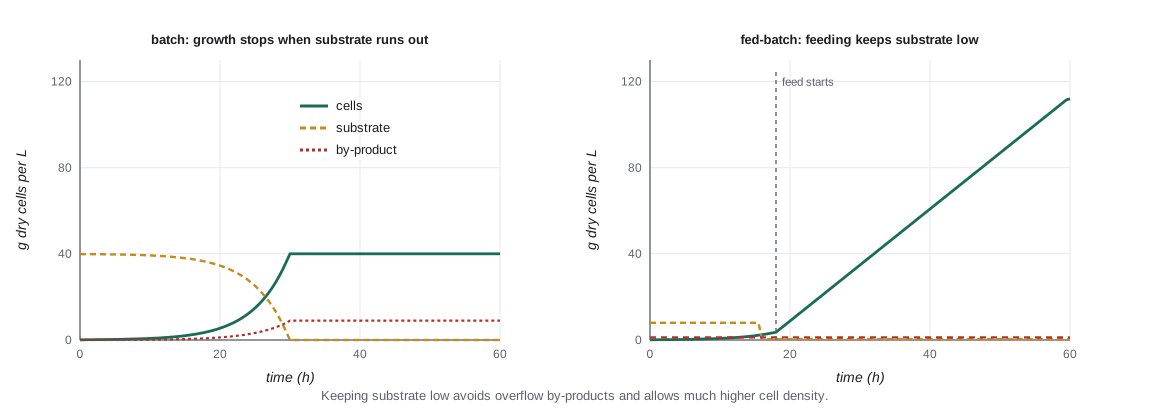
In batch culture, all nutrients are added at the start; cells grow until something runs out, and the run ends. Batch is simple, but high starting sugar can inhibit growth or drive overflow metabolism, in which yeasts make ethanol and E. coli makes acetate even when oxygen is available, wasting carbon and poisoning the culture. Fed-batch culture starts with a modest amount of substrate and then feeds more at a controlled rate, keeping \(S\) low and growth steady. Almost all high-density microbial processes and most antibody processes are fed-batch. Northfield's phytase process grows the yeast on glycerol in batch, then on a glycerol feed, then switches to a methanol feed to induce the AOX1 promoter for about four days.
In continuous culture, fresh medium flows in and culture flows out at the same rate, keeping the volume constant. In a chemostat, the dilution rate \(D\), the flow rate divided by the volume, sets the growth rate at steady state: cells must grow at \(\mu = D\) to replace those washed out. If \(D\) exceeds \(\mu_{\max}\), the cells cannot keep up and wash out. Continuous culture gives steady conditions ideal for research, but most industrial processes avoid it because of the risk of contamination and of genetic drift over long runs. Perfusion culture, in which cells are retained by a filter while medium is exchanged, is used for some mammalian products and is growing in use.
# Simulate batch growth with Monod kinetics (simple Euler steps).
mu_max, Ks, Y = 0.20, 0.05, 0.5        # per hour, g/L, g cells per g glycerol
X, S, dt = 0.1, 40.0, 0.05             # starting cells g/L, glycerol g/L, time step h
t = 0.0
report = {10, 20, 30, 35, 40}
while t < 40.0001:
    if round(t, 2) in report:
        print(f"t = {t:4.0f} h   cells {X:6.2f} g/L   glycerol {S:6.2f} g/L")
    mu = mu_max * S / (Ks + S)
    dX = mu * X * dt
    X += dX
    S = max(S - dX / Y, 0.0)
    t = round(t + dt, 2)
print("maximum cells possible from 40 g/L glycerol:", 0.1 + 40 * Y, "g/L")t = 10 h cells 0.73 g/L glycerol 38.74 g/L t = 20 h cells 5.32 g/L glycerol 29.55 g/L t = 30 h cells 20.18 g/L glycerol 0.00 g/L t = 35 h cells 20.18 g/L glycerol 0.00 g/L t = 40 h cells 20.18 g/L glycerol 0.00 g/L maximum cells possible from 40 g/L glycerol: 20.1 g/L
The simulation shows the classic batch shape. Growth is exponential while glycerol is plentiful, then stops abruptly when it is exhausted, at a cell density fixed by the yield coefficient. To go further, a process must feed more substrate, which is exactly what fed-batch does.
Oxygen and mixing
Aerobic microbes at high density consume oxygen faster than almost anything else limits them. Oxygen dissolves poorly in water, only about 7 to 8 milligrams per litre at 30 °C in equilibrium with air, so it must be supplied continuously by sparging air or oxygen through the broth and breaking bubbles up with impellers. The rate at which oxygen moves from bubbles into liquid is the oxygen transfer rate:
where \(k_L a\) is the volumetric mass transfer coefficient, \(C^{*}\) the dissolved oxygen concentration in equilibrium with the gas and \(C_L\) the actual concentration. Cells consume oxygen at the oxygen uptake rate, OUR, which equals the specific uptake rate per gram of cells times the cell concentration. When OUR exceeds the maximum OTR the vessel can deliver, cells become oxygen limited. Engineers raise \(k_L a\) with faster stirring, more gas flow, better impellers, higher pressure or pure oxygen, all of which cost energy. Metabolism also releases heat, and at high density cooling capacity can limit a process as much as oxygen.
Worked problem
Is the fermenter big enough?
During methanol induction, Samuel's yeast culture reaches 120 grams of dry cells per litre with a specific oxygen uptake rate of 2.5 millimoles of oxygen per gram of cells per hour. The fermenter can deliver a maximum OTR of 350 millimoles per litre per hour. Is oxygen limiting?
Show solution
- OUR = 2.5 mmol per g per h × 120 g/L = 300 mmol per L per h.
- The maximum OTR is 350 mmol per L per h, which exceeds the demand.
- The margin is 50 mmol per L per h, or about one-seventh of capacity.
- If cell density rose to 140 g/L, OUR would reach 350, at the limit; the feed rate must be controlled to stay below it.
Answer: Not yet: demand is 300 against a capacity of 350 mmol per L per h, so the feed must be capped as density rises.
Scale-up
Scaling up means keeping the cells' environment the same while the vessel grows by factors of ten at each step, typically from a 1 to 5 litre bench vessel to a 50 to 200 litre pilot vessel to production at thousands of litres. The difficulty is that physical properties scale differently. Volume grows with the cube of vessel diameter, but wall area, through which heat is removed, grows only with the square, so large vessels are harder to cool. Mixing time grows, so large tanks develop gradients: cells circulating past the feed point see bursts of high sugar, then starvation near the bottom. No single rule keeps everything constant. Engineers choose a criterion, such as equal power input per volume, equal \(k_L a\), equal impeller tip speed (important for shear-sensitive mammalian cells) or equal mixing time, and accept that other properties will change.
Because of this, processes are developed with scale-down models, small vessels deliberately operated to mimic the gradients and limits of the production tank, so surprises appear on the bench rather than in a 20,000 litre batch. Process analytical technology, online measurement of variables such as dissolved oxygen, pH, off-gas composition and even product concentration, lets the process be controlled in real time.
Downstream processing
Downstream processing often accounts for half or more of manufacturing cost. The steps depend on where the product is and how pure it must be. A secreted enzyme for animal feed needs only to be separated from cells, concentrated, stabilized and dried or formulated as a liquid. A therapeutic antibody must be purified so thoroughly that host cell proteins and host DNA are reduced to trace levels, viruses are removed or inactivated, and the antibody's structure is unchanged.
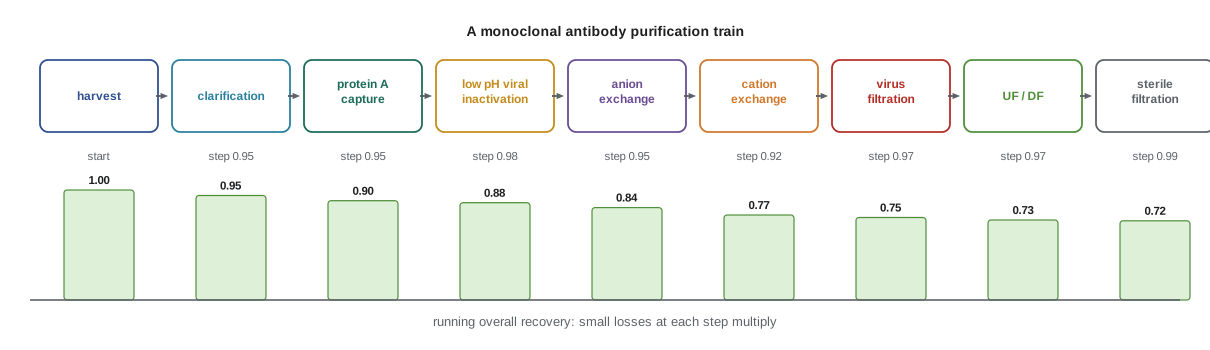
The antibody train shown in the figure is a near-universal platform. Cells and debris are removed by centrifugation and depth filtration. Protein A, a bacterial protein that binds the constant region of antibodies, is attached to a chromatography resin and captures the antibody from the clarified broth, removing most impurities in one step; the antibody is released with an acidic buffer. Holding the eluate at low pH for an hour or so inactivates enveloped viruses. Ion exchange chromatography, which separates molecules by charge, and sometimes hydrophobic interaction chromatography polish away remaining impurities and aggregates. A filter with pores about 20 nanometres wide removes viruses by size. Ultrafiltration and diafiltration concentrate the antibody and move it into the final formulation buffer, and a final sterile filtration precedes filling into vials or syringes.
Each step loses a little product, and the losses multiply. If a process has \(n\) steps with recoveries \(R_1, R_2, \ldots, R_n\), the overall recovery is their product:
steps = [("clarification", 0.95), ("protein A capture", 0.95), ("viral inactivation", 0.98),
         ("anion exchange", 0.95), ("cation exchange", 0.92), ("virus filtration", 0.97),
         ("UF/DF", 0.97), ("sterile filtration", 0.99)]
R = 1.0
for name, r in steps:
    R *= r
    print(f"{name:20s} step {r:.2f}   running overall {R:.3f}")
print(f"overall recovery {R:.2f}: 9.0 kg in the bioreactor gives {9.0 * R:.2f} kg purified")clarification step 0.95 running overall 0.950 protein A capture step 0.95 running overall 0.902 viral inactivation step 0.98 running overall 0.884 anion exchange step 0.95 running overall 0.840 cation exchange step 0.92 running overall 0.773 virus filtration step 0.97 running overall 0.750 UF/DF step 0.97 running overall 0.727 sterile filtration step 0.99 running overall 0.720 overall recovery 0.72: 9.0 kg in the bioreactor gives 6.48 kg purified
Quality by design and good manufacturing practice
Medicines are made under good manufacturing practice, or GMP: rules requiring documented procedures, trained staff, qualified equipment, controlled facilities, validated processes, testing of every batch and records that let any batch be traced. Inspectors from Health Canada audit facilities before approval and periodically afterward. Modern guidelines from the International Council for Harmonisation encourage quality by design: identifying the critical quality attributes of the product, such as purity, potency and glycan profile, linking them to the process parameters that affect them, and defining a range, the design space, within which the process reliably gives acceptable product. Feed enzymes and industrial products are made under less stringent but still documented food and feed safety systems.
Common mistakes
MistakeAssuming a process that works in a flask will work unchanged in a tank.
InsteadOxygen transfer, heat removal and mixing all change with scale.
MistakeRunning a chemostat at a dilution rate above the maximum growth rate.
InsteadCells wash out when D exceeds the maximum growth rate.
MistakeAdding all the sugar at the start to maximize growth.
InsteadHigh sugar can inhibit growth and cause overflow metabolism; fed-batch avoids this.
MistakeAdding step yields to find overall yield.
InsteadRecoveries multiply, so eight steps of 0.95 give about 0.66, not 7.6.
MistakeThinking downstream processing is a minor cost.
InsteadPurification often accounts for half or more of manufacturing cost.
Summary and key terms
- Upstream processing grows cells and makes product; downstream processing purifies and formulates it.
- Monod kinetics: \(\mu = \mu_{\max} S/(K_s + S)\); biomass yield links cells formed to substrate consumed.
- Fed-batch culture keeps substrate low and reaches high density; in a chemostat \(\mu = D\) at steady state.
- Oxygen transfer, \(\text{OTR} = k_L a (C^* - C_L)\), must meet the oxygen uptake rate; heat removal also limits large vessels.
- Scale-up changes mixing, heat and mass transfer; engineers choose criteria and use scale-down models.
- Antibody purification uses protein A capture, viral inactivation, polishing chromatography, virus filtration and UF/DF; overall recovery is the product of step recoveries.
- Medicines are made under GMP with critical quality attributes linked to process parameters.
- upstream processing
- The steps that grow cells and make the product.
- downstream processing
- The steps that recover, purify and formulate the product.
- fed-batch culture
- Culture in which nutrients are fed during the run without removing broth.
- chemostat
- A continuous culture in which the dilution rate sets the growth rate at steady state.
- Monod equation
- A model linking specific growth rate to limiting substrate concentration.
- overflow metabolism
- Production of by-products such as ethanol or acetate when substrate uptake exceeds respiratory capacity.
- kLa
- The volumetric mass transfer coefficient for oxygen from gas to liquid.
- scale-down model
- A small-scale system designed to mimic conditions in a large production vessel.
- protein A chromatography
- Affinity capture of antibodies on resin carrying bacterial protein A.
- good manufacturing practice
- Regulated systems ensuring medicines are made consistently to quality standards.
Practice problems
Work each problem on paper first, then reveal the answer to check.
What is the growth rate in Monod kinetics when S equals Ks?
Show answer
Half of the maximum growth rate.
A chemostat has a 10 L working volume and a feed of 2 L per hour. What is D?
Show answer
0.2 per hour.
Why does fed-batch reduce overflow metabolism?
Show answer
Substrate is kept low, so uptake does not exceed respiratory capacity.
Cells use 3 mmol O2 per g per h at 50 g/L. What is the OUR?
Show answer
150 mmol per L per h.
Why are large fermenters harder to cool than small ones?
Show answer
Volume grows with diameter cubed but wall area only with diameter squared.
Five steps each recover 0.90. What is the overall recovery?
Show answer
0.90 to the power 5 = 0.59.
What does low pH hold after protein A achieve?
Show answer
It inactivates enveloped viruses.
Lesson quiz · 5 questions
Score 60% or more to complete this lesson.
Create a free account to save your progress, take quizzes and earn a certificate.