
BIOL-470 · Lesson 10 of 12 · 23 min
Industrial and environmental biotechnology
▶ Video coming soon A video version of this lesson is on the way.
Industrial biotechnology uses cells and enzymes to make chemicals, materials and fuels, and environmental biotechnology uses them to clean up pollution and treat waste. Together they are sometimes called white and grey biotechnology, and they work under a different economic rule from medicine: products are made by the tonne and sold for a few dollars per kilogram, so the cost of feedstock, energy and equipment decides whether a process survives. This lesson covers industrial enzymes, biofuels, bio-based chemicals and materials, bioremediation and wastewater treatment, and the yield and energy calculations that govern them.
Northfield's phytase is itself an industrial enzyme, and on a visit to a customer's feed mill Lena sees the economics directly: the enzyme costs a fraction of a cent per kilogram of feed and replaces inorganic phosphate that costs several times more, while reducing the phosphorus that runs off fields into waterways.
Industrial enzymes
Enzymes are catalysts: they speed reactions by factors of millions, work at mild temperatures and pressures, and are highly specific, so they produce fewer by-products than chemical catalysts. The industry sells them for detergents, starch processing, baking, brewing, dairy, animal feed, textiles, pulp and paper, leather and biofuels. Detergent proteases and lipases let laundry be washed at lower temperatures, saving energy in millions of households. Amylases and glucoamylases convert starch to glucose syrups; glucose isomerase converts glucose to fructose for high-fructose syrups. Chymosin makes cheese, lactase makes lactose-free milk, and pectinases clarify fruit juice. Phytase releases phosphate bound in plant phytate so that pigs and poultry, which lack the enzyme, can absorb it.
Enzymes are improved by protein engineering. Directed evolution, developed by Frances Arnold and recognized with a share of the 2018 Nobel Prize in Chemistry, mimics natural selection in the laboratory: a gene is mutated at random, the variants are expressed and screened or selected for the desired property, the best are used as parents for the next round, and the cycle repeats. Rational design instead uses structural knowledge to choose specific changes, and computational design, now often aided by machine learning and protein structure prediction, proposes sequences directly. Northfield's three-change thermostable phytase variant came from a design informed by the structures of related enzymes, followed by screening of a small library.
Immobilization fixes an enzyme to a solid support or traps it in a gel. An immobilized enzyme can be used in a packed column, recovered and reused for months, and does not contaminate the product, which greatly reduces cost per kilogram. Glucose isomerase is used this way in long columns through which glucose syrup flows continuously.
Biofuels
Ethanol from fermentation is the largest-volume product of industrial biotechnology. First-generation ethanol uses sugar or starch: sugarcane juice in Brazil, maize starch in the United States, with enzymes converting starch to glucose which yeast then ferments. The theoretical yield follows the Gay-Lussac equation, in which one mole of glucose gives two of ethanol and two of carbon dioxide:
Glucose has a molar mass of 180.16 grams per mole and ethanol 46.07, so the maximum mass yield is 2 × 46.07 / 180.16 = 0.511 grams of ethanol per gram of glucose. Real plants reach about 0.90 to 0.95 of that, because some sugar goes into yeast biomass and by-products.
# Ethanol yield from a tonne of maize, and the energy balance of the fuel.
starch_fraction = 0.62          # kg starch per kg dry maize
conv_to_glucose = 0.95          # fraction of starch converted by enzymes
theoretical = 2 * 46.07 / 180.16   # g ethanol per g glucose
process_eff = 0.92              # fraction of theoretical achieved
hydration = 1.111               # starch to glucose adds water (162 -> 180 g/mol)
mass = 1000.0                   # kg dry maize
glucose = mass * starch_fraction * conv_to_glucose * hydration
ethanol_kg = glucose * theoretical * process_eff
litres = ethanol_kg / 0.789     # density of ethanol, kg per litre
print(f"glucose from 1 tonne dry maize: {glucose:.0f} kg")
print(f"theoretical mass yield: {theoretical:.3f} g ethanol per g glucose")
print(f"ethanol: {ethanol_kg:.0f} kg = {litres:.0f} L per tonne of dry maize")
energy_out = litres * 21.1      # MJ per litre of ethanol
for energy_in in (14.0, 18.0):
print(f"if production uses {energy_in} MJ per litre, energy ratio = {21.1 / energy_in:.2f}")glucose from 1 tonne dry maize: 654 kg theoretical mass yield: 0.511 g ethanol per g glucose ethanol: 308 kg = 390 L per tonne of dry maize if production uses 14.0 MJ per litre, energy ratio = 1.51 if production uses 18.0 MJ per litre, energy ratio = 1.17
The calculation shows both the promise and the problem. A tonne of dry maize yields a few hundred litres of ethanol, but the energy needed to grow, transport and process the grain and to distil the product is a large share of the energy in the fuel, so the net benefit depends heavily on the feedstock and the process. Sugarcane ethanol, which uses bagasse for process heat, has a much better balance than maize ethanol.
Second-generation or cellulosic ethanol uses non-food biomass: straw, corn stover, wood residues and grasses. Cellulose and hemicellulose are locked in a tough matrix with lignin, so the biomass must be pretreated with heat, acid, alkali or steam explosion, then broken down by cocktails of cellulases and hemicellulases, and the resulting mix of glucose and five-carbon sugars such as xylose must be fermented. Baker's yeast does not naturally use xylose, so engineered strains were developed. Despite decades of work, cellulosic ethanol has struggled commercially: pretreatment is expensive, enzymes are costly even after large reductions in price, and plants have been slow to reach capacity. Biodiesel, made chemically or enzymatically from vegetable oils and fats, and renewable diesel, made by hydrotreating, are produced at larger scale, and biogas from anaerobic digestion of manure and food waste is a growing source of energy.
Bio-based chemicals and materials
Fermentation makes many chemicals more cheaply or cleanly than chemical synthesis can. Citric acid, almost all of it made by Aspergillus niger, is produced at a scale of over two million tonnes a year for food and cleaning products. Lactic acid from bacterial fermentation is polymerized into polylactic acid, a compostable plastic used in packaging and 3D printing. 1,3-propanediol made by engineered E. coli from sugar replaced a petrochemical route for a polymer fibre. Succinic acid, amino acids such as lysine and glutamate for feed and food, vitamins, xanthan gum and enzymes themselves are all fermentation products. Polyhydroxyalkanoates are polyesters that bacteria accumulate as storage granules and that can be harvested as biodegradable plastics, though cost has limited their use.
Two measures decide whether such a process is viable. The carbon yield is the mass of product per mass of sugar consumed, compared with the theoretical maximum set by stoichiometry. The productivity is the mass of product made per litre of reactor per hour. A process must usually achieve a high share of theoretical yield, a titre high enough that separation is not ruinous, and a productivity that keeps capital costs reasonable; the industry shorthand is titre, rate and yield.
Feedstocks and the food debate
Every industrial fermentation starts with a carbon source, and that choice shapes both cost and public acceptance. Sugar from cane or beet and glucose from maize or wheat starch are cheap, pure and easy for cells to use, which is why they dominate. They are also food, and diverting them to fuel or plastics raises prices and competes for land, a concern that grew after the food price spikes of 2008. Non-food feedstocks avoid that objection but bring their own problems: agricultural residues are bulky and expensive to collect and transport, and the sugars in them are locked behind lignin. Waste streams such as used cooking oil, whey from cheese making and glycerol from biodiesel production are attractive because a producer may be paid to take them away, but their supply is limited and their composition varies, which complicates process control. Gaseous feedstocks are a newer route: some bacteria grow on carbon monoxide and hydrogen from industrial off-gases, and others fix carbon dioxide directly, though volumetric productivity is limited by how little gas dissolves in water.
The cost arithmetic is unforgiving for bulk products. If a feedstock costs 400 dollars per tonne and a process converts it to product at 0.40 grams per gram, the raw material alone contributes 1,000 dollars per tonne of product before any capital, energy or purification cost. That is why small gains in yield matter so much in white biotechnology, and why processes are often sited next to a cheap, reliable feedstock rather than next to their customers.
Worked problem
Judging a fermentation
A succinic acid process reaches 68 grams per litre in 36 hours and consumes 108 grams of glucose per litre. The theoretical maximum yield for this pathway is 1.12 grams of succinic acid per gram of glucose. How does it compare?
Show solution
- Observed yield: 68 / 108 = 0.630 grams per gram.
- Share of theoretical: 0.630 / 1.12 = 0.56.
- Productivity: 68 / 36 = 1.89 grams per litre per hour.
- A yield of 0.56 of theoretical is modest; raising it would cut raw material cost, the largest expense in a bulk chemical.
Answer: Yield is 0.63 g/g, about 0.56 of theoretical, with a productivity of 1.9 g per litre per hour.
Bioremediation
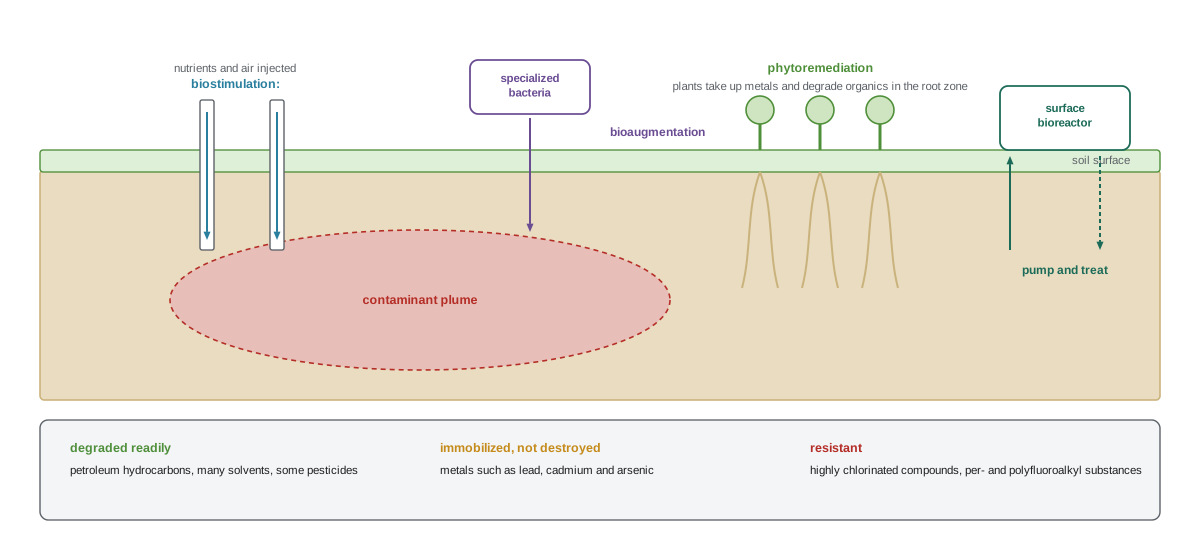
Microbes can degrade many pollutants, because for almost every natural compound some organism has evolved to use it as food. Bioremediation harnesses this. Biostimulation adds nutrients, oxygen or electron acceptors to encourage the microbes already present; after the Exxon Valdez oil spill in 1989, fertilizer applied to oiled shorelines in Alaska accelerated natural degradation. Bioaugmentation adds organisms with the needed capability. Treatment can be in place, or excavated soil can be treated in piles or reactors. Plants are used too: phytoremediation uses plants to take up metals, break down organics or hold contaminated soil in place.
The limits are important. Petroleum hydrocarbons, many solvents and some pesticides are degraded readily under the right conditions. Metals cannot be destroyed, only moved or changed in form, so treatment immobilizes them or concentrates them for disposal. Highly chlorinated compounds and per- and polyfluoroalkyl substances resist breakdown, the latter so strongly that they are called forever chemicals; research into enzymes and microbial consortia that attack them is active but not yet a mature technology. Rates depend on temperature, moisture, pH, oxygen and whether the contaminant is physically accessible, and cleanups take months to years.
Wastewater treatment
The largest biotechnology process on earth, by volume, is municipal wastewater treatment. After screening and settling, the activated sludge process aerates wastewater with a dense mixed community of bacteria and protozoa that consume organic matter; the biomass is then settled out and most of it is returned to the aeration tank to maintain the population. Operators measure the organic load as biochemical oxygen demand, the oxygen microbes consume while degrading the organic matter in a sample over five days at 20 °C. Nitrogen is removed in two biological steps: nitrification, in which bacteria oxidize ammonium to nitrite and then nitrate under aerobic conditions, and denitrification, in which other bacteria reduce nitrate to nitrogen gas under anoxic conditions using organic carbon. Phosphorus is removed biologically by organisms that accumulate it, or chemically. Sludge is often digested anaerobically, producing methane that can run the plant.
Wastewater has also become a source of data. Wastewater-based epidemiology measures pathogens and chemicals in sewage to monitor populations; during the COVID-19 pandemic, measuring SARS-CoV-2 RNA in sewage by quantitative PCR (lesson 3) gave early warning of rising infections, and the approach is used for polio surveillance, influenza and drug use.
Life cycle thinking
A bio-based process is not automatically better for the environment than a petrochemical one. A fair comparison needs life cycle assessment, which accounts for inputs and emissions from land use and fertilizer through processing to disposal. Bio-based products can shift burdens: lower fossil carbon but more land, water or fertilizer use. Biodegradable does not mean it will break down in an ordinary landfill or the ocean; polylactic acid needs industrial composting conditions. Realistic assessment of these trade-offs is part of the engineer's job, and is the reason regulators and customers increasingly ask for life cycle data alongside performance.
Common mistakes
MistakeAssuming a bio-based product is automatically greener.
InsteadLife cycle assessment may show shifted burdens such as land or fertilizer use.
MistakeExpecting more than 0.511 grams of ethanol per gram of glucose.
InsteadStoichiometry sets that maximum; real yields are lower.
MistakeThinking bioremediation can destroy heavy metals.
InsteadMetals can only be immobilized, moved or changed in form.
MistakeAssuming biodegradable plastics break down anywhere.
InsteadMany need industrial composting conditions.
MistakeJudging a fermentation by titre alone.
InsteadTitre, rate and yield together decide whether a process is viable.
Summary and key terms
- Industrial enzymes serve detergents, starch, food, feed, textiles and fuels; immobilization allows reuse.
- Directed evolution, rational and computational design improve enzyme properties.
- Ethanol fermentation has a maximum yield of 0.511 g per g of glucose; energy balance depends on feedstock and process.
- Cellulosic ethanol needs pretreatment, enzyme cocktails and fermentation of five-carbon sugars, and remains costly.
- Bio-based chemicals include citric and lactic acids, amino acids and polymers; viability depends on titre, rate and yield.
- Bioremediation uses biostimulation, bioaugmentation and plants; metals and fluorinated compounds resist treatment.
- Activated sludge, nitrification and denitrification treat wastewater, measured by biochemical oxygen demand; sewage also provides surveillance data.
- Life cycle assessment is needed to compare bio-based and conventional routes.
- industrial enzyme
- An enzyme produced for use in manufacturing or consumer products.
- directed evolution
- Iterative mutation and selection of a protein in the laboratory.
- immobilization
- Attaching or trapping an enzyme on a support so it can be reused.
- first-generation biofuel
- Fuel made from food crops such as sugarcane or maize.
- cellulosic ethanol
- Ethanol made from lignocellulosic biomass after pretreatment and enzymatic hydrolysis.
- product yield
- Mass of product per mass of substrate consumed.
- productivity
- Mass of product per litre of reactor per unit time.
- bioremediation
- Using organisms to degrade or immobilize contaminants.
- activated sludge
- A wastewater process using an aerated, recycled microbial community.
- biochemical oxygen demand
- The oxygen consumed by microbes degrading organic matter in a sample under set conditions.
Practice problems
Work each problem on paper first, then reveal the answer to check.
Why do detergent enzymes save energy?
Show answer
They allow effective washing at lower temperatures.
What are the three steps of one round of directed evolution?
Show answer
Mutate the gene, screen or select the variants, use the best as parents for the next round.
What is the maximum mass yield of ethanol from glucose, and why?
Show answer
0.511 g per g, because two ethanol molecules of 46.07 g/mol come from one glucose of 180.16 g/mol.
Why is pretreatment needed for cellulosic ethanol?
Show answer
Lignin and crystalline cellulose block enzyme access.
What does titre, rate and yield mean?
Show answer
Concentration of product, productivity per volume per time, and product per substrate: the three measures of a viable fermentation.
Name one contaminant class that resists bioremediation.
Show answer
Per- and polyfluoroalkyl substances, or highly chlorinated compounds.
What happens during denitrification?
Show answer
Bacteria reduce nitrate to nitrogen gas under anoxic conditions using organic carbon.
Lesson quiz · 5 questions
Score 60% or more to complete this lesson.
Create a free account to save your progress, take quizzes and earn a certificate.