
BIOL-460 · Lesson 7 of 12 · 18 min
Benthic and littoral communities
▶ Video coming soon A video version of this lesson is on the way.
Sam Whitehorse lowers a square metal box on a cable over the side of the boat, sends a brass weight down the line to trip its spring-loaded jaws, and hauls up a grab of soft brown mud from 20 metres down in Kestrel Lake. The students wash it through a sieve with a mesh of half a millimetre and pick through what remains with forceps: a few red midge larvae, some tiny fingernail clams, a pale amphipod and a dozen thin worms. Next they wade into the weedy shallows of the north bay with a D-shaped kick net and come up with dragonfly nymphs, snails, caddisfly larvae in cases of sand and leaf fragments, water mites, scuds and a small crayfish. The contrast between those two samples, a sparse community adapted to cold, dark mud and a crowded one living among plants and stones, is the subject of this lesson.
The benthos
The benthos is the community of organisms living on or in the bottom. It includes bacteria and fungi that decompose organic matter, microscopic animals called meiofauna, and the macroinvertebrates, animals large enough to be retained by a sieve of about half a millimetre. Macroinvertebrates are the best studied because they are easy to collect and identify, live for months to years in one place, and respond in characteristic ways to changes in water and sediment quality.
The major groups of freshwater benthic macroinvertebrates are:
- Insect larvae, especially non-biting midges (chironomids), mayflies, caddisflies, stoneflies, dragonflies and damselflies, and beetles. Insects dominate stream benthos and the littoral zone of lakes, and most leave the water as winged adults.
- Crustaceans, including amphipods, isopods and crayfish.
- Oligochaete worms, relatives of earthworms that burrow in soft sediment and eat organic matter.
- Molluscs: snails, fingernail clams and the large native freshwater mussels, or unionids.
- Others, including leeches, flatworms, water mites and sponges.
Benthic animals do essential work. They break down leaves and dead algae, mix and oxygenate sediments by burrowing, filter particles from the water, and are the main food of many fish, from young perch to adult lake whitefish and sturgeon. Their emergence as winged adults also exports energy from water to land, feeding swallows, bats and spiders along the shore.
Life in profundal mud
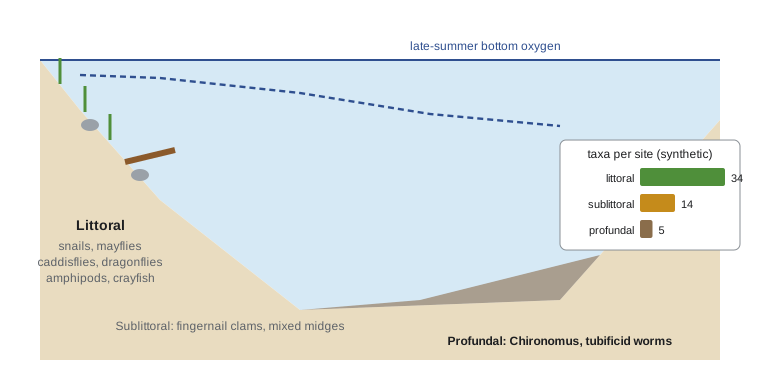
The profundal zone is dark, cold, and supplied only with food that sinks from above, and in productive lakes it may lose its oxygen for weeks or months. Few groups tolerate those conditions. The most characteristic are chironomid larvae of the genus Chironomus, called bloodworms because they carry haemoglobin that lets them extract oxygen at very low concentrations, and tubificid oligochaetes, which wave their tails in the water above their burrows to ventilate. In deep oxygenated lakes, other groups join them: fingernail clams, the amphipod Diporeia in the Great Lakes, and opossum shrimp.
Early in the twentieth century the German limnologist August Thienemann used profundal midges to classify lakes. Lakes with well-oxygenated depths were dominated by the midge Tanytarsus and its relatives; lakes whose deep water lost oxygen were dominated by Chironomus. That simple observation is one of the roots of the trophic classification of Lesson 4, and chironomids remain powerful indicators today.
Benthic animals can also tell the history of a lake. The heads of chironomid larvae are made of tough chitin and are preserved in lake sediments for thousands of years, along with diatom walls, pollen and pigments. By taking cores of sediment and counting the remains layer by layer, paleolimnologists reconstruct past oxygen levels, temperatures and nutrient conditions. Work by John Smol and colleagues on Shield and Arctic lakes has used such records to date the onset of acidification, eutrophication and recent warming, giving a baseline for how lakes were before monitoring began.
Indicators of recovery: the burrowing mayfly
One of the most celebrated examples of a benthic indicator comes from western Lake Erie. Burrowing mayflies of the genus Hexagenia once emerged from its mud in such vast numbers that their swarms piled up on roads and bridges. As the lake became eutrophic in the 1950s, periods of low oxygen near the bottom killed the larvae, which live in U-shaped burrows and need oxygen in the overlying water, and the mayflies all but vanished. After phosphorus controls improved oxygen conditions, Hexagenia returned to the western basin in the 1990s. Their abundance is still used as an indicator of the health of the lake bottom, and periodic declines are watched as a warning of renewed oxygen stress.
The littoral zone
The littoral zone is the most diverse habitat in most lakes. Light reaches the bottom, so plants and periphyton grow; the substrate varies from sand and cobble to mud and woody debris; and wave action and temperature fluctuate. Each type of habitat supports a different assemblage. Snails and mayfly nymphs graze periphyton on stones and plants; caddisfly larvae build portable cases or fixed nets; dragonfly and damselfly nymphs ambush prey among stems; amphipods and isopods feed on decaying plants; and crayfish, which eat almost anything, are often the largest invertebrates present.
Plants and wood multiply the surface area available for periphyton and invertebrates many times over, and they shelter young fish from predators. Fallen trees in the shallows, called coarse woody habitat, can persist for centuries in cold northern lakes and are used by fish for cover and spawning. Studies of lakes in northern Wisconsin and Michigan found far fewer fallen trees along shorelines with cottages and homes, because owners remove them and cut the trees that would have fallen, and fish growth and diversity were lower near developed shores. Shoreline hardening with retaining walls and riprap, lawns to the water's edge and removal of aquatic plants all simplify littoral habitat.
Freshwater mussels
Native freshwater mussels deserve special attention. North America has the richest mussel fauna on Earth, about 300 species, most of them in the rivers of the southeastern United States, and they are among the most endangered animals on the continent: a large majority of species are considered at risk, and dozens have gone extinct in the past century. Mussels are long-lived, some exceeding a century, and filter large volumes of water. Their life cycle is remarkable: the larvae, called glochidia, must attach to the gills or fins of a particular host fish for weeks before dropping off as juveniles. Many mussels lure their hosts with flaps of tissue that look like small fish or insects. If the host fish disappear, because of a dam, pollution or overfishing, the mussels cannot reproduce, even if the adults survive for decades.
In Canada, several mussel species, such as the wavyrayed lampmussel and the rainbow mussel, are listed under the Species at Risk Act, mostly in the rivers of southwestern Ontario, and their habitat is protected under that act and the Fisheries Act. Native mussels in the Great Lakes region also suffered heavily after the arrival of zebra and quagga mussels, which attach to them in such numbers that they cannot feed or open their shells.
Zebra and quagga mussels as ecosystem engineers
Zebra mussels and their relatives quagga mussels, both native to the Black and Caspian Sea region, arrived in the Great Lakes in ballast water in the late 1980s; zebra mussels were found in Lake St. Clair in 1988. Unlike native mussels, they attach to hard surfaces with strong threads, reproduce through free-swimming larvae and reach densities of thousands per square metre. By filtering enormous volumes of water, they cleared the water of the lower Great Lakes and many inland lakes, shifting production from open water to the bottom. Researchers have called this redirection of nutrients and energy toward the nearshore the nearshore shunt. Clearer water lets light reach the bottom, encouraging plants and nuisance attached algae such as Cladophora, while the open-water food web loses food. In Lake Michigan and Lake Huron, the native amphipod Diporeia, once the main food of lake whitefish and many other fish, has nearly disappeared over large areas, apparently because the mussels intercept the food that used to sink to it.
Measuring benthic communities
Benthic samples are reported as numbers per square metre, so the area sampled must be known. A standard Ekman grab, for example, samples a square of 15 by 15 centimetres, an area of 0.0225 square metres.
Worked problem
Density from grab samples
Three Ekman grabs (0.0225 square metres each) from 20 metres in Kestrel Lake contained 14, 9 and 16 chironomid larvae (synthetic data). Estimate the density per square metre.
Show solution
- Total larvae: 14 + 9 + 16 = 39.
- Total area sampled: 3 times 0.0225, or 0.0675 square metres.
- \[\text{density} = \frac{39}{0.0675\ \text{m}^2} \approx 580\ \text{larvae per m}^2\]
- Each grab alone represents about 44 square-metre units, so one larva in a grab is about 44 larvae per square metre; small samples give coarse estimates and high variability.
Answer: About 580 chironomid larvae per square metre.
Beyond density, ecologists summarize benthic communities with richness, the number of taxa; diversity indices such as Shannon's, which combine richness and evenness; and biotic indices that weight each taxon by its tolerance to pollution. The Hilsenhoff biotic index, developed in Wisconsin, gives each family or genus a tolerance value from 0, very intolerant, to 10, very tolerant, and averages them weighted by abundance. Low values indicate good water quality. Another common metric is the richness of mayflies, stoneflies and caddisflies, the EPT taxa, which are mostly sensitive to pollution and low oxygen.
import math
# Kick-net samples (synthetic counts) with family-level tolerance values used in Hilsenhoff-style indices.
tolerance = {'Heptageniidae (mayfly)': 4, 'Leptoceridae (caddisfly)': 4, 'Perlidae (stonefly)': 1,
             'Gammaridae (amphipod)': 4, 'Chironomidae (midge)': 8, 'Physidae (snail)': 8, 'Tubificidae (worm)': 10}
ept = {'Heptageniidae (mayfly)', 'Leptoceridae (caddisfly)', 'Perlidae (stonefly)'}
sites = {
    'Kestrel north bay': {'Heptageniidae (mayfly)': 42, 'Leptoceridae (caddisfly)': 25, 'Perlidae (stonefly)': 6,
                          'Gammaridae (amphipod)': 30, 'Chironomidae (midge)': 38, 'Physidae (snail)': 5, 'Tubificidae (worm)': 4},
    'Mallard boat launch': {'Heptageniidae (mayfly)': 2, 'Leptoceridae (caddisfly)': 3, 'Gammaridae (amphipod)': 12,
                            'Chironomidae (midge)': 96, 'Physidae (snail)': 31, 'Tubificidae (worm)': 58},
}
for site, counts in sites.items():
    n = sum(counts.values())
    hbi = sum(tolerance[t] * c for t, c in counts.items()) / n
    shannon = -sum(c / n * math.log(c / n) for c in counts.values())
    n_ept = sum(1 for t in counts if t in ept)
print(f"{site:20s} animals {n:3d} taxa {len(counts)} EPT taxa {n_ept} Shannon H {shannon:.2f} biotic index {hbi:.2f}")Kestrel north bay animals 150 taxa 7 EPT taxa 3 Shannon H 1.66 biotic index 5.19 Mallard boat launch animals 202 taxa 6 EPT taxa 2 Shannon H 1.28 biotic index 8.24
The north bay of Kestrel Lake has more taxa, three EPT families and a biotic index near 5, typical of good conditions for a lake shore; the Mallard Lake site is dominated by tolerant midges, snails and worms, with an index near 8. Programs such as the Canadian Aquatic Biomonitoring Network, run by Environment and Climate Change Canada, and the Ontario Benthos Biomonitoring Network use standardized kick-net and grab protocols so that results from thousands of sites can be compared. Lesson 8 applies the same methods to Bittern Creek.
Designing a benthic survey
Benthic animals are patchily distributed, so the design of a survey matters as much as the identification of what is caught. Replicate samples are needed at each site, because a single grab or kick may by chance hit or miss a cluster of animals; three to five replicates are common, and the variation among them gives a measure of precision. Sites must be comparable in depth, substrate and season, or differences in habitat will be mistaken for differences in water quality. Many programs use a reference-condition approach: they sample many minimally disturbed sites to describe the communities expected in each kind of habitat, then judge a test site by how far its community departs from that expectation. Sorting and identification are time-consuming and require training, so programs check a fraction of samples with a second taxonomist to keep errors low. Emergence traps floating on the surface, which catch winged adults as they leave the water, complement bottom samples and show how much insect production is exported from the lake to the land each year.
Common mistakes
MistakeAn empty-looking profundal grab means the lake is polluted.
InsteadProfundal communities are naturally sparse; compare like depths and habitats, and look at which taxa are present.
MistakeZebra mussels improve lakes because the water gets clearer.
InsteadClearer water comes at the cost of open-water food, native mussels and Diporeia, and can encourage nuisance bottom algae.
MistakeA single biotic index value is a complete assessment.
InsteadIndices summarize tolerance; they should be read with habitat, density, richness and reference sites.
Summary and key terms
- The benthos includes insect larvae, crustaceans, worms, molluscs and others, which decompose, burrow, filter and feed fish.
- Profundal communities are sparse and dominated by low-oxygen specialists such as Chironomus and tubificid worms.
- Chironomids and other remains in sediment cores record a lake's history.
- The littoral zone is the most diverse habitat; shoreline development removes wood and plants and simplifies it.
- Native mussels are highly imperilled; invasive dreissenids reengineer whole lakes; biotic indices summarize benthic condition.
- Benthos
- Organisms living on or in the bottom of a water body.
- Macroinvertebrate
- An invertebrate large enough to be retained by a sieve of about half a millimetre.
- Paleolimnology
- Reconstruction of past lake conditions from remains preserved in sediments.
- Glochidium
- The larva of a freshwater mussel, which attaches to a host fish.
- Coarse woody habitat
- Fallen trees and large wood in the shallows of lakes and streams.
- Biotic index
- A score combining the abundance and pollution tolerance of the taxa in a sample.
Practice problems
Work each problem on paper first, then reveal the answer to check.
Four Ekman grabs of 0.0225 square metres contain 90 worms in total. What is the density per square metre?
Show answer
1,000 per square metre, since 90 divided by 0.09 is 1,000.
Why do Chironomus larvae survive in oxygen-poor mud?
Show answer
They carry haemoglobin that binds oxygen at low concentrations.
Why can a mussel population fail to reproduce even when adults are healthy?
Show answer
Its glochidia need a particular host fish; if the host disappears, no juveniles are produced.
Lesson quiz · 5 questions
Score 60% or more to complete this lesson.
Create a free account to save your progress, take quizzes and earn a certificate.