
BIOL-460 · Lesson 2 of 12 · 19 min
Light, heat and the stratification of lakes
▶ Video coming soon A video version of this lesson is on the way.
On the class's second morning at Kestrel Lake, Dr. Solberg anchors the boat over the deepest point and hands Lena Fournier a Secchi disk. Lena lowers it on a marked rope until the black-and-white quadrants vanish, raises it until they reappear and reads the average: 6.2 metres. The same afternoon at Mallard Lake, the disk disappears at 1.1 metres. Then the students lower a temperature probe and watch the readings. In both lakes the water is warm at the surface, but in Kestrel Lake the temperature falls sharply between about 5 and 10 metres and stays near 6 degrees all the way to the bottom at 32 metres. In shallow Mallard Lake it is almost the same from top to bottom. This lesson explains both observations, because light and heat set the stage for everything that lives in a lake.
Light entering water
Sunlight that reaches a lake is partly reflected, more when the sun is low and the water rough, and the rest enters. Photosynthesis uses photosynthetically active radiation, wavelengths from about 400 to 700 nanometres, so limnologists measure light in that band. Once in the water, light is absorbed and scattered by water itself, by dissolved organic matter, by algae and by suspended particles. Water absorbs red light strongly, which is why clear lakes look blue. Coloured dissolved organic matter, the tea-coloured compounds that leach from forest soils and wetlands, absorbs blue and ultraviolet light strongly, so brown-water lakes turn dark within a metre or two and are shielded from harmful ultraviolet radiation. Algae absorb blue and red light and make a lake green; suspended clay makes it brown or grey and scatters light.
Because each layer of water absorbs a constant fraction of the light reaching it, light decreases exponentially with depth. This is the Beer–Lambert law applied to lakes:
where \(I_0\) is the light just below the surface, \(I_z\) the light at depth \(z\) and \(k_d\) the diffuse attenuation coefficient, in units of inverse metres. A very clear lake has \(k_d\) of about 0.1 to 0.2 per metre; Kestrel Lake, with its slight brown stain, about 0.3; Mallard Lake in midsummer about 1.6; and a muddy river can exceed 5. Taking logarithms gives a straight line, so \(k_d\) is found as the slope of the natural log of light against depth from readings with an underwater light meter.
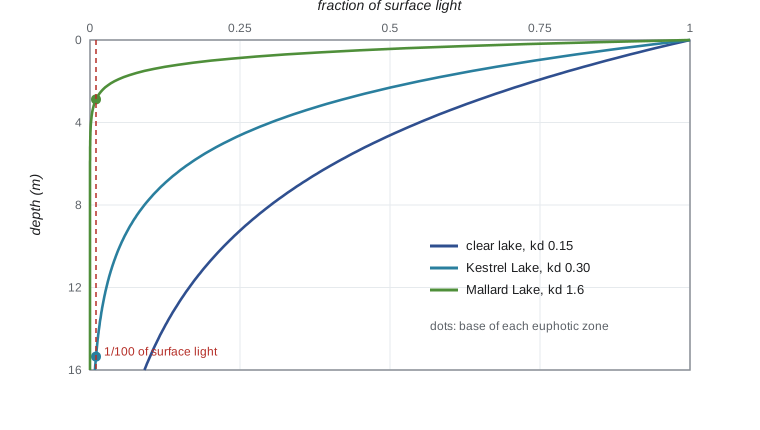
The euphotic zone is the lit upper layer where photosynthesis can exceed respiration. By convention its base is placed where light falls to about one hundredth of the surface value. Setting \(I_z/I_0 = 0.01\) in the equation gives
So Kestrel Lake's euphotic zone reaches about 15 metres and Mallard Lake's about 3. The one-hundredth rule is only a convention; shade-adapted algae and mosses can photosynthesize at lower light, and the true compensation depth varies with season and with the organisms present.
The Secchi depth is a cheap and remarkably useful index of clarity. It is roughly where light falls to a tenth to a twentieth of the surface value, and an approximate relationship, the Poole–Atkins relation, links it to attenuation: \(k_d \approx 1.7 / z_{SD}\). The constant varies between lakes, from about 1.4 to more than 2, so the relation is a rough guide, but it means a Secchi reading can estimate the depth of the euphotic zone as roughly two and a half to three times the Secchi depth. Volunteer programs in which cottagers and students lower Secchi disks every week have produced some of the longest clarity records in North America.
Worked problem
From Secchi depth to euphotic depth
Kestrel Lake's Secchi depth is 6.2 metres. Use the Poole–Atkins relation to estimate the attenuation coefficient and the depth of the euphotic zone.
Show solution
- \[k_d \approx \frac{1.7}{6.2\ \text{m}} \approx 0.27\ \text{m}^{-1}\]
- \[z_{eu} \approx \frac{4.6}{0.27\ \text{m}^{-1}} \approx 17\ \text{m}\]
- The light meter gave \(k_d\) of 0.30 per metre and a euphotic depth of about 15 metres, so the Secchi estimate is reasonable but a little high, as expected when the constant is uncertain.
Answer: About 0.27 per metre and about 17 metres; the measured values were 0.30 per metre and 15 metres.
import math
# Light profile from underwater light meter readings at Kestrel Lake (synthetic), as a share of surface light.
depth = [0, 2, 4, 6, 8, 10, 12]
light = [1.00, 0.56, 0.30, 0.17, 0.090, 0.050, 0.027]
n = len(depth)
y = [math.log(v) for v in light]
mx, my = sum(depth) / n, sum(y) / n
slope = sum((d - mx) * (v - my) for d, v in zip(depth, y)) / sum((d - mx) ** 2 for d in depth)
kd = -slope
print(f"attenuation coefficient kd = {kd:.3f} per m")
print(f"euphotic depth (1/100 of surface light) = {math.log(100) / kd:.1f} m")attenuation coefficient kd = 0.301 per m euphotic depth (1/100 of surface light) = 15.3 m
Heat and the strange density of water
Water has an unusually high specific heat, about 4.18 joules per gram per degree, so lakes warm and cool slowly and moderate the climate around them. Most of the sun's energy is absorbed in the top few metres, especially in coloured or green water. Wind then mixes that heat downward, but only so far.
The key to lake physics is that water is densest not at its freezing point but at about 4 degrees Celsius. Above 4 degrees, warmer water is lighter; below 4 degrees, colder water is lighter, which is why ice forms at the surface and floats, and why the bottom of a deep northern lake stays near 4 degrees through winter. Just as important, density changes faster with temperature at high temperatures than near 4 degrees. The density difference between water at 24 and 25 degrees is roughly thirty times that between water at 4 and 5 degrees, so a warm surface layer resists mixing far more strongly than a cool one.
def density(t):
    """Density of pure water in kg per m3 at temperature t (degrees C), a standard limnological formula."""
    return 1000 * (1 - (t + 288.9414) / (508929.2 * (t + 68.12963)) * (t - 3.9863) ** 2)
for t in (0, 4, 10, 20, 25):
    print(f"{t:2d} C  density {density(t):.3f} kg/m3")
d_cold = density(4) - density(5)
d_warm = density(24) - density(25)
print(f"density drop 4 to 5 C:   {d_cold:.4f}")
print(f"density drop 24 to 25 C: {d_warm:.4f} (about {d_warm / d_cold:.0f} times larger)")0 C density 999.868 kg/m3 4 C density 1000.000 kg/m3 10 C density 999.728 kg/m3 20 C density 998.234 kg/m3 25 C density 997.075 kg/m3 density drop 4 to 5 C: 0.0081 density drop 24 to 25 C: 0.2515 (about 31 times larger)
Thermal stratification
In spring, after the ice melts, the whole water column of a northern lake is near 4 degrees and has almost the same density from top to bottom, so even a light wind can mix it completely. As the sun strengthens, the surface warms faster than wind can carry the heat down. Within a few weeks a warm, light upper layer floats on a cold, dense lower layer, and the lake is thermally stratified. Three layers are recognized:
- The epilimnion is the warm, well-mixed upper layer, stirred by wind and in contact with the air.
- The metalimnion is the transition layer where temperature falls rapidly with depth. The plane of steepest change within it is the thermocline, often defined where temperature drops by at least a degree per metre.
- The hypolimnion is the cold, dense bottom layer, isolated from the atmosphere and from wind mixing for the rest of the summer.
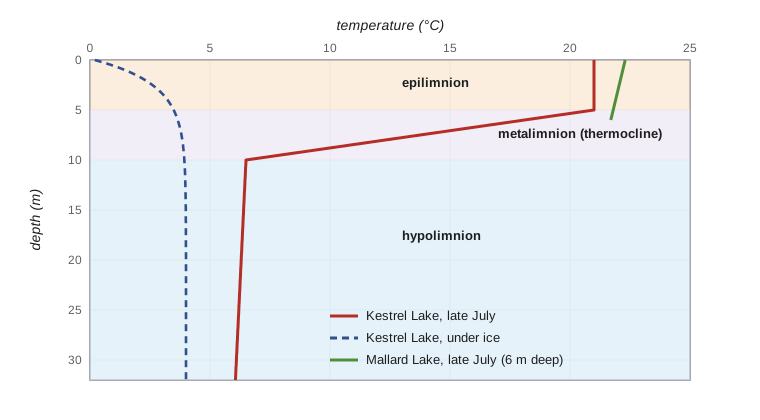
Stratification divides a lake into two worlds for the summer. The epilimnion receives light and oxygen from the air but loses nutrients as algae take them up and sink. The hypolimnion is dark and receives a steady rain of dead algae, faeces and other particles that decompose, consuming oxygen and releasing nutrients that cannot reach the surface until mixing resumes. Lesson 3 follows the oxygen consequences of that separation.
How deep the thermocline sits depends mainly on wind and lake size. A small, sheltered lake may stratify with a thermocline at 3 or 4 metres; a large lake with a long fetch, the distance wind travels over water, mixes deeper, often 10 to 20 metres in the Great Lakes. Water clarity matters too: in brown or green lakes heat is absorbed close to the surface and the epilimnion is shallow. Shallow lakes such as Mallard Lake may never stratify for long, because wind can mix their whole depth; they may form a weak, temporary stratification on calm, hot days and mix again when the wind rises.
The annual cycle of mixing
In autumn the surface cools, the epilimnion grows denser and deepens, and eventually the whole lake reaches the same temperature and mixes from top to bottom. This fall turnover can last weeks, recharging the hypolimnion with oxygen and bringing nutrients to the surface. As the water cools below 4 degrees, the coldest water floats at the top and ice forms. Under the ice the lake is inversely stratified, with water near 0 degrees under the ice and near 4 degrees at the bottom. After ice-out the lake mixes again in a spring turnover before summer stratification sets in.
A lake that mixes twice a year in this way is called dimictic, and it is the typical pattern for deep lakes in Canada. Limnologists recognize several other patterns:
- Polymictic lakes are shallow lakes that mix many times a year, or continuously, such as Mallard Lake.
- Warm monomictic lakes, found in mild climates, never freeze and mix once a year in winter, stratifying in summer.
- Cold monomictic lakes, found in polar regions, are ice-covered most of the year and mix once in a brief summer.
- Meromictic lakes never mix completely, because a dense, salty bottom layer, the monimolimnion, resists mixing year after year. Some small, deep, sheltered lakes and saline lakes are meromictic, and their bottom waters may lack oxygen permanently.
Not all of a lake's motion is mixing. Wind piles water at the downwind end, and when it stops the water sloshes back and forth in a standing wave called a seiche. In stratified lakes the thermocline itself rocks up and down in internal seiches that can be several metres high, moving cold hypolimnetic water up and down the shore and carrying nutrients into the littoral zone.
Ice
For many northern lakes, ice cover is the longest season. Ice and snow block light, so winter phytoplankton production is low, and the lake is sealed from the air, so oxygen used by decomposition is not replaced. In shallow, productive lakes this can lead to winterkill of fish, the subject of Lesson 10. Ice dates are also among the longest records of climate in North America. Lake Mendota in Wisconsin has records of ice-on and ice-off dates since the 1850s, and its average period of ice cover has shortened by about a month over that time. Lesson 12 returns to what warmer, shorter winters mean for lakes.
Why the physics matters for life
Light and stratification together define the habitats available to organisms. Phytoplankton need light, so they live in the euphotic zone, but in a stratified lake the nutrients they need accumulate below it, in the hypolimnion. In clear lakes such as Kestrel Lake the euphotic zone reaches below the thermocline, and a deep chlorophyll maximum often forms in the metalimnion, where algae get some light from above and nutrients from below. Lena Fournier's sonde profiles show it every July as a peak of chlorophyll fluorescence at about 9 metres. In green Mallard Lake, light, not nutrients, limits algae for much of the summer, because the algae shade one another.
Temperature layers matter just as much to animals. Cold-water fish such as lake trout and cisco spend the summer in or just above the hypolimnion, where the water stays below about 12 degrees, while warm-water fish such as bass and sunfish use the epilimnion and littoral zone. Zooplankton migrate vertically every day, rising to the warm, food-rich surface at night and sinking to the dark, cold depths by day, a behaviour that Lesson 6 links to predation by fish.
Ultraviolet radiation is another part of the light climate. It damages DNA and proteins, and in very clear alpine and Arctic lakes it penetrates several metres and can harm plankton and fish eggs. Coloured dissolved organic matter is the main natural sunscreen. Many lakes in eastern Canada, Scandinavia and the northeastern United States have become browner since the 1990s, as recovery from acid rain and changes in climate and land use have released more dissolved organic carbon from soils. Browning shades out deep algae and warms the surface while cooling the depths, strengthening stratification. A change in the colour of the water, in other words, can reorganize a whole lake.
Common mistakes
MistakeThe thermocline is the bottom of the lake's warm water.
InsteadThe thermocline is the plane of steepest temperature change within the metalimnion, between the epilimnion and the hypolimnion.
MistakeWater is densest at 0 degrees, when it freezes.
InsteadWater is densest at about 4 degrees; colder water and ice are lighter and float.
MistakeAll lakes stratify in summer.
InsteadShallow lakes may be mixed by wind all summer; stratification needs enough depth and shelter.
Summary and key terms
- Light falls exponentially with depth, and the attenuation coefficient summarizes how quickly.
- The euphotic zone ends near one hundredth of surface light, about 4.6 divided by the attenuation coefficient.
- Water is densest at about 4 degrees, and density changes faster at warm temperatures, so warm surface layers resist mixing.
- Summer stratification separates a warm epilimnion from a cold hypolimnion, with a metalimnion and thermocline between.
- Dimictic lakes turn over in spring and fall; shallow lakes may be polymictic; some lakes are meromictic.
- Attenuation coefficient
- The rate at which light decreases with depth, in inverse metres.
- Euphotic zone
- The lit upper layer of water where photosynthesis can exceed respiration.
- Epilimnion
- The warm, mixed upper layer of a stratified lake.
- Hypolimnion
- The cold, dense bottom layer of a stratified lake, isolated from the air in summer.
- Thermocline
- The depth of most rapid temperature change in a stratified lake.
- Dimictic
- Mixing completely twice a year, in spring and fall.
Practice problems
Work each problem on paper first, then reveal the answer to check.
A lake has an attenuation coefficient of 0.46 per metre. Estimate its euphotic depth.
Show answer
About 10 metres, since 4.6 divided by 0.46 is 10.
Why does the hypolimnion of a deep northern lake stay near 4 degrees in winter?
Show answer
Water at about 4 degrees is densest and sinks to the bottom; colder water floats above it.
Why is Mallard Lake polymictic?
Show answer
It is shallow enough that wind can mix its whole depth.
Lesson quiz · 5 questions
Score 60% or more to complete this lesson.
Create a free account to save your progress, take quizzes and earn a certificate.