
BIOL-460 · Lesson 10 of 12 · 18 min
Fish ecology
▶ Video coming soon A video version of this lesson is on the way.
Marcus Achebe sets his nets on Kestrel Lake in the last week of September, when the water has cooled and lake trout are gathering over a rocky shoal off the east shore to spawn. At dawn the class helps him lift a short gill net, measure each fish, clip a small fin to mark it, take a scale and a few drops of blood, and release it. One female, 74 centimetres long, carries a tag from 2009, when she was already an adult; she is probably more than 25 years old. Later that week, in Mallard Lake, the class pulls a seine through the shallows and lands a writhing mass of bluegill, yellow perch, young largemouth bass and a single common carp as long as a student's arm. This lesson brings together the physics, chemistry and food webs of the previous lessons to explain where fish live, how they grow and reproduce, and how their populations are studied and managed.
Fish diversity in fresh water
Freshwater fishes make up roughly half of all fish species, an astonishing number given how little of Earth's water is fresh. North America has one of the richest temperate freshwater fish faunas, but it is unevenly distributed. Canada has roughly 200 native freshwater fish species, most of which recolonized the country from glacial refuges after the last ice age, while the United States, with its unglaciated southeastern rivers, has more than 800. Lakes on the Shield often have only a handful of species, while warm southern rivers may hold more than a hundred.
Temperature and oxygen: where fish can live
Fish are ectotherms, so water temperature controls their metabolism, growth and behaviour, and each species does best within a particular range. Fisheries biologists group species into thermal guilds:
- Cold-water fish, such as lake trout, brook trout, cisco and lake whitefish, prefer water below about 15 degrees and grow best near 10 to 12 degrees.
- Cool-water fish, such as walleye, yellow perch and northern pike, prefer roughly 18 to 24 degrees.
- Warm-water fish, such as largemouth bass, bluegill and channel catfish, prefer about 25 degrees or more.
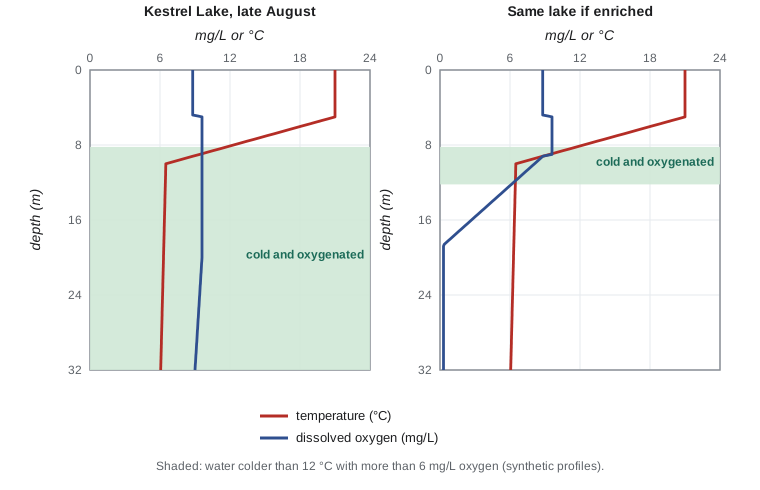
In a stratified lake, cold-water fish are caught between two constraints in late summer. The epilimnion is too warm for them, so they must stay in the metalimnion or hypolimnion; but if decomposition has depleted oxygen in the hypolimnion, the cold water may be too oxygen-poor. Their usable habitat is squeezed into a narrowing band of water that is both cold enough and oxygenated enough. In productive lakes the band can vanish entirely, which is why lake trout disappear from lakes that become eutrophic even when the water is not toxic. Ontario manages lake trout lakes using a criterion for the mean volume-weighted dissolved oxygen of the hypolimnion at the end of summer, and treats values below about 7 milligrams per litre as a sign that the habitat is at risk.
Warm-water and shallow lakes face different oxygen threats. Under ice and snow, photosynthesis nearly stops while decomposition continues, and shallow productive lakes like Mallard Lake can lose most of their oxygen by late winter, killing fish in a winterkill. In summer, a sudden die-off of a bloom on a calm, hot night can do the same in a summerkill. Winterkill lakes are dominated by tolerant species such as fathead minnows and brook stickleback, and some lake associations run aerators through the winter to prevent kills.
Feeding and growth
Most fish change their diet as they grow, in what are called ontogenetic niche shifts. Larval fish of almost every species eat zooplankton; juveniles shift to larger invertebrates; and large individuals of piscivorous species eat other fish. A fish's gape, the width of its mouth, limits the largest prey it can swallow, so growth opens up new food and a fish that grows quickly escapes predators and reaches the piscivorous stage sooner. These shifts link fish to every part of the food web described in Lessons 6 and 7, and they mean that the same species can be a competitor of its prey's young and a predator of its competitors.
Growth in length often follows the von Bertalanffy curve, fast when young and slowing as the fish approaches a maximum size:
where \(L_{\infty}\) is the asymptotic length, \(K\) a growth coefficient and \(t_0\) a theoretical age at zero length. Age is read from annual rings on scales, fin rays or, most reliably, the ear stones called otoliths. In cold, unproductive lakes, fish grow slowly and live long: lake trout in Shield lakes may take a decade to mature and live for several decades, and lake sturgeon may not spawn until they are 15 to 25 years old and can live more than a century.
import math
def vb(t, Linf, K, t0):
    return Linf * (1 - math.exp(-K * (t - t0)))
# Synthetic growth parameters for lake trout in Kestrel Lake and yellow perch in Mallard Lake (cm).
for name, Linf, K, t0 in (('lake trout', 82, 0.11, -0.6), ('yellow perch', 28, 0.32, -0.4)):
    sizes = ', '.join(f"age {a}: {vb(a, Linf, K, t0):4.1f}" for a in (1, 3, 5, 10, 20))
print(f"{name:12s} {sizes}")lake trout age 1: 13.2, age 3: 26.8, age 5: 37.7, age 10: 56.4, age 20: 73.5 yellow perch age 1: 10.1, age 3: 18.6, age 5: 23.0, age 10: 27.0, age 20: 28.0
Reproduction
Fish reproduce in strikingly varied ways, and their spawning needs often decide where they can persist. Lake trout and lake whitefish scatter eggs over clean rocky shoals or gravel in the fall, and the eggs incubate under the winter ice. Walleye and lake sturgeon migrate up rivers in spring to spawn over gravel and rock in fast water. Northern pike and yellow perch spawn among flooded plants in early spring. Largemouth bass, smallmouth bass and sunfish build nests in the shallows, and the males guard eggs and young. Salmon and some trout are anadromous, hatching in rivers, feeding at sea and returning to spawn, though in the Great Lakes introduced Pacific salmon complete their cycle entirely in fresh water.
Ecologists describe a few broad life-history strategies. Periodic species, such as walleye and sturgeon, are large, long-lived and very fecund, releasing huge numbers of small eggs in a short season and relying on occasional good years. Opportunistic species, such as many minnows, are small, mature early and spawn repeatedly, and they quickly colonize disturbed or newly available habitat. Equilibrium species, such as bass and sunfish, produce fewer, larger eggs and invest in parental care. Recognizing which strategy a species follows helps predict how it will respond to fishing, habitat change and climate.
Studying fish populations
Counting fish is hard because they are hidden and mobile, so biologists combine several methods. Standardized gill nets and trap nets, set at the same places and times each year, provide indices of relative abundance; Ontario's Broad-scale Monitoring program, for example, samples hundreds of lakes on a rotating schedule with a common netting design. Electrofishing boats and backpacks temporarily stun fish so they can be netted, measured and released. Hydroacoustic surveys count fish in open water with sonar, and environmental DNA, traces of genetic material in water samples, can detect rare or invasive species.
To estimate absolute population size, biologists often use mark and recapture. In the simplest version, a sample of \(M\) fish is caught, marked and released; later a second sample of \(C\) fish is caught, of which \(R\) carry marks. If marked fish have mixed randomly, the proportion marked in the second sample estimates the proportion marked in the population. Chapman's version of the Lincoln–Petersen estimator reduces bias when recaptures are few:
Worked problem
Estimating the lake trout population
In September (synthetic data), Marcus marks and releases 64 adult lake trout on the spawning shoal. The following September his crew catches 71 adults, of which 9 carry marks. Estimate the adult population.
Show solution
- \[\hat{N} = \frac{(64+1)(71+1)}{9+1} - 1 = \frac{65 \times 72}{10} - 1 = 467\]
- The estimate is about 470 adult lake trout.
- The method assumes no fish were born, immigrated, died or left between samples, that marks were not lost, and that marked and unmarked fish were equally likely to be caught. Over a year, some marked fish will have died, which inflates the estimate, so biologists use more elaborate models for open populations.
Answer: About 470 adult lake trout.
Population change depends on recruitment, the number of young that survive to join the catchable population, and on mortality. Total mortality is divided into fishing mortality and natural mortality from predation, disease and old age. Recruitment varies enormously from year to year, often by a factor of ten or more, because survival of eggs and larvae depends on weather, food and predators in their first weeks. Stock–recruitment models such as the Ricker curve relate the number of spawners to the recruits they produce; at low spawner numbers recruitment rises with stock, but at high numbers crowding, cannibalism and competition reduce it. Such models underlie estimates of sustainable harvest, though their uncertainty is large.
People and fish
Most inland fisheries in North America are recreational, and anglers spend billions of dollars a year on them. Fishing regulations, such as seasons, size limits and daily limits, aim to keep fishing mortality below what populations can replace. Commercial fisheries remain important on the Great Lakes, Lake Winnipeg and other large lakes, and Indigenous fisheries for food, social and ceremonial purposes are protected rights. In Canada, Aboriginal and treaty rights to fish are recognized and affirmed by section 35 of the Constitution Act, 1982, and courts have held that they take priority over other uses after conservation.
Introductions and invasions have reshaped many fish communities. The sea lamprey, a parasitic fish that entered the upper Great Lakes after the Welland Canal was deepened, helped devastate lake trout populations by the 1950s; since then the binational Great Lakes Fishery Commission, created by a 1955 convention between Canada and the United States, has controlled lampreys with barriers and a selective lampricide, and lake trout have recovered in Lake Superior. In inland lakes, introduced smallmouth bass and rock bass have been shown, using stable isotopes, to push lake trout from eating littoral fish to eating zooplankton, shortening the food chain and slowing trout growth. Common carp uproot plants and stir up sediment in shallow lakes like Mallard Lake, helping keep them turbid. And bighead and silver carp, which have spread up the Mississippi River system, are the target of major efforts to keep them out of the Great Lakes.
Fish and their habitat are protected federally by the Fisheries Act, whose 2019 amendments restored a general prohibition on the harmful alteration, disruption or destruction of fish habitat, and species at risk such as some populations of lake sturgeon are assessed by the Committee on the Status of Endangered Wildlife in Canada and may be listed under the Species at Risk Act. Provinces manage most sport fisheries.
Stocking, the release of hatchery-raised fish, has long been a tool of fisheries management, and it is effective for creating fisheries where natural reproduction is impossible, such as put-and-take trout fisheries in warm or newly built ponds, and for restoring extirpated populations, such as lake trout in the lower Great Lakes. It also carries risks. Hatchery fish can carry diseases, compete with wild fish, and, when they interbreed with wild populations, dilute local adaptations built up over thousands of years. Stocking a species into a lake where it did not occur can reshape the food web, as introduced bass and pike have shown. For these reasons, agencies increasingly stock only where wild reproduction cannot sustain a population, use broodstock from nearby genetic strains, and evaluate each program by marking stocked fish and measuring their survival and contribution to the catch. Kestrel Lake's lake trout have never been stocked, which makes them a rare example of an original genetic strain and another reason the class gives the lake high priority for protection.
Common mistakes
MistakeA fish kill means the water was poisoned.
InsteadMost fish kills in lakes come from low oxygen under ice or after blooms collapse, not from toxic chemicals.
MistakeA lake that is cold enough at depth will keep its lake trout.
InsteadThe deep water must also stay oxygenated; eutrophication can remove trout habitat without any toxic effect.
MistakeMark-recapture always gives an exact population.
InsteadIt gives an estimate that depends on assumptions about mixing, mark loss and closure, with wide uncertainty when recaptures are few.
Summary and key terms
- Freshwater fishes are diverse but unevenly distributed; glaciated northern lakes have fewer species.
- Thermal guilds and oxygen together define habitat; cold-water fish suffer a summer habitat squeeze in productive lakes.
- Fish shift diets as they grow; growth often follows the von Bertalanffy curve and is slow in cold, unproductive lakes.
- Spawning needs and life-history strategies determine how species respond to habitat change and harvest.
- Populations are studied with standardized nets, electrofishing, acoustics, environmental DNA and mark-recapture, and managed under federal, provincial or state and treaty frameworks.
- Thermal guild
- A group of fish species with similar temperature preferences.
- Habitat squeeze
- The narrowing of water that is both cold and oxygenated enough for cold-water fish.
- Winterkill
- Death of fish from oxygen depletion under ice.
- Ontogenetic niche shift
- A change in diet or habitat as an animal grows.
- Recruitment
- The number of young fish that survive to join the adult or catchable population.
- Otolith
- An ear stone with annual growth rings used to age fish.
Practice problems
Work each problem on paper first, then reveal the answer to check.
A biologist marks 100 fish; later 50 are caught, of which 10 are marked. What is the simple Lincoln–Petersen estimate?
Show answer
500 fish, since 100 times 50 divided by 10 is 500.
Why do lake trout disappear from lakes that become eutrophic?
Show answer
Decomposition removes oxygen from the cold hypolimnion, eliminating water that is both cold and oxygenated.
What makes shallow productive lakes prone to winterkill?
Show answer
Ice and snow stop photosynthesis and air exchange while decomposition continues to use oxygen.
Lesson quiz · 5 questions
Score 60% or more to complete this lesson.
Create a free account to save your progress, take quizzes and earn a certificate.