
BIOL-460 · Lesson 12 of 12 · 16 min
Climate change and freshwater management: a capstone lake plan
▶ Video coming soon A video version of this lesson is on the way.
On the last day of the field course, Dr. Solberg spreads twenty years of station records across the lab bench. Ice now leaves Kestrel Lake about eleven days earlier than when monitoring began. Late-summer surface water is about 1.5 degrees warmer, the lake stratifies about two weeks earlier, and the oxygen at the bottom at the end of summer has drifted down, slowly but steadily. Mallard Lake's blooms start earlier and last longer. None of these numbers is dramatic on its own, but together they show two lakes changing under a warming climate on top of the pressures of the previous lessons. The class's final task is to write a management plan for both lakes, and this lesson provides the ideas needed: how climate change affects fresh waters, and how ecologists, communities and agencies plan under uncertainty.
How climate change affects lakes
Lakes respond to climate change quickly and visibly, which makes them sentinels of change. The main effects are well documented.
Lakes are warming. A global analysis of 235 lakes published in 2015 found that summer surface water temperatures rose by an average of about a third of a degree per decade between 1985 and 2009, faster than air temperatures in many regions. Warming is not uniform: deep water often warms little, so the density difference between surface and depth grows and stratification becomes stronger and longer.
Ice cover is shrinking. Across the Northern Hemisphere, lakes freeze later and thaw earlier, and records such as Lake Mendota's show losses of about a month of ice cover since the nineteenth century. Thousands of lakes that once froze every year now have winters without complete ice cover, and the number is projected to grow. Shorter ice seasons lengthen the growing season, change winter oxygen dynamics and affect people who travel, fish and harvest on the ice.
Lakes are losing oxygen. A study of 393 temperate lakes with records from 1941 to 2017, published in 2021, found widespread declines in dissolved oxygen in both surface and deep water, at rates considerably greater than those observed in the oceans. Warmer water holds less oxygen, and longer, stronger stratification gives decomposition more time to deplete the hypolimnion. For cold-water fish, the result is the habitat squeeze of Lesson 10, tightening year by year.
Blooms are favoured. Cyanobacteria grow best at warm temperatures and in calm, stable water, many can regulate their buoyancy to stay in the light, and some fix nitrogen, so warming and stronger stratification tend to favour them over other phytoplankton. More intense spring storms wash more phosphorus from fields: the record western Lake Erie bloom of 2011 followed an unusually wet spring. Warming also increases internal loading, because anoxia in the hypolimnion starts earlier and lasts longer.
Other changes include browning, as warmer, wetter conditions release more dissolved organic carbon from soils; shifts in water levels, with both higher highs and lower lows on the Great Lakes in recent decades; and the northward spread of warm-water fish and invaders, while cold-water species lose habitat at the southern edges of their ranges. In Ontario, smallmouth bass are expected to spread into many northern lakes as they warm, with consequences for lake trout and brook trout food webs.
Managing under uncertainty
No one can predict exactly how a particular lake will respond to a management action, let alone to climate change, because lakes are complex, monitoring is incomplete and the future climate is uncertain. Adaptive management is a structured response to that uncertainty. Its cycle is to assess the problem and define goals; design actions and the monitoring needed to judge them; implement the actions; monitor the response; evaluate the results against the goals; and adjust the actions, repeating the cycle. The key is that monitoring is designed in advance to answer specific questions, and that managers commit to changing course when the evidence says so.
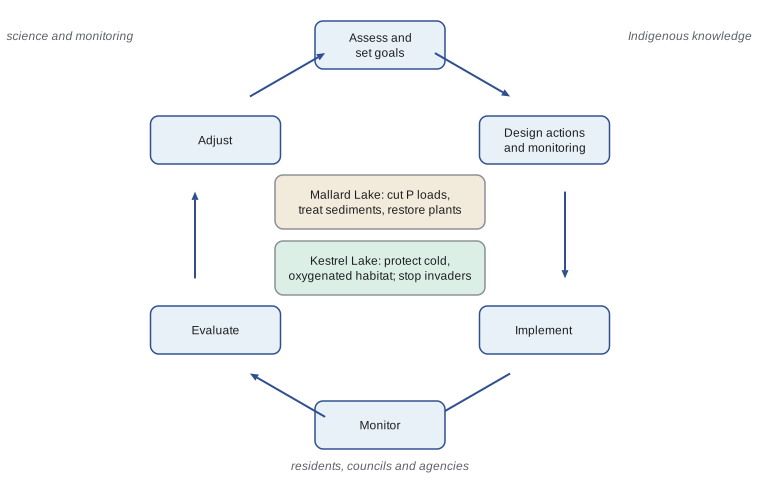
Good plans also draw on more than one kind of knowledge. Indigenous knowledge holders often have long, detailed records of change in water, ice, fish and plants, and they may frame problems in terms of relationships and responsibilities rather than parameters. In Canada, the approach called Two-Eyed Seeing, described by the Mi'kmaw Elder Albert Marshall, asks people to see with the strengths of Indigenous knowledge in one eye and of Western science in the other, and to use both together. Research partnerships with First Nations increasingly follow the First Nations principles of ownership, control, access and possession of their data, known as OCAP. At the station, the agreement with the First Nation's water program sets out how guardians' observations and the station's data are shared and how decisions about the wild rice beds and fisheries are made jointly.
The capstone: a plan for Mallard Lake
The class begins with Mallard Lake, because its problem is clear. Its total phosphorus, about 58 micrograms per litre, makes it eutrophic; it has lost most of its submersed plants and is in the turbid state described in Lesson 5; its blooms trigger advisories; and Lesson 4 showed that much of its phosphorus comes from its own sediments. The class proposes four goals for the next fifteen years: bring summer total phosphorus below 30 micrograms per litre, cut the number of advisory days by more than half, restore submersed plants to at least a third of the bottom shallower than 2 metres, and sustain a healthy warm- and cool-water fishery.
To judge which actions could meet the phosphorus goal, the class extends the Vollenweider model of Lesson 4. It adds an internal load, chosen so that the model reproduces the measured concentration, and then estimates chlorophyll with the Dillon and Rigler regression. It runs four scenarios: no change; halving the external load through watershed measures; halving the external load and cutting internal loading by four fifths with alum; and the same actions under a warmer climate that increases internal loading by a quarter.
import math
z, tau = 3.2, 0.36                   # Mallard Lake mean depth (m) and residence time (yr), synthetic
qs = z / tau
L_ext = 0.21                         # external load, g P per m2 per year
L_int = 0.616                        # internal load chosen so the model matches the measured 58 micrograms per L
def lake_tp(le, li):
    return (le + li) / qs / (1 + math.sqrt(tau)) * 1000      # micrograms per L
def chl_from_tp(tp):
    return 10 ** (1.449 * math.log10(tp) - 1.136)            # Dillon and Rigler (1974) regression
scenarios = {
    'no change':                         (L_ext, L_int),
    'watershed load halved':             (L_ext * 0.5, L_int),
    'watershed halved + alum':           (L_ext * 0.5, L_int * 0.2),
    'same actions, warmer climate':      (L_ext * 0.5, L_int * 0.2 * 1.25),
}
for name, (le, li) in scenarios.items():
    tp = lake_tp(le, li)
print(f"{name:30s} TP {tp:5.1f} ug/L chlorophyll about {chl_from_tp(tp):5.1f} ug/L")no change TP 58.1 ug/L chlorophyll about 26.3 ug/L watershed load halved TP 50.7 ug/L chlorophyll about 21.6 ug/L watershed halved + alum TP 16.0 ug/L chlorophyll about 4.1 ug/L same actions, warmer climate TP 18.2 ug/L chlorophyll about 4.9 ug/L
The results make the strategy clear. Halving the external load alone barely changes the lake, because the sediments dominate. Combined with an alum treatment, the model predicts phosphorus near 16 micrograms per litre, well inside the goal, even with the extra internal loading of a warmer climate. The class notes the caveats: the model is simple, the internal load was fitted rather than measured, alum works less well in a shallow, wind-mixed, carp-stirred lake, and the treatment will wear off if watershed loads are not controlled first. Because of hysteresis, plants may not return on their own even when phosphorus falls.
The plan therefore sequences its actions:
- Years 1 to 5: reduce the external load with cover crops, manure management and riparian buffers on the farms upstream, fencing cattle from the inlet creek, inspecting and upgrading shoreline septic systems, and restoring a drained wetland on the main inlet to trap phosphorus.
- Years 3 to 6: measure internal loading directly with sediment cores and hypolimnetic monitoring, then apply alum at a dose calculated from the mobile phosphorus in the sediment.
- Years 4 to 8: remove common carp with targeted netting during spawning aggregations and install a barrier on the inlet; replant native submersed plants in protected plots; protect remaining plant beds from cutting and herbicides.
- Throughout: adopt rules that keep a natural buffer along the shore, discourage lawn fertilizer, and keep the public informed through the township, the lake association and the beach advisory system.
Monitoring is designed to answer the plan's questions. The class lists total phosphorus, chlorophyll, Secchi depth and cyanotoxins every two weeks in the open-water season; hypolimnetic oxygen and sediment phosphorus release once a year; plant cover surveys each August; carp and other fish populations every three years; and tributary loads during storms, with automated samplers at the inlet. Each indicator has a target and a decision point: if phosphorus has not fallen by year six, for example, the plan calls for a review of watershed measures before any further in-lake treatment.
The capstone: protecting Kestrel Lake
Kestrel Lake needs a different kind of plan, because it is still in good condition. Its total phosphorus is about 6 micrograms per litre, its hypolimnion stays oxygenated, and it supports a naturally reproducing lake trout population and wild rice beds of great cultural importance. The threats are slower: shoreline development, septic systems and logging in the watershed; invasive species arriving on boats; and climate change shrinking cold, oxygenated habitat. The class's goal is to keep end-of-summer oxygen in the hypolimnion high enough to sustain lake trout, keep total phosphorus below 10 micrograms per litre, and keep the lake free of invasive mussels, spiny water flea and smallmouth bass.
Because warming will increase oxygen loss from the hypolimnion regardless of local action, every microgram of phosphorus kept out of the lake becomes more valuable: less algae sinking into the hypolimnion means slower oxygen depletion, buying time for cold-water fish. The plan therefore sets a phosphorus budget for the watershed and limits new development so the budget is not exceeded; requires septic inspections at property sale; protects shoreline trees and fallen wood; reviews forestry plans for the watershed with the First Nation; and establishes a boat-washing station and an education program at the public landing. Monitoring centres on the indicators that matter most for lake trout: continuous temperature and oxygen sensors on a buoy over the deepest point, annual lake trout netting and recruitment surveys, and environmental DNA sampling at the landing for early detection of invaders. Kestrel Lake, being deep, clear and cold, is likely to be one of the region's climate refuges for cold-water fish, which makes protecting it a priority far beyond its own shores.
What the course has shown
The plans draw on every lesson. Morphometry and residence time set how fast each lake responds. Light and stratification divide each lake into habitats and control the oxygen budget of the depths. Nutrients, especially phosphorus, set the trophic state, while food webs from Daphnia to lake trout modify how nutrients become algae. Benthic invertebrates and stream communities record the condition of the bottom and the watershed. Wetlands store water, nutrients and carbon. Fish integrate everything. And human actions, from fertilizing a field to moving a boat, reach into every part of the system. Aquatic ecology is a science of connections, and managing fresh water well means seeing them.
Finally, the class notes that plans succeed only when people support them. The Mallard Lake plan names who is responsible for each action: farmers and the provincial or state agricultural agency for watershed measures, the township for septic inspections and shoreline rules, the lake association for volunteer monitoring and education, the First Nation and the station for wild rice and fisheries monitoring, and the environment agency for permits and the alum treatment. It estimates costs and possible funding sources and commits to an annual public report of the indicators in plain language. Experience from lakes across North America suggests that transparent reporting, early wins such as fencing cattle from a creek, and patience through the years when indicators barely move are what keep such partnerships together.
Common mistakes
MistakeClimate change will affect only the temperature of lakes.
InsteadWarming also changes ice, stratification, oxygen, internal loading, blooms, water levels and species ranges.
MistakeA management plan is finished once it is approved.
InsteadAdaptive management treats the plan as a hypothesis, with monitoring designed to test it and commitments to adjust.
MistakeLakes in good condition do not need plans.
InsteadProtecting a healthy lake is far cheaper and more effective than restoring a degraded one.
Summary and key terms
- Lakes are warming, losing ice and oxygen, and becoming more prone to cyanobacterial blooms.
- Warming strengthens stratification and internal loading, tightening the habitat squeeze for cold-water fish.
- Adaptive management cycles through goals, actions, monitoring, evaluation and adjustment.
- Plans are stronger when they include Indigenous knowledge and data governance alongside scientific monitoring.
- Restoring Mallard Lake needs watershed and sediment phosphorus control plus fish and plant measures; protecting Kestrel Lake needs a phosphorus budget, invasion prevention and climate-focused monitoring.
- Adaptive management
- A structured, iterative approach to management that uses monitoring to learn and adjust.
- Climate refuge
- A habitat likely to retain suitable conditions for a species as the climate changes.
- Scenario
- A plausible set of future conditions or actions used to compare possible outcomes.
- Indicator
- A measured variable chosen to track progress toward a management goal.
- Two-Eyed Seeing
- An approach that brings together the strengths of Indigenous knowledge and Western science.
- Phosphorus budget
- An accounting of phosphorus inputs, outputs and storage that sets limits on loading.
Practice problems
Work each problem on paper first, then reveal the answer to check.
Why does halving Mallard Lake's external load change its phosphorus so little in the model?
Show answer
Most of its phosphorus comes from internal loading by the sediments.
Name two ways warming reduces oxygen in a lake's hypolimnion.
Show answer
Warmer water holds less oxygen, and longer stratification gives decomposition more time.
What makes Kestrel Lake a likely climate refuge?
Show answer
It is deep, clear and cold, so it should keep cold, oxygenated water longer than most lakes.
Lesson quiz · 5 questions
Score 60% or more to complete this lesson.
Create a free account to save your progress, take quizzes and earn a certificate.