
BIOL-460 · Lesson 6 of 12 · 18 min
Zooplankton, plankton food webs and trophic cascades
▶ Video coming soon A video version of this lesson is on the way.
At dusk on a calm evening in July, Dr. Solberg takes the class out on Kestrel Lake with a fine-meshed plankton net and a small echo sounder. At noon the same day, a net hauled through the top 5 metres caught few animals, and the sounder showed a diffuse layer of echoes at about 20 metres. Now, an hour after sunset, the layer has risen almost to the surface, and the net comes up full of Daphnia, copepods and the transparent larvae of the phantom midge Chaoborus. The animals have migrated upward through 15 metres of water in a few hours, as they do every night. This lesson explains why, and follows energy from algae through zooplankton to fish, showing how changes at the top of a food web can reach all the way down to the colour of the water.
Who the zooplankton are
Zooplankton are the animals and animal-like protists that drift in open water. Although many can swim, they cannot move against currents over long distances. Four groups dominate in fresh water.
- Protozoa, especially ciliates and heterotrophic flagellates, are single cells that eat bacteria and small algae. They are invisible in a net haul but numerous, and they are the link between bacteria and larger animals.
- Rotifers are tiny multicellular animals, mostly under half a millimetre long, with a crown of cilia that sweeps food into the mouth. They reproduce quickly and are often the most numerous animals in productive lakes.
- Cladocerans, the water fleas, include Daphnia, Bosmina and Holopedium. Most are filter feeders that sweep particles from the water with comb-like limbs. Daphnia, the largest common herbivore, can clear algae from large volumes of water.
- Copepods are small crustaceans with long antennae. Calanoid copepods mostly feed selectively on algae, while many cyclopoid copepods are raptorial, seizing small prey. Their life cycle runs from egg through several naupliar stages to copepodites and adults.
Predatory invertebrates are part of the zooplankton too. Chaoborus larvae ambush small crustaceans; the large cladoceran Leptodora hunts in open water; and in deep, cold lakes the opossum shrimp Mysis migrates between the bottom and the surface. Since the 1980s two invasive predatory cladocerans from Eurasia, the spiny water flea and the fishhook water flea, have spread through the Great Lakes and many inland lakes, where they eat native zooplankton and compete with young fish.
How zooplankton live
Daphnia shows several features that make cladocerans so successful. In good conditions females reproduce without males, producing clutches of daughters every few days, so populations can double in less than a week in warm water. This is cyclic parthenogenesis: when food runs short, the days shorten or crowding increases, females produce males and resting eggs, enclosed in a protective case called an ephippium, that survive winter, drying or passage through a fish's gut. Resting eggs buried in sediments can hatch after decades, and researchers have revived Daphnia from eggs laid a century ago to study how populations evolved as lakes changed.
Filter feeding is measured as a clearance rate: the volume of water from which an animal removes particles per unit time. An adult Daphnia at summer temperatures clears very roughly 5 to 20 millilitres of water a day, depending on its size, the temperature and the food concentration. Multiplied by population density, that gives the share of the lake's water filtered each day by the whole community.
Worked problem
How much of the lake does Daphnia filter?
In early June (synthetic data), Mallard Lake holds about 25 adult Daphnia per litre, each clearing about 12 millilitres a day. What fraction of the epilimnion is filtered daily, and what does that imply for the algae?
Show solution
- Community clearance is 25 animals per litre times 12 millilitres per animal per day, or 300 millilitres per litre per day.
- 300 millilitres per litre is 0.3 of the water filtered every day.
- If algae grow more slowly than about 0.3 per day, grazing removes them faster than they grow, and biomass falls.
- This is the mechanism of the clear-water phase described in Lesson 5.
Answer: About 0.3 of the water each day, enough to drive the late-spring clear-water phase.
Diel vertical migration
Why do zooplankton spend each day in the cold, dark, food-poor depths and climb to the surface at night? The leading explanation is predation. Most planktivorous fish hunt by sight, so a large, pigmented crustacean in bright surface water is easy prey. By hiding in the dark depths during the day and feeding near the surface at night, zooplankton trade some growth, because the deep water is cold and has little food, for a large reduction in risk. Experiments in large tanks and lakes in the 1980s and 1990s confirmed that Daphnia migrate more strongly when they can smell fish, through chemical cues called kairomones, and that populations from lakes without fish migrate little.
Where invertebrate predators dominate, the pattern can reverse. Chaoborus larvae themselves migrate, hiding in or near the sediment by day, and small zooplankton that are their prey sometimes migrate in the opposite direction, staying near the surface by day and descending at night. Migration is a flexible behaviour shaped by the predators present.
Size, predation and the structure of the zooplankton
In 1965 John Brooks and Stanley Dodson compared Crystal Lake in Connecticut before and after it was colonized by the alewife, a small planktivorous fish. Before, the zooplankton were dominated by large Daphnia and calanoid copepods; after, large species had disappeared and small Bosmina and copepods dominated. They proposed the size-efficiency hypothesis: large zooplankton are better competitors for algae, because they can filter more efficiently and eat a wider range of particle sizes, so they dominate when predation is weak; but they are also preferred by visual fish, so when planktivorous fish are abundant, small species prevail. A similar pattern had been described a few years earlier by Jaroslav Hrbáček in Czech fishponds.
The consequence is a direct link between fish and water clarity. Small zooplankton graze less efficiently, so lakes with many planktivorous fish tend to have more algae for the same nutrient supply. At the station, Kestrel Lake's zooplankton are dominated by large Daphnia and calanoids, and Mallard Lake's, where yellow perch and bluegill are abundant, by small Bosmina, rotifers and cyclopoid copepods.
The microbial loop
The classic food chain runs from algae to zooplankton to fish. Since the 1980s, ecologists have recognized a second pathway running in parallel. Much of the carbon fixed by algae, and much of the organic matter washed in from the watershed, ends up as dissolved organic carbon, which only bacteria can use. Bacteria are eaten by heterotrophic flagellates, which are eaten by ciliates and rotifers, which are eaten by copepods and Daphnia. This microbial loop, first described for the ocean by Farooq Azam and colleagues in 1983, recycles nutrients and channels energy that would otherwise be lost back into the food web, though with losses at each of its extra steps.
In brown-water lakes, where dissolved organic carbon from forests and wetlands is abundant, the microbial loop can make a large share of the energy reaching zooplankton come from the land rather than from algae in the lake. Measuring that share, the degree of allochthony, with stable isotopes has become an active field. The answer appears to vary widely among lakes and seasons.
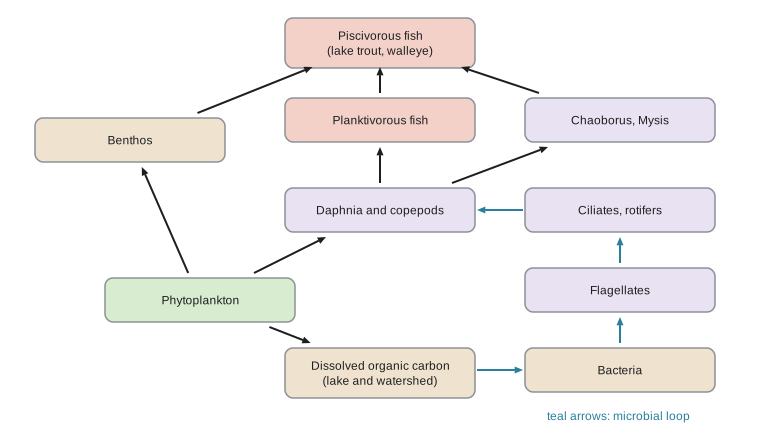
As BIOL-208 showed, only about a tenth of the energy at one trophic level, on average, becomes biomass at the next, so food chains in lakes rarely have more than four or five links. The number of links matters for more than energy. Contaminants such as methylmercury biomagnify, becoming more concentrated at each step, so top predators in lakes with longer food chains carry more mercury. Studies of Ontario lakes in the 1990s found that lake trout had higher mercury where their food chain included Mysis and pelagic forage fish than where they ate mainly invertebrates, an idea that returns in Lesson 11.
Trophic cascades
If fish control zooplankton and zooplankton control algae, then changing the fish should change the algae. In 1985 Stephen Carpenter, James Kitchell and James Hodgson proposed that such cascading trophic interactions explain why lakes with the same nutrient supply differ in productivity. Adding piscivorous fish suppresses planktivores, so large zooplankton increase and algae decline; removing piscivores does the reverse. The effect cascades through alternating levels, so the top level of a four-level chain indirectly benefits the algae.
Carpenter and Kitchell tested the idea with whole-lake experiments in Peter, Paul and Tuesday lakes, small lakes at the University of Notre Dame Environmental Research Center on the Michigan–Wisconsin border. Paul Lake was left as a reference. In Peter Lake, largemouth bass were removed and planktivorous minnows added; in Tuesday Lake, the planktivores were removed and bass added. The zooplankton and algae responded in the directions the cascade predicted, with large Daphnia and lower chlorophyll in lakes dominated by piscivores, though the responses were noisy and depended on nutrient levels. Later experiments added nutrients and showed that strong piscivore control could dampen, but not prevent, blooms in enriched lakes.
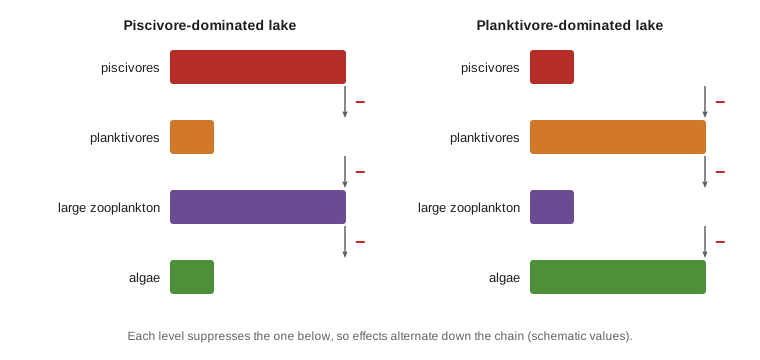
Using cascades deliberately to improve water quality is called biomanipulation. In shallow European lakes, removing large fractions of the planktivorous and bottom-feeding fish has often cleared the water and allowed plants to return, at least for several years. Success is most likely in shallow lakes with moderate nutrient levels and when fish removal is large and repeated; in very fertile lakes, cyanobacteria too large or toxic for Daphnia can escape grazing, and the effect fades as fish recover. Biomanipulation is a supplement to nutrient reduction, not a substitute, a point that matters for Mallard Lake in Lesson 12.
The class explores a cascade with a small simulation: algae grow logistically, Daphnia graze them, and planktivorous fish eat Daphnia at a rate set by their abundance.
def run(planktivory, days=400, dt=0.05):
    A, Z = 5.0, 0.5            # algae (micrograms chlorophyll per L), Daphnia (per L)
    r, K = 0.6, 60.0           # algal growth rate per day, carrying capacity set by nutrients
    a, h, e, m = 0.08, 0.02, 0.5, 0.05   # grazing, handling, conversion, Daphnia death
    for _ in range(int(days / dt)):
        graze = a * A / (1 + a * h * A) * Z
        dA = r * A * (1 - A / K) - graze
        dZ = e * graze - m * Z - planktivory * Z
        A, Z = max(A + dA * dt, 1e-6), max(Z + dZ * dt, 1e-6)
    return A, Z
for label, p in (('few planktivores', 0.05), ('moderate', 0.30), ('many planktivores', 0.90)):
    A, Z = run(p)
print(f"{label:18s} Daphnia {Z:6.2f} per L algae {A:5.1f} micrograms chlorophyll per L")few planktivores Daphnia 7.23 per L algae 2.7 micrograms chlorophyll per L moderate Daphnia 6.48 per L algae 8.9 micrograms chlorophyll per L many planktivores Daphnia 4.59 per L algae 24.7 micrograms chlorophyll per L
The model is a caricature, with invented parameters and none of the size structure or behaviour of real plankton, but it shows the logic: the same nutrient supply, represented by the carrying capacity, can support clear or green water depending on what happens at the top of the food web.
Zooplankton are also the critical first food of young fish. Most fish larvae can eat only small, soft prey such as rotifers and copepod nauplii, and they starve within days if they hatch when such food is scarce. The match-mismatch hypothesis, first proposed for marine fisheries, holds that year-to-year variation in fish recruitment depends largely on whether the timing of larval hatching matches the seasonal peak of suitable zooplankton. Because warming advances the timing of plankton peaks more than it advances the spawning of some fish, which may be cued partly by day length, ecologists are watching for growing mismatches in lakes. At Kestrel Lake, Marcus Achebe's larval fish tows and Lena Fournier's zooplankton counts are timed so that the two can be compared each spring.
Common mistakes
MistakeZooplankton stay at the same depth all day.
InsteadMany migrate tens of metres daily, mainly to avoid visual predators.
MistakePlanktivorous fish make a lake clearer because they eat plankton.
InsteadThey eat zooplankton, which releases algae from grazing, so they usually make the water greener.
MistakeBiomanipulation can replace nutrient control.
InsteadCascade effects weaken in very fertile lakes and fade as fish recover; nutrients must still be reduced.
Summary and key terms
- Freshwater zooplankton are mainly protozoa, rotifers, cladocerans and copepods, with predatory invertebrates such as Chaoborus.
- Daphnia reproduce by cyclic parthenogenesis and can filter a large share of lake water each day.
- Diel vertical migration trades food and warmth for safety from visual predators.
- The size-efficiency hypothesis links planktivorous fish to small zooplankton and greener water.
- The microbial loop channels dissolved organic carbon into the food web; trophic cascades link fish to algae.
- Clearance rate
- The volume of water from which a filter feeder removes particles per unit time.
- Cyclic parthenogenesis
- Alternation between asexual reproduction by females and sexual reproduction producing resting eggs.
- Diel vertical migration
- Daily movement of zooplankton between deep water by day and surface water by night.
- Microbial loop
- The pathway by which dissolved organic carbon passes through bacteria and protozoa to larger consumers.
- Trophic cascade
- Indirect effects of predators that alternate down a food chain to the primary producers.
- Biomanipulation
- Managing fish communities to strengthen grazing on algae and improve water clarity.
Practice problems
Work each problem on paper first, then reveal the answer to check.
A lake has 10 Daphnia per litre each clearing 15 millilitres per day. What share of the water is filtered daily?
Show answer
0.15, since 10 times 15 millilitres is 150 millilitres per litre.
Why do Daphnia from fishless ponds migrate little?
Show answer
Without visual predators there is little benefit to hiding in cold, food-poor depths.
In a four-level chain of piscivores, planktivores, zooplankton and algae, what is the effect of adding piscivores on algae?
Show answer
Algae decrease, because piscivores reduce planktivores and zooplankton increase.
Lesson quiz · 5 questions
Score 60% or more to complete this lesson.
Create a free account to save your progress, take quizzes and earn a certificate.