
BIOL-450 · Lesson 2 of 12 · 24 min
Oncogenes and growth signalling
Normal cells divide only when told to. Growth factors outside the cell bind receptors on its surface, the receptors switch on cascades of signalling proteins inside, and those cascades turn on the genes that drive the cell through the cell cycle. When the signal stops, the cascade switches off. Cancer cells short-circuit this chain so that the proliferative signal never stops. The genes whose activated forms do this are oncogenes, and their normal counterparts are proto-oncogenes. BIOL-214 covered receptors and signalling in normal cells; this lesson asks how those same pathways are hijacked, and how the discovery of oncogenes led to the first targeted cancer drugs.
From tumour viruses to proto-oncogenes
The first oncogenes were found in viruses. In 1911 Peyton Rous showed that a filterable agent, later named Rous sarcoma virus, transmitted sarcomas between chickens. Six decades later the gene responsible, src, was identified in the virus. In 1976 Harold Varmus and Michael Bishop made the discovery that changed the field: normal chicken cells, and indeed all vertebrate cells, carried a closely related gene. The viral oncogene was a captured and altered copy of a normal cellular gene, a proto-oncogene, picked up by the retrovirus from a host cell. Bishop and Varmus received the 1989 Nobel Prize in Physiology or Medicine. The implication was profound. Cancer genes were not foreign; they were the cell's own growth-control genes in damaged form.
Soon afterwards, transfection experiments by Robert Weinberg, Michael Wigler and Mariano Barbacid showed that DNA from human bladder carcinoma cells could transform mouse fibroblasts in culture. The transforming gene was a mutant HRAS, differing from the normal gene by a single base, which changed glycine 12 to valine. A single point mutation was enough to turn a normal growth gene into a cancer gene.
How proto-oncogenes are activated
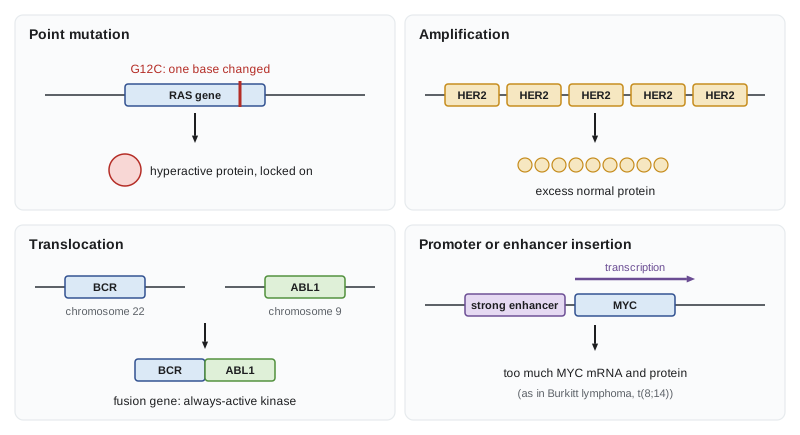
Oncogenes act dominantly at the level of the cell: one activated allele is enough to push signalling, because the mutant protein is hyperactive regardless of what the normal allele does. Proto-oncogenes are activated by four main mechanisms. Point mutations can lock a protein in its active state, as in RAS, or create a kinase that is always on, as in the EGFR L858R mutation common in lung adenocarcinoma of never-smokers, or BRAF V600E in melanoma. Gene amplification produces many copies of a gene, so the normal protein is made in excess; HER2 (ERBB2) amplification in about 15 to 20 per cent of breast cancers and MYCN amplification in aggressive neuroblastoma are classic examples. Chromosomal translocations can fuse two genes into a new hybrid protein, or move a gene next to a strong promoter; the Philadelphia chromosome, a translocation between chromosomes 9 and 22, creates the BCR-ABL fusion kinase in chronic myeloid leukemia, and the t(8;14) translocation in Burkitt lymphoma places MYC under the control of immunoglobulin enhancers. Finally, insertional mutagenesis by retroviruses can place a strong viral promoter beside a proto-oncogene; this is common in animal tumours and was an unwanted side effect in some early gene therapy trials.
The RAS–MAPK and PI3K pathways
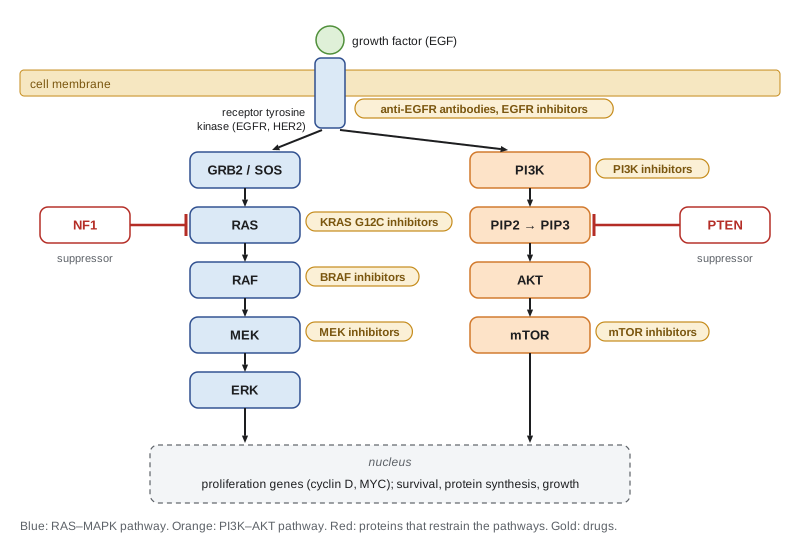
Two signalling pathways are mutated so often in cancer that they deserve detailed attention. In the RAS–MAPK pathway, a growth factor such as epidermal growth factor binds its receptor tyrosine kinase (RTK), the receptor dimerizes and phosphorylates tyrosines on its own tail, and adaptor proteins such as GRB2 recruit SOS, a guanine nucleotide exchange factor. SOS loads RAS with GTP. Active RAS recruits and activates RAF, which phosphorylates MEK, which phosphorylates ERK. ERK enters the nucleus and phosphorylates transcription factors that switch on genes for cell cycle entry, including cyclin D. RAS has its own slow GTPase activity, accelerated by GTPase-activating proteins such as NF1, which switches it off.
The oncogenic RAS mutations at codons 12, 13 and 61 cripple GTP hydrolysis, so RAS stays loaded with GTP and keeps signalling without any growth factor. RAS genes (KRAS, NRAS and HRAS) are mutated in roughly a fifth to a quarter of human cancers, including most pancreatic adenocarcinomas, about 40 per cent of colorectal cancers and about 30 per cent of lung adenocarcinomas. Loss of NF1 has a similar effect by removing the brake on RAS.
The PI3K pathway runs alongside. Activated RTKs and RAS recruit phosphoinositide 3-kinase, which converts the membrane lipid PIP2 to PIP3. PIP3 recruits the kinase AKT, which promotes cell survival, growth and glucose uptake, partly through mTOR. The phosphatase PTEN reverses the reaction, converting PIP3 back to PIP2, and acts as a tumour suppressor; lesson 3 returns to it. Activating mutations in PIK3CA, the gene for the catalytic subunit of PI3K, are among the most frequent mutations in breast cancer.
MYC: a transcriptional amplifier
Not all oncogenes are kinases or signal transducers. MYC is a transcription factor that, with its partner MAX, binds DNA at E-box sequences and broadly amplifies the transcription of active genes, especially those for ribosome biogenesis, metabolism and cell cycle progression. In normal cells MYC is short-lived and tightly controlled by growth signals; ERK, for example, stabilizes MYC protein. In cancer, MYC is activated by amplification, translocation or upstream signalling and is deregulated in a large share of tumours. Overexpressed MYC alone tends to trigger apoptosis, a built-in safeguard. Cancer therefore usually combines MYC activation with a block on apoptosis, such as loss of p53 or overexpression of BCL-2, an early example of oncogene cooperation.
Oncogene cooperation and oncogene addiction
Classic experiments in the 1980s showed that a single oncogene rarely transforms primary rodent cells: activated RAS and MYC together could, but neither alone. Transgenic mice expressing MYC or RAS in the mammary gland developed tumours after a long delay, and mice carrying both developed tumours faster. Such cooperation reflects the multistep nature of cancer met in lesson 1: no single change confers all the hallmarks.
Paradoxically, once a tumour has evolved around an oncogene, it often becomes dependent on it. Bernard Weinstein called this oncogene addiction. Switching off the oncogene in established tumours in mouse models, for example by turning off a doxycycline-controlled MYC transgene, causes the tumours to regress. Oncogene addiction is the biological basis of targeted therapy: a drug that blocks the addicting oncogene can kill tumour cells while sparing normal cells that do not depend on it.
From oncogenes to targeted drugs
Imatinib is the landmark. Designed to inhibit the ABL kinase, it binds the inactive conformation of BCR-ABL and blocks ATP binding. In clinical trials led by Brian Druker, almost all patients with chronic-phase chronic myeloid leukemia responded, and the US Food and Drug Administration approved imatinib in 2001. Chronic myeloid leukemia changed from a disease that usually killed within a few years to one in which most patients on treatment have a near-normal life expectancy. Trastuzumab, a monoclonal antibody against HER2 approved in 1998, did the same for HER2-amplified breast cancer, which had been among the worst-prognosis subtypes. EGFR kinase inhibitors such as gefitinib, erlotinib and later osimertinib transformed treatment of EGFR-mutant lung cancer, and BRAF plus MEK inhibitor combinations did so for BRAF V600-mutant melanoma.
RAS was long called undruggable: its smooth surface offered no obvious pocket, and its affinity for GTP is extremely high. The breakthrough came from Kevan Shokat's group, who in 2013 found a pocket beneath the switch II region that could be reached by drugs reacting covalently with the cysteine present in KRAS G12C, a mutation caused mainly by tobacco smoke. Sotorasib received accelerated approval from the FDA in 2021 for KRAS G12C-mutant non-small cell lung cancer, followed by adagrasib in 2022, and both have been authorized in Canada (approvals as of 2026; check current labels). Responses are real but usually partial and temporary, and resistance develops through new RAS mutations or reactivation of the pathway, a theme for lesson 11. Inhibitors aimed at other RAS mutations and at active, GTP-bound RAS are in clinical trials.
In Maya's case, her KRAS mutation turns out to be G12C. That matters: it makes her eligible for a KRAS G12C inhibitor after first-line treatment, a choice that did not exist a decade ago. Lesson 10 shows how her tumour was sequenced to find this.
Growth signalling can also be hijacked from outside the cell. Some tumours make their own growth factors and the receptors for them, a loop called autocrine stimulation; glioblastomas, for example, often co-express PDGF and its receptor. Others amplify or mutate receptors so that they signal without ligand, as with the EGFRvIII deletion mutant in glioblastoma, which lacks most of the ligand-binding domain and is constantly active. Still others rely on growth factors supplied by surrounding stromal cells, a theme lesson 7 takes up. Whatever the route, the outcome is the same: a proliferative signal that no longer depends on the body's needs.
Measuring how strongly a cancer depends on an oncogene is a routine laboratory task. Cells grown in culture are exposed to a range of drug concentrations, and viability after a few days is measured, for instance by an assay of cellular ATP. The data are fitted with a Hill equation, \(V = V_{max}/(1 + (c/IC_{50})^{h})\), where \(IC_{50}\) is the concentration that halves viability and \(h\) describes the steepness of the curve. Comparing \(IC_{50}\) values between cells that carry the target mutation and cells that do not gives a first measure of selectivity.
# Dose-response: an EGFR inhibitor in EGFR-mutant and wild-type cell lines (synthetic data), Hill fit for IC50.
import numpy as np
from scipy.optimize import curve_fit
def hill(c, top, ic50, h):
    return top / (1 + (c / ic50) ** h)
rng = np.random.default_rng(22)
conc = np.logspace(-3, 1, 9)                     # micromolar, 1 nM to 10 uM
truth = {'EGFR-mutant': (100, 0.02, 1.2), 'EGFR wild-type': (100, 2.5, 1.0)}
for name, (top, ic, h) in truth.items():
    viab = hill(conc, top, ic, h) + rng.normal(0, 3, conc.size)
    p, _ = curve_fit(hill, conc, viab, p0=[100, 0.1, 1], bounds=([50, 1e-4, 0.3], [120, 100, 4]))
    print(f"{name:15s} IC50 = {p[1] * 1000:7.1f} nM, Hill slope = {p[2]:.2f}")
print("selectivity ratio (wild-type IC50 / mutant IC50) is the therapeutic window in vitro")EGFR-mutant IC50 = 19.6 nM, Hill slope = 1.11 EGFR wild-type IC50 = 2162.4 nM, Hill slope = 1.14 selectivity ratio (wild-type IC50 / mutant IC50) is the therapeutic window in vitro
The fitted half-maximal inhibitory concentrations differ by about two orders of magnitude. Cells carrying the activating EGFR mutation depend on the receptor and die at low drug concentrations; wild-type cells tolerate much higher concentrations. That gap, seen in cultured cells and in patients, is the therapeutic window that makes targeted therapy possible.
| Oncogene | Activation | Typical cancers | Targeted therapy example |
|---|---|---|---|
| KRAS | Point mutation (G12, G13, Q61) | Pancreatic, colorectal, lung | Sotorasib, adagrasib (G12C) |
| EGFR | Point mutation, exon 19 deletion | Lung adenocarcinoma | Osimertinib |
| ERBB2 (HER2) | Amplification | Breast, gastric | Trastuzumab, trastuzumab deruxtecan |
| BCR-ABL | Translocation t(9;22) | Chronic myeloid leukemia | Imatinib |
| BRAF | Point mutation (V600E) | Melanoma, thyroid, colorectal | Dabrafenib with trametinib |
| MYC | Amplification, translocation | Burkitt lymphoma, many solid tumours | No approved direct inhibitor |
| PIK3CA | Point mutation | Breast, endometrial | Alpelisib |
Worked problem
Reading a dose-response result
A kinase inhibitor has an IC50 of 15 nM in a cell line carrying an activating mutation in its target and 1,800 nM in a line without it. The drug reaches a steady plasma concentration of about 300 nM in patients. Is there a therapeutic window?
Show solution
- Selectivity ratio = 1,800 / 15 = 120.
- At 300 nM the mutant cells are exposed to 20 times their IC50, so strong inhibition is expected.
- The wild-type cells are exposed to about one-sixth of their IC50, so most should be spared.
- Plasma concentration is not tumour concentration, and protein binding lowers free drug, so this is a first estimate only.
Answer: Yes: the drug concentration lies well above the mutant IC50 and well below the wild-type IC50, a window of about 120-fold.
Common mistakes
MistakeThinking oncogenes are foreign genes brought in by viruses.
InsteadOncogenes are activated forms of the cell's own proto-oncogenes; viruses captured them from host cells.
MistakeAssuming both alleles of an oncogene must be mutated.
InsteadOncogenes act dominantly in the cell; one activated allele is enough.
MistakeTreating overexpression and mutation as the same thing.
InsteadAmplification gives excess normal protein; point mutation gives an altered, hyperactive protein. Drugs may work differently on each.
MistakeExpecting a targeted drug to cure a cancer permanently.
InsteadMost targeted therapies produce responses that end when resistance evolves; durable control usually needs combinations or sequencing.
MistakeCalling RAS undruggable.
InsteadKRAS G12C inhibitors are approved, and inhibitors for other RAS mutants are in trials.
Summary and key terms
- Proto-oncogenes are normal growth-control genes; oncogenes are their activated forms and act dominantly.
- Activation occurs by point mutation, amplification, translocation or promoter insertion.
- The RAS–MAPK and PI3K–AKT pathways are among the most frequently altered in cancer; NF1 and PTEN act as brakes.
- MYC broadly amplifies transcription and usually cooperates with blocks on apoptosis.
- Tumours often become addicted to the oncogene that drove them, which is the basis of targeted therapy.
- Imatinib, trastuzumab, EGFR and BRAF inhibitors and KRAS G12C inhibitors show the power and limits of targeting oncogenes.
- proto-oncogene
- A normal gene that promotes growth and can become an oncogene when altered.
- oncogene
- An activated form of a proto-oncogene that promotes uncontrolled growth.
- receptor tyrosine kinase
- A cell surface receptor that phosphorylates tyrosines when bound by its ligand, starting intracellular signalling.
- RAS
- A small GTPase that relays signals from receptors to the MAPK and PI3K pathways.
- gene amplification
- An increase in the number of copies of a gene, raising its expression.
- chromosomal translocation
- Exchange of segments between chromosomes, which can create fusion genes.
- BCR-ABL
- The fusion kinase created by the Philadelphia chromosome in chronic myeloid leukemia.
- oncogene addiction
- The dependence of an established tumour on continued activity of the oncogene that drove it.
- IC50
- The drug concentration that reduces a response, such as cell viability, by half.
- targeted therapy
- Treatment directed at a specific molecular change in cancer cells.
Practice problems
Work each problem on paper first, then reveal the answer to check.
Why does a single mutant RAS allele drive signalling even when the other allele is normal?
Show answer
The mutant protein stays GTP-bound and active independently of the normal protein.
Name the four main ways a proto-oncogene is activated.
Show answer
Point mutation, amplification, translocation and promoter insertion.
What does the Philadelphia chromosome produce?
Show answer
The BCR-ABL fusion tyrosine kinase.
Which enzyme reverses the PI3K reaction, and what kind of gene encodes it?
Show answer
PTEN, a tumour suppressor.
Why did RAS and MYC together transform primary cells when neither alone did?
Show answer
Cancer requires several cooperating changes; MYC drives growth while RAS adds signals and blocks safeguards.
What made KRAS G12C druggable?
Show answer
The mutant cysteine allowed covalent drugs to bind a pocket under the switch II region.
An inhibitor has IC50 values of 10 nM and 10,000 nM in mutant and wild-type cells. What is the selectivity ratio?
Show answer
1,000-fold.
What is oncogene addiction?
Show answer
Dependence of an established tumour on its driving oncogene, so that inhibiting it causes regression.
Lesson quiz · 5 questions
Score 60% or more to complete this lesson.
Create a free account to save your progress, take quizzes and earn a certificate.