
BIOL-450 · Lesson 11 of 12 · 28 min
Cancer therapy and drug resistance
Cancer treatment has three foundations, surgery, radiation and drugs, and each has changed as understanding of tumour biology has grown. Surgery and radiation treat the tumour where it is; drugs reach cells wherever they have spread. This lesson describes how each works, how they are combined, and why so many treatments that shrink tumours eventually fail. Resistance is the central problem of cancer therapy, and it follows directly from the evolutionary view of cancer set out in lesson 1: a large, genetically diverse population of cells under strong selection will usually contain, or soon produce, cells that survive.
Surgery and radiation
Surgery remains the most effective single treatment for most localized solid tumours. The aim is complete removal with a margin of normal tissue, together with sampling or removal of draining lymph nodes, which also provides pathological staging. Minimally invasive and robotic approaches have reduced the burden of operations, and for some tumours, organ-sparing surgery such as lumpectomy with radiation has replaced more radical procedures with equal survival.
Radiation therapy kills cells mainly by damaging DNA. Ionizing radiation produces free radicals, largely from water, that cause single- and double-strand breaks; unrepaired double-strand breaks lead to death when cells try to divide, a process called mitotic catastrophe. Dose is measured in grays (Gy), one joule absorbed per kilogram. Conventional treatment divides the total dose into daily fractions of about 2 Gy, which exploits differences between tumours and normal tissues summarized as the four Rs of radiobiology: normal cells repair sublethal damage between fractions better than many tumour cells; tumour cells redistribute into more radiosensitive phases of the cell cycle; hypoxic tumour regions reoxygenate as the tumour shrinks, and oxygen makes radiation damage permanent, which is why the hypoxia of lesson 7 confers resistance; and tumours repopulate between fractions, which argues against prolonging treatment. Stereotactic body radiotherapy (SBRT) delivers a few very large fractions with sub-centimetre precision and is now standard for small lung tumours in patients unfit for surgery. Proton therapy deposits most of its energy at a defined depth, sparing tissue beyond the target, which is especially valuable for children.
# The linear-quadratic model: surviving fraction after n fractions of dose d, S = exp(-n*(alpha*d + beta*d**2)).
import numpy as np
def survival(n, d, alpha, beta):
    return np.exp(-n * (alpha * d + beta * d ** 2))
def bed(n, d, ab):
    return n * d * (1 + d / ab)          # biologically effective dose
tumour = dict(alpha=0.30, beta=0.03)      # alpha/beta = 10 Gy, typical of many tumours
late = dict(alpha=0.10, beta=0.033)       # alpha/beta = 3 Gy, typical of late-responding normal tissue
for label, n, d in (('conventional 30 x 2 Gy', 30, 2.0), ('SBRT 3 x 18 Gy', 3, 18.0)):
    s = survival(n, d, **tumour)
    print(f"{label:24s} total {n * d:4.0f} Gy  tumour log10 kill {-np.log10(s):5.1f}  "
          f"BED tumour {bed(n, d, 10):5.0f} Gy  BED late tissue {bed(n, d, 3):5.0f} Gy")
print("SBRT is safe only because tight targeting keeps most normal tissue far below the prescribed dose")conventional 30 x 2 Gy total 60 Gy tumour log10 kill 9.4 BED tumour 72 Gy BED late tissue 100 Gy SBRT 3 x 18 Gy total 54 Gy tumour log10 kill 19.7 BED tumour 151 Gy BED late tissue 378 Gy SBRT is safe only because tight targeting keeps most normal tissue far below the prescribed dose
Chemotherapy
Cytotoxic chemotherapy began in the 1940s, when nitrogen mustards, derived from chemical warfare agents, were found to shrink lymphomas, and Sidney Farber produced remissions in childhood leukemia with the folate antagonist aminopterin. Most cytotoxic drugs damage DNA or interfere with its synthesis or with cell division, so they hit rapidly dividing cells hardest, including normal cells in the bone marrow, gut lining and hair follicles, which explains the familiar side effects of low blood counts, mouth sores, diarrhoea and hair loss.
| Class | Examples | Mechanism |
|---|---|---|
| Alkylating agents | Cyclophosphamide, temozolomide | Add alkyl groups to DNA bases, causing cross-links and breaks |
| Platinum compounds | Cisplatin, carboplatin, oxaliplatin | Form DNA cross-links that block replication |
| Antimetabolites | 5-fluorouracil, methotrexate, pemetrexed, gemcitabine | Mimic nucleotides or block enzymes of nucleotide synthesis |
| Topoisomerase inhibitors | Irinotecan, etoposide, doxorubicin | Trap topoisomerases on DNA, converting them into DNA breaks |
| Microtubule agents | Paclitaxel, docetaxel, vincristine | Stabilize or destabilize microtubules, arresting mitosis |
Several principles, worked out largely in childhood leukemia and lymphoma, still guide chemotherapy. Howard Skipper's experiments in mouse leukemia in the 1960s suggested the log-kill hypothesis: each dose kills a constant fraction of cells, not a constant number, so a drug that kills 99.9 per cent of cells reduces 10 to the power 11 cells to 10 to the power 8, still a large tumour. Repeated cycles are therefore needed, spaced to let normal tissues, especially the bone marrow, recover. Combinations of drugs with different mechanisms and non-overlapping toxicities, such as the MOPP regimen that cured advanced Hodgkin lymphoma in the 1960s, kill more cells and reduce the chance that any cell is resistant to all drugs at once. Chemotherapy given after surgery to eliminate micrometastases, adjuvant therapy, reduces recurrence in breast, colorectal, lung and other cancers, and chemotherapy given before surgery, neoadjuvant therapy, can shrink a tumour, make surgery easier and show whether the tumour is sensitive.
Hormonal therapy
Some cancers depend on hormones that drive their normal tissue of origin. About 70 per cent of breast cancers express the estrogen receptor, and tamoxifen, which blocks the receptor in breast tissue, was among the first targeted therapies; aromatase inhibitors such as letrozole block estrogen synthesis in postmenopausal women, and fulvestrant degrades the receptor. Combining endocrine therapy with CDK4/6 inhibitors such as palbociclib, ribociclib or abemaciclib, which act on the G1/S checkpoint of lesson 5, has extended survival in advanced disease. Prostate cancer depends on androgens: androgen deprivation therapy lowers testosterone, and the androgen receptor blocker enzalutamide and the androgen synthesis inhibitor abiraterone extend survival when tumours become castration-resistant.
Targeted therapy
Targeted therapies act on the specific molecular changes that drive a cancer. The model is imatinib, which inhibits the BCR–ABL kinase produced by the Philadelphia chromosome in chronic myeloid leukemia. Approved in 2001 after striking early trials led by Brian Druker, it transformed a disease that was usually fatal within a few years into one with near-normal life expectancy for most patients who take it daily. Small-molecule kinase inhibitors now target EGFR, ALK, ROS1, BRAF, MET, RET, KRAS G12C, FLT3, BTK and many others. Monoclonal antibodies target cell surface proteins: trastuzumab blocks HER2, cetuximab and panitumumab block EGFR in RAS wild-type colorectal cancer, and rituximab marks CD20-bearing lymphoma cells for immune destruction. Antibody–drug conjugates attach a potent cytotoxic payload to an antibody, delivering it to cells that carry the target; trastuzumab deruxtecan and sacituzumab govitecan are examples.
Synthetic lethality offers a different kind of target. Two genes are synthetically lethal if loss of either alone is tolerated but loss of both kills the cell. Tumours with BRCA1 or BRCA2 loss cannot repair double-strand breaks by homologous recombination (lesson 4), so they depend on other pathways. Inhibitors of PARP, an enzyme of single-strand break repair that is also trapped on DNA by the drugs, cause breaks that BRCA-deficient cells cannot fix, while normal cells, which retain one working BRCA allele, survive. Olaparib and other PARP inhibitors are approved for BRCA-mutated ovarian, breast, prostate and pancreatic cancers.
KRAS was long considered undruggable, because its smooth surface offered no pocket for a drug and its affinity for GTP was too high to compete with. In 2013, Kevan Shokat's laboratory found a pocket that opens in the inactive, GDP-bound form of the G12C mutant, where a drug can bond covalently to the mutant cysteine. Sotorasib received accelerated FDA approval in 2021 for previously treated KRAS G12C lung cancer, followed by adagrasib in 2022; inhibitors of other KRAS mutants, including G12D, and drugs that block RAS in its active state are in clinical trials. Response rates of the first G12C inhibitors in lung cancer were around 35 to 45 per cent, with responses lasting several months on average, a reminder that hitting the driver is often not enough.
Maya's treatment
Maya's stage III tumour was judged unresectable because of its mediastinal nodal involvement. The standard treatment for her situation, based on the PACIFIC trial reported in 2017 and 2018, is concurrent chemoradiation, a platinum doublet chemotherapy given alongside radiation to about 60 Gy in 30 daily fractions, followed by a year of the PD-L1 antibody durvalumab as consolidation if the disease has not progressed. In PACIFIC, durvalumab improved overall survival, with about 43 per cent of patients alive at five years compared with 33 per cent on placebo. Platinum provides systemic treatment for micrometastases and sensitizes tumour cells to radiation. Her KRAS G12C mutation does not change first-line treatment in this setting, but it gives her a targeted option if the cancer returns. Had her tumour carried an EGFR mutation instead, current practice after chemoradiation would be osimertinib rather than durvalumab, based on the LAURA trial reported in 2024.
How resistance arises
Resistance can be primary, present from the start so that the tumour never responds, or acquired, emerging after an initial response. Much acquired resistance is not created by the drug but selected by it. In 1979 James Goldie and Andrew Coldman applied the mathematics of Luria and Delbrück's bacterial experiments to tumours: if resistance arises by mutation at rate mu per cell division, the probability that a tumour contains no resistant cells falls steeply as the tumour grows, roughly as e to the power of minus mu times N, where N is the number of cells. With mutation rates around one in a million per cell and per resistance mutation, a tumour of a billion cells, about one cubic centimetre, is almost certain to contain resistant cells before treatment begins. This argued for treating early, when tumours are small, and for combinations, because the chance of a cell already resistant to two independent drugs is the product of the two small probabilities.
# Goldie-Coldman: probability that a tumour of N cells contains no resistant cell, and the payoff from combinations.
import numpy as np
mu = 1e-6                               # resistance mutations per cell division (illustrative)
for N in (1e5, 1e6, 1e7, 1e8, 1e9, 1e10):
    p_none_one = np.exp(-mu * (N - 1))
    p_none_two = np.exp(-mu * mu * (N - 1))          # resistant to two independent drugs at once
    print(f"N = {N:7.0e} cells: P(no cell resistant to drug A) = {p_none_one:6.3f}   to A and B together = {p_none_two:6.3f}")
# simulate sensitive and pre-existing resistant cells under continuous therapy
days = np.arange(0, 900)
sens0, res0 = 1e9, 50.0
grow_s, kill_s, grow_r = 0.03, 0.10, 0.025          # per day; resistant cells grow a little more slowly
sens = sens0 * np.exp((grow_s - kill_s) * days)
res = res0 * np.exp(grow_r * days)
total = sens + res
nadir = int(np.argmin(total))
detect = 1e8                                         # roughly the smallest tumour visible on a scan
hidden = days[total < detect]
print(f"nadir on day {nadir} at {total[nadir] / total[0]:.4%} of baseline")
print(f"below the imaging limit from day {hidden[0]} to day {hidden[-1]}; back above baseline on day {int(np.argmax((days > nadir) & (total > total[0])))}")
print(f"cells in the relapsed tumour that are resistant: {res[-1] / total[-1]:.1%}")N = 1e+05 cells: P(no cell resistant to drug A) = 0.905 to A and B together = 1.000 N = 1e+06 cells: P(no cell resistant to drug A) = 0.368 to A and B together = 1.000 N = 1e+07 cells: P(no cell resistant to drug A) = 0.000 to A and B together = 1.000 N = 1e+08 cells: P(no cell resistant to drug A) = 0.000 to A and B together = 1.000 N = 1e+09 cells: P(no cell resistant to drug A) = 0.000 to A and B together = 0.999 N = 1e+10 cells: P(no cell resistant to drug A) = 0.000 to A and B together = 0.990 nadir on day 188 at 0.0007% of baseline below the imaging limit from day 33 to day 580; back above baseline on day 673 cells in the relapsed tumour that are resistant: 100.0%
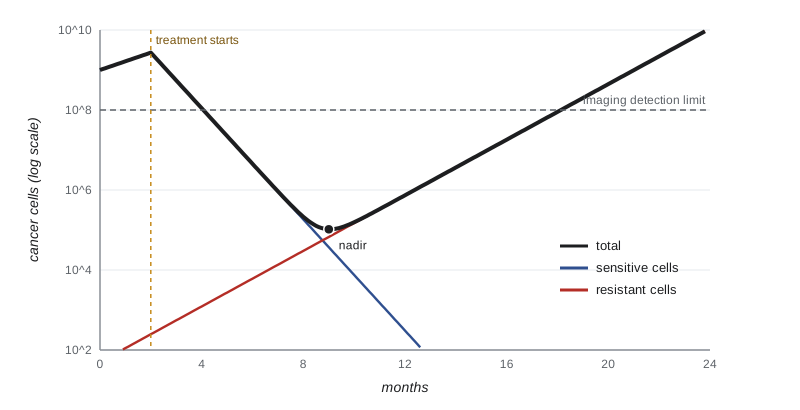
The mechanisms of resistance fall into a few groups, and the history of EGFR inhibitors in lung cancer illustrates most of them. Target alterations: about half of tumours that progressed on first-generation EGFR inhibitors carried a second EGFR mutation, T790M, that restored ATP binding; osimertinib was designed to inhibit T790M, and resistance to osimertinib can in turn involve a C797S mutation at its binding site. Similar gatekeeper and solvent-front mutations arise in BCR–ABL (T315I), ALK and ROS1, each prompting new drugs. Bypass signalling: amplification of MET, or activation of HER2 or of downstream KRAS or PIK3CA, restores growth signals without changing the target. Lineage plasticity: some EGFR-mutant adenocarcinomas transform into small cell lung cancer, usually after losing RB1 and TP53, and some prostate cancers become neuroendocrine and independent of the androgen receptor. Drug tolerance: a small fraction of cells survive treatment in a slow-growing, drug-tolerant persister state without any genetic change, as Sreenath Sharma and Jeffrey Settleman showed in 2010, buying time for genetic resistance to evolve. Pharmacological factors, such as drug efflux pumps like P-glycoprotein and poor penetration into the brain, add to these.
Resistance to KRAS G12C inhibitors follows the same patterns. Sequencing of tumours and ctDNA at progression has revealed secondary KRAS mutations that block drug binding, new activating mutations in other RAS genes, amplification of the mutant KRAS allele, MET amplification, activating mutations in BRAF, NRAS or MAP2K1, and histological transformation, often several mechanisms in one patient. Rapid feedback reactivation of upstream receptors also blunts the response from the start, which is why combinations with EGFR antibodies, already approved for KRAS G12C colorectal cancer, and with SHP2 or other pathway inhibitors are being tested.
Strategies against resistance
Several approaches aim to stay ahead of resistance. Sequential drugs designed against known resistance mutations, as for EGFR, ALK and BCR–ABL, extend control. Upfront combinations, the lesson of combination chemotherapy and of HIV treatment, aim to make simultaneous resistance unlikely, though toxicity often limits how many targeted drugs can be combined. Repeat biopsies and liquid biopsies at progression identify the mechanism in each patient and guide the next treatment. A more radical idea, adaptive therapy, developed by Robert Gatenby and colleagues, borrows from pest management: rather than killing as many cells as possible, which removes sensitive competitors and frees resistant cells to grow, treatment is paused once the tumour shrinks and resumed when it regrows, keeping sensitive cells to suppress resistant ones. A small pilot trial in men with metastatic castration-resistant prostate cancer, adjusting abiraterone doses according to PSA levels, reported longer control with less drug than expected, and larger trials are under way.
Worked problem
Combination arithmetic
A tumour of 10 to the power 10 cells is treated with drug A, to which a cell becomes resistant at a rate of 1 in 10 to the power 7 per division, and drug B, with an independent resistance rate of 1 in 10 to the power 6. Roughly how many cells are expected to be resistant to A, to B, and to both, before treatment, if the number of resistant cells is about the mutation rate times N?
Show solution
- Resistant to A: 10 to the power 10 x 10 to the power -7 = 1,000 cells.
- Resistant to B: 10 to the power 10 x 10 to the power -6 = 10,000 cells.
- Resistant to both: 10 to the power 10 x 10 to the power -13 = 0.001 cells, so most tumours of this size contain no doubly resistant cell.
- Either drug alone will select a resistant population; the combination given together has a good chance of eliminating every pre-existing resistant cell, provided both can be given at effective doses.
Answer: About 1,000 resistant to A and 10,000 to B, but only about 0.001 resistant to both, which is the rationale for combinations.
Common mistakes
MistakeAssuming a drug causes the resistance mutations it encounters.
InsteadMost acquired resistance reflects selection of cells that already carried, or randomly acquired, resistance changes.
MistakeExpecting one round of chemotherapy to cure a cancer that shrinks dramatically.
InsteadLog-kill means a 99.9 per cent kill can leave hundreds of millions of cells.
MistakeThinking targeted drugs have no side effects.
InsteadTargets are often present in normal tissues; EGFR inhibitors cause rash and diarrhoea, and many drugs have off-target effects.
MistakeTreating all resistance as genetic.
InsteadDrug-tolerant persisters and lineage plasticity allow survival without new mutations.
MistakeAssuming maximum dose is always best.
InsteadAdaptive therapy argues that keeping sensitive cells can suppress resistant ones, though evidence is still early.
Summary and key terms
- Surgery and radiation treat local disease; fractionated radiation exploits repair, redistribution, reoxygenation and repopulation.
- Cytotoxic chemotherapy damages DNA or blocks division; log-kill kinetics, combinations and adjuvant use guide its application.
- Hormonal therapies block estrogen or androgen signalling in breast and prostate cancers.
- Targeted therapies inhibit driver proteins such as BCR–ABL, EGFR, ALK and KRAS G12C; PARP inhibitors exploit synthetic lethality in BRCA-deficient tumours.
- Maya's stage III disease is treated with concurrent chemoradiation followed by durvalumab, with a KRAS G12C inhibitor in reserve.
- Resistance is usually selected from pre-existing or newly arising variants; large tumours almost certainly contain resistant cells.
- Resistance mechanisms include target mutations, bypass signalling, lineage plasticity, drug tolerance and pharmacological factors; combinations, sequencing and adaptive therapy are strategies to counter it.
- gray
- The unit of absorbed radiation dose, one joule per kilogram.
- fractionation
- Dividing a radiation dose into multiple smaller treatments.
- log-kill hypothesis
- The idea that each chemotherapy dose kills a constant fraction of tumour cells.
- adjuvant therapy
- Treatment after surgery to reduce the risk of recurrence.
- neoadjuvant therapy
- Treatment before surgery to shrink a tumour.
- targeted therapy
- A drug directed at a specific molecular change that drives a cancer.
- antibody–drug conjugate
- An antibody linked to a cytotoxic drug that it delivers to target cells.
- synthetic lethality
- A situation in which loss of either of two genes is tolerated but loss of both is lethal.
- acquired resistance
- Resistance that emerges after an initial response to treatment.
- drug-tolerant persister
- A cell that survives treatment in a reversible slow-growing state without a resistance mutation.
- adaptive therapy
- Treatment adjusted to tumour response to maintain sensitive cells that suppress resistant ones.
Practice problems
Work each problem on paper first, then reveal the answer to check.
List the four Rs of radiobiology.
Show answer
Repair, redistribution, reoxygenation and repopulation.
Why does hypoxia make tumours resistant to radiation?
Show answer
Oxygen fixes radiation damage to DNA; without it, more damage is repaired.
A drug kills 99 per cent of cells per cycle. How many cycles reduce 10 to the power 10 cells to fewer than one?
Show answer
Each cycle removes 2 logs, so 5 cycles reach 1 cell and 6 cycles go below one, ignoring regrowth.
Explain why PARP inhibitors spare normal cells in a BRCA2 carrier.
Show answer
Normal cells keep one working BRCA2 allele and can repair breaks by homologous recombination; tumour cells cannot.
What made KRAS G12C druggable?
Show answer
A pocket in the GDP-bound mutant allows covalent binding to the mutant cysteine.
Name the resistance mutation that osimertinib was designed to overcome.
Show answer
EGFR T790M.
Give two non-genetic mechanisms of resistance.
Show answer
Drug-tolerant persister states and lineage plasticity, or poor drug penetration and efflux.
What is the rationale for adaptive therapy?
Show answer
Sensitive cells compete with resistant cells; preserving them can delay the takeover by resistant cells.
Lesson quiz · 5 questions
Score 60% or more to complete this lesson.
Create a free account to save your progress, take quizzes and earn a certificate.