
BIOL-440 · Lesson 7 of 12 · 24 min
Caribou and the conservation of northern species
No animal is more closely tied to the North than the caribou. For thousands of years caribou have fed, clothed and shaped the cultures of Inuit, Dene, Cree, Gwich'in, Iñupiat and many other peoples, and their migrations are among the great wildlife spectacles of the world. Yet across most of their range caribou are declining, some herds by more than 90 per cent from their peaks. This lesson looks at caribou ecology, the evidence for decline, its causes, and the tools used to conserve caribou, from protecting habitat and restoring seismic lines to maternal penning, predator management and harvest co-management. BIOL-367 introduced the federal recovery strategy for boreal caribou and its 65 per cent undisturbed-habitat threshold; here we look at the ecology behind such rules and at management on the ground.
One species, many ways of life
Caribou and reindeer belong to a single species, Rangifer tarandus, distributed around the Arctic and boreal regions; reindeer are the Eurasian forms, many of them domesticated or semi-domesticated. In North America, ecologists recognize several ecotypes, groups adapted to different ways of life. Barren-ground or migratory tundra caribou form large herds that calve on the tundra in early summer and migrate hundreds of kilometres to winter in the northern forest; the Porcupine, Bathurst, Bluenose, Qamanirjuaq, George River and Western Arctic herds are examples. Boreal woodland caribou live year-round in mature conifer forest and peatlands in small, dispersed groups, avoiding predators by spacing out across large areas of old forest and wetland. Mountain caribou of the western cordillera migrate up and down slopes, and some feed in winter on arboreal lichens in deep-snow old-growth forests. Peary caribou, the smallest, live in the high Arctic islands, and Dolphin and Union caribou migrate across sea ice between Victoria Island and the mainland.
All caribou share adaptations to cold and snow: hollow hairs that insulate, large crescent-shaped hooves that act as snowshoes in winter and paddles when swimming, and a diet that, unusually among large mammals, relies heavily in winter on terrestrial lichens. Lichens are energy-rich but low in protein and grow slowly, a few millimetres a year, so a lichen range takes 50 to 100 years or more to recover after fire or heavy grazing. Caribou find lichens beneath snow by smell and dig feeding craters; snow depth and hardness determine how much energy that costs.
Calving is the most sensitive time. Migratory herds return to traditional calving grounds, often on coastal tundra where predators are few and early green plants such as cotton grass are nutritious. Boreal woodland caribou cows instead disperse to calve alone in peatlands and islands, spacing away from moose, wolves and bears. Calf survival through the first year, measured as calves per 100 cows in late winter, is the key indicator of population trend: values below about 25 to 30 calves per 100 cows usually signal decline in boreal caribou.
Evidence of decline
Many migratory herds in Canada have declined sharply since the 1990s. The George River herd of northern Quebec and Labrador, once among the largest in the world and part of an Ungava population that exceeded one million animals, fell to about 8,000 caribou by recent surveys, and the 2024 estimate of about 8,600 animals was the first increase in more than 25 years; hunting has been closed for years. In the Northwest Territories, the 2025 survey estimated about 3,600 adult Bathurst caribou, down from about 6,900 in 2022 and from hundreds of thousands in the 1980s, while the Bluenose-East herd was about 28,800. Boreal woodland caribou are listed as threatened under the Species at Risk Act, and the 2012 recovery strategy assessed most of the 51 local boreal populations as not self-sustaining. COSEWIC assessed barren-ground caribou as threatened in 2016, and several southern mountain herds have disappeared entirely.
Population trend is estimated from repeated counts, usually photographic surveys of calving or post-calving aggregations for migratory herds and collar-based estimates for boreal caribou. Because counts are noisy and taken every few years, ecologists fit a log-linear regression of log population on year. The slope gives the instantaneous rate of change \(r\), from which the annual rate \(\lambda = e^r\) and the halving time \(\ln 2 / |r|\) follow.
# Log-linear trend for a synthetic barren-ground herd counted every 2-3 years.
import numpy as np
from scipy import stats
years = np.array([1990, 1993, 1996, 1999, 2002, 2005, 2008, 2010, 2012, 2015, 2018, 2021, 2024])
rng = np.random.default_rng(707)
true = 420_000 * np.exp(-0.11 * (years - 1990))
true[years >= 2010] = true[years == 2010] * np.exp(-0.05 * (years[years >= 2010] - 2010))
counts = np.round(true * np.exp(rng.normal(0, 0.12, years.size)), -2)
for (lo, hi) in ((1990, 2010), (2010, 2024)):
    m = (years >= lo) & (years <= hi)
    fit = stats.linregress(years[m], np.log(counts[m]))
    lam = np.exp(fit.slope)
    print(f"{lo}-{hi}: r = {fit.slope:+.3f} per year, lambda = {lam:.3f}, halving time {np.log(2) / abs(fit.slope):.0f} years, "
          f"95% CI for r {fit.slope - 1.96 * fit.stderr:+.3f} to {fit.slope + 1.96 * fit.stderr:+.3f}")
print(f"count in 1990: {counts[0]:,.0f} count in 2024: {counts[-1]:,.0f} overall decline {100 * (1 - counts[-1] / counts[0]):.0f}%")1990-2010: r = -0.105 per year, lambda = 0.900, halving time 7 years, 95% CI for r -0.121 to -0.089 2010-2024: r = -0.039 per year, lambda = 0.962, halving time 18 years, 95% CI for r -0.057 to -0.020 count in 1990: 413,000 count in 2024: 28,400 overall decline 93%
Splitting the series shows a steep early decline and a slower later one, a pattern seen in several real herds. Confidence intervals matter: with few surveys and large count errors, a slowing decline can be hard to distinguish from stability, which is why managers combine counts with vital rates from collared animals, adult female survival and calf recruitment, to judge whether a herd has turned the corner.
Why are caribou declining?
Caribou declines have several interacting causes, and their mix differs between ecotypes and regions. For boreal and mountain caribou, the dominant cause is habitat change that increases predation. Forestry, roads, seismic lines, pipelines, mines and fire convert old forest and peatland into young forest, which supports more moose and deer and therefore more wolves, while linear features act as travel corridors that let wolves move faster and encounter caribou more often. Studies using GPS collars on wolves and caribou in Alberta and British Columbia have shown wolves travelling along seismic lines at speeds several times higher than through the forest, and caribou survival declining with the density of linear features in their range. The key relationship, compiled across 57 ranges for the 2011 federal science assessment, is between the percentage of a range disturbed, by fire and human features buffered by 500 metres, and calf recruitment.
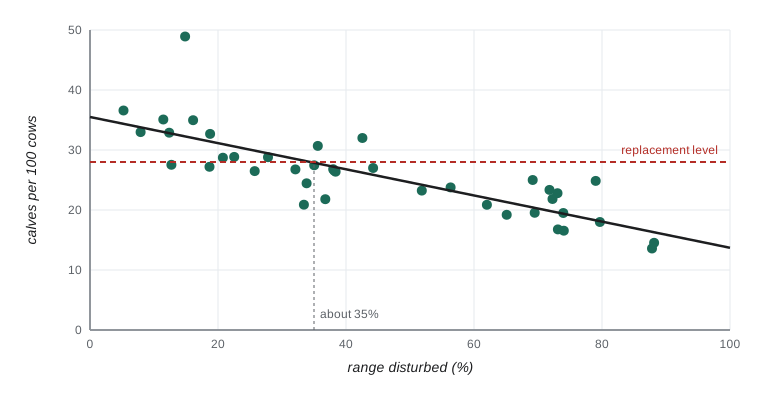
# Disturbance and recruitment across synthetic caribou ranges, with a replacement threshold.
import numpy as np
from scipy import stats
rng = np.random.default_rng(77)
dist = rng.uniform(5, 90, 40)                                   # % of range disturbed (fire + buffered human features)
recruit = 36 - 0.24 * dist + rng.normal(0, 4.5, dist.size)      # calves per 100 cows in late winter
fit = stats.linregress(dist, recruit)
replacement = 28.0                                              # approximate calves per 100 cows needed for stability
crossing = (replacement - fit.intercept) / fit.slope
print(f"recruitment = {fit.intercept:.1f} {fit.slope:+.3f} x disturbance  (r2 = {fit.rvalue ** 2:.2f})")
print(f"predicted recruitment at 20% disturbed: {fit.intercept + 20 * fit.slope:.1f}; at 60% disturbed: {fit.intercept + 60 * fit.slope:.1f}")
print(f"disturbance at which recruitment falls to replacement: about {crossing:.0f}%")
print(f"ranges below replacement: {np.sum(recruit < replacement)} of {dist.size}")recruitment = 35.5 -0.218 x disturbance (r2 = 0.65) predicted recruitment at 20% disturbed: 31.2; at 60% disturbed: 22.5 disturbance at which recruitment falls to replacement: about 35% ranges below replacement: 28 of 40
With these illustrative data, recruitment falls below replacement at roughly 35 per cent disturbance, close to the 65 per cent undisturbed threshold in the recovery strategy. The real analysis used a logistic model of the probability that a population is self-sustaining and accounted for uncertainty; the threshold of 65 per cent undisturbed was chosen to give a 60 per cent probability of self-sustainability, a value that was itself a policy decision about acceptable risk.
For migratory herds, causes are more varied and debated. Natural cycles in abundance occurred before industrial development, as Indigenous oral histories and historical records describe, and herds can decline when they outgrow their range. But recent declines coincide with warmer, more variable climate, more frequent rain-on-snow icing, more insect harassment by mosquitoes and warble and bot flies in hot summers, large fires on winter ranges, expanding development, and in some herds harvest levels that were not reduced quickly enough. Disentangling these factors is hard because they act together and herds range over enormous areas.
Conservation tools
Protecting and restoring habitat is the foundation of caribou conservation, but because forests take decades to mature and lichens even longer, habitat measures alone cannot halt short-term declines in small herds. Managers have therefore used several more direct and sometimes controversial tools.
| Tool | How it works | Evidence and concerns |
|---|---|---|
| Habitat protection | Limit new disturbance in ranges; protected and Indigenous conserved areas | Essential long term; slow to show effects |
| Seismic line restoration | Replant, mound soil, place logs to block travel and regrow forest | Reduces wolf travel; recovery takes decades |
| Maternal penning | Pregnant cows held in predator-proof pens through calving | Raised calf survival; costly; small scale |
| Predator reduction | Wolf removal by aerial shooting or trapping | Increased caribou growth in several studies; ethical and social controversy |
| Moose reduction | Increased moose harvest to lower wolf numbers | Promising in some ranges; slower |
| Harvest management | Reduced or closed harvest, guided by co-management boards | Essential when herds are low; heavy cultural cost |
| Translocation | Moving caribou between ranges or to predator-free islands | Mixed results; useful for very small herds |
Maternal penning has an Indigenous-led success story. In northeastern British Columbia, the West Moberly and Saulteau First Nations began penning pregnant cows of the Klinse-Za herd in 2014, with partners, alongside wolf reduction by the province. A study published in 2024 reported that the herd, which had fallen to about 38 animals in 2013, roughly tripled in under a decade, and argued that the combined measures together with habitat protection gave the herd a chance of recovery. The case illustrates both the potential of intensive management and its cost: such programs run for years at millions of dollars, buying time while habitat recovers.
Predator reduction is the most contentious tool. Wolf culls in Alberta's Little Smoky range, in British Columbia and elsewhere have increased caribou population growth rates in studies, but they raise ethical objections, affect wolves that are themselves valued by many people, and must continue indefinitely unless habitat is restored. Many ecologists argue that predator reduction without habitat protection simply delays extinction while disturbance continues to grow.
Harvest co-management has grown since the land claims agreements of the 1980s and 1990s. Boards such as the Porcupine Caribou Management Board, the Wek'èezhìi Renewable Resources Board and the Beverly and Qamanirjuaq Caribou Management Board bring Indigenous governments and Crown agencies together to set harvest and protect habitat. When the Bathurst herd collapsed, the Tłı̨chǫ Government and the Northwest Territories agreed in 2015 to close harvest of that herd, a decision with deep cultural costs for communities that had relied on it for generations. Federal-provincial agreements under section 11 of the Species at Risk Act, provincial range plans and Indigenous-led protected areas are the main tools for boreal caribou habitat.
Worked problem
Halving time from two surveys
A herd was counted at 48,000 in 2014 and 21,000 in 2023. Assuming exponential decline, calculate r, the annual rate lambda, and the halving time. If the decline continues, when would the herd fall below 10,000?
Show solution
- r = ln(21,000 / 48,000) / 9 = ln(0.4375) / 9 = −0.827 / 9 = −0.092 per year.
- lambda = e^−0.092 = 0.912, a decline of about 8.8 per cent per year.
- Halving time = ln 2 / 0.092 = 7.5 years.
- Years from 2023 to reach 10,000: ln(10,000 / 21,000) / −0.092 = 0.742 / 0.092 = 8.1 years, around 2031.
Answer: r = −0.092 per year, lambda = 0.91, halving time about 7.5 years; below 10,000 around 2031 if nothing changes.
Common mistakes
MistakeTreating all caribou as one kind of animal with one problem.
InsteadEcotypes differ in behaviour, habitat and threats; boreal, mountain and migratory caribou need different measures.
MistakeAssuming caribou and moose compete for food.
InsteadThe main link is shared predators: more moose support more wolves that also kill caribou.
MistakeExpecting habitat restoration to reverse declines quickly.
InsteadForests and lichens take decades to recover, so small herds may need short-term measures meanwhile.
MistakeJudging trend from two counts alone.
InsteadUse several surveys with confidence intervals, plus survival and recruitment from collared animals.
MistakeIgnoring Indigenous knowledge and governance.
InsteadOral histories document past cycles, and Indigenous-led programs such as maternal penning have achieved recoveries.
Summary and key terms
- Caribou and reindeer are one species with ecotypes: migratory tundra, boreal woodland, mountain, Peary and others.
- Winter diet relies on slow-growing terrestrial lichens; calf recruitment is the key indicator of trend.
- Many herds have declined steeply, including the George River, Bathurst and Western Arctic herds.
- For boreal and mountain caribou, disturbance that increases moose, wolves and wolf travel efficiency is the main cause.
- Log-linear regression of counts gives rates of change and halving times; vital rates confirm trends.
- Tools include habitat protection and restoration, maternal penning, predator and moose reduction, translocation and harvest co-management.
- ecotype
- A population group adapted to a particular habitat and way of life within a species.
- migratory tundra caribou
- Caribou that calve on the tundra and migrate long distances to winter in the forest.
- boreal woodland caribou
- Caribou that live year-round in mature boreal forest and peatlands in small, dispersed groups.
- calf recruitment
- The number of calves surviving to late winter per 100 cows, a key indicator of population trend.
- halving time
- The time for a declining population to fall by half, ln 2 divided by the decline rate.
- linear feature
- A narrow corridor such as a road, seismic line or pipeline right-of-way.
- maternal penning
- Holding pregnant females in predator-proof enclosures through calving to raise calf survival.
- predator reduction
- Deliberate removal of predators to increase survival of prey.
- co-management
- Shared decision-making between Indigenous governments and Crown or state agencies.
- self-sustaining population
- A population that can persist without intensive management.
Practice problems
Work each problem on paper first, then reveal the answer to check.
Name three caribou ecotypes in North America.
Show answer
For example migratory tundra (barren-ground), boreal woodland and mountain caribou.
Why does fire on winter range harm caribou for decades?
Show answer
Terrestrial lichens take 50 to 100 years or more to recover.
A herd has lambda = 0.95. What is its halving time?
Show answer
r = ln(0.95) = −0.051; halving time = 0.693 / 0.051 = about 13.5 years.
How do seismic lines increase predation on caribou?
Show answer
They let wolves travel faster and encounter caribou more often, and create young vegetation for moose and deer.
What indicator do managers use to judge annual reproduction and survival of young?
Show answer
Calves per 100 cows in late winter.
What did the Klinse-Za program combine?
Show answer
Indigenous-led maternal penning with wolf reduction and habitat protection.
Why is predator reduction controversial?
Show answer
It raises ethical concerns, affects valued wolves and must continue unless habitat recovers.
Give one cause proposed for declines in migratory herds.
Show answer
For example warmer, icier winters, insect harassment, fires on winter range, development or harvest.
Lesson quiz · 5 questions
Score 60% or more to complete this lesson.
Create a free account to save your progress, take quizzes and earn a certificate.