
BIOL-420 · Lesson 5 of 12 · 25 min
Neurotransmitter systems and neuropharmacology
About a hundred substances act as neurotransmitters or neuromodulators, but a handful do most of the work. Glutamate carries most fast excitation in the brain and GABA most fast inhibition. A small number of neuromodulators, released from tiny clusters of neurons with enormous projections, tune whole brain states: dopamine, noradrenaline, serotonin, acetylcholine and histamine. Neuropeptides and endocannabinoids add slower, more diffuse signalling. Because each system has its own receptors, transporters and enzymes, each offers targets for drugs, medicinal and otherwise. This lesson surveys the major systems and the principles of how drugs act on them, ending with two cases with large social stakes: opioids and cannabis.
Criteria and classes
A substance is accepted as a neurotransmitter when it is synthesized in the presynaptic neuron, stored and released in a calcium-dependent way on stimulation, acts on specific receptors on the target, and is removed by a specific mechanism; applying it should mimic the effect of stimulating the presynaptic neuron. Classical small-molecule transmitters include amino acids (glutamate, GABA, glycine), acetylcholine, the monoamines (dopamine, noradrenaline, adrenaline, serotonin, histamine) and purines (ATP, adenosine). Neuropeptides, chains of 3 to 40 or so amino acids, are made in the cell body, packaged in large dense-core vesicles and released mainly during high-frequency firing. Gases such as nitric oxide and lipid messengers such as the endocannabinoids are made on demand and diffuse through membranes rather than being stored in vesicles. Many neurons release more than one transmitter, a phenomenon called co-transmission: a dopamine neuron may also release glutamate or GABA, and most neurons that release a small-molecule transmitter also release one or more peptides.
Glutamate and GABA
Glutamate is used by roughly 80 per cent of cortical neurons. It is made from glutamine and loaded into vesicles by VGLUT; after release it is removed by excitatory amino acid transporters, mainly on astrocytes, which convert it back to glutamine and return it to neurons in the glutamate–glutamine cycle. AMPA receptors carry most fast excitatory current; NMDA receptors, which need both glutamate and the co-agonist glycine or D-serine and are blocked by magnesium at rest, open only with depolarization and admit calcium, which makes them central to plasticity (lesson 6); metabotropic mGluRs modulate transmission. Too much glutamate kills neurons through calcium overload, a process called excitotoxicity that contributes to damage after stroke and brain injury. NMDA receptor antagonists such as ketamine and phencyclidine produce dissociative states; ketamine is used in anaesthesia and, at lower doses, as a rapid-acting antidepressant (lesson 12).
GABA is made from glutamate by glutamic acid decarboxylase and is the main inhibitory transmitter in the brain; glycine plays that role in much of the spinal cord and brainstem. GABA-A receptors are chloride channels built from five subunits; their many subunit combinations produce receptors with different locations and pharmacology. Benzodiazepines, such as diazepam, bind between alpha and gamma subunits and increase how often the channel opens in response to GABA; barbiturates and many general anaesthetics prolong opening; alcohol also enhances GABA-A function, which partly explains why combining these drugs is dangerous. GABA-B receptors are metabotropic and open potassium channels and close calcium channels through G proteins; baclofen, a GABA-B agonist, treats spasticity. In the developing brain, high intracellular chloride makes GABA depolarizing; a switch in chloride transporter expression around birth in humans makes it hyperpolarizing in most mature neurons.
The neuromodulatory systems
Monoamine and cholinergic neurons are few but project very widely. The locus coeruleus, a nucleus in the pons with only about 50,000 neurons on each side in humans, supplies noradrenaline to almost the entire forebrain, cerebellum and spinal cord and regulates arousal, attention and responses to stress. Serotonin neurons in the raphe nuclei of the brainstem project throughout the brain and influence mood, sleep, appetite, impulsivity and pain. Dopamine neurons in the substantia nigra pars compacta project to the dorsal striatum and are crucial for movement (lesson 9); those in the ventral tegmental area project to the nucleus accumbens and prefrontal cortex and signal reward prediction errors (lesson 10). Acetylcholine neurons of the basal forebrain project to cortex and hippocampus and support attention and memory; those of the brainstem regulate sleep and arousal. Histamine neurons of the tuberomammillary nucleus promote wakefulness, which is why older antihistamines that cross the blood–brain barrier cause drowsiness.
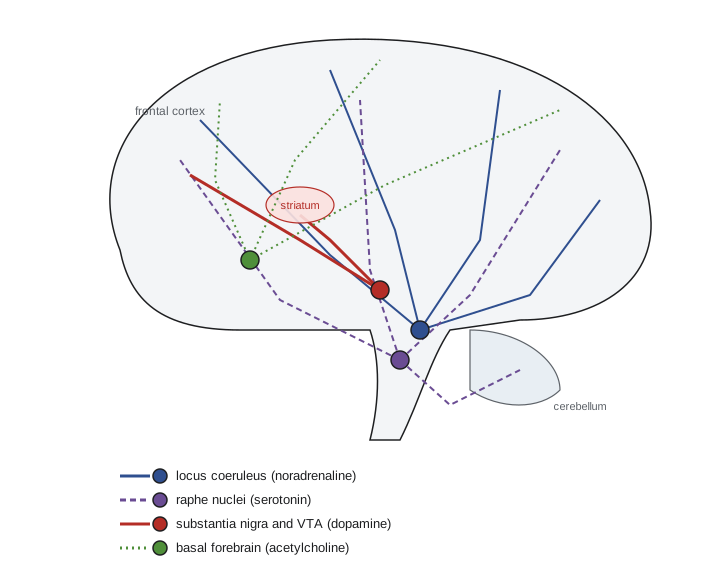
These systems act mostly through metabotropic receptors, with many subtypes: five dopamine receptors (D1 to D5), at least 14 serotonin receptors, nine adrenergic receptors and five muscarinic receptors. Different subtypes couple to different G proteins with opposite effects, so the same transmitter can excite one cell and inhibit another. Signalling is terminated mainly by reuptake through plasma membrane transporters: the dopamine transporter (DAT), noradrenaline transporter (NET) and serotonin transporter (SERT). Acetylcholine is the exception; it is hydrolysed in the cleft by acetylcholinesterase, the target of drugs for myasthenia gravis and Alzheimer's disease and of organophosphate nerve agents and insecticides.
| Transmitter | Main source | Termination | Example drugs and their actions |
|---|---|---|---|
| Glutamate | Most cortical projection neurons | Astrocytic transporters | Ketamine (NMDA antagonist), memantine |
| GABA | Interneurons, striatal and cerebellar projection neurons | GABA transporters | Benzodiazepines and alcohol (GABA-A enhancers), baclofen |
| Dopamine | Substantia nigra, ventral tegmental area | DAT reuptake, MAO and COMT | Levodopa, antipsychotics (D2 antagonists), cocaine (DAT blocker), amphetamine (releaser) |
| Noradrenaline | Locus coeruleus | NET reuptake | Atomoxetine, some antidepressants |
| Serotonin | Raphe nuclei | SERT reuptake | SSRIs, psilocybin (5-HT2A agonist), triptans |
| Acetylcholine | Basal forebrain, brainstem, motor neurons | Acetylcholinesterase | Donepezil, nicotine, atropine |
Neuropeptides and endocannabinoids
Neuropeptides include the endogenous opioids (endorphins, enkephalins and dynorphins), substance P and CGRP in pain pathways, neuropeptide Y and orexin in feeding and arousal, oxytocin and vasopressin in social behaviour, and corticotropin-releasing hormone in stress. Because they are released mainly during intense firing, act on GPCRs at low concentrations and are broken down slowly by peptidases, they work over longer times and distances than classical transmitters. Drugs targeting peptide systems include the migraine treatments that block CGRP or its receptor and the orexin receptor antagonists used for insomnia. Loss of orexin neurons causes narcolepsy with cataplexy.
Endocannabinoids, mainly anandamide and 2-arachidonoylglycerol (2-AG), are lipids made from membrane phospholipids when a postsynaptic neuron is depolarized or its metabotropic receptors are activated. They diffuse backward across the synapse to CB1 receptors on presynaptic terminals, which suppress transmitter release. This retrograde signalling lets a postsynaptic cell turn down its own inputs. CB1 is one of the most abundant GPCRs in the brain, dense in the hippocampus, basal ganglia, cerebellum and cortex, which explains the broad effects of cannabis. Delta-9-tetrahydrocannabinol (THC), the main psychoactive compound in cannabis, is a partial agonist at CB1; cannabidiol (CBD) does not activate CB1 in the same way and has different, less understood actions.
Principles of drug action
Drugs that act on receptors are described by affinity, how tightly they bind, and efficacy, how strongly they activate the receptor once bound. Full agonists produce the maximum response, partial agonists produce a smaller maximum even at full occupancy, antagonists bind without activating, and inverse agonists reduce constitutive receptor activity. For simple binding, fractional occupancy follows a hyperbola, \(f = [A]/([A] + K_d)\), and response often follows a Hill equation with an EC50 and a Hill coefficient. A competitive antagonist shifts the agonist dose–response curve to the right without lowering its maximum; the size of the shift, the dose ratio \(r\), is given by the Schild equation:
where \([B]\) is the antagonist concentration and \(K_B\) its dissociation constant. This is how naloxone reverses opioid overdose: it competes with the opioid at the mu receptor. Because potent synthetic opioids such as fentanyl bind with high affinity and may be present in large amounts, more or repeated naloxone doses are sometimes needed, and naloxone's effect can wear off before the opioid's does.
# Agonist dose-response, partial agonism and competitive antagonism (Schild shift).
import numpy as np
def response(A, EC50=10.0, Emax=1.0, n=1.0, B=0.0, KB=1.0):
    EC50_eff = EC50 * (1 + B / KB)          # competitive antagonist shifts EC50
    return Emax * A**n / (A**n + EC50_eff**n)
doses = [1, 3, 10, 30, 100, 300, 1000, 3000]   # nM, invented agonist
print("dose(nM)  full  partial  full+antag(10 nM)  full+antag(100 nM)")
for d in doses:
    print(f"{d:7d}  {response(d):5.2f}   {response(d, Emax=0.4):5.2f}"
          f"        {response(d, B=10, KB=2):5.2f}              {response(d, B=100, KB=2):5.2f}")
for B in (10, 100):
print(f"antagonist {B:3d} nM (KB = 2 nM): dose ratio = {1 + B/2:.0f}, EC50 moves from 10 to {10*(1+B/2):.0f} nM")dose(nM) full partial full+antag(10 nM) full+antag(100 nM)
1 0.09 0.04 0.02 0.00
3 0.23 0.09 0.05 0.01
10 0.50 0.20 0.14 0.02
30 0.75 0.30 0.33 0.06
100 0.91 0.36 0.62 0.16
300 0.97 0.39 0.83 0.37
1000 0.99 0.40 0.94 0.66
3000 1.00 0.40 0.98 0.85
antagonist 10 nM (KB = 2 nM): dose ratio = 6, EC50 moves from 10 to 60 nM
antagonist 100 nM (KB = 2 nM): dose ratio = 51, EC50 moves from 10 to 510 nMOther drug mechanisms target transporters and enzymes. Selective serotonin reuptake inhibitors (SSRIs) block SERT and raise extracellular serotonin within hours, yet mood effects take weeks, which suggests that downstream adaptations such as receptor desensitization, changes in gene expression and new synapse formation are what matter. Cocaine blocks DAT, NET and SERT; amphetamine enters terminals through the transporters and reverses them, releasing monoamines. Monoamine oxidase inhibitors block breakdown. Drugs of abuse share one property: they raise dopamine in the nucleus accumbens, directly or indirectly, hijacking the reward learning circuitry of lesson 10. Repeated use produces tolerance, dependence and, in some people, addiction, a chronic condition with lasting changes in synaptic plasticity, motivation and control.
Opioids and the overdose crisis
Opioids act on mu, delta and kappa receptors, which are GPCRs coupled to Gi/o proteins. Mu receptor activation inhibits pain transmission in the spinal cord and brainstem and produces euphoria, partly by inhibiting GABA neurons that normally restrain dopamine neurons. It also suppresses breathing by acting on neurons of the pre-Bötzinger complex in the medulla, which generate the respiratory rhythm. Respiratory depression is what kills in an overdose. Tolerance to euphoria and pain relief develops faster than tolerance to respiratory depression, which narrows the margin of safety over time, and the margin is lost entirely after a period of abstinence, when tolerance falls.
Canada has faced a severe toxic drug crisis driven by an unregulated supply contaminated with fentanyl and its analogues, increasingly mixed with sedatives such as benzodiazepine-related drugs and the veterinary sedative xylazine, which naloxone does not reverse. The Public Health Agency of Canada reported 53,308 apparent opioid toxicity deaths from January 2016 to June 2025, with 2,787 in the first half of 2025, about 15 per day; annual deaths peaked in 2023 and have since declined, though officials describe the progress as fragile (figures as of the December 2025 release; check current data). British Columbia, the hardest-hit province, declared a public health emergency in 2016 and ran a three-year pilot decriminalizing possession of small amounts that began in January 2023 and ended in January 2026, after the province had already recriminalized public use in 2024. Responses include naloxone distribution, supervised consumption sites, drug checking, opioid agonist treatment with methadone or buprenorphine, and, more controversially, prescribed safer supply.
Neurobiologically, the crisis illustrates several principles of this lesson: the high potency of fentanyl reflects its high affinity and efficacy at mu receptors and its rapid entry into the brain; naloxone works by competitive antagonism; and buprenorphine, a high-affinity partial agonist, treats opioid use disorder by occupying receptors while producing a ceiling on respiratory depression.
Cannabis
Canada legalized non-medical cannabis nationally under the Cannabis Act in October 2018, after medical access had been available since 2001. Provinces regulate retail sale and set minimum ages of 18 to 21. Federal law limits THC in edibles to 10 milligrams per package and requires plain packaging and health warnings. Public health monitoring has focused on youth use, cannabis-impaired driving, emergency visits for cannabis poisoning in young children who eat edibles, cannabis hyperemesis syndrome, and the association between frequent use of high-potency products and psychosis, especially in adolescents and people with a predisposition.
Neurobiologically, THC's acute effects on memory reflect CB1 activation in the hippocampus, which suppresses transmitter release and disrupts the coordinated activity that encodes memories; its effects on coordination reflect CB1 in the cerebellum and basal ganglia. The adolescent brain, still refining its circuits, may be especially sensitive to repeated exposure, although causal conclusions from human observational studies are limited by confounding.
Worked problem
How much naloxone does it take?
In an invented receptor model, an opioid occupies mu receptors at a concentration ten times its Kd. Naloxone has a K_B of 1 nM. What naloxone concentration would reduce opioid occupancy from about 91 per cent to 50 per cent, and why might a highly potent opioid require repeated doses?
Show solution
- With agonist alone, occupancy = [A]/([A] + Kd) = 10/(10 + 1) ≈ 0.91.
- With a competitive antagonist, occupancy = [A]/([A] + Kd(1 + [B]/K_B)). For 50 per cent, Kd(1 + [B]/K_B) must equal [A] = 10 Kd, so 1 + [B]/K_B = 10.
- Therefore [B] = 9 K_B = 9 nM.
- If the opioid concentration is higher or it is cleared more slowly than naloxone, more naloxone is needed, and its effect can wear off while opioid remains.
Answer: About 9 nM naloxone, nine times its K_B; higher opioid levels or slower opioid clearance require more or repeated doses.
Common mistakes
MistakeCalling dopamine the pleasure chemical.
InsteadDopamine signals reward prediction errors, motivation and movement; it is not simply pleasure.
MistakeAssuming SSRIs work because they raise serotonin.
InsteadSerotonin rises within hours but clinical effects take weeks, implicating downstream adaptations.
MistakeThinking naloxone reverses all overdoses.
InsteadIt reverses opioids only; xylazine, benzodiazepines and alcohol are not reversed.
MistakeTreating a transmitter as having one effect.
InsteadReceptor subtypes can produce opposite effects of the same transmitter.
MistakeEquating THC and CBD.
InsteadTHC is a CB1 partial agonist and psychoactive; CBD acts differently and is not intoxicating in the same way.
Summary and key terms
- Glutamate and GABA provide most fast excitation and inhibition; NMDA receptors admit calcium and GABA-A receptors are modulated by benzodiazepines, barbiturates and alcohol.
- Small nuclei supply dopamine, noradrenaline, serotonin, acetylcholine and histamine widely, acting mainly through many GPCR subtypes.
- Monoamine signalling ends by reuptake through DAT, NET and SERT; acetylcholine by acetylcholinesterase.
- Neuropeptides act slowly and diffusely; endocannabinoids act retrogradely on presynaptic CB1 receptors.
- Drug action is described by affinity and efficacy; competitive antagonists shift dose–response curves by r = 1 + [B]/K_B.
- Opioids kill by depressing breathing; the overdose and cannabis policy landscapes differ between Canada and the United States.
- co-transmission
- Release of more than one transmitter by the same neuron.
- excitotoxicity
- Neuronal damage caused by excessive glutamate receptor activation and calcium entry.
- neuromodulator
- A transmitter that changes neuronal excitability or synaptic strength rather than directly carrying fast signals.
- reuptake
- Removal of transmitter from the cleft by plasma membrane transporters.
- endocannabinoid
- A lipid messenger made on demand that acts retrogradely on CB1 receptors.
- affinity
- How tightly a drug binds its receptor, often expressed as Kd.
- efficacy
- The ability of a bound drug to activate its receptor.
- partial agonist
- A drug that produces less than the maximum response even at full receptor occupancy.
- competitive antagonist
- A drug that binds the same site as the agonist without activating, shifting the dose–response curve.
- tolerance
- A reduced response to a drug after repeated exposure.
Practice problems
Work each problem on paper first, then reveal the answer to check.
What two conditions must be met for an NMDA receptor to pass current?
Show answer
Glutamate (and co-agonist) binding and depolarization to relieve magnesium block.
Why can combining benzodiazepines and alcohol be dangerous?
Show answer
Both enhance GABA-A receptor function, adding to depression of breathing and consciousness.
Where are noradrenaline neurons concentrated?
Show answer
In the locus coeruleus of the pons.
A competitive antagonist with K_B = 5 nM is present at 45 nM. What is the dose ratio?
Show answer
1 + 45/5 = 10.
How does amphetamine differ from cocaine at the dopamine transporter?
Show answer
Cocaine blocks it; amphetamine enters through it and reverses it to release dopamine.
Why does buprenorphine have a ceiling on respiratory depression?
Show answer
It is a partial agonist, so its maximum effect is lower than that of full agonists.
Where do endocannabinoids act, and in which direction do they signal?
Show answer
On presynaptic CB1 receptors, signalling retrogradely from the postsynaptic cell.
Why do older antihistamines cause drowsiness?
Show answer
They cross the blood–brain barrier and block H1 receptors on targets of wake-promoting histamine neurons.
Lesson quiz · 5 questions
Score 60% or more to complete this lesson.
Create a free account to save your progress, take quizzes and earn a certificate.