
BIOL-420 · Lesson 12 of 12 · 27 min
Capstone: disorders of the nervous system, brain–computer interfaces and neuroethics
Neurological and psychiatric disorders are among the largest causes of disability worldwide. A 2024 analysis for the Global Burden of Disease study estimated that more than 3 billion people, over 40 per cent of the world's population, were living with a neurological condition in 2021, led by stroke, migraine, dementia and neuropathy, and mental disorders add a comparable burden. This capstone applies the course to disease and technology. It examines Alzheimer's disease and the controversial new antibody treatments, other neurodegenerative and acute disorders, the biology of depression and new rapid treatments, brain–computer interfaces that restore communication and movement, and the ethical and legal questions that neurotechnology raises. It ends with a case that draws on every lesson.
Alzheimer's disease
Alzheimer's disease is the most common cause of dementia, responsible for perhaps 60 to 70 per cent of cases. Alois Alzheimer described its two hallmarks in 1906: extracellular plaques, now known to be made of amyloid-beta peptides cut from the amyloid precursor protein, and intracellular neurofibrillary tangles of hyperphosphorylated tau. Synapses are lost early, and memory, which depends on the entorhinal cortex and hippocampus where tangles first appear, is affected first. Genetics shaped the dominant theory. Rare dominant mutations in the genes for amyloid precursor protein or the presenilins, which cut it, cause early-onset disease by increasing production of the aggregation-prone 42-amino-acid form of amyloid-beta; extra copies of the APP gene in Down syndrome produce Alzheimer's pathology by middle age; and a variant of APP that reduces amyloid-beta production protects against the disease. The commonest risk gene, APOE, has three alleles: one copy of APOE4 raises risk about three- to fourfold and two copies roughly tenfold or more.
The amyloid cascade hypothesis proposes that amyloid-beta accumulation triggers tau pathology, inflammation and neurodegeneration. For decades, drugs that lowered amyloid failed in trials, prompting doubts. Critics also note that many older people have amyloid plaques without dementia, that tau tangles correlate better with symptoms than plaques, and that microglia, vascular disease and other proteins contribute. A 2006 study that had been influential in the field was retracted in 2024 after findings of image manipulation, although the broader amyloid hypothesis rests on independent genetic and clinical evidence.
Antibodies that clear amyloid plaques changed the debate. In the CLARITY AD trial of lecanemab, published in 2022, people with early Alzheimer's disease declined about 27 per cent more slowly over 18 months on a clinical rating scale than those on placebo, a difference of 0.45 points on an 18-point scale. In the TRAILBLAZER-ALZ 2 trial, donanemab slowed decline by about 35 per cent in participants with low or intermediate tau. Both drugs cause amyloid-related imaging abnormalities (ARIA), brain swelling or small bleeds seen on MRI, which are usually asymptomatic but occasionally serious or fatal; ARIA with swelling occurred in about 13 per cent of lecanemab recipients and about a quarter of donanemab recipients in the trials, with higher rates in APOE4 carriers. Whether the modest slowing is clinically meaningful, and justifies the risks, costs and intensive monitoring, remains contested.
Health Canada granted conditional approval to lecanemab in October 2025 for adults with mild cognitive impairment or mild dementia due to Alzheimer's disease who carry no or one copy of APOE4 and have confirmed amyloid, with full approval dependent on further evidence. Canada's Drug Agency (CDA-AMC) recommended against public reimbursement. In May 2026 Health Canada approved donanemab for adults who do not carry APOE4. Access in practice depends on provincial funding decisions, amyloid testing, MRI capacity and specialist availability (status as of 2026; check current decisions).
Diagnosis is also changing. Amyloid and tau can be detected by PET imaging, in spinal fluid and, increasingly, by blood tests measuring phosphorylated tau such as p-tau217; in May 2025 the FDA cleared the first blood test to aid diagnosis in symptomatic patients. Accurate tests raise their own issues, which the worked example below explores: a positive biomarker in a person without symptoms indicates risk, not a diagnosis.
# Positive predictive value of an amyloid blood test depends on prevalence in the tested group.
def ppv(sens, spec, prev):
    tp = sens * prev
    fp = (1 - spec) * (1 - prev)
    return tp / (tp + fp)
sens, spec = 0.90, 0.90                       # illustrative accuracy
groups = [("memory clinic patients with symptoms", 0.60),
          ("adults over 70 in primary care", 0.30),
          ("healthy adults aged 50 to 60", 0.10)]
for name, prev in groups:
    p = ppv(sens, spec, prev)
    npv = (spec * (1 - prev)) / (spec * (1 - prev) + (1 - sens) * prev)
print(f"{name:38s} prevalence {prev:4.0%}: PPV {p:5.1%}, NPV {npv:5.1%}")memory clinic patients with symptoms prevalence 60%: PPV 93.1%, NPV 85.7% adults over 70 in primary care prevalence 30%: PPV 79.4%, NPV 95.5% healthy adults aged 50 to 60 prevalence 10%: PPV 50.0%, NPV 98.8%
Other neurodegenerative and acute disorders
Many neurodegenerative diseases involve misfolded proteins that spread from cell to cell in a prion-like way: alpha-synuclein in Parkinson's disease (lesson 9), TDP-43 in most cases of amyotrophic lateral sclerosis (ALS) and frontotemporal dementia, and huntingtin with an expanded polyglutamine tract in Huntington's disease. ALS destroys upper and lower motor neurons, causing progressive paralysis, usually fatal within a few years. About 10 per cent of cases are familial; the antisense oligonucleotide tofersen, which lowers production of mutant SOD1 protein, was approved by the FDA in 2023 for SOD1-associated ALS, the first genetically targeted treatment for the disease, building on the success of the antisense drug nusinersen for spinal muscular atrophy.
Stroke, the interruption of blood flow to part of the brain, kills neurons within minutes in the core of the affected region through energy failure and excitotoxicity (lesson 5), while a surrounding penumbra can be rescued if flow is restored quickly. Clot-dissolving drugs such as alteplase and tenecteplase, and mechanical thrombectomy, in which a clot is pulled out through a catheter, have transformed outcomes when given within hours, which is why public campaigns teach the signs of stroke. Multiple sclerosis, in which autoimmune attack destroys central myelin (lessons 1 and BIOL-380), is common in both countries; Canada has one of the highest rates in the world. Epilepsy, recurrent seizures from abnormal synchronous activity, affects about 1 per cent of people and can arise from channelopathies (lesson 2), developmental malformations or injury; about a third of patients do not respond to drugs, and some benefit from surgery, devices or dietary therapy.
| Disorder | Core biology | Examples of treatment |
|---|---|---|
| Alzheimer's disease | Amyloid-beta plaques, tau tangles, synapse loss | Cholinesterase inhibitors, anti-amyloid antibodies |
| Parkinson's disease | Loss of nigral dopamine neurons, alpha-synuclein | Levodopa, deep brain stimulation |
| ALS | Motor neuron death, TDP-43 or SOD1 aggregation | Riluzole, edaravone, tofersen for SOD1 variants |
| Huntington's disease | Expanded CAG repeat in huntingtin, striatal neuron loss | Symptomatic; gene-lowering therapies in trials |
| Ischemic stroke | Energy failure, excitotoxicity, penumbra | Thrombolysis, thrombectomy, rehabilitation |
| Multiple sclerosis | Autoimmune demyelination | Immunomodulatory drugs, B-cell-depleting antibodies |
| Major depression | Altered monoamine, glutamate and plasticity mechanisms; stress circuits | Antidepressants, psychotherapy, ketamine-based drugs, brain stimulation |
Depression and rapid-acting treatments
Major depressive disorder affects roughly one in ten people at some point in their lives and is a leading cause of disability. The monoamine hypothesis grew from the accidental discovery in the 1950s that drugs affecting monoamines changed mood, but it does not explain why SSRIs take weeks to work (lesson 5) or why many people do not respond; a 2022 umbrella review found no consistent evidence that depression is caused by low serotonin. Current models emphasize stress, which through cortisol and inflammation reduces dendritic spines and synapses in prefrontal cortex and hippocampus, and the failure of plasticity mechanisms to restore them. Brain-derived neurotrophic factor (BDNF) and its receptor TrkB are central to this view.
Ketamine, an NMDA receptor antagonist, relieves depressive symptoms within hours in many patients with treatment-resistant depression, an effect that lasts days after a single dose. In rodents it triggers a burst of glutamate release and rapid formation of new spines in prefrontal cortex. Its S-enantiomer, esketamine, was approved as a nasal spray for treatment-resistant depression in the United States in 2019 and in Canada in 2020, used under supervision because of dissociative effects and misuse potential. Psychedelics such as psilocybin, which act on 5-HT2A receptors and also promote structural plasticity, have shown promise in clinical trials combined with psychotherapy, but trial blinding is difficult and long-term evidence limited; in 2024 the FDA declined to approve MDMA-assisted therapy for post-traumatic stress disorder, citing concerns about trial data. Brain stimulation approaches include electroconvulsive therapy, still the most effective treatment for severe depression; transcranial magnetic stimulation, including an accelerated, neuronavigated protocol cleared by the FDA in 2022; and experimental deep brain stimulation.
Brain–computer interfaces
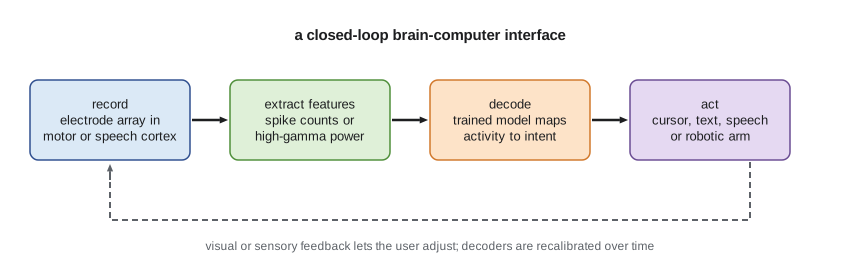
A brain–computer interface (BCI) records neural activity, decodes intended actions and uses them to control a computer or device, bypassing damaged pathways. The BrainGate trials, beginning in 2004, used Utah arrays of 96 electrodes implanted in motor cortex of people with paralysis from spinal cord injury, ALS or stroke, decoding population activity (lesson 9) to move cursors and robotic arms; in 2012 a participant drank from a bottle using a robotic arm under neural control. Speech decoding has advanced rapidly: in 2023 two groups reported decoding attempted speech from cortical activity at about 60 to 78 words per minute, and in 2024 a man with ALS communicated with a vocabulary of 125,000 words at about 97 per cent accuracy using implanted arrays. Less invasive designs include Synchron's stentrode, placed in a blood vessel next to motor cortex, and high-density electrode films on the cortical surface. Bidirectional BCIs add sensory feedback by stimulating somatosensory cortex, so a user can feel what a robotic hand touches.
Interest grew when companies began large trials. Neuralink implanted its first participant in January 2024, using a robot to insert thin polymer threads carrying more than 1,000 electrodes, and reported more than 20 participants in the United States and other countries by early 2026.
In Canada, the CAN-PRIME study at Toronto Western Hospital performed Neuralink's first implant surgeries outside the United States in August and September 2025, in people with paralysis from cervical spinal cord injury. Health Canada regulates implanted BCIs as medical devices, and research participation is governed by research ethics boards under the Tri-Council Policy Statement (TCPS 2).
Performance of a communication BCI can be summarized by its information transfer rate. For a system choosing among \(N\) targets with accuracy \(P\), the Wolpaw formula gives the bits conveyed per selection:
# Information transfer rate of BCIs (Wolpaw formula) for different designs.
import math
def bits(N, P):
    if P >= 1: return math.log2(N)
    return math.log2(N) + P * math.log2(P) + (1 - P) * math.log2((1 - P) / (N - 1))
designs = [("non-invasive EEG speller", 36, 0.85, 8.0),        # targets, accuracy, selections per minute
           ("intracortical cursor typing", 30, 0.95, 40.0),
           ("intracortical speech decoder (words)", 1000, 0.75, 60.0)]
for name, N, P, rate in designs:
    b = bits(N, P)
    print(f"{name:38s} {b:5.2f} bits/selection x {rate:4.0f}/min = {b * rate / 60:5.2f} bits/s")
print("typical conversational speech carries roughly 40 bits/s")non-invasive EEG speller 3.79 bits/selection x 8/min = 0.51 bits/s intracortical cursor typing 4.38 bits/selection x 40/min = 2.92 bits/s intracortical speech decoder (words) 6.66 bits/selection x 60/min = 6.66 bits/s typical conversational speech carries roughly 40 bits/s
The rates are illustrative, but they show why speech decoders, which select among many words quickly, convey several times more information per second than cursor typing and more than ten times more than non-invasive spellers, while still falling well short of natural conversation at about 150 words per minute. They also show that accuracy matters: errors cost information and frustrate users.
Neuroethics
Neurotechnology raises questions beyond those of ordinary medicine. Informed consent is complicated when the participants are people with locked-in syndrome or severe depression, or when an implant may change mood or personality, as DBS occasionally does. Long-term support is a real concern: participants in device trials have lost access to implants that helped them when companies failed or studies ended, prompting calls for obligations to maintain devices. Enhancement, using drugs or devices to improve normal function, raises questions of fairness and coercion. And brain data are unusually sensitive: recordings from consumer EEG headbands and future implants could reveal attention, emotion, health conditions or, as decoding improves, aspects of thought.
No Canadian statute specifically addresses neural data as of 2026; it falls under general privacy law, PIPEDA in the private sector and provincial health and privacy statutes such as Quebec's Law 25, which treat health and biometric information as sensitive. Privacy regulators, including Ontario's Information and Privacy Commissioner, have published analyses of neurotechnology, and scholars have called for explicit protection. Internationally, Chile amended its constitution in 2021 to protect mental integrity, and UNESCO adopted a recommendation on the ethics of neurotechnology in 2025.
Neuroscience also bears on responsibility and justice. Brain imaging has been offered as evidence in criminal trials, for example to argue diminished responsibility, and adolescent brain development, with prefrontal circuits maturing into the mid-twenties, has informed court decisions on youth sentencing. Neuroscientists caution that group-level findings rarely support conclusions about an individual's capacities at a particular moment.
Bringing it together
Consider a woman in her sixties with early Parkinson's disease who joins a trial of adaptive deep brain stimulation. Her dopamine neurons are dying because misfolded alpha-synuclein spreads between cells (this lesson); the loss unbalances the direct and indirect basal ganglia pathways and produces excessive beta oscillations (lesson 9); levodopa crosses her blood–brain barrier on an amino acid transporter (lesson 1) and is converted to dopamine, which acts on D1 and D2 GPCRs (lessons 4 and 5); the electrodes record local field potentials, voltage signals generated by synaptic currents (lessons 2 and 3); and the device adjusts stimulation using a decoder, a small piece of computational neuroscience (lesson 11). Her motor learning in physiotherapy depends on corticostriatal plasticity shaped by dopamine prediction errors (lessons 6 and 10), the very signal her disease erodes. Questions about consent, device maintenance and the privacy of her recorded brain signals are part of her care. Neurobiology, from channel to clinic, is a single connected science.
Worked problem
Interpreting a biomarker result
An invented 55-year-old with no memory complaints buys a direct-to-consumer amyloid blood test with 90 per cent sensitivity and 90 per cent specificity. About 10 per cent of people her age have amyloid plaques. She tests positive. What is the probability that she has amyloid, and does a positive result mean she has Alzheimer's disease?
Show solution
- In 1,000 such people, 100 have amyloid; 90 of them test positive (true positives).
- Of the 900 without amyloid, 10 per cent, 90 people, test positive (false positives).
- PPV = 90 / (90 + 90) = 50 per cent, matching the third line of the code output.
- Even if she has amyloid, many people with plaques never develop dementia in their lifetime; a positive result indicates increased risk, not a diagnosis, and treatment is approved only for people with symptoms.
Answer: About a 50 per cent chance of amyloid; a positive test indicates risk, not disease, and should be interpreted with clinical assessment and counselling.
Common mistakes
MistakeTreating the amyloid hypothesis as either proven or disproven.
InsteadGenetic evidence supports a causal role for amyloid, but tau, inflammation and other factors matter and treatment benefits are modest.
MistakeAssuming a positive biomarker equals disease.
InsteadPredictive value depends on prevalence, and biomarker positivity in people without symptoms indicates risk.
MistakeSaying depression is caused by a chemical imbalance of serotonin.
InsteadEvidence does not support a simple serotonin deficit; stress, plasticity and circuit changes are central.
MistakeAssuming BCIs read thoughts.
InsteadCurrent BCIs decode attempted movements or speech from specific cortical areas after training with the user.
MistakeAssuming medical privacy law covers all brain data.
InsteadConsumer neurotechnology often falls outside health privacy law; a few jurisdictions have added specific protections.
Summary and key terms
- Neurological and mental disorders are leading causes of disability worldwide.
- Alzheimer's disease involves amyloid plaques, tau tangles and synapse loss; anti-amyloid antibodies modestly slow decline with ARIA risks, and approvals differ between Canada and the US.
- Biomarker predictive value depends on prevalence; a positive result without symptoms indicates risk.
- Prion-like protein spread, excitotoxicity, autoimmunity and channelopathies underlie many disorders; antisense drugs target genetic forms.
- Depression models emphasize stress and impaired plasticity; ketamine and psychedelics act rapidly through plasticity mechanisms.
- BCIs decode population activity to restore communication and movement; speech decoders reach 60 to 80 words per minute, far faster than spellers but slower than conversation.
- Neuroethics addresses consent, device support, enhancement and neural data privacy, regulated differently in Canada and the US.
- amyloid cascade hypothesis
- The proposal that amyloid-beta accumulation initiates the pathology of Alzheimer's disease.
- neurofibrillary tangle
- An intracellular aggregate of hyperphosphorylated tau protein.
- ARIA
- Amyloid-related imaging abnormalities: brain swelling or microbleeds seen on MRI with anti-amyloid antibodies.
- APOE4
- An allele of the apolipoprotein E gene that increases risk of Alzheimer's disease.
- penumbra
- Brain tissue around a stroke core that is at risk but salvageable.
- antisense oligonucleotide
- A short synthetic nucleic acid that binds RNA to alter protein production.
- brain–computer interface
- A system that decodes neural activity to control external devices.
- information transfer rate
- The rate at which a communication system conveys information, in bits per second.
- neural data
- Information obtained by measuring nervous system activity.
- neuroethics
- The study of ethical, legal and social questions raised by neuroscience and neurotechnology.
Practice problems
Work each problem on paper first, then reveal the answer to check.
Why does Down syndrome lead to early Alzheimer's pathology?
Show answer
An extra copy of chromosome 21 carries an extra copy of the APP gene, increasing amyloid-beta production.
What is ARIA, and which genotype increases its risk?
Show answer
Brain swelling or microbleeds on MRI during anti-amyloid therapy; APOE4 carriers are at higher risk.
A test with 90 per cent sensitivity and specificity is used where prevalence is 60 per cent. What is its PPV?
Show answer
0.54 / (0.54 + 0.04) ≈ 93 per cent.
How does tofersen work?
Show answer
It is an antisense oligonucleotide that reduces production of mutant SOD1 protein.
Why must stroke treatment be fast?
Show answer
The penumbra can be rescued only if blood flow is restored before neurons die.
How is ketamine thought to relieve depression rapidly?
Show answer
By blocking NMDA receptors, triggering glutamate release, BDNF signalling and rapid synapse formation in prefrontal cortex.
What does the Wolpaw formula give for 4 targets at 100 per cent accuracy?
Show answer
log2 4 = 2 bits per selection.
Name one jurisdiction outside North America that has protected mental integrity in law.
Show answer
Chile, through a 2021 constitutional amendment.
Lesson quiz · 5 questions
Score 60% or more to complete this lesson.
Create a free account to save your progress, take quizzes and earn a certificate.