
BIOL-410 · Lesson 2 of 12 · 25 min
Sequencing technologies and sequence data
Every genomic analysis begins with a sequencing instrument converting molecules into data, and the characteristics of that data, its read length, error rate, error pattern and cost, shape every later choice. This lesson compares the main technologies in use in 2026, explains how libraries are prepared, and introduces the FASTQ format and the Phred quality scores that express how much each base call can be trusted. BIOL-207 described the chemistry of Sanger sequencing and outlined high-throughput methods; here the focus is on what each technology means for analysis.
Preparing a sequencing library
Instruments do not read chromosomes directly. DNA is first extracted and converted into a library: a collection of fragments, each flanked by short synthetic adapters that let it bind to the instrument and be primed for sequencing. For short-read sequencing the DNA is fragmented, mechanically by sonication or enzymatically by a transposase that cuts and inserts adapters in one step, to a typical insert size of 300 to 500 base pairs. Adapters often include an index, or barcode, a short sequence unique to each sample, so that dozens or hundreds of libraries can be pooled and sequenced together, a practice called multiplexing, and separated afterwards by reading the index.
Many protocols include PCR amplification to obtain enough material, which introduces two problems. PCR duplicates, multiple reads descending from the same original fragment, inflate apparent coverage and can make a polymerase error look like a supported variant; they are identified after mapping by identical start positions and removed or marked. PCR also amplifies fragments unevenly, under-representing very GC-rich and GC-poor regions. PCR-free library protocols avoid both problems when enough DNA is available, and unique molecular identifiers (UMIs), random tags attached to each molecule before amplification, let duplicates be recognized exactly, which matters for RNA-seq and for detecting rare variants in cancer (lesson 7).
Long-read libraries are made differently. To read molecules tens of thousands of bases long, DNA must be extracted gently to avoid shearing; high-molecular-weight extraction is often the hardest step of a long-read project. Fragments are size-selected and ligated to platform-specific adapters, usually without amplification, which preserves base modifications such as methylation for direct detection.
Illumina sequencing by synthesis
Illumina instruments have dominated sequencing since about 2008. Library fragments bind to oligonucleotides on the surface of a glass flow cell and are amplified in place into clusters, each containing about a thousand identical copies; modern patterned flow cells hold billions of clusters in ordered nanowells. Sequencing proceeds in cycles. In each cycle, a polymerase adds a single fluorescently labelled nucleotide with a reversible terminator that blocks further extension; the flow cell is imaged, the dye and terminator are cleaved, and the next cycle begins. The colour (or, in two-channel chemistry, the combination of signals) at each cluster in each cycle gives the base. A 150-cycle run yields 150-base reads.
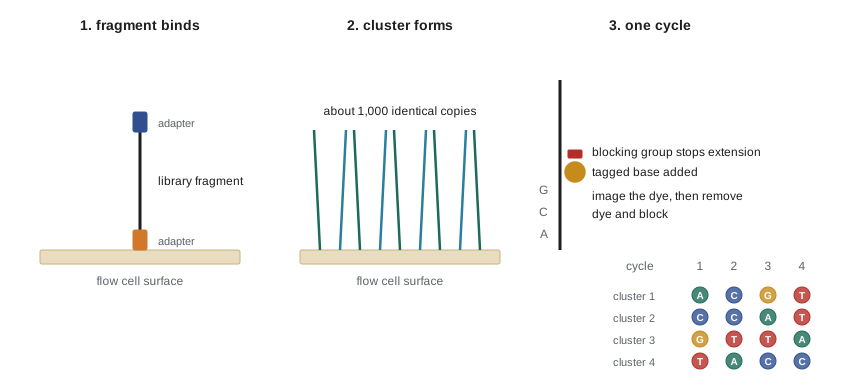
Because each cluster contains many molecules, small chemical inefficiencies accumulate. In each cycle a few strands fail to incorporate a base (phasing) or incorporate two (prephasing), so the cluster's signal gradually becomes a mixture of positions, and quality declines toward the end of the read. Illumina errors are mostly substitutions at rates of roughly 0.1 to 1 per cent per base, with few insertions or deletions, and they are concentrated at read ends, after particular sequence contexts and in low-complexity regions. Paired-end sequencing reads both ends of each fragment, giving two reads whose separation, the insert size, is approximately known; the pairing helps place reads in repeats and detect structural variants. A further artifact on patterned flow cells is index hopping, in which a small fraction of reads acquires the index of another sample in the pool; unique dual indexes, a different index at each end, let such reads be discarded.
Other short-read platforms work on similar principles with different chemistry: Element Biosciences' avidity sequencing, MGI's DNA nanoball sequencing, and Ultima Genomics' approach using mostly natural nucleotides on a spinning wafer, which its makers have promoted as reaching a genome for about 100 US dollars in reagent costs (a manufacturer's figure, not an independent estimate). Ion Torrent instruments detect the hydrogen ions released when a nucleotide is incorporated; they are fast but have higher error rates in homopolymers, runs of the same base.
Long-read sequencing
Pacific Biosciences (PacBio) single-molecule real-time sequencing watches one polymerase at a time copying a single circular template, held at the bottom of a tiny well called a zero-mode waveguide. The circular template, made by ligating hairpin adapters to both ends of a fragment, is read around and around; combining the passes into a circular consensus produces HiFi reads of about 15 to 25 kb with accuracy above 99.9 per cent (Q30 and higher). The kinetics of incorporation also reveal base modifications such as 5-methylcytosine and 6-methyladenine.
Oxford Nanopore Technologies (ONT) sequencing passes a single DNA or RNA strand through a protein pore in a membrane while a voltage drives an ionic current through it. Each group of bases in the pore changes the current in a characteristic way, and neural network basecallers translate the current trace into sequence. Read length is limited only by the DNA itself; reads above 100 kb are routine with careful extraction and some exceed a megabase. Early nanopore reads had error rates of 10 per cent or more, mainly insertions and deletions in homopolymers, but newer pores and chemistry, together with better basecallers, have brought single-read accuracy to about 99 per cent and above. Nanopore devices range from the pocket-sized MinION, which has been used in field outbreak investigations and even on the International Space Station, to large PromethION instruments. Native RNA can be sequenced directly, and modifications are detected from the current signal.
| Platform | Typical read length | Single-read accuracy | Main error type | Strengths |
|---|---|---|---|---|
| Sanger (capillary) | 500 to 1,000 bp | About 99.9 per cent | Low; poor at read start and end | Validation of specific variants, small projects |
| Illumina short reads | 2 x 50 to 2 x 300 bp | About 99 to 99.9 per cent | Substitutions, more at read ends | Very high throughput, low cost per base |
| PacBio HiFi | 15 to 25 kb | Above 99.9 per cent | Residual indels in long homopolymers | Accurate long reads, assembly, methylation |
| Oxford Nanopore | 10 kb to over 1 Mb | About 99 per cent or better (improving) | Indels, homopolymers | Longest reads, portability, direct RNA, real time |
| Ion Torrent | 200 to 600 bp | About 99 per cent | Homopolymer indels | Fast runs, targeted panels |
No platform is best for every purpose. Short reads give the most bases per dollar and remain standard for population sequencing, clinical exomes and genomes, RNA-seq counting and most variant calling of small variants. Long reads span repeats and structural variants, phase variants into haplotypes and produce near-complete assemblies. Many projects combine them; for example, a bacterial genome is often assembled from nanopore reads and then polished with Illumina reads to correct residual errors, although high-accuracy long reads alone now often suffice.
The falling cost of sequencing
The cost of sequencing fell slowly in the Sanger era and then collapsed after high-throughput instruments appeared around 2007, outpacing Moore's law, the doubling of computing power roughly every two years. NHGRI tracked the cost of sequencing a human genome at its funded centres: from about 100 million US dollars in 2001 to about 10 million in 2007, around 10,000 by 2011 and below 1,000 by the early 2020s; its published series, last updated in 2023, ends near 500 to 600 dollars per genome. These figures include reagents, labour, instrument depreciation and data processing at large centres; they exclude interpretation, which in clinical settings often costs more than the sequencing itself.
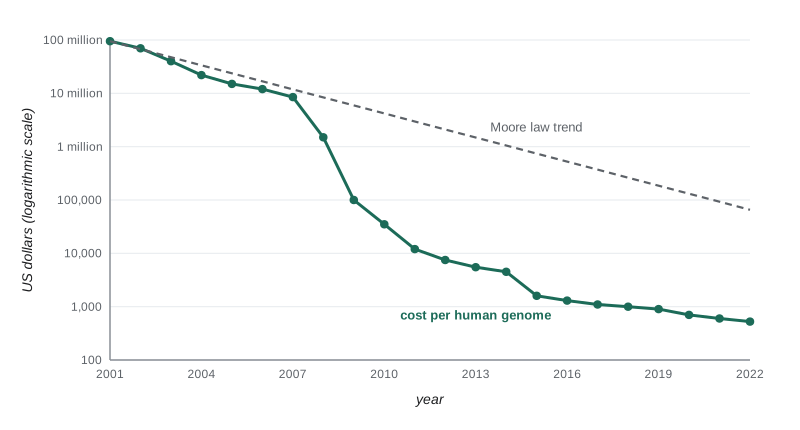
Cheap sequencing has shifted the bottleneck from data generation to storage, analysis and interpretation. A 30-fold human genome produces about 100 Gb of sequence, roughly 30 to 60 gigabytes of compressed data, and large projects produce petabytes. Compression formats such as CRAM, which store reads as differences from a reference, reduce storage several-fold.
FASTQ and Phred quality scores
Reads are delivered in FASTQ format. Each record has four lines: a header beginning with '@' and naming the read, the sequence, a separator line beginning with '+', and a quality string with one character per base. Each character encodes a Phred quality score, defined from the estimated probability \(P\) that the base call is wrong:
Thus Q10 means a 1 in 10 chance of error, Q20 a 1 in 100 chance, Q30 1 in 1,000 and Q40 1 in 10,000. The score is stored as the character whose ASCII code is \(Q + 33\), so '!' (code 33) is Q0, '+' is Q10, '5' is Q20, '?' is Q30 and 'I' is Q40. Quality scores are estimates produced by the instrument's software from features of the signal, calibrated against known sequences; they are usually reasonable but can be systematically wrong, which is why variant callers may recalibrate them.
# Parse invented FASTQ records, decode Phred+33 qualities and estimate expected errors per read.
fastq = """@read1
ACGTTAGCCGATTACGGATCCGATAGCTAGGCTAA
+
IIIIIIIIIIIIIIIHHHHGGGFFF@@@;;;5552
@read2
TTGACCGGTAACGTTAGGCATTACGGATACCGTAG
+
IIIIIHHHGGG@@@;;;55522+++++######!!
@read3
GGCATTAGCCGATTACAGGCTAGGATCCGAATCGA
+
IIIIIIIIIIIIIIIIIIIIIIIIIIIIIIIIIII
"""
lines = fastq.strip().splitlines()
for i in range(0, len(lines), 4):
    name, seq, plus, qual = lines[i:i + 4]
    assert name.startswith('@') and plus.startswith('+') and len(seq) == len(qual)
    q = [ord(c) - 33 for c in qual]
    p_err = [10 ** (-x / 10) for x in q]
    expected = sum(p_err)
    print(f"{name[1:]}: mean Q {sum(q) / len(q):5.1f}, min Q {min(q):2d}, "
f"expected errors {expected:.3f}, keep={expected <= 1.0}")read1: mean Q 35.1, min Q 17, expected errors 0.063, keep=True read2: mean Q 21.7, min Q 0, expected errors 6.367, keep=False read3: mean Q 40.0, min Q 40, expected errors 0.004, keep=True
The expected number of errors in a read, the sum of the error probabilities of its bases, is a more informative filter than the mean quality, because a few very low-quality bases contribute most of the expected errors. Read 2 in the example has a moderate mean quality of about 22, but its expected errors exceed six because its tail is so poor; trimming the low-quality end (lesson 3) would rescue the first part of it.
Demultiplexing pooled samples
After a multiplexed run, reads are assigned to samples by their index sequences. Because index reads also contain errors, demultiplexing software usually allows one mismatch, which is safe only if every pair of indexes in the pool differs at three or more positions; otherwise a single error could turn one sample's index into another's. The number of positions at which two equal-length sequences differ is the Hamming distance.
# Demultiplex invented index reads, allowing one mismatch, after checking the index set is safe.
from itertools import combinations
indexes = {'S1': 'ACGTACGT', 'S2': 'TGCATGCA', 'S3': 'GATCGATC', 'S4': 'CTAGCTAG'}
def hamming(a, b):
    return sum(x != y for x, y in zip(a, b))
min_d = min(hamming(a, b) for a, b in combinations(indexes.values(), 2))
print('minimum distance between indexes:', min_d, '-> one mismatch is safe' if min_d >= 3 else '-> unsafe')
reads = ['ACGTACGT', 'ACGTACGA', 'TGCATGCA', 'TGCTTGCA', 'GATCGATC', 'CTAGCTAG', 'CTAGGTAG', 'AAAAAAAA', 'GACCGTTC']
counts = {s: 0 for s in indexes}
counts['undetermined'] = 0
for r in reads:
    hits = [s for s, idx in indexes.items() if hamming(r, idx) <= 1]
    counts[hits[0] if len(hits) == 1 else 'undetermined'] += 1
print(counts)minimum distance between indexes: 8 -> one mismatch is safe
{'S1': 2, 'S2': 2, 'S3': 1, 'S4': 2, 'undetermined': 2}Worked problem
Choosing a sequencing strategy
A public health laboratory wants (a) complete, closed genomes of 20 bacterial isolates from a hospital outbreak, including any plasmids, and (b) to compare them rapidly for relatedness. What sequencing approach would you recommend?
Show solution
- Complete genomes need reads longer than the bacterial repeats, such as rRNA operons of about 5 to 7 kb and insertion sequences; long reads of 10 kb or more resolve them.
- Plasmids often carry resistance genes and share repeats with the chromosome, so long reads are also needed to place them correctly.
- Nanopore or PacBio sequencing of all 20 isolates, multiplexed with barcodes on one run, can produce closed assemblies.
- If single-read accuracy is a concern for fine-scale comparison, add Illumina reads to polish the assemblies or use high-accuracy long-read chemistry.
- For relatedness, compare core-genome single-nucleotide differences (lesson 7 and lesson 10); accuracy matters here because a few false differences change conclusions about transmission.
Answer: Multiplexed long-read sequencing for closed genomes, with short-read polishing or high-accuracy chemistry so that SNP-level comparisons are reliable.
Common mistakes
MistakeTreating PCR duplicates as independent evidence for a variant.
InsteadDuplicates descend from one molecule; mark or remove them, or use UMIs, before counting support.
MistakeComparing read quality by mean Q alone.
InsteadExpected errors, the sum of per-base error probabilities, reflects the impact of a few very bad bases.
MistakeAssuming nanopore reads are too inaccurate for any fine-scale analysis.
InsteadCurrent nanopore chemistry and basecallers reach about 99 per cent single-read accuracy and higher consensus accuracy.
MistakeAllowing one mismatch when demultiplexing indexes that differ at only two positions.
InsteadOne-mismatch tolerance requires a minimum Hamming distance of at least three between indexes.
MistakeQuoting the headline cost per genome as the cost of a clinical test.
InsteadReported sequencing costs exclude interpretation, confirmation and reporting, which are often larger.
Summary and key terms
- Libraries are fragments with adapters and often sample indexes; PCR adds duplicates and GC bias, which PCR-free protocols and UMIs address.
- Illumina sequencing by synthesis gives billions of accurate short reads with mostly substitution errors that rise toward read ends.
- PacBio HiFi reads are long and highly accurate; nanopore reads are the longest, portable and increasingly accurate, with indel-prone homopolymers.
- Sequencing cost per human genome fell from about 100 million US dollars in 2001 to the hundreds of dollars, shifting bottlenecks to analysis.
- FASTQ stores reads with Phred qualities, Q = −10 log10 P, encoded as ASCII characters offset by 33.
- Demultiplexing assigns reads to samples by index; error tolerance requires well-separated indexes.
- library
- A collection of DNA fragments with adapters prepared for sequencing.
- adapter
- A synthetic oligonucleotide ligated to fragment ends for binding and priming.
- index
- A short barcode sequence identifying the sample a read came from.
- PCR duplicate
- A read descending from the same original molecule as another read.
- unique molecular identifier
- A random tag added to each molecule before amplification to identify duplicates.
- sequencing by synthesis
- Sequencing by imaging the incorporation of labelled reversible-terminator nucleotides.
- paired-end reads
- Two reads from opposite ends of the same fragment.
- HiFi read
- A highly accurate PacBio read produced by circular consensus sequencing.
- Phred quality score
- A base-call confidence score equal to −10 log10 of the error probability.
- FASTQ
- A four-line text format storing read names, sequences and quality strings.
- Hamming distance
- The number of positions at which two equal-length sequences differ.
Practice problems
Work each problem on paper first, then reveal the answer to check.
What error probability corresponds to Q25?
Show answer
10^-2.5, about 0.0032, or 1 in 316.
Which ASCII character encodes Q35 in Phred+33?
Show answer
Code 68, the character D.
Why does Illumina base quality decline along a read?
Show answer
Phasing and prephasing make the cluster signal a mixture of positions as cycles accumulate.
Why are HiFi reads so accurate despite single-molecule sequencing?
Show answer
The circular template is read many times and the passes are combined into a consensus.
A read has 100 bases at Q30 and 10 at Q10. What is its expected number of errors?
Show answer
100 x 0.001 + 10 x 0.1 = 1.1.
Give two advantages of long reads over short reads.
Show answer
They span repeats for assembly and structural variants, and they phase variants into haplotypes.
What is index hopping, and how is it controlled?
Show answer
Reads acquiring another sample’s index on patterned flow cells; unique dual indexes let them be discarded.
Why is high-molecular-weight extraction important for nanopore sequencing?
Show answer
Read length is limited by the length of the DNA molecules loaded.
Lesson quiz · 5 questions
Score 60% or more to complete this lesson.
Create a free account to save your progress, take quizzes and earn a certificate.