
BIOL-410 · Lesson 1 of 12 · 25 min
Genomes and the genomics revolution
A genome is the complete set of DNA instructions carried by an organism: every chromosome, every gene, every regulatory element and every stretch of repetitive sequence whose function is still argued about. Reading genomes was once the work of large international consortia; today a single laboratory can sequence a bacterial genome before lunch and a human genome in a day. This course is about what happens after the sequencer stops: how raw signals become reads, how reads become genomes, how genomes are compared and annotated, how gene expression is measured, and how all of this is used, responsibly, in medicine and public health. BIOL-207 introduced Sanger and high-throughput sequencing, coverage and RNA-seq at an introductory level, BIOL-321 built phylogenetic trees, and BIOL-322 covered population genetics and genome-wide association. Here we go deeper into the computational methods and the decisions that shape every genomic result.
What a genome contains
Genomes vary enormously in size and organization. The bacterium Escherichia coli K-12 has a single circular chromosome of about 4.6 million base pairs (4.6 Mb) carrying roughly 4,300 protein-coding genes packed closely together, with less than 15 per cent of the sequence non-coding. Baker's yeast has about 12 Mb on 16 chromosomes and about 6,000 genes. The human genome has about 3.1 billion base pairs (3.1 Gb) per haploid set, on 23 chromosomes, but only about 20,000 protein-coding genes; coding sequence makes up little more than 1 per cent of it. Roughly half of the human genome consists of transposable elements and their decayed remnants, and large blocks are made of tandem repeats such as the alpha-satellite arrays at centromeres.
Genome size bears little relation to organismal complexity, an observation once called the C-value paradox. The marbled lungfish genome is about 40 Gb, more than ten times larger than ours, and some flowering plants exceed 100 Gb; the Japanese canopy plant Paris japonica has one of the largest known, about 150 Gb. The differences come mostly from repetitive DNA and whole-genome duplications rather than from more genes. Bacteria and archaea, under selection for rapid replication, have compact genomes; many eukaryotes carry large amounts of DNA that is tolerated rather than required. Understanding which parts of a genome matter is one of the main tasks of annotation and functional genomics, which lessons 8 and 11 take up.
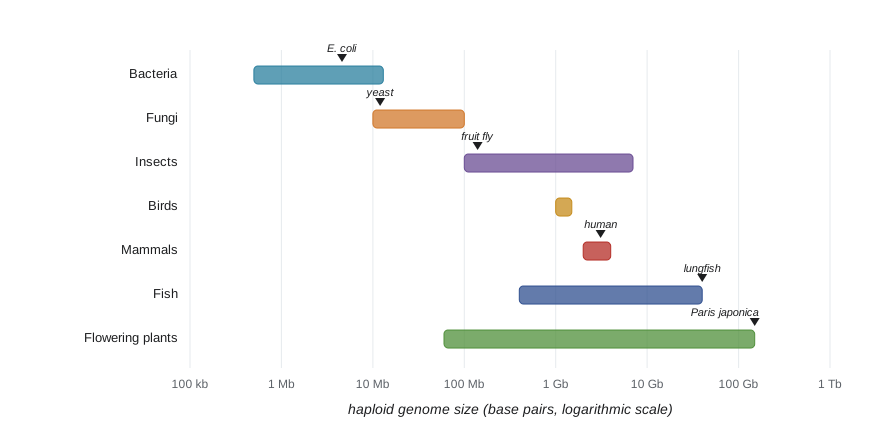
Genomes also differ in architecture. Most bacterial chromosomes are circular and many bacteria carry plasmids, small extra chromosomes that often encode antibiotic resistance and move between cells (BIOL-330). Eukaryotic chromosomes are linear, capped by telomeres and organized around centromeres, and mitochondria and chloroplasts have their own small genomes, about 16.6 kb in human mitochondria. Ploidy matters for analysis: a diploid human carries two versions of each autosome, so a genome sequence is really two haplotypes, and many plants are polyploid, with four, six or more copies, which complicates assembly and variant calling considerably.
From the Human Genome Project to telomere-to-telomere
The Human Genome Project (HGP), an international public effort launched in 1990 and led in the United States by the National Institutes of Health and the Department of Energy, set out to determine the sequence of the human genome. A competing private effort by Celera Genomics, using whole-genome shotgun sequencing, began in 1998. Both published draft sequences in February 2001, and the HGP declared the project complete in April 2003, at a cost of about 3 billion US dollars. Yet 'complete' meant about 92 per cent of the genome: the remaining eight per cent, mostly centromeres, the short arms of five chromosomes carrying ribosomal DNA, and segmental duplications, consisted of repeats too long and too similar for the methods of the time.
Those gaps were finally closed by the Telomere-to-Telomere (T2T) Consortium, which in 2022 published T2T-CHM13, the first truly complete sequence of a human genome: 3.055 Gb with no gaps, adding about 200 Mb of new sequence and nearly 2,000 predicted genes, most of them copies of known genes. The key was long-read sequencing (lesson 2): PacBio HiFi reads of 15 to 20 kb with very high accuracy, combined with ultra-long Oxford Nanopore reads exceeding 100 kb that could span entire repeat arrays. The cell line used, CHM13, came from a complete hydatidiform mole, a growth in which both chromosome sets derive from a single sperm, so the genome is effectively haploid and the two-haplotype problem disappears.
A single reference genome cannot represent human diversity. The widely used reference GRCh38 is a mosaic of a few individuals, and about 70 per cent of it comes from one person. The Human Pangenome Reference Consortium published a first draft human pangenome in 2023, built from phased assemblies of 47 genetically diverse individuals, adding about 119 Mb of sequence absent from GRCh38. Its second data release, announced in May 2025, includes genomes from 232 individuals. A pangenome is represented not as one string but as a graph in which alternative versions of a region form branches, an idea we return to when discussing read mapping in lesson 6.
| Milestone | Year | What changed |
|---|---|---|
| First complete genome of a free-living organism (Haemophilus influenzae, 1.8 Mb) | 1995 | Showed whole-genome shotgun sequencing works |
| Yeast genome (12 Mb) | 1996 | First eukaryote, by an international consortium |
| Human draft sequences (HGP and Celera) | 2001 | About 90 per cent of the euchromatin |
| HGP declared complete | 2003 | About 92 per cent of the genome; reference used for two decades |
| First high-throughput instruments widely available | 2005 to 2007 | Cost per base began falling far faster than before |
| T2T-CHM13 complete human genome | 2022 | Gapless, including centromeres and rDNA arrays |
| Draft human pangenome (47 individuals) | 2023 | Graph reference capturing diversity |
| Pangenome data release 2 (232 individuals) | 2025 | Broader representation of human populations |
Beyond humans, sequencing biodiversity has become a goal in itself. The Earth BioGenome Project, launched in 2018, aims eventually to sequence all known eukaryotic species, about 1.8 million described species, with reference-quality assemblies; the Vertebrate Genomes Project and the Darwin Tree of Life project are among its affiliated efforts. Reference genomes for endangered species support the conservation genetics described in BIOL-322 and BIOL-367, and genomes of crops and their wild relatives speed plant breeding (BIOL-340).
What bioinformatics is
Bioinformatics is the development and use of computational methods to store, retrieve, analyse and interpret biological data. It sits between biology, computer science and statistics. Some problems are algorithmic: aligning two sequences optimally, or assembling millions of fragments into a chromosome, are problems of dynamic programming and graph theory (CMPUT-204). Others are statistical: deciding whether a gene's expression truly differs between conditions, or whether a base that disagrees with the reference is a real variant or a sequencing error, requires probability models of noisy measurements (STAT-151). Still others are about data engineering: a single modern sequencer can produce several terabytes of data per run, and public archives hold many petabases.
A practical feature of the field is its reliance on standard file formats, mostly plain text, that let tools from different groups work together. Sequences are stored as FASTA (a header line beginning with '>' followed by sequence lines) and reads with qualities as FASTQ (lesson 2). Alignments of reads to a reference are stored in SAM or its compressed binary form BAM (lesson 6), variants in VCF (lesson 7), and genome features such as genes in GFF3 or GTF, or as intervals in BED (lesson 8). Learning to read these formats by eye, and to check them with small scripts, prevents many errors.
# Parse a small FASTA file (invented sequences) and report length, GC content and ambiguous bases.
fasta = """>contig_1 invented bacterial contig
ATGGCGTTAGCCGCGATTTACGGCGGCATTAGCCGATCGNNNNNGCTAGCTAGGCGCGCTA
TTAGCCGATGCGCGTATAGCGCTAGGCGGCGCTATATAGCGC
>contig_2 invented plasmid fragment
ATATATTTAAATTTATAATTTAAGCGCATATTTAAATATAATAAAT
"""
def read_fasta(text):
    records, name, seq = {}, None, []
    for line in text.splitlines():
        line = line.strip()
        if not line:
            continue
        if line.startswith('>'):
            if name:
                records[name] = ''.join(seq)
            name, seq = line[1:].split()[0], []
        else:
            seq.append(line.upper())
    if name:
        records[name] = ''.join(seq)
    return records

for name, s in read_fasta(fasta).items():
    acgt = sum(s.count(b) for b in 'ACGT')
    gc = (s.count('G') + s.count('C')) / acgt
print(f"{name}: length {len(s)} bp, GC {gc:.1%}, ambiguous (N) {s.count('N')}")contig_1: length 103 bp, GC 60.2%, ambiguous (N) 5 contig_2: length 46 bp, GC 8.7%, ambiguous (N) 0
GC content, the fraction of G and C bases, is one of the first statistics computed for any sequence. It varies from below 20 per cent in some bacteria to above 70 per cent in others, it varies along chromosomes, and it affects sequencing: regions of extreme GC content are often under-represented in Illumina data because they amplify poorly by PCR. The second contig in the example, at under 10 per cent GC, would be suspicious in a genome whose other contigs are near 60 per cent; it might be a plasmid, a contaminant or a horizontally transferred island, each a hypothesis to check.
Databases and the culture of sharing
Genomics depends on public data. Since 1996 the Bermuda Principles, agreed by the HGP centres, required that sequence data be released within 24 hours, and most journals now require deposition of raw reads and assemblies before publication. The International Nucleotide Sequence Database Collaboration (INSDC) links three archives that exchange data daily: GenBank at the US National Center for Biotechnology Information (NCBI), the European Nucleotide Archive at EMBL-EBI in the United Kingdom, and the DNA Data Bank of Japan. Raw reads are deposited in the Sequence Read Archive. Curated resources build on these: RefSeq and Ensembl provide reference genomes and annotations, the UCSC Genome Browser and Ensembl browser display genomes with layers of annotation, and UniProt and the Protein Data Bank hold protein sequences and structures (lesson 11).
Not all genomic data can be open. Human genomes are identifying and can reveal health information about individuals and their relatives, so human data are usually held in controlled-access archives such as dbGaP or the European Genome-phenome Archive, where researchers must apply and agree to conditions of use. Lesson 12 discusses the law and ethics of genomic data, including Indigenous data sovereignty, which BIOL-322 introduced.
In Canada, Genome Canada, a not-for-profit organization funded by the federal government since 2000, funds large-scale genomics projects through six regional genome centres (Genome British Columbia, Genome Alberta, Genome Prairie, Ontario Genomics, Génome Québec and Genome Atlantic). Canadian institutions have been prominent in the field: Canada's Michael Smith Genome Sciences Centre in Vancouver sequenced the SARS coronavirus genome in April 2003 within days of receiving samples, and the Ontario Institute for Cancer Research hosted the data coordination centre of the International Cancer Genome Consortium. The Canadian BioGenome Project contributes Canadian species to the Earth BioGenome Project.
Thinking like a bioinformatician
Three habits run through this course. First, every computational result rests on assumptions: a variant caller assumes an error model, an assembler assumes how repeats behave, and a test for differential expression assumes a distribution for counts. Knowing the assumptions tells you when a result may fail. Second, validate at every step: check that a file has the expected number of records, that coverage is roughly even, that control samples behave as expected, and that results are robust to reasonable changes in parameters. Third, make analyses reproducible: record software versions and parameters, script every step rather than clicking through it, and keep raw data unchanged. Lesson 12 shows how workflow systems and containers make this practical.
The examples in this course use small synthetic data sets generated by seeded random code, so that every output can be reproduced exactly and the true answer is known. Real analyses use established tools, such as BWA and minimap2 for mapping, SPAdes, Flye and hifiasm for assembly, GATK and DeepVariant for variant calling, and DESeq2 or edgeR for differential expression, but those tools implement the same ideas you will code here in miniature.
Worked problem
Is this contig part of the genome?
An assembly of an invented freshwater bacterium has 40 contigs. Thirty-nine have GC content between 61 and 64 per cent and coverage of about 80 reads per base. One contig of 5,200 bp has 38 per cent GC and coverage of about 950. What are the most likely explanations, and how would you test them?
Show solution
- Note the two signals: GC content far from the rest of the genome, and coverage about 12 times higher than the chromosome.
- High coverage means the sequence is present in many copies per cell or comes from a more abundant organism in the sample.
- A small multicopy plasmid would explain both: plasmids often differ in GC content from the host chromosome and can be present at 10 or more copies per cell.
- Alternatively the contig could be contamination, for example from a phage or from another organism in the culture or reagents.
- Test by searching the contig against a nucleotide database (lesson 5): plasmid replication and mobilization genes support a plasmid, while best matches to an unrelated organism suggest contamination. Check whether the contig is circular in the assembly graph (lesson 4).
Answer: Most likely a multicopy plasmid or a contaminant; database searches, gene content and assembly graph structure distinguish them.
Common mistakes
MistakeAssuming larger genomes mean more genes or more complex organisms.
InsteadGenome size is driven mainly by repeats and duplications; gene number and complexity correlate poorly with it.
MistakeCalling GRCh38 complete because the HGP was declared finished in 2003.
InsteadGRCh38 has gaps in centromeres and other repeats; T2T-CHM13 (2022) was the first gapless human genome.
MistakeTreating a reference genome as representing everyone.
InsteadA single reference is a mosaic of few individuals; pangenome graphs capture variation absent from it.
MistakeEditing raw data files by hand during analysis.
InsteadKeep raw data unchanged and script every transformation so results can be reproduced.
MistakeAssuming all genomic data can be shared openly.
InsteadHuman genomes are identifying and are usually held under controlled access.
Summary and key terms
- Genomes range from under 1 Mb to over 100 Gb, with size driven mostly by repeats and duplication rather than gene number.
- The Human Genome Project (completed 2003) left about 8 per cent unsequenced; T2T-CHM13 (2022) completed a human genome using long reads.
- Pangenome graphs, from 47 individuals in 2023 and 232 in the 2025 release, represent human diversity better than one reference.
- Bioinformatics combines algorithms, statistics and data engineering, connected by standard formats such as FASTA, FASTQ, SAM/BAM, VCF and GFF.
- Public archives linked through the INSDC make data sharing the norm, while human data usually require controlled access.
- Good practice means knowing assumptions, validating at every step and making analyses reproducible.
- genome
- The complete DNA content of an organism or organelle.
- C-value paradox
- The lack of correlation between genome size and organismal complexity.
- haplotype
- The sequence of one copy of a chromosome or region in a diploid or polyploid organism.
- reference genome
- A representative assembled genome sequence used as a coordinate system for analysis.
- pangenome
- A collection of genomes, often represented as a graph, capturing the variation in a species.
- T2T-CHM13
- The first complete, gapless human genome sequence, published in 2022.
- FASTA
- A text format for sequences: a header line beginning with > followed by sequence lines.
- GC content
- The fraction of bases in a sequence that are G or C.
- INSDC
- The International Nucleotide Sequence Database Collaboration of GenBank, ENA and DDBJ.
- controlled access
- A data-sharing model in which approved researchers access sensitive data under agreed conditions.
Practice problems
Work each problem on paper first, then reveal the answer to check.
Why is the human genome about 650 times larger than that of E. coli but has only about five times as many protein-coding genes?
Show answer
Most human DNA is non-coding: transposable elements, other repeats, introns and regulatory sequence.
What parts of the human genome were missing from the 2003 reference?
Show answer
Mainly centromeric satellite arrays, rDNA arrays on the short arms of acrocentric chromosomes and segmental duplications.
Why was the CHM13 cell line especially suitable for a first complete genome?
Show answer
It is effectively haploid, so there is only one haplotype to assemble.
What advantage does a pangenome graph have over a linear reference?
Show answer
Reads carrying alternative alleles or sequences absent from one reference can be placed correctly, reducing reference bias.
A FASTA record has the header >chr2 and 3 lines of 60 bases plus a final line of 25. How long is the sequence?
Show answer
205 bases.
Name the three archives of the INSDC.
Show answer
GenBank (NCBI), the European Nucleotide Archive (EMBL-EBI) and the DNA Data Bank of Japan.
Why might GC-rich and GC-poor regions be under-represented in Illumina data?
Show answer
PCR amplification during library preparation is less efficient at extreme GC content.
Give one reason human genomic data are kept under controlled access.
Show answer
Genomes identify individuals and reveal health information about them and their relatives.
Lesson quiz · 5 questions
Score 60% or more to complete this lesson.
Create a free account to save your progress, take quizzes and earn a certificate.